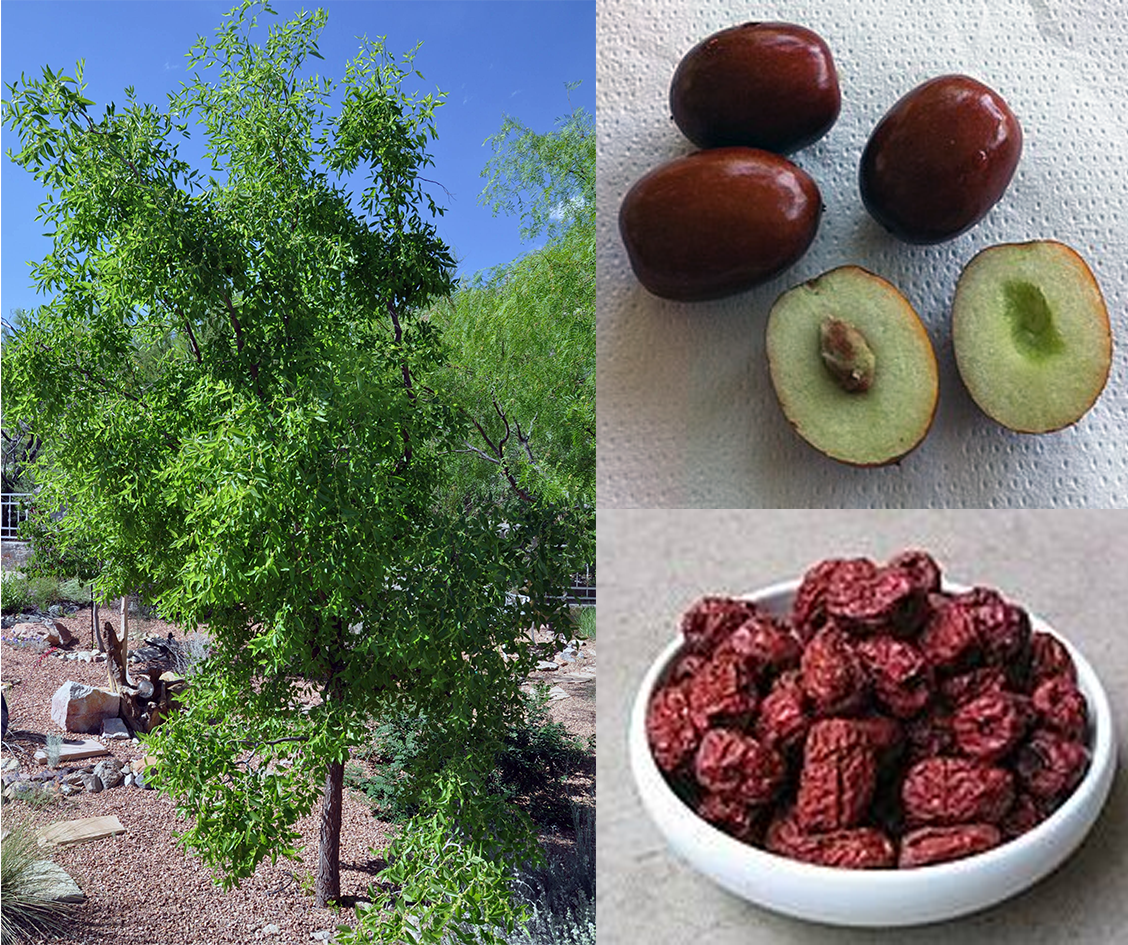
 The image above shows a mature jujube tree with mature fruit both
whole and sliced (top right) and the dried fruit, known as
Chinese red dates (bottom right)..
Welcome to the summary page for FabulousFusionFood's Cook's Guide entry for Chinese red date along with all the recipes employing Chinese red date presented on this site, with 4 recipes in total.
This is a continuation of an entire series of pages that will, I hope, allow my visitors to better navigate this site. As well as displaying recipes by name, country and region of origin I am now planning a whole series of pages where recipes can be located by meal type and main ingredient. This page gives a listing of all the Chinese red date recipes added to this site.
These recipes, all contain Chinese red date as a major wild food ingredient.
Chinese red date (also known as Jujube, jujuba, red date, Chinese date, and Chinese jujube) is a species in the genus Ziziphus in the buckthorn family Rhamnaceae. It is often confused with the closely related Indian jujube, Z. mauritiana. The jujube tolerates a diverse range of climates, from temperate to tropical. Its origin is thought to be in eastern Asia, but it has been widely dispersed through cultivation, and is today cultivated in gardens as a shrub as well as in agriculture as a food crop. Its fruit is eaten freshly harvested as well as dried and candied.
Ziziphus jujuba is a small deciduous tree or shrub reaching a height of 5–10m, usually with thorny branches. The leaves are shiny-green, ovate-acute, 2–7cm long and 1–3cm wide, with three conspicuous veins at the base, and a finely toothed margin. Leaves of trees grown in the climate region in Turkey measure average between 3.8–4.28cm in length and 1.79–1.98cm in width. The flowers are small, 5 millimetres (1⁄4 in) wide, with five inconspicuous yellowish-green petals. The fruit is an edible oval drupe 1.5–3cm deep; when immature it is smooth-green, with the consistency and taste of an apple with lower acidity, maturing brown to purplish-black, and eventually wrinkled, looking like a small date. There is a single hard kernel, similar to an olive stone, containing two seeds. Modern cultivated jujubes have kernels up to 3.8 times larger than those of wild jujubes.
Its precise natural distribution is uncertain due to extensive cultivation. However, its origin is thought to be in eastern Asia, in southern and central China, India, Korea, and Japan, and possibly also southwestern Asia between Lebanon, and southeastern Europe, though more likely introduced there. Chinese jujubes have been grown in parts of Asia for thousands of years. Wild jujube kernels have been found in three sites on the Qi River basin of northern China dating to the Neolithic period. It may have originated in Syria, but was distributed across the Mediterranean region at least 3,000 years ago. Today, it is most widely grown in China. The tree is tolerant of droughts and flooding, and can be cultivated on a large scale.
Freshly harvested and candied dried fruit are often eaten as a snack or with coffee. Smoked jujubes are consumed in Vietnam and are referred to as black jujubes. A drink can be made by crushing the pulp in water. Both China and Korea produce a sweetened tea syrup containing jujube fruit in glass jars, and canned jujube tea or jujube tea in the form of teabags. To a lesser extent, jujube fruit is made into juice and jujube vinegar (called 枣醋 or 紅枣醋 in Chinese). They are used for making pickles (কুলের আচার) in west Bengal and Bangladesh. In Assam it is known as 'Bogori' and the pickle, Bogori aachar (বগৰি আচাৰ), is famous. In China, a wine made from jujube fruit is called hong zao jiu (紅枣酒).
Traditionally in India, the fruit are dried in the sun and the hard seeds removed, after which the dried flesh is pounded with tamarind, red chillies, salt, and jaggery. In some parts of the Indian state of Tamil Nadu, fresh whole ripe fruit is crushed with the above ingredients and sun-dried to make cakes called ilanthai vadai or regi vadiyalu (Telugu). It is also commonly consumed as a snack. In Madagascar, jujube fruit is eaten fresh or dried. People also use it to make jam. A jujube honey is produced in the Atlas Mountains of Morocco. In Croatia, especially Dalmatia, jujubes are used in marmalades, juices, and rakija (fruit brandy). In Senegal and The Gambia, jujube is called Sii dem or Ceedem, and the fruit is used as snack, and also turned into a dried paste favoured as a sweetmeat by schoolchildren.
In Chinese cuisine, dried red jujubes (often sold as Chinese red dates) are used like a spice and added as a flavouring to stocks and stews.
This is a continuation of an entire series of pages that will, I hope, allow my visitors to better navigate this site. As well as displaying recipes by name, country and region of origin I am now planning a whole series of pages where recipes can be located by meal type and main ingredient. This page gives a listing of all the Chinese red date recipes added to this site.
These recipes, all contain Chinese red date as a major wild food ingredient.
Chinese red date (also known as Jujube, jujuba, red date, Chinese date, and Chinese jujube) is a species in the genus Ziziphus in the buckthorn family Rhamnaceae. It is often confused with the closely related Indian jujube, Z. mauritiana. The jujube tolerates a diverse range of climates, from temperate to tropical. Its origin is thought to be in eastern Asia, but it has been widely dispersed through cultivation, and is today cultivated in gardens as a shrub as well as in agriculture as a food crop. Its fruit is eaten freshly harvested as well as dried and candied.
Ziziphus jujuba is a small deciduous tree or shrub reaching a height of 5–10m, usually with thorny branches. The leaves are shiny-green, ovate-acute, 2–7cm long and 1–3cm wide, with three conspicuous veins at the base, and a finely toothed margin. Leaves of trees grown in the climate region in Turkey measure average between 3.8–4.28cm in length and 1.79–1.98cm in width. The flowers are small, 5 millimetres (1⁄4 in) wide, with five inconspicuous yellowish-green petals. The fruit is an edible oval drupe 1.5–3cm deep; when immature it is smooth-green, with the consistency and taste of an apple with lower acidity, maturing brown to purplish-black, and eventually wrinkled, looking like a small date. There is a single hard kernel, similar to an olive stone, containing two seeds. Modern cultivated jujubes have kernels up to 3.8 times larger than those of wild jujubes.
Its precise natural distribution is uncertain due to extensive cultivation. However, its origin is thought to be in eastern Asia, in southern and central China, India, Korea, and Japan, and possibly also southwestern Asia between Lebanon, and southeastern Europe, though more likely introduced there. Chinese jujubes have been grown in parts of Asia for thousands of years. Wild jujube kernels have been found in three sites on the Qi River basin of northern China dating to the Neolithic period. It may have originated in Syria, but was distributed across the Mediterranean region at least 3,000 years ago. Today, it is most widely grown in China. The tree is tolerant of droughts and flooding, and can be cultivated on a large scale.
Freshly harvested and candied dried fruit are often eaten as a snack or with coffee. Smoked jujubes are consumed in Vietnam and are referred to as black jujubes. A drink can be made by crushing the pulp in water. Both China and Korea produce a sweetened tea syrup containing jujube fruit in glass jars, and canned jujube tea or jujube tea in the form of teabags. To a lesser extent, jujube fruit is made into juice and jujube vinegar (called 枣醋 or 紅枣醋 in Chinese). They are used for making pickles (কুলের আচার) in west Bengal and Bangladesh. In Assam it is known as 'Bogori' and the pickle, Bogori aachar (বগৰি আচাৰ), is famous. In China, a wine made from jujube fruit is called hong zao jiu (紅枣酒).
Traditionally in India, the fruit are dried in the sun and the hard seeds removed, after which the dried flesh is pounded with tamarind, red chillies, salt, and jaggery. In some parts of the Indian state of Tamil Nadu, fresh whole ripe fruit is crushed with the above ingredients and sun-dried to make cakes called ilanthai vadai or regi vadiyalu (Telugu). It is also commonly consumed as a snack. In Madagascar, jujube fruit is eaten fresh or dried. People also use it to make jam. A jujube honey is produced in the Atlas Mountains of Morocco. In Croatia, especially Dalmatia, jujubes are used in marmalades, juices, and rakija (fruit brandy). In Senegal and The Gambia, jujube is called Sii dem or Ceedem, and the fruit is used as snack, and also turned into a dried paste favoured as a sweetmeat by schoolchildren.
In Chinese cuisine, dried red jujubes (often sold as Chinese red dates) are used like a spice and added as a flavouring to stocks and stews.
The alphabetical list of all Chinese red date recipes on this site follows, (limited to 100 recipes per page). There are 4 recipes in total:
Page 1 of 1
| Adobong Pato a la Moja (Duck Adobo with Pineapple and Dates) Origin: Philippines | Eight-treasures Sweet Rice Cake Origin: China |
| Chinese-style Rib Stock Origin: Fusion |
Page 1 of 1