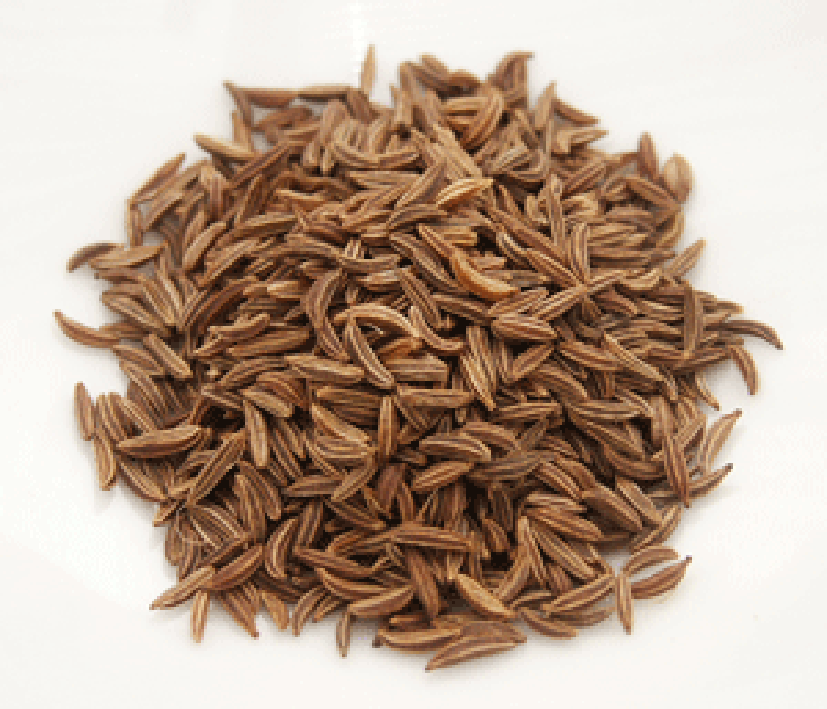
 Pile of caraway Carum carvi seeds.
Welcome to the summary page for FabulousFusionFood's Cook's Guide entry for Caraway Seed along with all the recipes employing Caraway Seed presented on this site, with 125 recipes in total.
This is a continuation of an entire series of pages that will, I hope, allow my visitors to better navigate this site. As well as displaying recipes by name, country and region of origin I am now planning a whole series of pages where recipes can be located by meal type and main ingredient. This page gives a listing of all the Caraway Seed recipes added to this site.
These recipes, all contain Caraway Seed as a major wild food ingredient.
Caraway (also known as Persian cumin) is a biennial plant, Carum carvi native to Europe and western Asia. It is a membero of the Apiaceae (also known as Umbelliferae) plants of which carrots are also a member. The plant has divided feathery leaves and grows to between 20 and 30 cm tall. These bear flower stems that can grow to almost 60cm tall and bear white flowers in umbels (umbrella-like structures). When ripe the fruit are crescent-shaped and contain a single seed. (The fruits of the caraway plant are often, and erroneously, called seeds. If you actually open one of these fruit you will see that it bears a seed within).
The fruit are generally used whole in cooking and they have a pungent anise-like flavour. They are used especially in rye bread but are also used in casseroles and carrot cakes. Liqueurs are also flavoured with caraway seeds, as are a number of continental cheeses.
This is a continuation of an entire series of pages that will, I hope, allow my visitors to better navigate this site. As well as displaying recipes by name, country and region of origin I am now planning a whole series of pages where recipes can be located by meal type and main ingredient. This page gives a listing of all the Caraway Seed recipes added to this site.
These recipes, all contain Caraway Seed as a major wild food ingredient.
Caraway (also known as Persian cumin) is a biennial plant, Carum carvi native to Europe and western Asia. It is a membero of the Apiaceae (also known as Umbelliferae) plants of which carrots are also a member. The plant has divided feathery leaves and grows to between 20 and 30 cm tall. These bear flower stems that can grow to almost 60cm tall and bear white flowers in umbels (umbrella-like structures). When ripe the fruit are crescent-shaped and contain a single seed. (The fruits of the caraway plant are often, and erroneously, called seeds. If you actually open one of these fruit you will see that it bears a seed within).
The fruit are generally used whole in cooking and they have a pungent anise-like flavour. They are used especially in rye bread but are also used in casseroles and carrot cakes. Liqueurs are also flavoured with caraway seeds, as are a number of continental cheeses.
The alphabetical list of all Caraway Seed recipes on this site follows, (limited to 100 recipes per page). There are 125 recipes in total:
Page 1 of 2
| Abernethy Biscuits Origin: Scotland | Cornish Seedy Bread Origin: Britain | Köömnekeeks (Estonian Caraway Tea Cake) Origin: Estonia |
| Adjika II (Paprika Sauce) Origin: Abkhazia | Cornish Seedy Cake Origin: Britain | Kammon Hoot Origin: Libya |
| Advieh (Iranian Spice Mix) Origin: Iran | County Cavan Soda Bread Origin: Ireland | Keema Aloo with Kale Origin: Scotland |
| Advieh Torshi (Persian Pickle Spice Blend) Origin: Iran | Cucurbitas cum Gallina (Gourds with Chicken) Origin: Roman | Kohl Westfalisch (Westphalian Cabbage II) Origin: Germany |
| Ajlouke et Potiron (Pumpkin Dip) Origin: Tunisia | Dogfish Origin: Roman | Kyrgyz Plov Origin: Kyrgyzstan |
| Aliter assaturas (Roast Meats, Another Way) Origin: Roman | Dušené kysané zelí (Braised Sauerkraut) Origin: Czech | Latvian Pickled Beetroot Origin: Latvia |
| Aliter in Elixis Palumbis sive Columbis (Sauce for Boiled Wood Pigeons and Doves) Origin: Roman | Eisbein mit Sauerkraut (Ham hock with Sauerkraut) Origin: Germany | Leavened Bread Origin: Ancient |
| Aliter ius candidum in elixam (Another White Sauce for Boiled Meats) Origin: Roman | Fish in Orange and Caraway Sauce Origin: Mediterranean | Luk Marinovannyi Origin: Georgia |
| Aper ita conditur (Seasoned Wild Boar) Origin: Roman | Fruit and Bacon Braised Red Cabbage Origin: Britain | Meghli (Lebanese Rice Pudding) Origin: Lebanon |
| Aurangabadi Naan Qaliya Origin: India | Goda Masala Origin: India | Meghli (Rice Flour Pudding) Origin: Lebanon |
| Baked Morel Escargot Origin: Britain | Goosnargh Cakes Origin: England | Mititei (Romanian Minced Meat Sausages) Origin: Romania |
| Bara Carwe Ynys Môn (Anglesea Caraway Bread) Origin: Welsh | Gustato pro Caro (Sauce for Meat) Origin: Roman | Nuernberger Rostbratwuerste (Nuremberg Grilled Sausage) Origin: Germany |
| Bara Ceirch Lafwr Sych (Dried Laver Oatcakes) Origin: Welsh | Harissa Origin: North Africa | Old Milwaukee Rye Bread Origin: American |
| Bayerische Schweinekotletts (Bavarian Pork Chops) Origin: Germany | Hawayij (Yemeni Spice Mix) Origin: Yemen | Old-world Rye Bread Origin: American |
| Bayrisch Kraut (Pickled Bavarian Cabbage) Origin: Germany | Hungarian Goulash Soup Origin: Britain | Palumbis sive Columbis in Assis (Sauce for Roasted Wood Pigeons and Doves) Origin: Roman |
| Bayrisches Bratensäuglingshwein (Bavarian Roast Suckling Pig) Origin: Germany | Iflaghun Origin: Syria | Pan-fried Sea Bass with Lemon Mash Origin: Britain |
| Beef with Paprika and Potatoes Origin: Ireland | In Sepia Farsili (Sauce for Stuffed Cuttlefish) Origin: Roman | Pickled Bolete Mushrooms Origin: American |
| Bigos (Polish Hunter's Stew) Origin: Poland | Indonesian Curry Spice Paste Origin: Indonesia | Pickled Field Mushrooms Origin: American |
| Bigos (Lithuanian Hunter's Stew) Origin: Lithuania | Iumbolls Origin: Britain | Pickled St George's Mushrooms Origin: Britain |
| Bonnach Strùthan Origin: Scotland | Ius candidum in ansere elixo (Boiled Goose with Cold Sauce) Origin: Roman | Pisam coques (Peas in Herb Sauce) Origin: Roman |
| Bosnian Goulash Origin: Bosnia | Ius Candidum in Ansere Elixo (White Sauce for Boiled Goose) Origin: Roman | Pisum Indicum (Indigo Peas) Origin: Roman |
| Bottle Masala Origin: India | Ius Frigidum in Porcellum Elixum (Cold Sauce for Boiled Suckling Pig) Origin: Roman | Pizzoccheri with Miso Cabbage and Spiced Breadcrumbs Origin: Fusion |
| Brooke Priory Biscuits Origin: England | Ius in Caprea (Sauce for Roebuck) Origin: Roman | Porcellum Flaccianum (Suckling Pig a la Flaccus) Origin: Roman |
| Cacen Gneifio (Shearing Cake) Origin: Welsh | Ius in Cervum (Sauce for Venison) Origin: Roman | Porcellum Lacte Pastum Elixum (Suckling Pig Crowned with Bayleaves) Origin: Roman |
| Caraway Biscuits Origin: Britain | Ius in Cervum, Aliter (Sauce for Venison, Another Way) Origin: Roman | Porcellum Lasaratum (Suckling Pig Seasoned with Laser) Origin: Roman |
| Caraway Cake Origin: England | Ius in copadiis (Sauce for Choice Cuts) Origin: Roman | Potato and Onion Flan Origin: Ireland |
| Caraway Comfits Origin: Britain | Ius in copadiis II (Sauce for Choice Cuts II) Origin: Roman | Prince Bisket Origin: Britain |
| Caraway Seed Cake Origin: Britain | Ius in elixam allecatum (Fish-pickle Sauce for Boiled Meat) Origin: Roman | Pumpernickel Origin: Germany |
| Caraway Seed Cake II Origin: Britain | Ius in Locusta et Cammari (Sauce for Lobster and Crayfish) Origin: Roman | Reuben Sandwich Origin: American |
| Carrot and Caraway Cake Origin: Britain | Ius in Murena Elixa (Sauce for Poached Moray Eel) Origin: Roman | Rupjmaize (Latvian Rye Bread) Origin: Latvia |
| Carvie Cake Origin: Ireland | Ius in Pisce Aurata (Sauce for Gilthead Bream) Origin: Roman | Rye Bread with Caraway Seeds Origin: British |
| Comarye Origin: England | Ius in pisce rubellione (Sauce for Red Snapper) Origin: Roman | Salata Méchouia Nablia (Grilled Red Pepper, Chilli and Tomato Salad) Origin: Tunisia |
| Comarye (Roast Pork Marinated in Red Wine) Origin: England | Ius in Scorpione Elixo (Sauce for Poached Scorpion Fish) Origin: Roman | |
| Corn pilhi Origin: Norfolk Island | Ius Viride in Avibus (Green Sauce for Birds) Origin: Roman |
Page 1 of 2