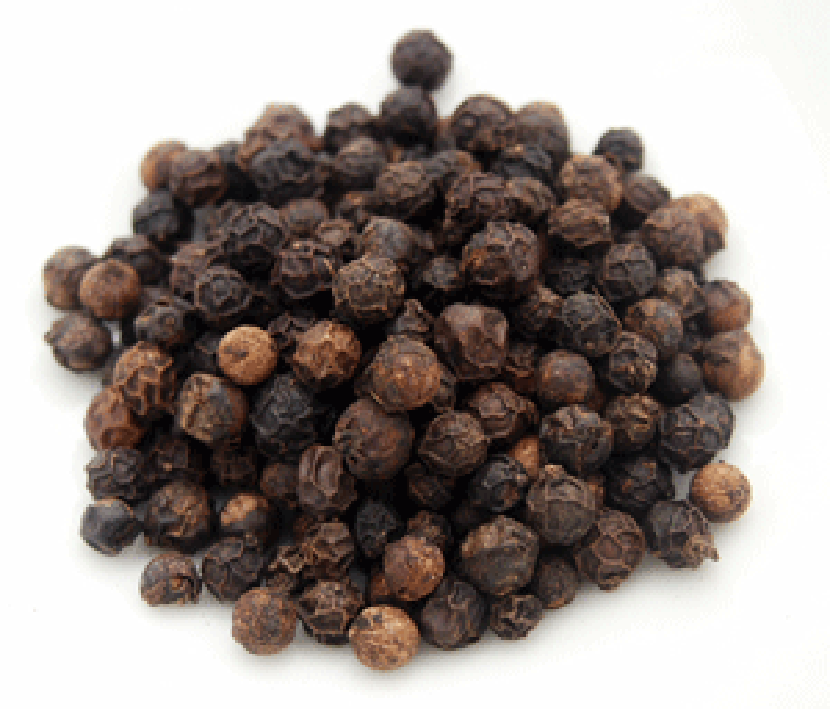
 Black peppercorns (the dried fruit of Piper nigrum) in a
white bowl.
Welcome to the summary page for FabulousFusionFood's Cook's Guide entry for Black Pepper along with all the recipes employing Black Pepper presented on this site, with 5567 recipes in total.
This is a continuation of an entire series of pages that will, I hope, allow my visitors to better navigate this site. As well as displaying recipes by name, country and region of origin I am now planning a whole series of pages where recipes can be located by meal type and main ingredient. This page gives a listing of all the Black Pepper recipes added to this site.
These recipes, all contain Black Pepper as a major wild food ingredient.
Black pepper represents the dried fruit of the flowering vine, Piper nigrum a member of the Piperaceae (pepper) family. The pepper vine is a native of south-western India and has been traded from there since prehistory. In early Europe pepper was so valuable that it was often used as collateral or even currency. The exorbitant price of pepper during the late middle ages (due to the virtual monopoly Venice had on the trade) was one of the reasons for the early Protugese voyages of discovery. Even today pepper is the world's most widely-traded spice and in Europe at least you will find pepper side-by-side with salt on every dinner table.
The pepper plant is a perennial woody vine growing to four metres in height on supporting trees, poles, or trellises. It is a spreading vine, rooting readily where trailing stems touch the ground. The leaves are alternate, entire, five to ten centimetres long and three to six centimetres broad. The flowers are small, produced on pendulous spikes four to eight centimetres long at the leaf nodes, the spikes lengthening to seven to 15 centimetres as the fruit matures. A single stem will bear 20 to 30 fruiting spikes. The harvest begins as soon as one or two berries at the base of the spikes begin to turn red, and before the fruit is mature, but when full grown and still hard; if allowed to ripen, the berries lose pungency, and ultimately fall off and are lost. The spikes are collected and spread out to dry in the sun, then the peppercorns are stripped off the spikes. This produces black pepper, the dried still-unripe green fruit of the pepper vine. The berries are cooked briefly in hot water, both to clean them and to prepare them for drying. The heat ruptures cell walls in the fruit, speeding the work of browning enzymes during drying. White pepper in contrast is made from only the seed of the pepper fruit. The outer fruit wall is removed by allowing fully ripe berries to soak in water for about a week, during which time the flesh of the fruit softens and decomposes. Rubbing then removes what remains of the fruit, and the naked seed is dried. Green pepper, like black, is made from the unripe berries. Dried green peppercorns are treated in a manner that retains the green colour, such as treatment with sulphur dioxide or freeze-drying. Pickled peppercorns, also green, are unripe berries preserved in brine or vinegar. Pink pepper can also be made by preserving ripe red pepper berries preserved in brine and vinegar. (This pink pepper should not be confused with the more familiar dried 'red pepercorns' which are not true peppercorns at all (see below).
Pepper gains its spicy heat from the piperine compound which is present both in the seed and the outer fruit (which is why most people believe white pepper to be milder than black pepper). In reality piperine is about one hundredth the strength of capsaicin found in chilli peppers. Pepper loses flavour and aroma through evaporation, so airtight storage helps preserve pepper's original spiciness longer. Pepper can also lose flavour when exposed to light, which can transform piperine into nearly tasteless isochavicine. Once ground, pepper's aromatics can evaporate quickly; most culinary sources recommend grinding whole peppercorns immediately before use for this reason. The Romans where very fond of using pepper in all their dishes including desserts and in Europe pepper is so commonplace that it is used with salt to season most savoury dishes and is also used as a condiment at the table.
This is a continuation of an entire series of pages that will, I hope, allow my visitors to better navigate this site. As well as displaying recipes by name, country and region of origin I am now planning a whole series of pages where recipes can be located by meal type and main ingredient. This page gives a listing of all the Black Pepper recipes added to this site.
These recipes, all contain Black Pepper as a major wild food ingredient.
Black pepper represents the dried fruit of the flowering vine, Piper nigrum a member of the Piperaceae (pepper) family. The pepper vine is a native of south-western India and has been traded from there since prehistory. In early Europe pepper was so valuable that it was often used as collateral or even currency. The exorbitant price of pepper during the late middle ages (due to the virtual monopoly Venice had on the trade) was one of the reasons for the early Protugese voyages of discovery. Even today pepper is the world's most widely-traded spice and in Europe at least you will find pepper side-by-side with salt on every dinner table.
The pepper plant is a perennial woody vine growing to four metres in height on supporting trees, poles, or trellises. It is a spreading vine, rooting readily where trailing stems touch the ground. The leaves are alternate, entire, five to ten centimetres long and three to six centimetres broad. The flowers are small, produced on pendulous spikes four to eight centimetres long at the leaf nodes, the spikes lengthening to seven to 15 centimetres as the fruit matures. A single stem will bear 20 to 30 fruiting spikes. The harvest begins as soon as one or two berries at the base of the spikes begin to turn red, and before the fruit is mature, but when full grown and still hard; if allowed to ripen, the berries lose pungency, and ultimately fall off and are lost. The spikes are collected and spread out to dry in the sun, then the peppercorns are stripped off the spikes. This produces black pepper, the dried still-unripe green fruit of the pepper vine. The berries are cooked briefly in hot water, both to clean them and to prepare them for drying. The heat ruptures cell walls in the fruit, speeding the work of browning enzymes during drying. White pepper in contrast is made from only the seed of the pepper fruit. The outer fruit wall is removed by allowing fully ripe berries to soak in water for about a week, during which time the flesh of the fruit softens and decomposes. Rubbing then removes what remains of the fruit, and the naked seed is dried. Green pepper, like black, is made from the unripe berries. Dried green peppercorns are treated in a manner that retains the green colour, such as treatment with sulphur dioxide or freeze-drying. Pickled peppercorns, also green, are unripe berries preserved in brine or vinegar. Pink pepper can also be made by preserving ripe red pepper berries preserved in brine and vinegar. (This pink pepper should not be confused with the more familiar dried 'red pepercorns' which are not true peppercorns at all (see below).
Pepper gains its spicy heat from the piperine compound which is present both in the seed and the outer fruit (which is why most people believe white pepper to be milder than black pepper). In reality piperine is about one hundredth the strength of capsaicin found in chilli peppers. Pepper loses flavour and aroma through evaporation, so airtight storage helps preserve pepper's original spiciness longer. Pepper can also lose flavour when exposed to light, which can transform piperine into nearly tasteless isochavicine. Once ground, pepper's aromatics can evaporate quickly; most culinary sources recommend grinding whole peppercorns immediately before use for this reason. The Romans where very fond of using pepper in all their dishes including desserts and in Europe pepper is so commonplace that it is used with salt to season most savoury dishes and is also used as a condiment at the table.
The alphabetical list of all Black Pepper recipes on this site follows, (limited to 100 recipes per page). There are 5567 recipes in total:
Page 1 of 56
| 'West Indian' Mulled Wine Origin: Fusion | Adana Kebap Origin: Turkey | Air Fryer Chicken Kiyiv Origin: Britain |
| Äggröra med lufttorkad skinka (Scrambled eggs with cured ham) Origin: Sweden | Adenydd Cath Fôr gyda Saws Tartar Cyflym (Fried Skate Wings with Quick Home-made Tartar Sauce) Origin: Welsh | Air Fryer Chicken Livers Origin: Britain |
| Ćevapčići Origin: Serbia | Adobo Marinade Origin: Puerto Rico | Air Fryer Chips Origin: Britain |
| Ćevapi Origin: Bosnia | Adobo Sauce Origin: Mexico | Air Fryer Corn on the Cob Origin: Britain |
| Šproty v smetane (Smoked Sprats in Sour Cream) Origin: Russia | Adobo Seasoning Origin: Britain | Air Fryer Couscous Two Ways Origin: Britain |
| Ŵyau Mewn Caws (Eggs in Cheese) Origin: Welsh | Adobo Valentine Lamb Origin: American | Air Fryer Crisps Origin: Britain |
| A Good Sauce for Steaks Origin: British | Adobong Pato a la Moja (Duck Adobo with Pineapple and Dates) Origin: Philippines | Air Fryer Crispy Fish Origin: Britain |
| A Messe of Greens Origin: Britain | Advieh (Iranian Spice Mix) Origin: Iran | Air Fryer Crispy Sichuan Duck Origin: Britain |
| Aad Maas (Goan Pork Rib Curry) Origin: India | Advieh Ash (Persian Soup Spice Blend) Origin: Iran | Air Fryer Dry Rub Chicken Wings Origin: Britain |
| Aaloo Gosht (Mutton Curry with Potatoes) Origin: Pakistan | Advieh Khoresh (Persian Stew Blend) Origin: Iran | Air Fryer Egg Fried Rice Origin: Britain |
| Abacate Recheado com Atum (Avocado Stuffed with Tuna) Origin: Guinea-Bissau | Advieh Mahi (Persian Fish Spice Blend) Origin: Iran | Air Fryer Hasselback Potatoes Origin: Britain |
| Abbacchio alla Cacciatora Origin: Italy | Advieh Torshi (Persian Pickle Spice Blend) Origin: Iran | Air Fryer Kale Chips Origin: America |
| Abbacchio alla scottadito (Barbecued Milk-fed Lamb Chops) Origin: Vatican City | Advieh-spiced Persian Meatballs Origin: Iran | Air Fryer Lamb Chops Origin: Britain |
| Abbachio al Forno (Italian Roast Baby Lamb) Origin: Italy | Afalau Sur Bach wedi Piclo (Pickled Crabapples) Origin: Welsh | Air Fryer Liver and Sausage Curry Origin: Britain |
| Aberdeen Haddock Soufflé Origin: Scotland | Afelia (Pork Marinated in Wine) Origin: Cyprus | Air Fryer Mackerel Origin: Britain |
| Abgousht (Persian Beef Stew) Origin: Iran | Afghan Kofta Curry Origin: Afghanistan | Air Fryer Mashed Potato Cakes Origin: Britain |
| Accent Herbs Origin: Caribbean | Afghani Chicken Curry Origin: Pakistan | Air Fryer Meat-stuffed Mushrooms Origin: Britain |
| Accras Origin: Trinidad | African All Purpose Seasoning Origin: Nigeria | Air Fryer Omelette Origin: Britain |
| Accras de Morue Origin: French Guiana | African Stew Curry Powder Origin: West Africa | Air Fryer Onion Rings Origin: Britain |
| Accras de Morue (Salt Cod Fritters) Origin: Saint Barthelemy | Afrikaanse Yakhni Origin: South Africa | Air Fryer Pancakes Origin: Britain |
| Accras de Morue (Salt Cod Fritters) Origin: Sint Maarten | Agneau Provençal au Jus Menthe Verte (Roast Lamb Provençal with Mint Gravy) Origin: France | Air Fryer Pastry Origin: Britain |
| Accras de Morue (Salt Cod Fritters) Origin: Saint-Martin | Aguají (Plantain Soup) Origin: Dominican Republic | Air Fryer Pork Chops Origin: Britain |
| Achapa (Walnut Lobio) Origin: Abkhazia | Agushi Soup (Ghanaian Egusi Soup) Origin: Ghana | Air Fryer Pork Roast Origin: Britain |
| Achard de pahua confit (Achard of Confit of Pahua) Origin: Tahiti | Ailes de Poulet au Riz et Poivron (Chicken Wings with Rice and Chillies) Origin: Senegal | Air Fryer Pot Roast Origin: Canada |
| Achards de Legumes (Vegetable Achards) Origin: New Caledonia | Ailes de raie sauce au beurre noir (Skate wings with black butter sauce) Origin: France | Air Fryer Roast Potatoes Origin: Britain |
| Achari Roast Chicken Origin: Pakistan | Air Fried Beef Brisket Origin: Britain | Air Fryer Sage and Onion Stuffing Balls Origin: Britain |
| Achu Spice Blend Origin: Cameroon | Air Fried Egg-stuffed Chestnut Mushrooms Origin: Britain | Air Fryer Sausage Rolls Origin: Britain |
| Ackee and Callaloo Bake Origin: Jamaica | Air Fryer Asparagus Origin: Britain | Air Fryer Spaghetti Squash Origin: Britain |
| Ackee and Saltfish Origin: Jamaica | Air Fryer Bacon and Eggs on Toast Origin: Britain | Air Fryer Spinach Origin: Britain |
| Acorn Flour Tagliatelle Origin: Italy | Air Fryer Baked Eggs Origin: Britain | Air Fryer Steak Origin: Britain |
| Ad Aves Hircosas Omni Genere (How to Prepare 'High' Birds of Any Kind) Origin: Roman | Air Fryer Beef Wellington Origin: Britain | Air Fryer Steak and Fries Meal Origin: America |
| Ad Digestionem (An Aid to Digestion) Origin: Roman | Air Fryer Breaded Cod Origin: America | Air Fryer Sweet Potato Wedges Origin: Britain |
| Adaka Roti Origin: Sri Lanka | Air Fryer Burgers Origin: Britain | |
| Adana Kebab Origin: Turkey | Air Fryer Cheese and Onion Pasty Origin: Britain |
Page 1 of 56