FabulousFusionFood's Cocktail Recipes Home Page
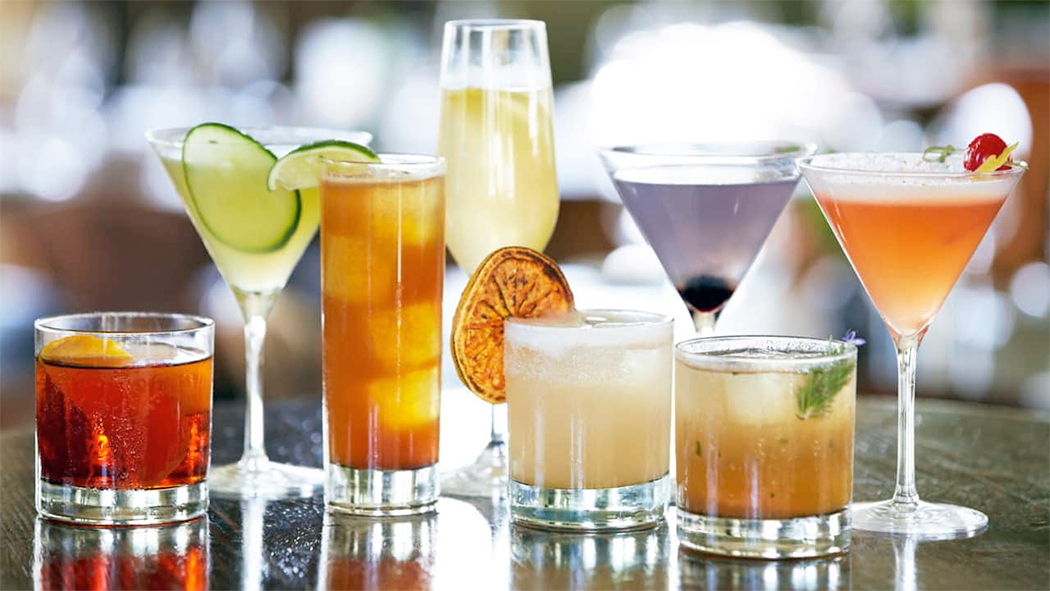 A range of cocktails presented on a bar.
Welcome to FabulousFusionFood's Cocktail Recipes Page — A cocktail is defined as: a mixed drink, usually alcoholic. Most commonly, a cocktail is a combination of one or more spirits mixed with other ingredients, such as juices, flavoured syrups, tonic water, shrubs, and bitters. Cocktails vary widely across regions of the world with new ones being invented frequently.
The original cocktails seem to have been developed as a 'pick me up' and have a long history going back to the kykeon drink of Ancient Greece. Ancient Greek κυκεών (from κυκάω, kykáō; 'to stir, to mix') was an Ancient Greek drink of varied description. Some were made of water, barley and naturally occurring substances. Others were made with wine and grated cheese. It is widely believed that kykeon refers to a psychoactive brew, as in the case of the Eleusinian Mysteries. A kykeon was used at the climax of the Eleusinian Mysteries to break a sacred fast, but it is also mentioned as a favourite drink of Greek peasants. Later, it became a staple of Roman Legionaries' drinks as a blend of barley water, barley groats and white wine (see the kykeon recipe for an example).
The original cocktails seem to have been developed as a 'pick me up' and have a long history going back to the kykeon drink of Ancient Greece. Ancient Greek κυκεών (from κυκάω, kykáō; 'to stir, to mix') was an Ancient Greek drink of varied description. Some were made of water, barley and naturally occurring substances. Others were made with wine and grated cheese. It is widely believed that kykeon refers to a psychoactive brew, as in the case of the Eleusinian Mysteries. A kykeon was used at the climax of the Eleusinian Mysteries to break a sacred fast, but it is also mentioned as a favourite drink of Greek peasants. Later, it became a staple of Roman Legionaries' drinks as a blend of barley water, barley groats and white wine (see the kykeon recipe for an example).
The modern cocktail is believed to have been an American invention, though the first mention of a cocktail in the modern sense of a mixed drink is to be found in The Morning Post and Gazetteer London, England, March 20, 1798:
Mr. Pitt,The Oxford English Dictionary cites the word as originating in the U.S. The first recorded use of cocktail as a beverage (possibly non-alcoholic) in the United States appears in The Farmer's Cabinet, April 28, 1803:
two petit vers of "L'huile de Venus"
Ditto, one of "perfeit amour"
Ditto, "cock-tail" (vulgarly called ginger)
11. [a.m.] Drank a glass of cocktail—excellent for the head...Call'd at the Doct's. found Burnham—he looked very wise—drank another glass of cocktail.The first definition of cocktail known to be an alcoholic beverage appeared in The Balance and Columbian Repository (Hudson, New York) May 13, 1806; editor Harry Croswell answered the question, "What is a cocktail?":
Cock-tail is a stimulating liquor, composed of spirits of any kind, sugar, water, and bitters—it is vulgarly called bittered sling, and is supposed to be an excellent electioneering potion, in as much as it renders the heart stout and bold, at the same time that it fuddles the head. It is said, also to be of great use to a democratic candidate: because a person, having swallowed a glass of it, is ready to swallow any thing else.
Etymology
The origin of the word "cocktail" is disputed. It is presumably from "cock-tail", meaning "with tail standing up, like a cock's", in particular that of a horse, but how this came to be applied to alcoholic mixed drinks is unclear. The most prominent theories are that it refers to a stimulant, hence a stimulating drink, or to a non-purebred horse, hence a mixed drink. Cocktail historian David Wondrich speculates that "cocktail" is a reference to gingering, a practice for perking up an old horse by means of a ginger suppository so that the animal would "cock its tail up and be frisky", hence by extension a stimulating drink, like pick-me-up. This agrees with usage in early citations (1798: "'cock-tail' (vulgarly called ginger)", 1803: drink at 11 a.m. to clear the head, 1806: "stimulating liquor"), and suggests that a cocktail was initially considered a medicinal drink, which accords with the use of bitters. Etymologist Anatoly Liberman endorses as "highly probable" the theory advanced by Låftman (1946), which Liberman summarizes as follows:It was customary to dock the tails of horses that were not thoroughbred [...] They were called cocktailed horses, later simply cocktails. By extension, the word cocktail was applied to a vulgar, ill-bred person raised above his station, assuming the position of a gentleman but deficient in gentlemanly breeding. [...] Of importance [in the 1806 citation above] is [...] the mention of water as an ingredient. [...] Låftman concluded that cocktail was an acceptable alcoholic drink, but diluted, not a "purebred", a thing "raised above its station". Hence the highly appropriate slang word used earlier about inferior horses and sham gentlemen.There is a lack of clarity on the origins of cocktails. Traditionally cocktails were a mixture of spirits, sugar, water, and bitters. By the 1860s, however, a cocktail frequently included a liqueur.
The first publication of a bartenders' guide which included cocktail recipes was in 1862 – How to Mix Drinks; or, The Bon Vivant's Companion, by "Professor" Jerry Thomas. In addition to recipes for punches, sours, slings, cobblers, shrubs, toddies, flips, and a variety of other mixed drinks were 10 recipes for "cocktails". A key ingredient distinguishing cocktails from other drinks in this compendium was the use of bitters. Mixed drinks popular today that conform to this original meaning of "cocktail" include the Old Fashioned whiskey cocktail, the Sazerac cocktail, and the Manhattan cocktail.
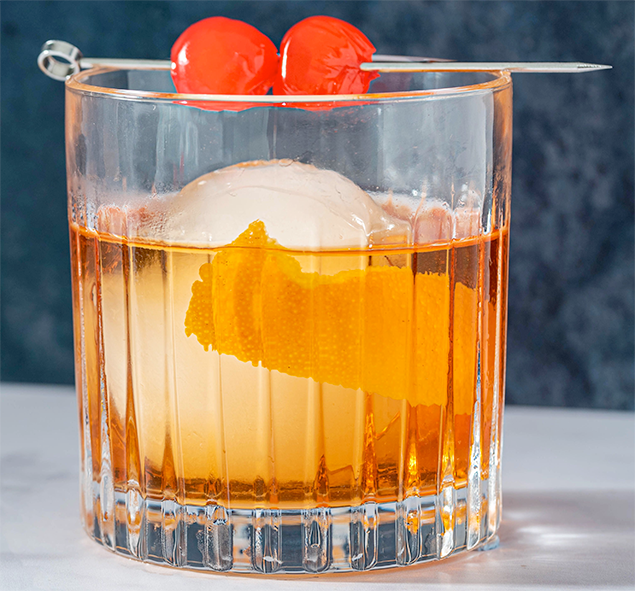 Old fashioned whisky-based cocktail in a tumbler (old
fashioned) glass with a garnish of two glacé cherries.
In the 1869 recipe book Cooling Cups and Dainty Drinks, by William Terrington, cocktails are described as:
Cocktails are compounds very much used by "early birds" to fortify the inner man, and by those who like their consolations hot and strong.The term highball appears during the 1890s to distinguish a drink composed only of a distilled spirit and a mixer.
Published in 1902 by Farrow and Jackson, "Recipes of American and Other Iced Drinks" contains recipes for nearly two dozen cocktails, some still recognizable today.
The first "cocktail party" ever thrown was allegedly by Julius S. Walsh Jr. of St. Louis, Missouri, in May 1917. Walsh invited 50 guests to her home at noon on a Sunday. The party lasted an hour until lunch was served at 1 p.m. The site of this first cocktail party still stands. In 1924, the Roman Catholic Archdiocese of St. Louis bought the Walsh mansion at 4510 Lindell Boulevard, and it has served as the local archbishop's residence ever since.
During Prohibition in the United States (1920–1933), when alcoholic beverages were illegal, cocktails were still consumed illegally in establishments known as speakeasies. The quality of the liquor available during Prohibition was much worse than previously. There was a shift from whiskey to gin, which does not require aging and is, therefore, easier to produce illicitly. Honey, fruit juices, and other flavorings served to mask the foul taste of the inferior liquors. Sweet cocktails were easier to drink quickly, an important consideration when the establishment might be raided at any moment. With wine and beer less readily available, liquor-based cocktails took their place, even becoming the centerpiece of the new cocktail party.
Cocktails became less popular in the late 1960s and through the 1970s, until resurging in the 1980s with vodka often substituting for the original gin in drinks such as the martini. Traditional cocktails began to make a comeback in the 2000s, and by the mid-2000s there was a renaissance of cocktail culture in a style typically referred to as mixology that draws on traditional cocktails for inspiration but uses novel ingredients and often complex flavours.
Mixed drinks without alcohol that resemble cocktails can be known as "zero-proof" or "virgin" cocktails or "mocktails". As a note to my readers, the links below include recipes for virgin cocktails and punches as well as true cocktails of various types.
The alphabetical list of all the cocktail recipes on this site follows, (limited to 100 recipes per page). There are 62 recipes in total:
Page 1 of 1
| 'West Indian' Mulled Wine Origin: Fusion | Hot Buttered Rum Origin: Britain | Punch à la Vanille (Vanilla Punch) Origin: Madagascar |
| Absinthum Romanum (Roman wormwood wine is made thus) Origin: Roman | Hypocras Origin: France | Sangría Especial (Special Sangria) Origin: Spain |
| An Admirable Cool Cup Origin: British | Kemyskans Haf (Summer Punch) Origin: England | Sangria Origin: Spain |
| Apricot Ratafia Origin: British | Lemon Verbena Lemonade Origin: Britain | Sangria Seca Origin: Non-alcoholic |
| Basic Sugar Syrup Origin: Britain | Lemon Watermelon Smoothie Origin: American | Sea-buckthorn Schnapps Origin: Denmark |
| Batido de Abacaxi (Pineapple Shake) Origin: Guinea-Bissau | Malteada de Arequipe (Dulce de Leche Milkshake) Origin: Colombia | Sekanjabin Origin: Roman |
| Bellinitini Cocktail Origin: Traditional Cocktail | Mauby Origin: Bahamas | Shirley Temple Cocktail Origin: Non-alcoholic |
| Blackberry Drink Origin: England | Menthe Vert (Green Mint Syrup) Origin: France | Sloe Gin Origin: Britain |
| Bombaylinis Origin: India | Midnight Hour Cocktail Origin: Traditional Cocktail | Sloe Gin Royale Cocktail Origin: Traditional Cocktail |
| Caudell Origin: England | Mocha Frappé Origin: American | Soft Sangria Origin: Non-alcoholic |
| Champagne Punch Origin: Britain | Moscow Mule Cocktail Origin: Traditional Cocktail | Sweet Vernal Grass Vodka Origin: Britain |
| Champassion Cocktail Origin: Traditional Cocktail | Mulled Apple Cider Punch Origin: American | Trinidad Mauby Origin: Trinidad |
| Christmas Glögg (Christmas Glogg) Origin: Sweden | Mulled Apple Juice Origin: Britain | Vermouth di Torino (Turin Vermouth) Origin: Italy |
| Clarrey (Claret) Origin: England | Mulled Cider Origin: Britain | Virgin Bull Cocktail Origin: Non-alcoholic |
| Cocktail Mangue Orange (Mango and Orange Cocktail) Origin: Niger | Mulled Mead Origin: Roman | Virgin Eggnog Origin: Britain |
| Cocquito Origin: Puerto Rico | Mulled Pomegranate Juice Origin: Britain | Virgin Mary Cocktail Origin: Non-alcoholic |
| Eggnog Origin: Britain | Mulsum Origin: Roman | Vodka Mimosa Cocktail Origin: Traditional Cocktail |
| Espresso and Tonic Origin: Britain | New Year's Eve Punch Origin: American | Waldmeister Bowle Origin: Germany |
| Feuerzangenbowle (Christmas Flaming Mulled Wine) Origin: Germany | Old Fashioned Cocktail Origin: IBA | Wassail Origin: Britain |
| French 75 Cocktail Origin: Traditional Cocktail | Paloma Mocktail Origin: Fusion | White Sangria Origin: Spain |
| Grand Champagne Cocktail Origin: Traditional Cocktail | Ponche de Creme Origin: Trinidad |
Page 1 of 1