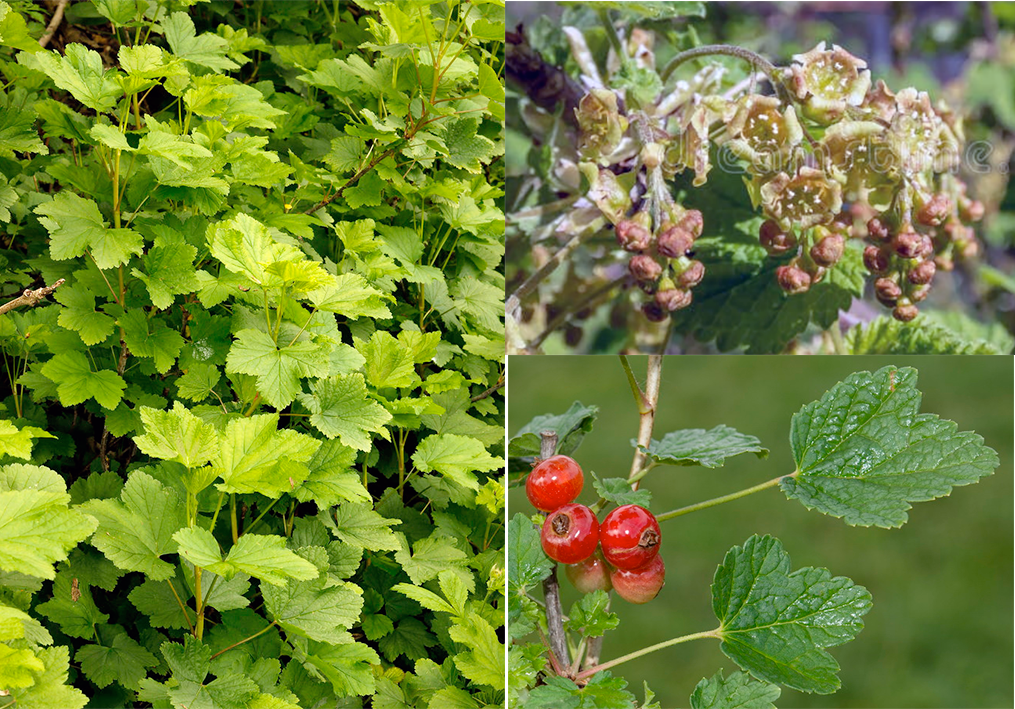
 The image, above, shows the full redcurrant plant (Ribes
rubrum) in full leaf, left. Also shown are close-ups of the
flowers (right-top) along with the fruit and leaves (right,
bottom)..
|
Common Name: Redcurrant |
| Scientific Name: Ribes rubrum |
|
Other Names: Red Currant, Cultivated Currant |
| Family: Grossulariaceae |
| Range: Western Europe, including Britain. |
Physical Characteristics Ribes rubrum is a deciduous shrub, growing to 1–1.5m tall. It is hardy to UK zone 5 and is not frost tender. It is in flower from April to May, and the seeds ripen from July to August. The species is hermaphrodite (has both male and female organs) and is pollinated by Bees. The plant is self-fertile.
Suitable: light (sandy), medium (loamy) and heavy (clay) soils and prefers well-drained soil. Suitable pH: mildly acid, neutral and basic (mildly alkaline) soils. It can grow in semi-shade (light woodland) or no shade. It prefers moist soil. |
| Edible Parts: Flowers, Fruit, Leaves |
 Edibility Rating: 3 Edibility Rating: 3 
|
 Known Hazards: The fresh leaves contain the toxin hydrogen cyanide, though details of quantities. Fresh and dried leaves have been used for centuries to prepared redcurrant teas, though the process of drying will help eliminate any cyanogenic compounds in the leaves, as will the addition of boiling water. Known Hazards: The fresh leaves contain the toxin hydrogen cyanide, though details of quantities. Fresh and dried leaves have been used for centuries to prepared redcurrant teas, though the process of drying will help eliminate any cyanogenic compounds in the leaves, as will the addition of boiling water.
|
Monthly Availability: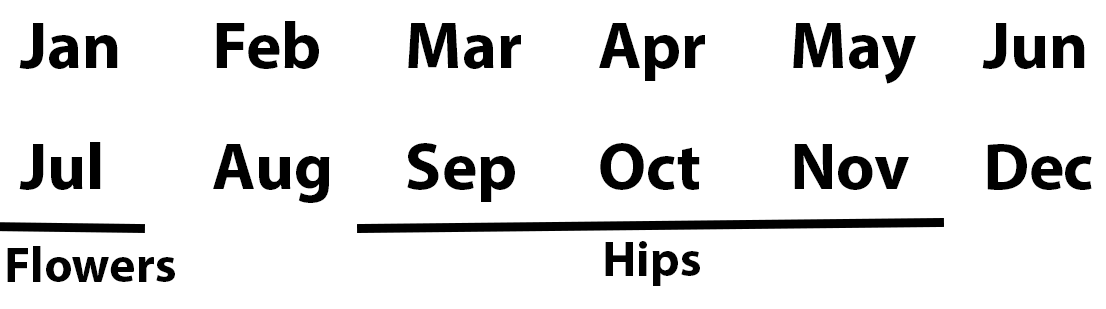
|
Welcome to the summary page for FabulousFusionFood's Wild Food guide to Redcurrant along with all the Redcurrant containing recipes presented on this site, with 77 recipes in total.
These recipes, all contain Redcurrant as a major wild food ingredient.
The Redcurrant, Ribes rubrum, (also known as the Red Currant, Cultivated Currant) is a deciduous shrub normally growing to 1–1.5 metres tall, occasionally 2m, with five-lobed leaves arranged spirally on the stems. The flowers are inconspicuous yellow-green, in pendulous 4–8-centimetre racemes, maturing into bright red translucent edible berries about 8–12 millimetres in diameter; the wild plant has 3–10 berries on each raceme. The plant is self-pollinating, but produces more fruit when pollinated by another plant of a different variety. An established bush can produce 3–4 kilograms of berries from mid- to late summer.
Redcurrant fruit are known for their tart flavour, a characteristic provided by a relatively high content of organic acids and mixed polyphenols. As many as 65 different phenolic compounds may contribute to the astringent properties of redcurrants, with these contents increasing during the last month of ripening. Twenty-five individual polyphenols and other nitrogen-containing phytochemicals in redcurrant juice have been isolated specifically with the astringent flavour profile sensed in the human tongue.
While R. rubrum is native to Europe, large berried cultivars of the redcurrant were first produced in Belgium and northern France in the 17th century. In modern times, numerous cultivars have been selected; some of these have escaped gardens and can be found in the wild across Europe and extending into Asia. The white currant is a cultivar of R. rubrum. Although it is a sweeter and less pigmented variant of the redcurrant, not a separate botanical species, it is sometimes marketed with names such as R. sativumR. silvestre, or sold as a different fruit.
With maturity, the tart flavour of redcurrant fruit is slightly greater than its blackcurrant relative, but with the same approximate sweetness. The white-fruited variant of redcurrant, often referred to as white currant, has the same tart flavour but with greater sweetness. Although frequently cultivated for jams and cooked preparations, much like the white currant, it is often served raw or as a simple accompaniment in salads, garnishes, or drinks when in season.
The dried leaves are used as a tea substitute or can be ground as a coffee substitute. The young leaves can also be collected and cooked as a vegetable.
Though the redcurrant is common in hedgerows and woodland throughout Britain it is often a disappointment to the forager. The flowers, though numerous and edible are not really pretty enough to be used as a garnish. The berries, though often fail to set or are picked off by birds before the forager can get to them. It's far more common to encounter bushes with no berries at all then those bearing berries. Even the most well-provisioned plant will only be sparsely laden as each sprig of berries only bears three or so fruit (as opposed to the large bunches of the cultivars). The main crop of fruit appears in July, but a secondary crop appearing in September can have more fruit for the forager.
[2]. Huxley, A. The New RHS Dictionary of Gardening. 1999
[3]. Tanaka, T. Tanaka's Cyclopaedia of Edible Plants of the World.
[4]. Lim T.K. Edible Medicinal And Non-Medicinal Plants, Vols 1–12.
[5]. Thomas, G. S. Perennial Garden Plants, 2004
[6]. Milner, E. Trees of Britain and Ireland, 2011
[7]. Rose, F. & O'Reilly, C. The Wild Flower Key (Revised Edition) — How to identify wild plants, trees and shrubs in Britain and Ireland, 2006
[8]. Streeter, D. & Garrard, I. The Wild Flowers of the British Isles, 1983
[9]. Clapham, A.R.; Tutin, T.G. & Moore, D.M. Flora of the British Isles, 1987
[10]. Phillips, R. Mushrooms, 2006
[11]. Jordan, P. & Wheeler, S. The Complete Book of Mushrooms: An Illustrated Encyclopedia of Edible Mushrooms, 2011
[12]. Bunker, F. Seaweeds of Britain and Ireland, Second Edition, 2017
[13]. Facciola, S. Cornucopia II — A Source Book of Edible Plants, 1998
[14]. Hartford, R. Edible and Medicinal Wild Plants of Britain and Ireland: A Foraging and Photographic Identification Guide
(Note that the above book links are Amazon Affiliate links)
These recipes, all contain Redcurrant as a major wild food ingredient.
The Redcurrant, Ribes rubrum, (also known as the Red Currant, Cultivated Currant) is a deciduous shrub normally growing to 1–1.5 metres tall, occasionally 2m, with five-lobed leaves arranged spirally on the stems. The flowers are inconspicuous yellow-green, in pendulous 4–8-centimetre racemes, maturing into bright red translucent edible berries about 8–12 millimetres in diameter; the wild plant has 3–10 berries on each raceme. The plant is self-pollinating, but produces more fruit when pollinated by another plant of a different variety. An established bush can produce 3–4 kilograms of berries from mid- to late summer.
Redcurrant fruit are known for their tart flavour, a characteristic provided by a relatively high content of organic acids and mixed polyphenols. As many as 65 different phenolic compounds may contribute to the astringent properties of redcurrants, with these contents increasing during the last month of ripening. Twenty-five individual polyphenols and other nitrogen-containing phytochemicals in redcurrant juice have been isolated specifically with the astringent flavour profile sensed in the human tongue.
While R. rubrum is native to Europe, large berried cultivars of the redcurrant were first produced in Belgium and northern France in the 17th century. In modern times, numerous cultivars have been selected; some of these have escaped gardens and can be found in the wild across Europe and extending into Asia. The white currant is a cultivar of R. rubrum. Although it is a sweeter and less pigmented variant of the redcurrant, not a separate botanical species, it is sometimes marketed with names such as R. sativumR. silvestre, or sold as a different fruit.
With maturity, the tart flavour of redcurrant fruit is slightly greater than its blackcurrant relative, but with the same approximate sweetness. The white-fruited variant of redcurrant, often referred to as white currant, has the same tart flavour but with greater sweetness. Although frequently cultivated for jams and cooked preparations, much like the white currant, it is often served raw or as a simple accompaniment in salads, garnishes, or drinks when in season.
The dried leaves are used as a tea substitute or can be ground as a coffee substitute. The young leaves can also be collected and cooked as a vegetable.
Though the redcurrant is common in hedgerows and woodland throughout Britain it is often a disappointment to the forager. The flowers, though numerous and edible are not really pretty enough to be used as a garnish. The berries, though often fail to set or are picked off by birds before the forager can get to them. It's far more common to encounter bushes with no berries at all then those bearing berries. Even the most well-provisioned plant will only be sparsely laden as each sprig of berries only bears three or so fruit (as opposed to the large bunches of the cultivars). The main crop of fruit appears in July, but a secondary crop appearing in September can have more fruit for the forager.
References:
[1]. David Evans Notes from field observations, tastings and cookery experiments.[2]. Huxley, A. The New RHS Dictionary of Gardening. 1999
[3]. Tanaka, T. Tanaka's Cyclopaedia of Edible Plants of the World.
[4]. Lim T.K. Edible Medicinal And Non-Medicinal Plants, Vols 1–12.
[5]. Thomas, G. S. Perennial Garden Plants, 2004
[6]. Milner, E. Trees of Britain and Ireland, 2011
[7]. Rose, F. & O'Reilly, C. The Wild Flower Key (Revised Edition) — How to identify wild plants, trees and shrubs in Britain and Ireland, 2006
[8]. Streeter, D. & Garrard, I. The Wild Flowers of the British Isles, 1983
[9]. Clapham, A.R.; Tutin, T.G. & Moore, D.M. Flora of the British Isles, 1987
[10]. Phillips, R. Mushrooms, 2006
[11]. Jordan, P. & Wheeler, S. The Complete Book of Mushrooms: An Illustrated Encyclopedia of Edible Mushrooms, 2011
[12]. Bunker, F. Seaweeds of Britain and Ireland, Second Edition, 2017
[13]. Facciola, S. Cornucopia II — A Source Book of Edible Plants, 1998
[14]. Hartford, R. Edible and Medicinal Wild Plants of Britain and Ireland: A Foraging and Photographic Identification Guide
(Note that the above book links are Amazon Affiliate links)
The alphabetical list of all Redcurrant recipes on this site follows, (limited to 100 recipes per page). There are 77 recipes in total:
Page 1 of 1
Page 1 of 1