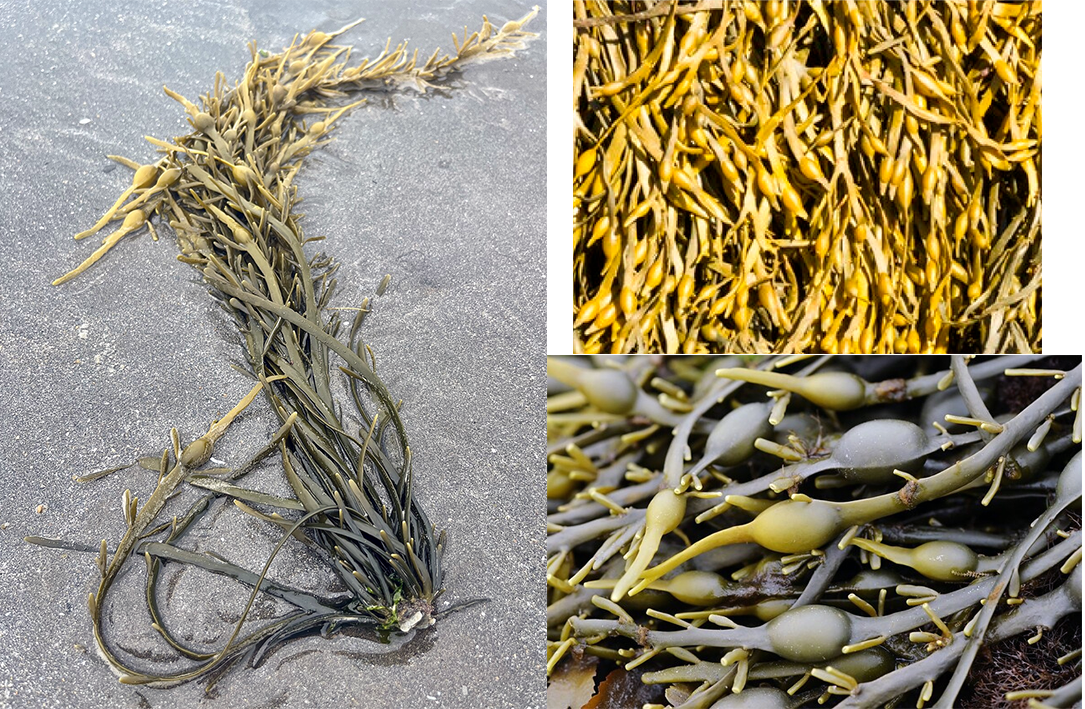
 The image, above, shows the full length fronds of egg wrack
(Fscophyllum nodosum) [left] with the young yellow
growth [top right] and a close-up of the edible reproductive
bladders [bottom right]..
| Common Name: Egg Wrack |
| Scientific Name: Ascophyllum nodosum |
| Other Names: knotted wrack, egg wrack, feamainn bhuí, rockweed, knotted kelp and Norwegian kelp |
| Family: Fucaceae |
| Range: Northern Atlantic Ocean, along the north-western coast of Europe (from the White Sea to Portugal) including east Greenland[1] and the north-eastern coast of North America |
Physical Characteristics Ascophyllum nodosum is a brown alga, ( Ochrophyta, Phaeophyceae), and typically dominates the intertidal zome. It is typically yellow to greenish in colour, with the shoots being darker and the fronds lighter. Ascophyllum nodosum has long tough and leathery fronds, irregularly dichotomously branched fronds with large, egg-shaped air bladders set in series at regular intervals along the fronds and not stalked. The air bladders create a way for fronds broken by wave exposure or other causes to be dispersed and regrow in other areas. While the fronds can reach up to 2 m, the length depends on wave exposure: the length increases with water velocity until a certain point, then decreases as waves become more intense. The fronds can reach 2 m in length and are attached by a holdfast to rocks and boulders. In rare cases, the fronds can reach 6m long. The fronds are olive-green, olive-brown in color and somewhat compressed, but without a midrib. Young shoots are yellow, however darken with age.
|
| Edible Parts: Fronds |
 Edibility Rating: 3 Edibility Rating: 3 
|
 Known Hazards: Though not toxic reports have been found for egg wrack, like all sea vegetables (seaweed) they should only be collected where they grow in clean water and far away from effluent pipes and other sources of sewage. Seaweed can also accumulate toxic heavy metals and it's suggested not to consume them for more than 6 months continuously. Known Hazards: Though not toxic reports have been found for egg wrack, like all sea vegetables (seaweed) they should only be collected where they grow in clean water and far away from effluent pipes and other sources of sewage. Seaweed can also accumulate toxic heavy metals and it's suggested not to consume them for more than 6 months continuously.
|
Welcome to the summary page for FabulousFusionFood's Wild Food guide to Egg Wrack along with all the Egg Wrack containing recipes presented on this site, with 3 recipes in total.
These recipes, all contain Egg Wrack as a major wild food ingredient.
Spiral Wrack, Ascophyllum nodosum (also known as knotted wrack, egg wrack, feamainn bhuí, rockweed, knotted kelp and Norwegian kelp) is a large yellow to greenis alga (and a member of the Fucaceae family [bladderwrack]) that is typically yellow to dark green in colour. Ascophyllum nodosum is found mostly on sheltered sites on shores in the midlittoral, where it can become the dominant species in the littoral zone.
Ascophyllum nodosum is yellow to dark green in colour and similar to Fucus vesiculosus and Fucus serratus. This seaweed grows quite slowly, 0.5% per day, carrying capacity is about 40 kg wet weight per square meter, and it may live for 10–15 years. It may typically overlap in distribution with Fucus vesiculosus and Fucus serratus. Its distribution is also limited by salinity, wave exposure, temperature, desiccation, and general stress. It may take approximately five years before becoming fertile. Ascophyllum nodosum is an autotroph, meaning that it makes its own food by photosynthesis. The air bladders on A. nodosum serve as a flotation device, which allows sunlight to reach the fronds better, aiding photosynthesis.
Each individual is dioecious, either male or female. The gametes are produced in the spring in conceptacles embedded in yellowish receptacles on short branches. A year after the gamete is fertilized and forms a zygote, the first frond grows, and at the beginning of year 2, an air bladder forms, which creates a way to age individuals. For recognition look for the egg-shaped float bladders, developing within stems. By counting the number of air bladders in the central thallus you can calculate the age of the seaweed — one per year. The float bladders are generally too tough to eat, but the gel-filled reproductive bladders are juicy and succulent and make pleasing eating – good for pickling.
All wracks, if harvested in good condition (tender, new growth) make good stock powder that adds body, flavour and an awful lot of nutrition to soups, stews, sauces etc. Fully dehydrate until crisp then grind to a fine powder in a spice grinder. If you aren’t taking your wracks straight from a dehydrator, its usually best to toast them lightly in the oven or in a dry frying pan until they are crisp – this will make grinding a lot easier.
Egg Wrack, particularly the young growth at the tips can be dried, ground and added to a bulk seaweed powder (as for bladder wrack). The reproductive 'bladders' also pickle well and making pickles from them is one of the best ways of keeping them for winter and using them to flavour other dishes.
For other edible seaweed (sea vegetables), see the guide to edible seaweed
[2]. Huxley, A. The New RHS Dictionary of Gardening. 1999
[3]. Tanaka, T. Tanaka's Cyclopaedia of Edible Plants of the World.
[4]. Lim T.K. Edible Medicinal And Non-Medicinal Plants, Vols 1–12.
[5]. Thomas, G. S. Perennial Garden Plants, 2004
[6]. Milner, E. Trees of Britain and Ireland, 2011
[7]. Rose, F. & O'Reilly, C. The Wild Flower Key (Revised Edition) — How to identify wild plants, trees and shrubs in Britain and Ireland, 2006
[8]. Streeter, D. & Garrard, I. The Wild Flowers of the British Isles, 1983
[9]. Clapham, A.R.; Tutin, T.G. & Moore, D.M. Flora of the British Isles, 1987
[10]. Phillips, R. Mushrooms, 2006
[11]. Jordan, P. & Wheeler, S. The Complete Book of Mushrooms: An Illustrated Encyclopedia of Edible Mushrooms, 2011
[12]. Bunker, F. Seaweeds of Britain and Ireland, Second Edition, 2017
[13]. Facciola, S. Cornucopia II — A Source Book of Edible Plants, 1998
[14]. Hartford, R. Edible and Medicinal Wild Plants of Britain and Ireland: A Foraging and Photographic Identification Guide
(Note that the above book links are Amazon Affiliate links)
These recipes, all contain Egg Wrack as a major wild food ingredient.
Spiral Wrack, Ascophyllum nodosum (also known as knotted wrack, egg wrack, feamainn bhuí, rockweed, knotted kelp and Norwegian kelp) is a large yellow to greenis alga (and a member of the Fucaceae family [bladderwrack]) that is typically yellow to dark green in colour. Ascophyllum nodosum is found mostly on sheltered sites on shores in the midlittoral, where it can become the dominant species in the littoral zone.
Ascophyllum nodosum is yellow to dark green in colour and similar to Fucus vesiculosus and Fucus serratus. This seaweed grows quite slowly, 0.5% per day, carrying capacity is about 40 kg wet weight per square meter, and it may live for 10–15 years. It may typically overlap in distribution with Fucus vesiculosus and Fucus serratus. Its distribution is also limited by salinity, wave exposure, temperature, desiccation, and general stress. It may take approximately five years before becoming fertile. Ascophyllum nodosum is an autotroph, meaning that it makes its own food by photosynthesis. The air bladders on A. nodosum serve as a flotation device, which allows sunlight to reach the fronds better, aiding photosynthesis.
Each individual is dioecious, either male or female. The gametes are produced in the spring in conceptacles embedded in yellowish receptacles on short branches. A year after the gamete is fertilized and forms a zygote, the first frond grows, and at the beginning of year 2, an air bladder forms, which creates a way to age individuals. For recognition look for the egg-shaped float bladders, developing within stems. By counting the number of air bladders in the central thallus you can calculate the age of the seaweed — one per year. The float bladders are generally too tough to eat, but the gel-filled reproductive bladders are juicy and succulent and make pleasing eating – good for pickling.
All wracks, if harvested in good condition (tender, new growth) make good stock powder that adds body, flavour and an awful lot of nutrition to soups, stews, sauces etc. Fully dehydrate until crisp then grind to a fine powder in a spice grinder. If you aren’t taking your wracks straight from a dehydrator, its usually best to toast them lightly in the oven or in a dry frying pan until they are crisp – this will make grinding a lot easier.
Egg Wrack, particularly the young growth at the tips can be dried, ground and added to a bulk seaweed powder (as for bladder wrack). The reproductive 'bladders' also pickle well and making pickles from them is one of the best ways of keeping them for winter and using them to flavour other dishes.
For other edible seaweed (sea vegetables), see the guide to edible seaweed
References:
[1]. David Evans Notes from field observations, tastings and cookery experiments.[2]. Huxley, A. The New RHS Dictionary of Gardening. 1999
[3]. Tanaka, T. Tanaka's Cyclopaedia of Edible Plants of the World.
[4]. Lim T.K. Edible Medicinal And Non-Medicinal Plants, Vols 1–12.
[5]. Thomas, G. S. Perennial Garden Plants, 2004
[6]. Milner, E. Trees of Britain and Ireland, 2011
[7]. Rose, F. & O'Reilly, C. The Wild Flower Key (Revised Edition) — How to identify wild plants, trees and shrubs in Britain and Ireland, 2006
[8]. Streeter, D. & Garrard, I. The Wild Flowers of the British Isles, 1983
[9]. Clapham, A.R.; Tutin, T.G. & Moore, D.M. Flora of the British Isles, 1987
[10]. Phillips, R. Mushrooms, 2006
[11]. Jordan, P. & Wheeler, S. The Complete Book of Mushrooms: An Illustrated Encyclopedia of Edible Mushrooms, 2011
[12]. Bunker, F. Seaweeds of Britain and Ireland, Second Edition, 2017
[13]. Facciola, S. Cornucopia II — A Source Book of Edible Plants, 1998
[14]. Hartford, R. Edible and Medicinal Wild Plants of Britain and Ireland: A Foraging and Photographic Identification Guide
(Note that the above book links are Amazon Affiliate links)
The alphabetical list of all Egg Wrack recipes on this site follows, (limited to 100 recipes per page). There are 3 recipes in total:
Page 1 of 1
| Egg Wrack Capers Origin: Britain | Green Olive and Seaweed Tapanade Origin: Britain | Seaweed, Greens, and Feta Spring Omelette Origin: Britain |
Page 1 of 1