Eliza Acton's Chapter 30: Coffee, Chocolate
CHAPTER XXX.
Coffee, Chocolate, &c.
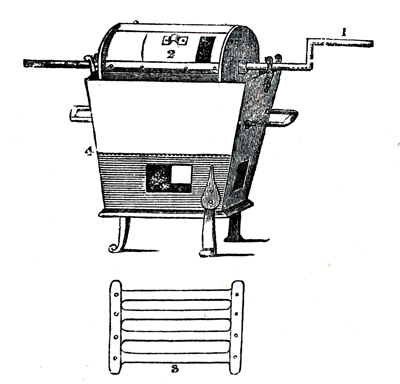
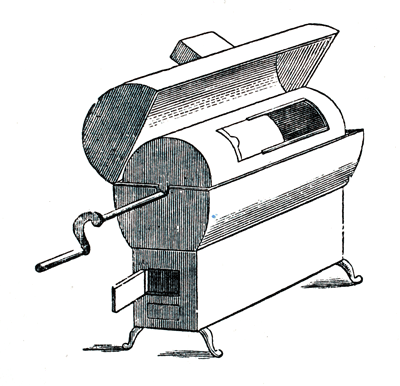
This can be cheaply done in small quantities by means of the inexpensive apparatus shown above; the cost of it not exceeding seven or eight shillings, and the supply of charcoal needed for it being very trifling indeed; or, with that inserted below, which is larger and about double the price. The cylinder which contains the coffee should be only half filled, and it should be turned rather slowly over the fire, which should never be fierce, until a strong aromatic smell is emitted; the movement should then be quickened, as the grain is in that case quite heated, and it will become too highly coloured before it is roasted through, if slowly finished. When it is of a fine, light equal brown, which must be ascertained, until some little experience has been acquired, by sliding back the door of the cylinder, and looking at it occasionally towards the end of the process, spread it quickly upon à large dish, and throw a thick folded cloth over it. Let it remain thus until it is quite cold; then put it immediately into canisters or bottles, and exclude the air carefully from it.
We say nothing about mingling chicory with it. Our directions are for making pure coffee; which, when not taken in excess is, we believe, a wholesome as well as a most agreeable beverage. The effect of chicory is, we believe, to impart a slightly bitter flavour to the infusion, and to deepen its colour so much as to make it appear much stronger than it really is. True connoisseurs, however, do not attach any importance to the dark hue of coffee, the very choicest can be tasted being sometimes of a quite pale tint.
Always serve hot milk or cream, or hot milk and cold cream, if preferred, with breakfast coffee. In the evening, when milk is served at all with it, it should likewise be boiling.
Do not, in any way, make use of the residue of one day's coffee in preparing that of the next; you would but injure the purity of its flavour by doing so, and effect next to nothing in the matter of economy.*
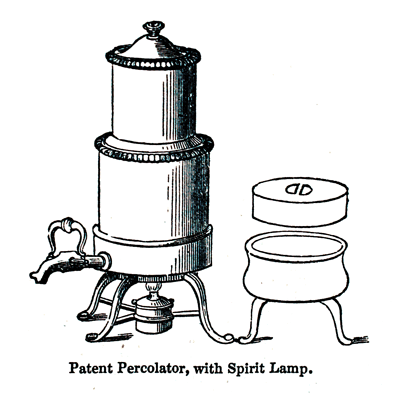
If nearly an additional half pint of water be added before the top of a percolater is taken off, it will still be very good, provided that the coffee used to be really of first-rate quality.
To make cheaper breakfast coffee to be served in the usual English mode, the same process should be followed, but the proportion of water must be considerably increased: it should always, however, be aded by slow degrees.
Good breakfast coffee (for three persons). Best Mocha, in moderately fine powder, ground at the instant of using it, 3 oz.; boiling water added by degrees, 1 pint; (more at pleasure). Boiling milk served with it, 1 1/2 pint to 1 quart. Common English coffee : coffee-powder, 3 oz.; water, 1 quart, to be slowly filtered; hot milk, half to whole pint. Cream in addition to either of the above, at choice.
Coffee, 2 oz,; water, 1 pint to 1 quart, according to the strength required. Boiled 10 minutes; left to clear 10 minutes.
Remark.—Filtering is, we should say, a far more economical, and in every way a superior mode of making coffee to boiling it; but as some persons still prefer the old method, we insert the receipt for it.
(In France vulgarly called Gloria.)
 An ounce of chocolate, if good, will be sufficient for one person. Rasp, and then boil it from five to ten minutes with about four tablespoonsful of water; when it is extremely smooth add nearly a pint of new milk, give it another boil, stir it well, or mill it, and serve it directly. For water-chocolate use three-quarters of a pint of water instead of the milk, and send rich hot cream to table with it. The taste must decide whether it shall be made thicker or thinner.
Chocolate, 2 oz.; water, quarter-pint, or rather more; milk, 1 3/4: 1/2 minute.
Obs.—The general reader will understand the use of the chocolate-mill shown in the engraving with the pot; but to the uninitiated it may be as well to observe, that it is worked quickly round between both hands to give a fine froth to the chocolate. It also serves in lieu of a whisk for working creams, or jellies, to a froth or whip.
Notes:
[*] At some of the principal stations on lines connected with the coast, by which an immense number of strangers pass and repass, the coffee is so bad, that great as the refreshment of it would be to them, particularly in night travelling, in very cold weather, they reject it as too nauseous to be swallowed. A little national pride ought surely to prevent this, if no higher principle interfered to do so; for to exact the full price of a good commodity, and habitually to supply only trash for it, is a commercial disgrace.
[*] We could indicate several houses where unadulterated coffee may be procured, but it is not always to be had from them so choice in quality as it might be; and it is in general to highly roasted. By far the finest we have ever tasted we had on two occasions, some years since, from Mr. Cobbett, of Pall Mall. The fragrance of it was too remarkable to be easily forgotten, and the flavour was exquisite; but it was apparently an accidental sample which he had met with in the market, for though very good, that with which we were supplied afterwards never equalled it.
Messrs. Staniforth and Co., 138, Oxford-street, are deservedly noted for the excellence of their coffee. It is always ground at the last instant of serving it to a customer; and they have the complaisance of roasting even so small a quantity as two pounds, to suit the taste of the purchaser : it may therefore be procured of them as pale-dried as it can be wished.
The house of Messrs. Decastro and Peach, next door to Hatchett's Hotel, Picadilly, may likewise, we think, be quite depended on for supplying genuine coffee to the public ; and they have an immense demand for it.
[*] When the coffee has been filtered in a proper manner, water poured afterwards on the "grounds" as they are termed, will have scarcely any taste or colour: this is not the case when it has been boiled.
[*] Sometimes with a water ice, which should be of an appropriate character.