Eliza Acton's Chapter 14: Poultry
Welcome to Celtnet's Eliza Acton's Chapter 14 (Poultry) Page — Here you will find the full text from the fourteenth chapter: Poultry; of Eliza Acton's Modern Cookery As well as the full text this page also provides links out to the overall index of the book and links to modern redactions of each and every recipe (where practicable). This site builds a complete library of Eliza Acton recipes, allowing the modern cook to make them at home today. Enjoy...
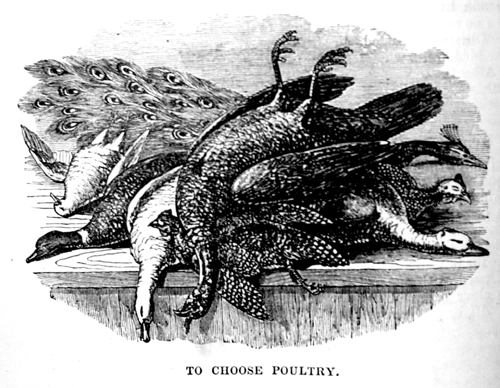
TO CHOOSE POULTRY.
Young, plump, well-fed, but not over-fatted poultry is the best The skin of fowls and turkeys should be clear, white, and finely grained, the breasts broad and full-fleshed, the legs smooth, the toes pliable and easily broken when bent back; the birds should also be heavy in proportion to their size. This applies equally to geese and ducks, of which the breasts likewise should be very plump, and the feet yellow and flexible : when these are red and hard, the bills of the same colour, and the skin full of hairs, and extremely coarse, the birds are old.
White-legged fowls and chickens should be chosen for boiling, because their appearance is the most delicate when dressed; but the dark-legged ones often prove more juicy and of better flavour when roasted, and their colour then is immaterial.
Every precaution should be taken to prevent poultry from becoming ever so slightly tainted before it is cooked, but unless the weather be exceedingly sultry, it should not be quite freshly killed : pigeons only are better for being so, and are thought to lose their flavour by hanging even a day or two. Turkeys, as we have stated in our receipts for them, are very tough and poor eating if not sufficiently long kept. A goose, also, in winter, should hang some days before it is dressed, and fowls, likewise, will be improved by it.
All kinds of poultry should be thoroughly cooked, though without being overdone, for nothing in general can more effectually destroy the appetite than the taste and appearance of their flesh when brought to table half roasted or boiled.
TO BONE A FOWL OR TURKEY WITHOUT OPENING IT.
After the fowl has been drawn and singed, wipe it inside and out with a clean cloth, but do not wash it. Take off the head, cut through the skin all round the first joint of the legs, and pull them from the fowl, to draw out the large tendons. Raise the flesh first from the lower part of the back-bone, and a little also from the end of the breast-bone, if necessary; work the knife gradually to the socket of the thigh; with the point of the knife detach the joint from it, take the end of the bone firmly in the fingers, and cut the flesh clean from it down to the next joint, round which pass the point of the knife carefully, and when the skin is loosened from it in every part, cut round the next bone, keeping the edge of the knife close to it, until the whole of the leg is done. Remove the bones of the other leg in the same manner; then detach the flesh from the back and breast-bone sufficiently to enable you to reach the upper joints of the wings; proceed with these as with the legs, but be especially careful not to pierce the skin of the second joint. it is usual to leave the pinions unboned, in order to give more easily its natural form to the fowl when it is dressed. The merrythought and neck-bones taken out without being divided, and the breast-bone separated carefully from the flesh (which, as the work progresses, must be turned back from the bones upon the fowl, until it is completely inside out). After the one remaining bone is removed, draw the wings and legs back to their proper form, and turn the fowl right side outwards.
A turkey is boned exactly in the same manner, but as it requires a very large proportion of forcemeat to fill it entirely, the legs and wings are sometimes drawn into the body, to diminish the expense of this. If very securely trussed, and sewn, the bird may be either boiled, or stewed in rich gravy, as well as roasted, after being boned and forced; but it must be most gently cooled, or it may burst.
ANOTHER MODE OF BONING A FOWL OR TURKEY.
Cut through the skin down the centre of the back, and raise the flesh carefully on either side with the point of a sharp knife, until the sockets of the wings and thighs are reached. Till a little practice has been gained, it will perhaps be better to bone these joints before proceeding further; but after they are once detached from it, the whole of the body may easily be separated from the flesh and taken out entire: only the neck-bones and merrythought will then remain to be removed. The bird thus prepared may either be restored to its original form, by filling the legs and wings with forcemeat, and the body with the livers of two or three fowls mixed with alternate layers of parboiled tongue freed from the rind, fine sausage meat, or veal forcemeat, or thin slices of the nicest bacon, or aught else of good flavour, which will give a marbled appearance to the fowl when it is carved; and then be sewn up and trussed as usual; or the legs and wings may be drawn inside the body, and the bird being first flattened on a table may be covered with sausage meat, and the various other ingredients we have named, so placed that it shall be of equal thickness in every part; then tightly rolled, bound firmly together with a fillet of broad tape, wrapped in a thin pudding-cloth, closely tied at both ends, and dressed as follows:—Put it into a braisingpan, stewpan, or thick iron saucepan, bright in the inside, and fitted as nearly as may be to its size; add all the chicken bones, a bunch of sweet herbs, two carrots, two bay-leaves, a large blade of mace, twenty-four white peppercorns, and any trimmings or bones of undressed veal which may be at hand; cover the whole with good veal-broth, add salt, if needed, and stew it very softly, from an hour and a quarter to an hour and a half; let it cool in the liquor in which it was stewed; and after it is lifted out, boil down the gravy to a jelly and strain it; let it become cold, clear off the fat, and serve it cut into large dice or roughed, and laid round the fowl, which is to be serve cold. If restored to its form, instead of being rolled, it must be stewed gently for an hour, and may then be sent to table hot, covered with mushroom, or an other good sauce that may be preferred; or it may be left until the following day, and served garnished with the jelly, which should be firm, and very clear and well-flavoured; the liquor in which a calf’s foot has been boiled down, added to the broth, will give it the necessary degree of consistence. French cooks add three or four onions to these preparations of poultry (the last of which is called a galantine); but these our own taste would lead us to reject.
Rolled, 1 1/4 to 1 1/2 hour; galantine, 1 hour.
Obs.—A couple of fowls, boned and rolled, make an excellent pie.
TO BONE FOWLS FOR FRICASSEES, CURRIES, AND PIES.
First carve them entirely into joints, then remove the bones, beginning with the legs and wings at the head of the largest bone; hold this with the fingers, and work the knife as directed in the receipt above. The remainder of the birds is too easily done to require any instructions.
TO ROAST A TURKEY.
 In very cold weather a turkey in its feathers will hang (in an airy larder) quite a fortnight with advantage ; and, however fine a quality of bird it may be, unless sufficiently long kept, it will prove not worth the dressing, though it should always be perfectly sweet when prepared for table. Pluck, draw, and singe it with exceeding care; wash, and then dry it thoroughly with clean cloths, or merely wipe the outside well, without wetting it, and pour water plentifully through the inside. Fill the breast with forcemeat (No. 1, Chapter VIII.), or with the finest sausage meat, highly seasoned with minced herbs, lemon-rind, mace, and cayenne. Truss the bird firmly, lay it to a clear sound fire, baste it constantly and bountifully with butter, and serve it when done with good brown gravy, and well-made bread sauce. An entire chain of delicate fried sausages is still often placed in the dish, round a turkey, as a garnish.
It is usual to fold and fasten a sheet of buttered writing paper over the breast to prevent its being too much coloured: this should be removed twenty minutes before the bird is done. The forcemeat of chestnuts (No. 15, Chatter VIII.) may be very advantageously substituted for the commoner kinds in stuffing it, and the body may then be filled with chestnuts, previously stewed until tender in rich gravy, or simmered over a slow fire in plenty of rasped bacon, with a high seasoning of mace, nutmeg, and cayenne, until they are so; or, instead of this, well-made chestnut sauce, or a dish of stewed chestnuts, may be sent to table with the turkey.
Obs. 1.—Baron Liebig's improved method of roasting will be found at p. 171, and can be followed always instead of the directions given here.
1 1/2 to 2 hours.
Obs. 2.—A turkey should be laid at first far from the fire, and drawn nearer when half done, though never sufficiently so to scorch it; it should be well roasted, for even the most inveterate advocates of under-dressed meat will seldom tolerate the taste or sight of partially-raw poultry.
TO BOIL TURKEY.
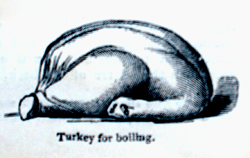 A delicate but plump hen turkey of moderate size should be selected for boiling. Free the skin most carefully from all the stumps, and draw the bird, using the greatest precaution not to break the gall bladder; singe it with writing paper, take off the head and neck, cut through the skin round the first joint of the legs, and draw them off: this is best accomplished by fastening the feel to a strong hook, and then pulling the bird away from it. Wash it exceedingly clean, and then wipe it dry, fill the breast with the forcemeat No. 1 or 2 of Chapter VIII., or with the oyster, chestnut. or French forcemeat, of which the receipts are given in the same chapter. In trussing it draw the legs into the body, break the breast-bone, and give the turkey as round and plump an appearance as can be. Put it into plenty of warm water, or into as much boiling water as will rise about an inch over it, and when it has quite boiled for ten minutes, cool it down by the addition of cold water, and then take out a portion of it, leaving only as much as will keep the bird thoroughly covered until it is ready for table.* Clear off the scum with the greatest care as it is thrown to the surface, and boil the bird very gently from an hour and a half to two hours and a quarter. A very large turkey would require a longer time, but it is unsuited to this mode of cooking. When the oyster-forcemeat is used, a large tureen of rich oyster sauce should accompany the dish; but celery sauce, or good white wine sauce, may otherwise be sent to table with it; and boiled tongue or a small ham is usually served in addition. For a plain family dinner, a delicate cheek of bacon is sometimes substituted for either of these, and parsley and butter for a more expensive sauce. Fast boiling will cause the skin of the bird to break, and must therefore be especially avoided: it should hang for some days before it is dressed, for if quite freshly killed it will not be tender, but it must be perfectly sweet to be fit for table. Truss the turkey by the directions of introductory chapter on trussing.
Moderate-sized turkey, 1 1/2 to 2 hours; large turkey, longer; very small one, less time.
TURKEY BONED AND FORCED.
(An excellent dish.)

Take a small, well-kept, but quite sweet hen-turkey, of from seven to eight pounds weight, and remove, by the receipt for a fowl (page 265), all the bones except those of the pinions, without opening the bird; draw it into shape, and fill it entirely with exceedingly fine sausage meat, beginning with the legs and wings; plump the breast well in preparing it, and when its original form is quite restored, tie it securely at both ends, and at the extremities of the legs; pass a slight iron skewer through these and the body, and another through the wings and body; then lay a twine over the back of the turkey, and pass it under the ends of the first skewer; cross it in the centre of the back, and pass it under the ends of the second skewer; then carry it over the pinions to keep them firmly in their place, and fasten it at the neck. When a cradle spit, of which the engraving below shows the form, and which opens with a joint to receive the roast, is not at hand, a bottle jack will be found more convenient than any other for holding the turkey; and after the hook of this is passed through the neck, it must be further supported by a string running across the back and under the points of the skewer which confines the pinions to the hook; for, otherwise, its weight would most probably cause it to fall. Flour it well, place it far from the fire until it is heated through baste it plentifully and incessantly with butter. An hour and three quarters will roast it well. Break and boil down the bones for gravy in a pint and a half of water, or good veal broth, with a little salt, a few slices of celery, a dozen corns of pepper, and a branch of two of parsley. Brown gently in a morsel of fresh butter, a couple of ounces of lean ham, add to them a slight dredging of flour, and a little cayenne, and pour to them the broth from the bones, after it has boiled for an hour, and been strained and skimmed shake the stewpan well round, and stew the gravy until it is wanted for table; clear it entirely from fat, strain, and serve it very hot. An eschalot or half an onion may be browned with the ham when either is liked, but their flavour is not, we think, appropriate to poultry.
The turkey may be partially filled with forcemeat No 1 or 3 or Chapter VIII., and the sausage-meat may then be placed on either side of it.
Hen turkey between 7 and 8 lbs. weight, boned, filled with sausage-meat, 3 to 4 lbs.; or with forcemeat No. 1, or with No. 3, Chapter VI., 1 lb. (that is to say, 1 lb. of bread-crumbs, and the other ingredients in proportion.) Sausage-meat, 2 to 3 lbs. roasted 1 3/4 hour.
Obs.—When a common spit is used for the turkey, it must be fastened to, an not put upon it.
Bread sauce can be served with the bird, or not, at pleasure.
It will be found an improvement to moisten the sausage-meat with two or three spoonsful of water: it should be finely minced, well spiced, and mixed with herbs, when the common forcemeat is not used in addition. In preparing it a pound and a quarter of fat should be mixed with each pound of the lean.
To give the turkey a very good appearance, the breast may be larded the directions of page 181.
TURKEY A LA FLAMANDE, OR, DINDE POUDRÉE.
Prepare as for boiling a fine well-kept hen turkey ; wipe the inside thoroughly with a dry cloth, but do not wash it; throw in a little salt to draw out the blood, let it remain a couple of hours or more, then drain and wipe it again; next, rub the outside in every part with about four ounces of fine dry salt, mixed with a large tablespoonful of pounded sugar; rub the turkey well with these, and turn it every day for four days; then fill it entirely with equal parts of choice sausage-meat, and of the crumb of bread soaked in boiling milk or cream, and wrung dry in a cloth; season these with the grated rind of a large lemon and nutmeg, mace, cayenne, and fine herbs, in the same proportion as for veal forcemeat (No. 1, Chapter VIII). Sew the turkey up very securely, and when trussed, roll it in a cloth, tie it closely at both ends, put it into boiling water and boil it very gently between three and four hours. When taken up, sprinkle it thickly with fine crumbs of bread, mixed with plenty of parsley, shred extremely small. Serve it cold, with a sauce made of the strained juice and grated rind of two lemons, a teaspoonful of made mustard, and one of pounded sugar, with as much oil as will prevent its being more than pleasantly acid, and a little salt, if needed; work these together until perfectly mixed, and send them to table in a tureen.
This receipt was given to us abroad, by a Flemish lady, who had had the dish often served with great success in Paris. We have inserted it on her authority, not on our own experience; but we think it may be quite depended on.
TO ROAST A TURKEY POULT.
[The turkey-poult is in season whenever it is of sufficient size to serve. In the earlier spring months it is very high in price, but in summer, and as the autumn advances, may be had at a more reasonable cost. The great demand for turkeys in England towards Christmas, and the care which they require in being reared, causes them to be brought much less abundantly into the markets when young, than they are in foreign countries; in many of which they are very plentiful and very cheap.]
A turkey-poult or half-grown turkey, makes a delicate roast, which some persons much prefer to the full-grown bird. It is served with the head on, but is generally in other respects trussed like a capon or a large fowl, except for fashionable tables, for which it is sometimes arranged with the legs twisted back at the first joint, and the feet brought close to the thighs in the same manner as those of a woodcock. It should be well basted with good butter, and will require from an hour to an hour and a quarter's roasting. If for the second course, it may be dished on water-cresses : pour a little gravy round it in the dish, and send more to table with it in a tureen.
TO ROAST A GOOSE.
[In best season from September to March.]
 After it has been plucked and singed with care, put into the body of the goose two parboiled onions of moderate size finely chopped, and mixed with half an ounce of minced sage-leaves, a saltspoonful of salt, and half as much black pepper, or a proportionate quantity of cayenne; to these add a small slice of fresh butter. Truss the goose, and after it is on the spit, tie it firmly at both ends that it may turn steadily, and that the seasoning may not escape ; roast it at a brisk fire, and keep it constantly basted. Serve it with brown gravy, and apple or tomata sauce. When the taste is in favour of a stronger seasoning than the above, which occurs we apprehend but seldom, use raw onions for it and increase the quantity; but should one still milder be preferred, mix a handful of fine bread-crumbs with the other ingredients, or two or three minced apples. The body of a goose is sometimes filled entirely with mashed potatoes, which, for this purpose, ought to be boiled very dry, and well blended with two or three ounces of butter, or with some thick cream, some salt, and white pepper or cayenne: to these minced sage and parboiled onions can also be added at pleasure. A teaspoonful of made-mustard, half as much of salt, and a small portion of cayenne, smoothly mixed with a glass of port wine, are sometimes poured into the goose just before it is served, through a cut made in the apron.
1 1/2 to 1 3/4 hour..
Obs.—We extract, for the benefit of our readers, from a work in our possession, the following passage, of which we have had no opportunity of testing the correctness. "Geese, with sage and onions, may be deprived of power to breathe forth any incense, thus: Pare from a lemon all the yellow rind, taking care not to bruise the fruit nor to cut so deeply as to let out the juice. Place this lemon in the centre of the seasoning within the bird. When or before it is brought to table, let the flap be gently opened, remove the lemon with a tablespoon; avoid breaking, and let it instantly be thrown away, as its white pithy skin will have absorbed all the gross particles which else would have escaped."
TO ROAST A GREEN GOOSE.
Season the inside with a little pepper and salt, and roast the goose at a brisk fire from forty to fifty minutes. Serve it with good brown gravy only. To this sorrel-sauce is sometimes added at not very modern English tables. Green geese are never stuffed.
TO ROAST A FOWL.
[Fowls are always in season when they can be procured sufficiently young to be tender. About February they become dear and scarce; and small spring chickens are generally very expensive. As summer advances they decline in price.]
 Strip off the feathers, and carefully pick every stump from the skin, as nothing can be more uninviting than the appearance of any kind of poultry where this has been neglected, nor more indicative of slovenliness on the part of the cook. Take off the head and neck close to the body, but leave sufficient of the skin to tie over the part that is cut. In drawing the bird, do not open it more than is needful, and use great precaution to avoid breaking the gall-bladder. Hold the legs in boiling water for two or three minutes that the skin may be peeled from them easily; cut the claws, and then, with a bit of lighted writing-paper, singe off the hairs without blackening the fowl. Wash, and wipe it afterwards very dry, and let the liver and gizzard be made delicately clean, and fasten into the pinions. Truss and spit it firmly; flour it well when first laid to the fire, baste it frequently with butter, and when it is done draw out the skewers, dish it, pour a little good gravy over, and send it to table with bread, mushroom, egg, chestnut, or olive sauce. A common mode of serving roast fowls in France is aux cressons, that is, laid upon young water-cresses,* which have previously been freed from the outer leaves, thoroughly washed, shaken dry in a clean cloth, and sprinkled with a little fine salt, and sometimes with a small quantity of vinegar : these should cover the dish, and after the fowls are placed on them, gravy should be poured over as usual.
The body of a fowl may be filled with very small mushrooms prepared as for partridges (see partridges with mushrooms), then sewn up, roasted served with mushroom-sauce : this is an excellent mode of dressing it. A little rasped bacon, or a bit or two of the lean of beef or veal minced, or cut into dice, may be put inside the bird when either is considered an improvement ; but its own liver, or that of another fowl, will he found to impart a much finer flavour than any of these last; and so likewise will a teaspoonful of really good mushroom-powder smoothly mixed with a slice of good butter, and a seasoning of fine salt and cayenne.†
Full-sized fowl, 1 hour: young chicken, 25 to 35 minutes.
Obs.—As we have already observed in our general remarks on roasting, the time must be regulated by various circumstances which we named, and which the cook should always take into consideration. A buttered paper should be fastened over the breast, and removed about fifteen minutes before the fowl is served: this will prevent its taking too much colour.
ROAST FOWL.
(A French Receipt.)
Fill the breast of a fine fowl with good forcemeat, roast it as usual, and when it is very nearly ready to serve take it from the fire, pour lukewarm butter over it in every part, and strew it thickly with very fine bread-crumbs; sprinkle these again with butter, and dip the fowl into more crumbs. Put it down to the fire, and when it is of a clear, light brown all over, take it carefully from the spit, dish, and serve it with lemon-sauce, and with gravy thickened and mixed with plenty of minced parsley, or with brown gravy and any other sauce usually served with fowls. Savoury herbs shred small, spice, and lemon-grate, may be mixed with the crumbs at pleasure. Do not pour gravy over the fowl when it is thus prepared.
TO ROAST A GUINEA FOWL.
Let the bird hang for as many days as the weather will allow ; then stuff, truss, roast, and serve it like a turkey, or leave the head on and lard the breast. Send gravy and bread-sauce to table with it in either case : it will be found excellent eating.
3/4 to 1 hour.
FOWL A LA CARLSFORS. (ENTRÉE.)
Bone a fowl without opening the back, and restore it to its original form by filling the vacant spaces in the legs and wings with forcemeat ; put a roll of it also into the body, and a large sausage freed from the skin on either side; tie it very securely at both ends, truss it with fine skewers, and roast it for a full hour, keeping it basted plentifully with butter. When appearance is not regarded, the pinions may be taken off, and the legs and wings drawn inside the fowl, which will then require a much smaller proportion of forcemeat:—that directed for veal will answer quite well in a general way, but for a dinner of ceremony, No. 17 or 18 of the same Chapter, should be used in preference. The fowl must be tied securely to the spit, not put upon it. Boned chickens are excellent when entirely filled with well-made mushroom forcemeat, or very delicate and nicely seasoned sausage-meat, and either roasted or stewed. Brown gravy, or mushroom sauce should then be sent to table with them.
BOILED FOWLS.
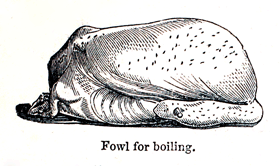 White-legged poultry should always be selected for boiling as it is of better colour when dressed than any other. Truss the fowls firmly and neatly, with the legs drawn into the bodies, and the wings twisted over the backs; let them be well covered with water, which should be hot, but not boiling when they are put in. A full-sized fowl will require about three quarters of an hour from the time of its beginning to simmer; but young chickens not more than from twenty to twenty-five minutes: they should be very gently boiled, and the scum should be removed with great care as it gathers on the surface of the water. Either of the following sauces may be sent to table with them: parsley and butter, béchamel, English white sauce, oyster, celery, or white-mushroom sauce. The fowls are often dished with small tufts of delicately boiled cauliflower placed round them; or with young vegetable marrow scarcely larger than an egg, merely pared and halved after it is dressed: white sauce must be served with both of these. The livers and gizzards are not, at the present day, ever served in the wings of boiled fowls. The livers may be simmered for four or five minutes, then pressed to a smooth paste with a wooden spoon, and mixed very gradually with the sauce, which should not boil after they are added.
Full-sized fowl, 3/4 hour : young chickens, 20 to 25 minutes.
Obs.—Rather less than half a gallon of cold added to an equal quantity of boiling water, will bring it to the proper degree of heat for putting in the fowls, or the same directions may be observed for them as those given for a boiled turkey. For richer modes of boiling poultry, see Blanc and Poêlée, Chapter IX.
TO BROIL A CHICKEN OR FOWL.
Either of these, when merely split and broiled, is very dry and unsavoury eating; but will be greatly improved if first boiled gently from five to ten minutes and left to become cold, then divided, dipped into egg and well seasoned bread-crumbs, plentifully sprinkled with clarified butter, dipped again into the crumbs, and broiled over a clear and gentle fire from half to three quarters of an hour. It should be served very hot, with mushroom-sauce or with a little good plain gravy, which may be thickened and flavoured with a teaspoonful of mushroom-powder mixed with half as much flour and a little butter; or with some Eespagnole. It should be opened at the back, and evenly divided quite through; the legs should be trussed like those of a boiled fowl; the breast-bone, or that of the back may be removed at pleasure, and both sides of the bird should be made as flat as they can be that the fire may penetrate every part equally : the inside should be first laid towards it. The neck, feet and gizzard may be boiled down with a small quantity of onion and carrot, previously browned in a morsel of butter to make the gravy; and the liver, after having been simmered with them for five or six minutes, may be used to thicken it after it is strained. A teaspoonful of lemon-juice, some cayenne, and minced parsley should be added to it, and a little arrow-root, or flour and butter.
1/2 to 3/4 hour.
FRICASSEED FOWLS OR CHICKENS. (ENTRÉE.)
To make a fricassee of good appearance without great expense, prepare, with exceeding nicety, a couple of plump chickens, strip off the skin, and carve them very neatly. Reserve the wings, breasts, merrythoughts, and thighs; and stew down the inferior joints with a couple of blades of mace, a small bunch of savoury herbs, a few white peppercorns, a pint and a half of water, and a small half-teaspoonful of salt. When something more than a third part reduced, strain the gravy, let it cool, and skim off every particle of fat. Arrange the joints which are to be fricasseed in one layer if it can be done conveniently, and pour to them as much of the gravy as will nearly cover them; add the very thin rind of half a fresh lemon, and simmer the fowls gently from half to three quarters of an hour ; throw in sufficient salt, pounded mace, and cayenne, to give the sauce a good flavour, thicken it with a large teaspoonful of arrow-root, and stir to it the third of a pint of rich boiling cream; then lift the stewpan from the fire, and shake it briskly round while the beaten yolks of three fresh eggs, mixed with a spoonful or two of cream, are added; continue to shake the pan gently above the fire till the sauce is just set, but it must not be allowed to boil, or it will curdle in an instant.
1/2 to 3/4 hour.
ENGLISH CHICKEN CUTLETS. (ENTRÉE).
Skin and cut into joints one or two young chickens, and remove the bones with care from the breasts, merrythoughts, and thighs, which are to be separated from the legs. Mix well together a teaspoonful of salt, nearly a fourth as much of mace, a little grated nutmeg, and some cayenne; flatten and form into good shape, the boned joints of chicken, and the flesh of the wings; rub a little of the seasoning over them in every part, dip them into beaten egg, and then into very fine bread-crumbs, and fry them gently in fresh butter until they are of a delete brown. Some of the bones and trimmings may be boiled down in half a pint of water, with a roll of lemon-peel, a little salt, and eight or ten white peppercorns, to make the gravy which, after being strained and cleared from fat, may be poured hot to some thickening made in the pan with a slice of fresh butter and a dessertspoonful of flour: a teaspoonful of mushroom-powder would improve it greatly, and a small quantity of lemon-juice should be added before it is poured out, with salt and cayenne if required. Pile the cutlets high in the centre of the dish, and serve the sauce under them, or in a tureen.
CUTLETS OF FOWLS, PARTRIDGES, OR PIGEONS. (ENTRÉE.)
(French Receipt.)
Take closely off the flesh of the breast and wing together, on either side of the bone, and when the large filets, as they are called, are thus raised from three birds, which will give but six cutlets, take the strips of flesh that lie under the wings, and that of the merrythoughts, and flatten two or three of these together, that there may be nine cutlets at least, of equal size. When all are ready, fry to a pale brown as many diamond-shaped sippets of bread as there are fillets of fowl, and let them be quite as large; place these before the fire to dry, and wipe out the pan. Dip the cutlets into some yolks of eggs, mixed with a little clarified butter, and strew them in every part with the finest bread-crumbs, moderately seasoned with salt, cayenne, and pounded mace. Dissolve as much good butter as will be required to dress them, and fry them in it of a light amber-colour: arrange them upon the sippets of bread, pie them high in the dish, and pour a rich brown gravy or Espagnole but not over them.
FRIED CHICKEN A LA MALABAR. (ENTRÉE.)
This is an Indian dish. Cut up the chicken, wipe it dry, and rub it well with currie—powder mixed with a little salt; fry it in a bit of butter, taking care that it is of a nice light brown. In the mean time cut two or three onions into thin slices, draw them out into rings, and cut the rings into little bits about half an inch long; fry them for a long time gently in a little clarified butter, until they have gradually dried up and are of a delicate yellow-brown. Be careful that they are not burnt, as the burnt taste of a single bit would spoil the flavour of the whole. When they are as dry as chips, without the least grease or moisture upon them, mix a little salt with them, strew them over the fried chicken, and serve up with lemon on a plate.
We have extracted this receipt from a clever little work called the "Hand-Book of Cookery."
HASHED FOWL. (ENTRÉE.)
After having taken off in joints, as much of a cold fowl or fowls as will suffice for a dish, bruise the bodies with a paste roller, pour to them a pint of water, and boil them for an hour and a half to two hours, with the addition of a little pepper and salt only, or with a small quantity of onion, carrot, and savoury herbs. Strain, and skim the fat from the gravy, put it into a clean saucepan, and, should it require thickening, stir to it, when it boils, half a teaspoonful of flour smoothly mixed with a small bit of butter; add a little mushroom catsup, or other store-sauce, with a slight seasoning of mace or nutmeg. Lay in the fowl, and keep it near the fire until it is heated quite through, and is at the point of boiling: serve it with fried sippets round the dish. For a hash of higher relish, add to the bones when they are first stewed down a large onion minced and browned in butter, and before the fowl is dished, add some cayenne and the juice of half a lemon.
FRENCH AND OTHER RECEIPTS FOR MINCED FOWL. (ENTRÉE.)
Raise from the bones all the more delicate parts of the flesh of either cold roast, or of cold boiled fowls, clear it from the skin, and keep it covered from the air until it is wanted for use. Boil the bones well bruised, and the skin, with three quarters of a pint of water until reduced quite half; then strain the gravy and let it cool; next, having first skimmed off the fat, put it into a clean saucepan, with a quarter of a pint of cream, an ounce and a half of butter well mixed with a dessertspoonful of flour, and a little pounded mace, and grated lemon-rind; keep these stirred until they boil, then put in the fowl, finely minced, with three or four hard-boiled eggs chopped small, and sufficient salt, and white pepper or cayenne, to season it properly. Shake the mince over the fire until it is just ready to boil, stir to it quickly a squeeze of lemon-juice, dish it with pale sippets of fried bread, and serve it immediately. When cream cannot easily be obtained, use milk, with a double quantity of butter and flour. To make an English mince, omit the hard eggs, heat the fowl in the preceding sauce or in a common béchamel, or white sauce, dish it with small delicately poached eggs (those of the guinea-fowl or bantam for example), laid over it in a circle and send it quickly to table. Another excellent variety of the dish is also made by covering the fowl thickly with very fine bread-crumbs, moistening them with clarified butter, ·and giving them colour with a salamander, or in a quick oven.*
FRITOT OF COLD FOWLS
Cut into joints and take the skin from some cold fowls, lay them into a deep dish, strew over them a little fine salt and cayenne, add the juice of a lemon, and let them remain for an hour, moving them occasionally that they may all absorb a portion of the acid; then dip them one by one into some French batter (see Chapter V.), and fry them a pale brown over a gentle fire. Serve them garnished with very green crisped parsley. A few drops of eschalot vinegar may be mixed with the lemon-juice which is poured to the fowls, or slices of raw onion or eschalot, and small branches of sweet herbs may be laid amongst them, and cleared off before they are dipped into the batter. Gravy made of the trimmings, thickened, and well flavoured, may be sent to table with them in a tureen: and dressed bacon (see page 259), in a dish apart.
SCALLOPS OF FOWL AU BECHAMEL. (ENTRÉE.)
Raise the flesh from a couple of fowls as directed for cutlets in the foregoing receipt, and take it as entire as possible from either side of the breast; strip off the skin, lay the fillets flat, and slice them into small thin scallops; dip them one by one into clarified butter, and arrange them evenly in a delicately clean and not large frying-pan; sprinkle a seasoning of fine salt over, and just before the dish is wanted for table, fry them quickly without allowing them to brown; drain them well from the butter, pile them in the centre of a hot dish, and sauce them with some boiling béchamel. This dish may be quickly prepared by taking a ready-dressed fowl from the spit or stewpan, and by raising the fillets, and slicing the scallops into the boiling sauce before they have had time to cool.
Fried, 3 to 4 minutes.
GRILLADE OF COLD FOWLS.
Carve and soak the remains of roast fowls as for the fritot which precedes, wipe them dry, dip them into clarified butter, and then into fine bread-crumbs, and broil them gently over a very clear fire. A little finely-minced lean of ham or grated lemon-peel, with a seasoning of cayenne, salt, and mace, mixed with the crumbs will vary this dish agreeably. When fried instead of broiled, the fowls may be dipped into yolk of egg instead of butter; but this renders them too dry for broiling.
FOWLS A LA MAYONNAISE.
Carve with great nicety a couple of cold roast fowls; place the inferior joints, if they are served at all, close together in the middle of a dish, and arrange the others round and over them, piling them high in the centre. Garnish them with the hearts of young lettuces cut in two, and hard-boiled eggs, halved lengthwise. At the moment of serving, pour over the fowls a well-made mayonnaise sauce (see Chapter VI.), or, if preferred, an English salad-dressing, compounded with thick cream, instead of oil.
TO ROAST DUCKS.
[Ducks are in season all the year, but are thought to be in their perfection about June or early in July. Ducklings (or half-grown ducks) are in the greatest request in spring, when there is no game in the market, and other poultry is somewhat scarce.]
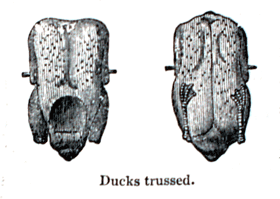 In preparing these for the spit, be careful to clear the skin entirely from the stumps of the feathers; take off the heads and necks, but leave the feet on, and hold them for a few minutes in boiling water to loosen the skin, which must be peeled off. Wash the inside of the birds by pouring water through them, but merely wipe the outsides with a dry cloth. Put into the bodies a seasoning of parboiled onions mixed with minced sage, salt, pepper, and a slice of butter when this mode of dressing them is liked; but as the taste of a whole party is seldom in its favour, one, when a couple are roasted, is often served without the stuffing. Cut off the pinions at the first joint from the bodies, truss the feet behind the backs, spit the birds firmly, and roast them at a brisk fire, but do not place them sufficiently near to be scorched; baste them constantly, and when the breasts are well plumped, and the steam from them draws towards the fire, dish, and serve them quickly with a little good brown gravy poured round them, and some also in a tureen; or instead of this, with some which has been made with the necks, gizzards, and livers well stewed down, with a slight seasoning of browned onion, some herbs, and spice.
Young ducks, 1/2 hour: full sized, from 3/4 to 1 hour.
Obs.—Olive-sauce may be served with roast as well as with stewed ducks.
STEWED DUCK. (ENTRÉE.)
A couple of quite young ducks, or a fine, full-grown, but still tender one, will be required for this dish. Cut either down neatly into joints, and arrange them in a single layer if possible, in a wide stewpan; pour in about three quarters of a pint of strong cold beef stock or gravy; let it be well cleared from scum when it begins to boil, then throw in a little salt, a rather full seasoning of cayenne, and a few thin strips of lemon-rind. Simmer the ducks very softly for three quarters of an hour, or somewhat longer should the joints be large; then stir into the gravy a tablespoonful of the finest rice flour, mixed with a wineglassful or rather more of port wine, and a dessertspoonful of lemon-juice: in ten minutes after, dish the stew and send it to table instantly.
The ducks may be served with a small portion only of their sauce, and dished in a circle, with green peas à la Française heaped high in the centre: the lemon-rind and port wine should then be altogether omitted, and a small bunch of green onions and parsley, with two or three young carrots, may be stewed down with the birds, or three or four eschalots, delicately fried in butter, may be used to flavour the gravy. The turnips au beurre, prepared by the receipt of Chapter XVII., may be substituted for the peas; and a well made Espagnole may take the place of beef stock, when a dish of high savour is wished for. A duck is often stewed without being divided into joints. It should then be firmly trussed, half roasted at a quick fire, and laid into the stewpan as it is taken from the spit; or well browned in some French thickening, then half covered with boiling gravy, and turned when partially done: from an hour to an hour and a quarter will stew it well.
TO ROAST PIGEON.
[In season from March to Michaelmas, and whenever they can be had young.]
 These, as we have already said, should be dressed while they are very fresh. If extremely young they will be ready in twelve hours for the spit, otherwise, in twenty-four. Take off the heads and necks, and cut off the toes at the first joint; draw them carefully, and pour plenty of water through them: wipe them dry, and put into each bird a small bit of butter lightly dipped into a little cayenne (formerly it was rolled in minced parsley, but this is no longer the fashionable mode of preparing them). Truss the wings over the backs, and roast them at a brisk fire, keeping them well and constantly basted with butter. Serve them with brown gravy and a tureen of parsley and butter. For the second course, dish them upon young water-cresses, as directed for roast fowl aux cressons, page 272. About twenty minutes will roast them.
18 to 20 minutes; five minutes longer, if large; rather less if very young.
BOILED PIGEONS.
Truss them like boiled fowls, drop them into plenty of boiling water, throw in a little salt, and in fifteen minutes lift them out, pour parsley and butter over, and send a tureen of it to table with them.
CHAPTER XIV.
Poultry.
White-legged fowls and chickens should be chosen for boiling, because their appearance is the most delicate when dressed; but the dark-legged ones often prove more juicy and of better flavour when roasted, and their colour then is immaterial.
Every precaution should be taken to prevent poultry from becoming ever so slightly tainted before it is cooked, but unless the weather be exceedingly sultry, it should not be quite freshly killed : pigeons only are better for being so, and are thought to lose their flavour by hanging even a day or two. Turkeys, as we have stated in our receipts for them, are very tough and poor eating if not sufficiently long kept. A goose, also, in winter, should hang some days before it is dressed, and fowls, likewise, will be improved by it.
All kinds of poultry should be thoroughly cooked, though without being overdone, for nothing in general can more effectually destroy the appetite than the taste and appearance of their flesh when brought to table half roasted or boiled.
A turkey is boned exactly in the same manner, but as it requires a very large proportion of forcemeat to fill it entirely, the legs and wings are sometimes drawn into the body, to diminish the expense of this. If very securely trussed, and sewn, the bird may be either boiled, or stewed in rich gravy, as well as roasted, after being boned and forced; but it must be most gently cooled, or it may burst.
Rolled, 1 1/4 to 1 1/2 hour; galantine, 1 hour.
Obs.—A couple of fowls, boned and rolled, make an excellent pie.
In very cold weather a turkey in its feathers will hang (in an airy larder) quite a fortnight with advantage ; and, however fine a quality of bird it may be, unless sufficiently long kept, it will prove not worth the dressing, though it should always be perfectly sweet when prepared for table. Pluck, draw, and singe it with exceeding care; wash, and then dry it thoroughly with clean cloths, or merely wipe the outside well, without wetting it, and pour water plentifully through the inside. Fill the breast with forcemeat (No. 1, Chapter VIII.), or with the finest sausage meat, highly seasoned with minced herbs, lemon-rind, mace, and cayenne. Truss the bird firmly, lay it to a clear sound fire, baste it constantly and bountifully with butter, and serve it when done with good brown gravy, and well-made bread sauce. An entire chain of delicate fried sausages is still often placed in the dish, round a turkey, as a garnish.
It is usual to fold and fasten a sheet of buttered writing paper over the breast to prevent its being too much coloured: this should be removed twenty minutes before the bird is done. The forcemeat of chestnuts (No. 15, Chatter VIII.) may be very advantageously substituted for the commoner kinds in stuffing it, and the body may then be filled with chestnuts, previously stewed until tender in rich gravy, or simmered over a slow fire in plenty of rasped bacon, with a high seasoning of mace, nutmeg, and cayenne, until they are so; or, instead of this, well-made chestnut sauce, or a dish of stewed chestnuts, may be sent to table with the turkey.
Obs. 1.—Baron Liebig's improved method of roasting will be found at p. 171, and can be followed always instead of the directions given here.
1 1/2 to 2 hours.
Obs. 2.—A turkey should be laid at first far from the fire, and drawn nearer when half done, though never sufficiently so to scorch it; it should be well roasted, for even the most inveterate advocates of under-dressed meat will seldom tolerate the taste or sight of partially-raw poultry.
A delicate but plump hen turkey of moderate size should be selected for boiling. Free the skin most carefully from all the stumps, and draw the bird, using the greatest precaution not to break the gall bladder; singe it with writing paper, take off the head and neck, cut through the skin round the first joint of the legs, and draw them off: this is best accomplished by fastening the feel to a strong hook, and then pulling the bird away from it. Wash it exceedingly clean, and then wipe it dry, fill the breast with the forcemeat No. 1 or 2 of Chapter VIII., or with the oyster, chestnut. or French forcemeat, of which the receipts are given in the same chapter. In trussing it draw the legs into the body, break the breast-bone, and give the turkey as round and plump an appearance as can be. Put it into plenty of warm water, or into as much boiling water as will rise about an inch over it, and when it has quite boiled for ten minutes, cool it down by the addition of cold water, and then take out a portion of it, leaving only as much as will keep the bird thoroughly covered until it is ready for table.* Clear off the scum with the greatest care as it is thrown to the surface, and boil the bird very gently from an hour and a half to two hours and a quarter. A very large turkey would require a longer time, but it is unsuited to this mode of cooking. When the oyster-forcemeat is used, a large tureen of rich oyster sauce should accompany the dish; but celery sauce, or good white wine sauce, may otherwise be sent to table with it; and boiled tongue or a small ham is usually served in addition. For a plain family dinner, a delicate cheek of bacon is sometimes substituted for either of these, and parsley and butter for a more expensive sauce. Fast boiling will cause the skin of the bird to break, and must therefore be especially avoided: it should hang for some days before it is dressed, for if quite freshly killed it will not be tender, but it must be perfectly sweet to be fit for table. Truss the turkey by the directions of introductory chapter on trussing.
Moderate-sized turkey, 1 1/2 to 2 hours; large turkey, longer; very small one, less time.
(An excellent dish.)
The turkey may be partially filled with forcemeat No 1 or 3 or Chapter VIII., and the sausage-meat may then be placed on either side of it.
Hen turkey between 7 and 8 lbs. weight, boned, filled with sausage-meat, 3 to 4 lbs.; or with forcemeat No. 1, or with No. 3, Chapter VI., 1 lb. (that is to say, 1 lb. of bread-crumbs, and the other ingredients in proportion.) Sausage-meat, 2 to 3 lbs. roasted 1 3/4 hour.
Obs.—When a common spit is used for the turkey, it must be fastened to, an not put upon it.
Bread sauce can be served with the bird, or not, at pleasure.
It will be found an improvement to moisten the sausage-meat with two or three spoonsful of water: it should be finely minced, well spiced, and mixed with herbs, when the common forcemeat is not used in addition. In preparing it a pound and a quarter of fat should be mixed with each pound of the lean.
To give the turkey a very good appearance, the breast may be larded the directions of page 181.
This receipt was given to us abroad, by a Flemish lady, who had had the dish often served with great success in Paris. We have inserted it on her authority, not on our own experience; but we think it may be quite depended on.
[The turkey-poult is in season whenever it is of sufficient size to serve. In the earlier spring months it is very high in price, but in summer, and as the autumn advances, may be had at a more reasonable cost. The great demand for turkeys in England towards Christmas, and the care which they require in being reared, causes them to be brought much less abundantly into the markets when young, than they are in foreign countries; in many of which they are very plentiful and very cheap.]
A turkey-poult or half-grown turkey, makes a delicate roast, which some persons much prefer to the full-grown bird. It is served with the head on, but is generally in other respects trussed like a capon or a large fowl, except for fashionable tables, for which it is sometimes arranged with the legs twisted back at the first joint, and the feet brought close to the thighs in the same manner as those of a woodcock. It should be well basted with good butter, and will require from an hour to an hour and a quarter's roasting. If for the second course, it may be dished on water-cresses : pour a little gravy round it in the dish, and send more to table with it in a tureen.
[In best season from September to March.]
After it has been plucked and singed with care, put into the body of the goose two parboiled onions of moderate size finely chopped, and mixed with half an ounce of minced sage-leaves, a saltspoonful of salt, and half as much black pepper, or a proportionate quantity of cayenne; to these add a small slice of fresh butter. Truss the goose, and after it is on the spit, tie it firmly at both ends that it may turn steadily, and that the seasoning may not escape ; roast it at a brisk fire, and keep it constantly basted. Serve it with brown gravy, and apple or tomata sauce. When the taste is in favour of a stronger seasoning than the above, which occurs we apprehend but seldom, use raw onions for it and increase the quantity; but should one still milder be preferred, mix a handful of fine bread-crumbs with the other ingredients, or two or three minced apples. The body of a goose is sometimes filled entirely with mashed potatoes, which, for this purpose, ought to be boiled very dry, and well blended with two or three ounces of butter, or with some thick cream, some salt, and white pepper or cayenne: to these minced sage and parboiled onions can also be added at pleasure. A teaspoonful of made-mustard, half as much of salt, and a small portion of cayenne, smoothly mixed with a glass of port wine, are sometimes poured into the goose just before it is served, through a cut made in the apron.
1 1/2 to 1 3/4 hour..
Obs.—We extract, for the benefit of our readers, from a work in our possession, the following passage, of which we have had no opportunity of testing the correctness. "Geese, with sage and onions, may be deprived of power to breathe forth any incense, thus: Pare from a lemon all the yellow rind, taking care not to bruise the fruit nor to cut so deeply as to let out the juice. Place this lemon in the centre of the seasoning within the bird. When or before it is brought to table, let the flap be gently opened, remove the lemon with a tablespoon; avoid breaking, and let it instantly be thrown away, as its white pithy skin will have absorbed all the gross particles which else would have escaped."
Strip off the feathers, and carefully pick every stump from the skin, as nothing can be more uninviting than the appearance of any kind of poultry where this has been neglected, nor more indicative of slovenliness on the part of the cook. Take off the head and neck close to the body, but leave sufficient of the skin to tie over the part that is cut. In drawing the bird, do not open it more than is needful, and use great precaution to avoid breaking the gall-bladder. Hold the legs in boiling water for two or three minutes that the skin may be peeled from them easily; cut the claws, and then, with a bit of lighted writing-paper, singe off the hairs without blackening the fowl. Wash, and wipe it afterwards very dry, and let the liver and gizzard be made delicately clean, and fasten into the pinions. Truss and spit it firmly; flour it well when first laid to the fire, baste it frequently with butter, and when it is done draw out the skewers, dish it, pour a little good gravy over, and send it to table with bread, mushroom, egg, chestnut, or olive sauce. A common mode of serving roast fowls in France is aux cressons, that is, laid upon young water-cresses,* which have previously been freed from the outer leaves, thoroughly washed, shaken dry in a clean cloth, and sprinkled with a little fine salt, and sometimes with a small quantity of vinegar : these should cover the dish, and after the fowls are placed on them, gravy should be poured over as usual.
The body of a fowl may be filled with very small mushrooms prepared as for partridges (see partridges with mushrooms), then sewn up, roasted served with mushroom-sauce : this is an excellent mode of dressing it. A little rasped bacon, or a bit or two of the lean of beef or veal minced, or cut into dice, may be put inside the bird when either is considered an improvement ; but its own liver, or that of another fowl, will he found to impart a much finer flavour than any of these last; and so likewise will a teaspoonful of really good mushroom-powder smoothly mixed with a slice of good butter, and a seasoning of fine salt and cayenne.†
Full-sized fowl, 1 hour: young chicken, 25 to 35 minutes.
Obs.—As we have already observed in our general remarks on roasting, the time must be regulated by various circumstances which we named, and which the cook should always take into consideration. A buttered paper should be fastened over the breast, and removed about fifteen minutes before the fowl is served: this will prevent its taking too much colour.
(A French Receipt.)
3/4 to 1 hour.
White-legged poultry should always be selected for boiling as it is of better colour when dressed than any other. Truss the fowls firmly and neatly, with the legs drawn into the bodies, and the wings twisted over the backs; let them be well covered with water, which should be hot, but not boiling when they are put in. A full-sized fowl will require about three quarters of an hour from the time of its beginning to simmer; but young chickens not more than from twenty to twenty-five minutes: they should be very gently boiled, and the scum should be removed with great care as it gathers on the surface of the water. Either of the following sauces may be sent to table with them: parsley and butter, béchamel, English white sauce, oyster, celery, or white-mushroom sauce. The fowls are often dished with small tufts of delicately boiled cauliflower placed round them; or with young vegetable marrow scarcely larger than an egg, merely pared and halved after it is dressed: white sauce must be served with both of these. The livers and gizzards are not, at the present day, ever served in the wings of boiled fowls. The livers may be simmered for four or five minutes, then pressed to a smooth paste with a wooden spoon, and mixed very gradually with the sauce, which should not boil after they are added.
Full-sized fowl, 3/4 hour : young chickens, 20 to 25 minutes.
Obs.—Rather less than half a gallon of cold added to an equal quantity of boiling water, will bring it to the proper degree of heat for putting in the fowls, or the same directions may be observed for them as those given for a boiled turkey. For richer modes of boiling poultry, see Blanc and Poêlée, Chapter IX.
1/2 to 3/4 hour.
1/2 to 3/4 hour.
(French Receipt.)
We have extracted this receipt from a clever little work called the "Hand-Book of Cookery."
Fried, 3 to 4 minutes.
In preparing these for the spit, be careful to clear the skin entirely from the stumps of the feathers; take off the heads and necks, but leave the feet on, and hold them for a few minutes in boiling water to loosen the skin, which must be peeled off. Wash the inside of the birds by pouring water through them, but merely wipe the outsides with a dry cloth. Put into the bodies a seasoning of parboiled onions mixed with minced sage, salt, pepper, and a slice of butter when this mode of dressing them is liked; but as the taste of a whole party is seldom in its favour, one, when a couple are roasted, is often served without the stuffing. Cut off the pinions at the first joint from the bodies, truss the feet behind the backs, spit the birds firmly, and roast them at a brisk fire, but do not place them sufficiently near to be scorched; baste them constantly, and when the breasts are well plumped, and the steam from them draws towards the fire, dish, and serve them quickly with a little good brown gravy poured round them, and some also in a tureen; or instead of this, with some which has been made with the necks, gizzards, and livers well stewed down, with a slight seasoning of browned onion, some herbs, and spice.
Young ducks, 1/2 hour: full sized, from 3/4 to 1 hour.
Obs.—Olive-sauce may be served with roast as well as with stewed ducks.
The ducks may be served with a small portion only of their sauce, and dished in a circle, with green peas à la Française heaped high in the centre: the lemon-rind and port wine should then be altogether omitted, and a small bunch of green onions and parsley, with two or three young carrots, may be stewed down with the birds, or three or four eschalots, delicately fried in butter, may be used to flavour the gravy. The turnips au beurre, prepared by the receipt of Chapter XVII., may be substituted for the peas; and a well made Espagnole may take the place of beef stock, when a dish of high savour is wished for. A duck is often stewed without being divided into joints. It should then be firmly trussed, half roasted at a quick fire, and laid into the stewpan as it is taken from the spit; or well browned in some French thickening, then half covered with boiling gravy, and turned when partially done: from an hour to an hour and a quarter will stew it well.
These, as we have already said, should be dressed while they are very fresh. If extremely young they will be ready in twelve hours for the spit, otherwise, in twenty-four. Take off the heads and necks, and cut off the toes at the first joint; draw them carefully, and pour plenty of water through them: wipe them dry, and put into each bird a small bit of butter lightly dipped into a little cayenne (formerly it was rolled in minced parsley, but this is no longer the fashionable mode of preparing them). Truss the wings over the backs, and roast them at a brisk fire, keeping them well and constantly basted with butter. Serve them with brown gravy and a tureen of parsley and butter. For the second course, dish them upon young water-cresses, as directed for roast fowl aux cressons, page 272. About twenty minutes will roast them.
18 to 20 minutes; five minutes longer, if large; rather less if very young.
Notes:
[*] As we have elsewhere stated, all meat and fish are injured by being cooked in a much larger quantity of water than is absolutely required for them.
[*] This is done with many other roasts which are served in the second course; but the vinegar is seldom added in this country.
[†] We cannot much recommend these mere superfluities of the table.
[*] For minced fowl and oysters, follow the receipt for veal, page 231.