FabulousFusionFood's Spice Guide for Caper Home Page
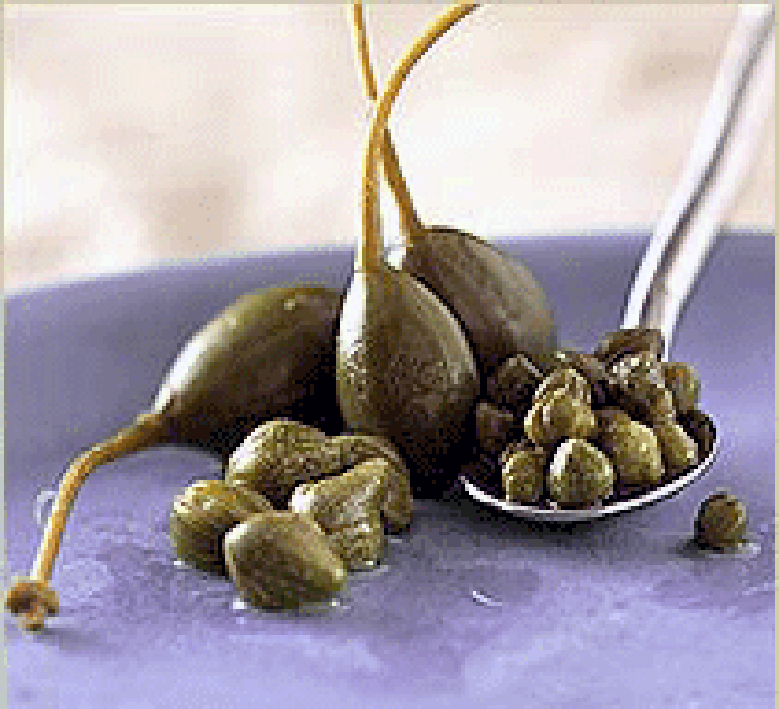 Capers and
caperberries, the
unopened flowers and
fruit of
Capparis
spinosa.
Capers and
caperberries, the
unopened flowers and
fruit of
Capparis
spinosa.
Welcome to the summary page for FabulousFusionFood's Spice guide to Caper along with all the Caper containing recipes presented on this site, with 92 recipes in total.
This is a continuation of an entire series of pages that will, I hope, allow my visitors to better navigate this site. As well as displaying recipes by name, country and region of origin I am now planning a whole series of pages where recipes can be located by meal type and main ingredient. This page gives a listing of all the spice-based recipes added to this site.
These recipes, all contain Caper as a major flavouring.
Capers are the pickled flower buds of Capparis spinosa a biennial spiny shrub (a member of the Capparaceae, or caper family) that is native to the Mediterranean. The pickled and salted caper flower bud (also called caper) is often used as a seasoning or garnish. Capers are a common ingredient in Mediterranean cuisine. The grown fruit of the caper shrub is also used, and prepared similarly to the buds to be used as caper berries. The shrubby plant is many-branched, with alternate leaves, thick and shiny, round to ovate in shape. The flowers are complete (ie has both carpels and stamen), showy, with four sepals, and four white to pinkish-white petals, many long violet-coloured stamens, and a single stigma usually rising well above the stamens. When fertilized, the flowers develop into fruit, which can also be picked and pickled and which are known as caper berries (cornichon de câpres in French). These are also pickled and sold as their spice and they have a very intense flavour. Caper Berries are much better than capers if you are going to boil them in a sauce (capers easily lose their flavour if they are cooked).
Capers are found growing wild all over the Mediterranean, though it is believed that their origin lies in direr areas of Western and Central Asia. Today they are cultivated in France, Spain, Italy, Cyprus, Greece and Algeria around the Mediterranean. Iran also produces capers on a commercial basis.
Capers are categorized and sold by their size, defined as follows, with the smallest sizes being the most desirable: Non-pareil (0–7 mm), surfines (7–8 mm), capucines (8–9 mm), capotes (9–11 mm), fines (11–13 mm), and grusas (14+ mm). To prepare, fresh capers are picked and immediately preserved in brine or wine vinegar, or are packed in salt (these should be rinsed before use to remove any excess salt). Their tangy, bitter flavour adds piquancy to many sauces and condiments, such as tartare sauce, and they're a good match for fish. They can be used as a garnish for meat and vegetable dishes and in tapenade. Indeed, the sensory qualities of capers can be described as spicy with a sour note (due to pickling) with a taste that is both pungent and astringent. Caper berries have a very similar flavour profile, but are much stronger in taste. It is this piquancy and the use of capers as a flavouring that allows them to be classified as a spice.
The name 'caper' itself derives from the classical Latin capparis (caper), itself a borrowing from the Greek kapparis [κάππαρις] (whose etymology is unknown but may refer to the island of Cyprus where capers grow abundantly).
Capers are crucial to a number of Mediterranean dishes (particularly Italian and Cypriot) and are used to intensify the flavours of sauces based on tomatoes or sauces intended to be used with fish. They also occur in certain North African dishes. Interestingly, the Spanish introduced capers to Central America and they are now employed in a number of Mexican dishes.
The fragrance is spicy and a little bit sour (because of the pickling), the taste is slightly astringent and pungent. Caper berries have a stronger, more dominant but otherwise similar flavour. Capers contain isothiocyanates and thus resemble several spices of the cabbage family (cress, black and white mustard, wasabi and horseradish). Among the flavonoids, rutin (named after its occurrence in rue) is the most important. The white spots often seen covering the surface of pickled capers are said to by rutin which crystallized during the pickling procedure.
This is a continuation of an entire series of pages that will, I hope, allow my visitors to better navigate this site. As well as displaying recipes by name, country and region of origin I am now planning a whole series of pages where recipes can be located by meal type and main ingredient. This page gives a listing of all the spice-based recipes added to this site.
These recipes, all contain Caper as a major flavouring.
Capers are the pickled flower buds of Capparis spinosa a biennial spiny shrub (a member of the Capparaceae, or caper family) that is native to the Mediterranean. The pickled and salted caper flower bud (also called caper) is often used as a seasoning or garnish. Capers are a common ingredient in Mediterranean cuisine. The grown fruit of the caper shrub is also used, and prepared similarly to the buds to be used as caper berries. The shrubby plant is many-branched, with alternate leaves, thick and shiny, round to ovate in shape. The flowers are complete (ie has both carpels and stamen), showy, with four sepals, and four white to pinkish-white petals, many long violet-coloured stamens, and a single stigma usually rising well above the stamens. When fertilized, the flowers develop into fruit, which can also be picked and pickled and which are known as caper berries (cornichon de câpres in French). These are also pickled and sold as their spice and they have a very intense flavour. Caper Berries are much better than capers if you are going to boil them in a sauce (capers easily lose their flavour if they are cooked).
Capers are found growing wild all over the Mediterranean, though it is believed that their origin lies in direr areas of Western and Central Asia. Today they are cultivated in France, Spain, Italy, Cyprus, Greece and Algeria around the Mediterranean. Iran also produces capers on a commercial basis.
Capers are categorized and sold by their size, defined as follows, with the smallest sizes being the most desirable: Non-pareil (0–7 mm), surfines (7–8 mm), capucines (8–9 mm), capotes (9–11 mm), fines (11–13 mm), and grusas (14+ mm). To prepare, fresh capers are picked and immediately preserved in brine or wine vinegar, or are packed in salt (these should be rinsed before use to remove any excess salt). Their tangy, bitter flavour adds piquancy to many sauces and condiments, such as tartare sauce, and they're a good match for fish. They can be used as a garnish for meat and vegetable dishes and in tapenade. Indeed, the sensory qualities of capers can be described as spicy with a sour note (due to pickling) with a taste that is both pungent and astringent. Caper berries have a very similar flavour profile, but are much stronger in taste. It is this piquancy and the use of capers as a flavouring that allows them to be classified as a spice.
The name 'caper' itself derives from the classical Latin capparis (caper), itself a borrowing from the Greek kapparis [κάππαρις] (whose etymology is unknown but may refer to the island of Cyprus where capers grow abundantly).
Capers are crucial to a number of Mediterranean dishes (particularly Italian and Cypriot) and are used to intensify the flavours of sauces based on tomatoes or sauces intended to be used with fish. They also occur in certain North African dishes. Interestingly, the Spanish introduced capers to Central America and they are now employed in a number of Mexican dishes.
The fragrance is spicy and a little bit sour (because of the pickling), the taste is slightly astringent and pungent. Caper berries have a stronger, more dominant but otherwise similar flavour. Capers contain isothiocyanates and thus resemble several spices of the cabbage family (cress, black and white mustard, wasabi and horseradish). Among the flavonoids, rutin (named after its occurrence in rue) is the most important. The white spots often seen covering the surface of pickled capers are said to by rutin which crystallized during the pickling procedure.
The alphabetical list of all Caper recipes on this site follows, (limited to 100 recipes per page). There are 92 recipes in total:
Page 1 of 1
| Adenydd Cath Fôr gyda Saws Tartar Cyflym (Fried Skate Wings with Quick Home-made Tartar Sauce) Origin: Welsh | Dill Piccata Sauce Origin: France | Potted Prawns Origin: Britain |
| Admiral Sauce Origin: Britain | Francatelli Boiled Neck of Mutton Origin: Britain | Provençale Sauce Origin: Britain |
| Ailes de raie sauce au beurre noir (Skate wings with black butter sauce) Origin: France | Grand Sallet (Great Salad) Origin: Britain | Rice with Pigeon Peas Origin: Puerto Rico |
| Air Fryer Tomato or Marinara Sauce Origin: Britain | Green Mix with Indian Ocean Seafood Origin: Tanzania | Roast Megrim with Parsley and Caper Butter Origin: England |
| Ajiaco Colombiano (Colombian Ajiaco) Origin: Colombia | Horiatiki Salata (Greek Salad) Origin: Greece | Rock Samphire Salsa Verde Origin: Britain |
| Alcapurrias de Jueyes (Crab-Stuffed Fritters) Origin: Puerto Rico | Kapernschnitzel (Veal Cutlets With Capers) Origin: Germany | Sala Cattabia (Potted Salads) Origin: Roman |
| Arroz Con Pollo (Costa Rican Arroz con Pollo) Origin: Costa Rica | Karni Mulá ku Zuurkool (Minced Beef with Sauerkraut) Origin: Curacao | Salmagundi Origin: Britain |
| Arroz Con Pollo Panameño (Panamanian Arroz con Pollo) Origin: Panama | Karry-remoulade (Danish Curry Remoulade) Origin: Denmark | Salmagundi with Herby Rack of Lamb Origin: Britain |
| Artichauts camus sauce bretonne (Camus artichokes with Breton sauce) Origin: France | Keshi Yena (Filled Cheese Shells) Origin: Aruba | Sancocho Dominicano (Dominican Stew) Origin: Dominican Republic |
| Baked New Potatoes with Wilted Wild Garlic Origin: Britain | Keshi Yena (Stuffed Cheese) Origin: Curacao | Sauce Robert Origin: France |
| Battered Queenies With Tartar Sauce Origin: Manx | Kocktail Yafo (Fish Cocktail) Origin: Israel | Sauce Tartare Origin: France |
| Beans with Artichokes and Olives Origin: Britain | Koenigsberger Klopse (German Meatballs) Origin: Germany | Sauce Verde Origin: Italy |
| Brithyll Abermeurig (Abermeurig Trout) Origin: Welsh | Kuddelfleck (Tripe) Origin: Luxembourg | Savoury Potato Roulade Origin: Ireland |
| Brown Butter Sauce Origin: Britain | Mackerel Tartare with Pickled Dulse Origin: Britain | Schweineschnitzel (Pork Schnitzels) Origin: Germany |
| Brown Caper Sauce Origin: Britain | Marinara Pizza Origin: Italy | Sharp Sauce Origin: Britain |
| Butterflied Lamb Shoulder with Salsa Verde Origin: Britain | Monkfish with Potatoes, Artichokes and Prosciutto Origin: Britain | Smoked Salmon and Cream Cheese Pâté Origin: Britain |
| Caesar Salad Origin: Mexico | Montpelier Butter Origin: France | Solyanka (Russian Sweet and Sour Meat Soup) Origin: Russia |
| Caper Sauce for Boiled Mutton Origin: Britain | Mrs Beeton Boiled Neck of Mutton Origin: Britain | Solyanka (Siberian Sweet and Sour Meat Soup) Origin: Siberia |
| Caper Sauce for Fish Origin: Britain | Olive Tortilla Origin: Chile | Steak Tartare Origin: France |
| Capered New Potatoes Origin: Ireland | Paella Valencia Origin: Spain | Tamal de Olla Origin: Panama |
| Caponata Origin: Italy | Pan-fried Megrim Sole with Creamed Spinach Origin: Britain | Tapenade Origin: Spain |
| Caponata alla Siciliana (Sicilian Aubergine Salad) Origin: Italy | Pan-fried Sea Bass with Citrus-dressed Broccoli Origin: Fusion | Tapenade Monegasque (Monaco-style Tapenade) Origin: Monaco |
| Christmas Pastelles Origin: Trinidad | Pasta with Olives and Caperberries Origin: Britain | Tartare d'algues fraîches (Tartare of Fresh Seaweed) Origin: France |
| Cig oen bys a bawd gyda saws bara lawr (Lamb Finger Food with Laverbread Sauce) Origin: Welsh | Pastechi di Tonijn (Tuna Pastechi) Origin: Aruba | Tartare Sauce Origin: Britain |
| Cig Oen gyda Saws Bara Lawr Llysieuog (Lamb with Herby Laverbread Sauce) Origin: Welsh | Pastechi di Tonijn (Tuna Pastechi) Origin: Curacao | The Prince of Wales' Sauce Origin: Britain |
| Confiture de Poivrons (Confit of Peppers) Origin: Monaco | Pastechi Karni (Aruban Meat Empanadas) Origin: Aruba | Three-cornered Leek Giardiniera Origin: Britain |
| Crimped Cod Origin: Britain | Pastei'r Porthmon (Drover's Pie) Origin: Welsh | Trini Sweet and Sour Mango Relish Origin: Trinidad |
| Crimped Skate Origin: Britain | Piquant Sauce Origin: Britain | White Caper Sauce Origin: Britain |
| Crumbed Chicken with Green Mayonnaise Origin: Britain | Pizza Quattro Stagioni (Four Seasons Pizza) Origin: Italy | Wild Spring Flower Salad Origin: Britain |
| Daube de chevreuil (Venison Daube) Origin: France | Potato Salad with Herb Sauce Origin: Ireland | Wild Spring Salad Origin: Britain |
| Daube de Provençale (Provençal Daube) Origin: France | Potato Salad with Thyme, Watercress and Lovage Origin: Britain |
Page 1 of 1