FabulousFusionFood's Spice Guide for Saffron Home Page
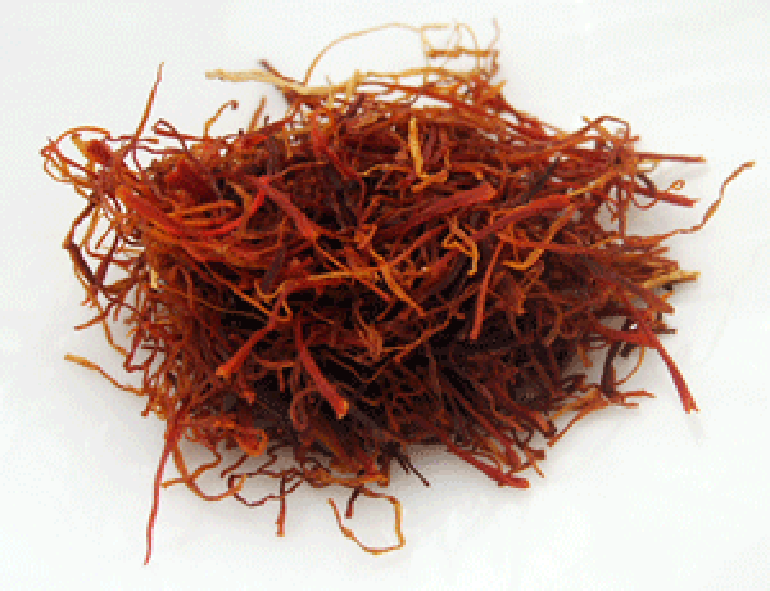 Saffron the dried
stigmas of
Crocus
sativus.
Saffron the dried
stigmas of
Crocus
sativus.
Welcome to the summary page for FabulousFusionFood's Spice guide to Saffron along with all the Saffron containing recipes presented on this site, with 306 recipes in total.
This is a continuation of an entire series of pages that will, I hope, allow my visitors to better navigate this site. As well as displaying recipes by name, country and region of origin I am now planning a whole series of pages where recipes can be located by meal type and main ingredient. This page gives a listing of all the spice-based recipes added to this site.
These recipes, all contain Saffron as a major flavouring.
Saffron is a spice derived from the saffron crocus Crocus sativus, members of the Iridaceae (Iris) family. The flower itself has three red stigmas (right-hand image) that are the distal ends of the plant's carpels. Together with its style (the stalk that connects the stigmas to the remainder of the plant) these components are often dried and used in cooking as a seasoning and colouring agent. Saffron is native to Southwestern Asia, where its wild precursor Crocus cartwrightianus still grows. Some 3000 years ago it seems that a sterile mutant of this plant, Crocus sativus, emerged in late Bronze Age Crete. This had bright red stigmas that extended outside the flower and it was used as a spice and a dye. As a result, the saffron crocus entered cultivation (indeed, saffron crocus, being sterile can only be propagated with the aid of humans.
Saffron has been used as a spice and medicine in the Mediterranean region since then, with usage and cultivation slowly spreading to other parts of Eurasia as well as North Africa and North America. In the last several decades, saffron cultivation has spread to Oceania, with small-scale cultivation now in New Zealand.
In Europe, saffron cultivation declined steeply following the Roman Empire's fall. Saffron was reintroduced when Moorish civilization spread to Spain, France, and Italy. During the 14th century Black Death, demand for saffron-based medicine skyrocketed, and considerable quantities of saffron had to be imported via Venetian and Genoan ships from southern and Mediterranean lands such as Rhodes. Fear of piracy and the loss of saffron imports led to the crocus being gown in Northern Europe, first in Basel and then Nuremberg and finally in England.
Saffron's aroma is often described by connoisseurs as reminiscent of metallic honey with grassy or hay-like notes, while its taste has been noted also as hay-like and yet somewhat bitter. Saffron also contributes a luminous yellow-orange colouring to foods. Because of the unusual taste and colouring it adds to foods, saffron is widely used in Arab, Central Asian, European, Indian, Iranian, and Moroccan cuisines it is also a crucial ingredient in any authentic paella. Confectionaries and liquors also often include saffron. Saffron remains the most expensive spice (by weight), mostly as it requires about 60 000 flowers to produce 0.5kg of the spice and about forty hours of frenetic day-and-night labour are needed to pick 150,000 flowers. Saffron grows well in all climates, from temperate to tropical and you can create a small crop even in your own garden and as an autumn flowerer it makes a colourful addition to any garden.
As a spice, saffron is very distinctive, it has a pungent aroma with a floral note that is somewhat reminiscent of iodoform. The taste is floral but slightly bitter, however this bitterness does not impart significantly when used in food. The best way to use saffron is to crumble the threads into a glass of warm water. The saffron then imparts a distinctive bright yellow-orange colour and its distinctive flavour to the water. The entire solution should then be added to the food to be cooked.
Saffron's intense colour is caused by carotenoid pigments (α- and β-carotene, lycopin and zeaxanthin) and its staining ability is caused by crocetine esters, with crocin, a diester of crocin with gentobiose, being saffron's single most important pigment. The scent of saffron is caused by terpene aldehydes and ketones, with safranal (2,6,6-trimethyl 1,3-cyclohexadiene-1-carbaldehyde) being the single most abundant constituent of the essential oil, with 2-hydroxy 4,4,6-trimethyl 2,5-cyclohexadien-1-one also being an important olfactory component. The spice's bitter taste is caused by the present of picrocrocin (4-hydroxy 2,4,4-trimethyl 1-cyclohexene-1-carboxaldehyde) which is a glucoside of an alcohol that's structuraly related to safranal.
The name, saffron, comes from the Arabic az-za'fran [الزعفران]. Iran, today, is the world's largest producer, followed by Spain and then Turkey and India. In contemporary European cookery, saffron is only used in Mediterranean cuisines, but it plays a much more important rôle in the foods of Central Asia and Northern India (where it is used extensively in rice dishes).
It should be noted that saffron is toxic in high quantities (but amounts of 5g or more need to be consumed before any real harm is done. As a result, due to the high cost of the spice and the limited amounts used in cookery accidental poisoning due to saffron is extremely unlikely.
This is a continuation of an entire series of pages that will, I hope, allow my visitors to better navigate this site. As well as displaying recipes by name, country and region of origin I am now planning a whole series of pages where recipes can be located by meal type and main ingredient. This page gives a listing of all the spice-based recipes added to this site.
These recipes, all contain Saffron as a major flavouring.
Saffron is a spice derived from the saffron crocus Crocus sativus, members of the Iridaceae (Iris) family. The flower itself has three red stigmas (right-hand image) that are the distal ends of the plant's carpels. Together with its style (the stalk that connects the stigmas to the remainder of the plant) these components are often dried and used in cooking as a seasoning and colouring agent. Saffron is native to Southwestern Asia, where its wild precursor Crocus cartwrightianus still grows. Some 3000 years ago it seems that a sterile mutant of this plant, Crocus sativus, emerged in late Bronze Age Crete. This had bright red stigmas that extended outside the flower and it was used as a spice and a dye. As a result, the saffron crocus entered cultivation (indeed, saffron crocus, being sterile can only be propagated with the aid of humans.
Saffron has been used as a spice and medicine in the Mediterranean region since then, with usage and cultivation slowly spreading to other parts of Eurasia as well as North Africa and North America. In the last several decades, saffron cultivation has spread to Oceania, with small-scale cultivation now in New Zealand.
In Europe, saffron cultivation declined steeply following the Roman Empire's fall. Saffron was reintroduced when Moorish civilization spread to Spain, France, and Italy. During the 14th century Black Death, demand for saffron-based medicine skyrocketed, and considerable quantities of saffron had to be imported via Venetian and Genoan ships from southern and Mediterranean lands such as Rhodes. Fear of piracy and the loss of saffron imports led to the crocus being gown in Northern Europe, first in Basel and then Nuremberg and finally in England.
Saffron's aroma is often described by connoisseurs as reminiscent of metallic honey with grassy or hay-like notes, while its taste has been noted also as hay-like and yet somewhat bitter. Saffron also contributes a luminous yellow-orange colouring to foods. Because of the unusual taste and colouring it adds to foods, saffron is widely used in Arab, Central Asian, European, Indian, Iranian, and Moroccan cuisines it is also a crucial ingredient in any authentic paella. Confectionaries and liquors also often include saffron. Saffron remains the most expensive spice (by weight), mostly as it requires about 60 000 flowers to produce 0.5kg of the spice and about forty hours of frenetic day-and-night labour are needed to pick 150,000 flowers. Saffron grows well in all climates, from temperate to tropical and you can create a small crop even in your own garden and as an autumn flowerer it makes a colourful addition to any garden.
As a spice, saffron is very distinctive, it has a pungent aroma with a floral note that is somewhat reminiscent of iodoform. The taste is floral but slightly bitter, however this bitterness does not impart significantly when used in food. The best way to use saffron is to crumble the threads into a glass of warm water. The saffron then imparts a distinctive bright yellow-orange colour and its distinctive flavour to the water. The entire solution should then be added to the food to be cooked.
Saffron's intense colour is caused by carotenoid pigments (α- and β-carotene, lycopin and zeaxanthin) and its staining ability is caused by crocetine esters, with crocin, a diester of crocin with gentobiose, being saffron's single most important pigment. The scent of saffron is caused by terpene aldehydes and ketones, with safranal (2,6,6-trimethyl 1,3-cyclohexadiene-1-carbaldehyde) being the single most abundant constituent of the essential oil, with 2-hydroxy 4,4,6-trimethyl 2,5-cyclohexadien-1-one also being an important olfactory component. The spice's bitter taste is caused by the present of picrocrocin (4-hydroxy 2,4,4-trimethyl 1-cyclohexene-1-carboxaldehyde) which is a glucoside of an alcohol that's structuraly related to safranal.
The name, saffron, comes from the Arabic az-za'fran [الزعفران]. Iran, today, is the world's largest producer, followed by Spain and then Turkey and India. In contemporary European cookery, saffron is only used in Mediterranean cuisines, but it plays a much more important rôle in the foods of Central Asia and Northern India (where it is used extensively in rice dishes).
It should be noted that saffron is toxic in high quantities (but amounts of 5g or more need to be consumed before any real harm is done. As a result, due to the high cost of the spice and the limited amounts used in cookery accidental poisoning due to saffron is extremely unlikely.
The alphabetical list of all Saffron recipes on this site follows, (limited to 100 recipes per page). There are 306 recipes in total:
Page 1 of 4
| Absinthum Romanum (Roman wormwood wine is made thus) Origin: Roman | Bouillabaisse with Rouille and Croutons Origin: France | Chicken Sautéed with Potatoes, Olives, and Lemon Origin: Britain |
| Ak-Ni Korma Origin: India | Breaded Saffron Milk Caps Origin: Britain | Chicken Thigh and Wallfish Paella Origin: British |
| Algerian Saffron and Raisin Couscous Origin: Algeria | Brewet of Ayrenn (Scrambled Eggs) Origin: England | Chicken Tikka Biryani Origin: India |
| Aliter Ius in Avibus (Sauce for Birds, Another Way) Origin: Roman | Brine-pickled Mushrooms with Herbs Origin: Britain | Chickpea and Saffron Broth Origin: North Africa |
| Aliter Ius in Murena Assa (Sauce for Grilled Moray Eel, Another Way) Origin: Roman | Broudou bil Hout (Tunisian Fish Soup) Origin: Tunisia | Chycches (Vetches) Origin: England |
| Almejas à la Marinera (Marinated Clams) Origin: Spain | Brown Shrimp Soup with Crisp Sesame Croûtons Origin: Britain | Chyches (Roast Chickpeas) Origin: England |
| Almond Katli with Pistachios Origin: India | Bryndons Origin: England | Clate Origin: England |
| Alubias Blancas Con Almejas (White Beans with Clams) Origin: Spain | Butternut Squash and Pea Risotto Origin: Britain | Comorian Pilaou Origin: Comoros |
| Ambrevades au Curry (Pigeon Pea and Coconut Curry) Origin: Comoros | Caboches in Potage (Cabbage Stew) Origin: England | Compost Origin: England |
| Angel Burfi Origin: India | Caldo de Papas y Cilantro (Potato and Coriander Soup) Origin: Spain | Conch Curry Coconut Banana Chowder Origin: Aruba |
| Apelsin och timjansfisk (Orange and Thyme Fish) Origin: Sweden | Capons in Concy (Capons in Confit) Origin: England | Conditum Paradoxum (Extraordinary Spiced Wine) Origin: Roman |
| Apple Kesari with Nutmeg Origin: India | Capons in Concy II (Chicken in Bread-thickened Stock with Eggs) Origin: England | Cornish Crab Chowder Origin: England |
| Apple Muse Origin: England | Capoun or Gos Farced (Stuffed Capon or Goose) Origin: England | Cornish Rock Cakes Origin: England |
| Appulmoy (Apple Stew) Origin: England | Cari Pom'Terre Boucané (Smoked Pork and Potato Curry) Origin: Reunion | Cornish Saffron Buns Origin: England |
| Arabic Pasta with Beef and Yogurt Sauce Origin: Fusion | Caril de Camarão (Prawn Curry) Origin: Mozambique | Cornish Saffron Cake Origin: England |
| Arancini di Riso (Rice 'Oranges') Origin: Italy | Caril de Frango (Chicken Curry) Origin: Sao Tome | Cornish Seaside Chowder with Saffron Origin: England |
| Arroz con Calamares (Rice with Squid) Origin: Spain | Caril de Frango com Coco (Chicken and Coconut Curry) Origin: Sao Tome | Cornish Tea Treat Buns Origin: England |
| Arroz con Pollo (Chicken with Saffron Rice) Origin: Spain | Carnel of Pork (Pork Flesh) Origin: England | Cotagrys (Cockatrice) Origin: England |
| Arroz Con Pollo (Costa Rican Arroz con Pollo) Origin: Costa Rica | Caudel Ferry (Caudle Ferry) Origin: England | Couscous with Dried Fruit, Nuts and Cinnamon Origin: Morocco |
| Arroz Con Pollo Panameño (Panamanian Arroz con Pollo) Origin: Panama | Caudel for gees (Caudle for Geese) Origin: England | Crustardes of Flessh Origin: England |
| Assabeh Tamr (Date Fingers) Origin: Arabic | Caudel of almannd mylke (Caudle of Almond Milk) Origin: England | Cruton (Savoury Custard) Origin: England |
| Assegas n Tajin s Ifrawen (Camel tagine with dried apricots) Origin: Western Sahara | Caudel of Muskels (Caudle of Mussels) Origin: England | Curry de Boeuf (Beef Curry) Origin: Mauritius |
| Aurangabadi Special Naan Bread Origin: India | Caudell Origin: England | Curry de Boeuf au Yaourt (Beef Curry with Yoghurt) Origin: Mauritius |
| Azeri Chicken Skewers Origin: Azerbaijan | Caudle or Caudel Origin: England | Dajaj bil Hamod (Lemon Chicken) Origin: Saudi Arabia |
| Baghali Shevid Polow (Lima Bean with Dill Rice) Origin: Iran | Cawdel of Samoun (Caudle of Salmon) Origin: England | Daryols Origin: England |
| Balti Garam Masala Origin: India | Chanterelle and King Scallop Salad Origin: Britain | Djed b'l-Qasbour (Chicken and Olive Stew) Origin: Algeria |
| Basundi (Thickened Milk Dessert) Origin: India | Chanterelle and Mascarpone Sauce Origin: Britain | Double ka Meetha Origin: India |
| Beef Koftas with Fruity Couscous Origin: Morocco | Chanterelle and Rosemary Galette Origin: Britain | Doucetey (Custard Tart) Origin: England |
| Bhapa Doi (Bengali Steamed Yoghurt) Origin: India | Charlet Origin: England | Drawen Benes (Mixed Beans) Origin: England |
| Biriani de Poulet (Chicken Biriani) Origin: Mauritius | Charlet Yforced (Meat Charlet) Origin: England | Easter Biscuits III Origin: Britain |
| Blank dessore (White Desire) Origin: England | Chastletes (Little Castles) Origin: England | Easter Sunday Saffron Cake Origin: Cornwall |
| Boondi Laddu Origin: India | Chelo Kabab Koobideh Origin: Iran | Elus Bakyn in Dyshes (Eels baked in dishes) Origin: England |
| Bottle Masala Origin: India | Chicken Chaap Origin: India | |
| Bouillabaisse Origin: France | Chicken Curry with Coconut Milk Origin: Seychelles |
Page 1 of 4