FabulousFusionFood's Pork-based Recipes 8th Page
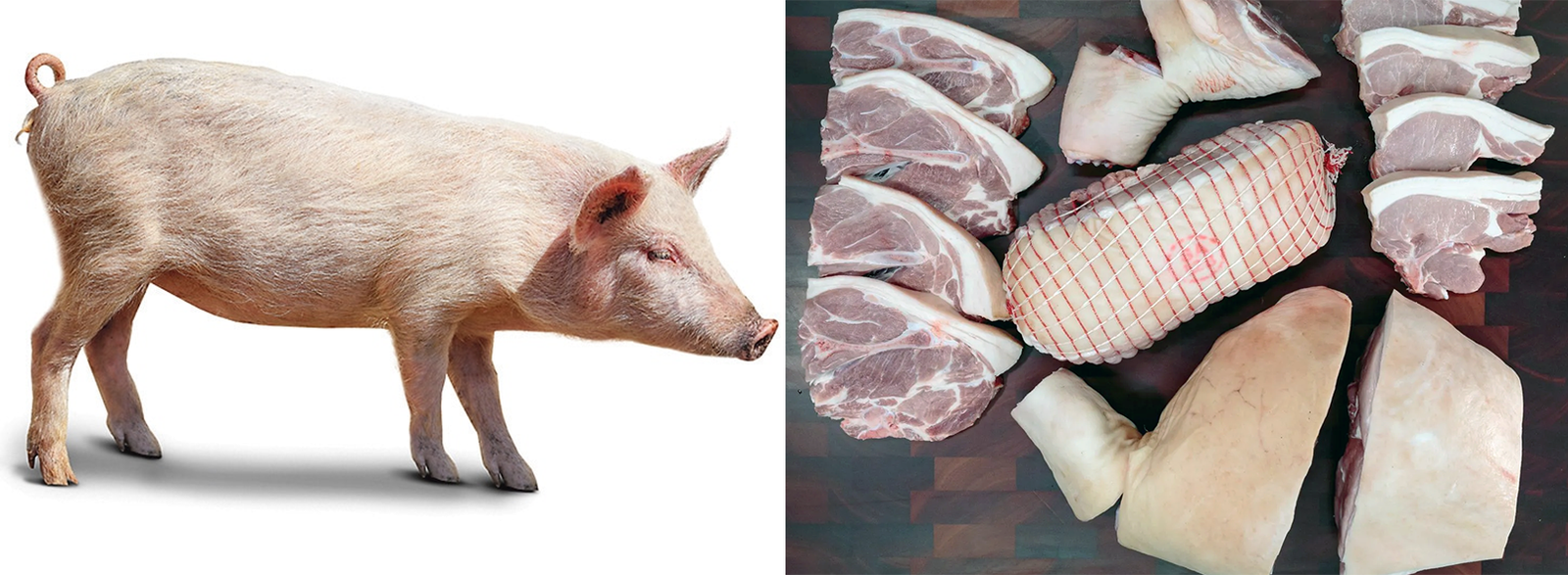 Image of a pig and a selection of pork cuts.
Welcome to FabulousFusionFood's Pork-based Recipes Page — The recipes presented here are all based on pig meat. Pork is the culinary name for the meat of the pig (Sus domesticus). It is the most commonly consumed meat worldwide, with evidence of pig husbandry dating back to 5000 BCE.
Pork is eaten both freshly cooked and preserved; curing extends the shelf life of pork products. Ham, gammon, bacon, and pork sausage are examples of preserved pork. Charcuterie is the branch of cooking devoted to prepared meat products, many from pork.
Pork is eaten both freshly cooked and preserved; curing extends the shelf life of pork products. Ham, gammon, bacon, and pork sausage are examples of preserved pork. Charcuterie is the branch of cooking devoted to prepared meat products, many from pork.
Archaeological evidence shows that pigs were domesticated from wild boar in the Near East in or around the Tigris Basin, being managed in a semi-wild state much as they are managed by some modern New Guineans. There were pigs in Cyprus more than 11,400 years ago, introduced from the mainland, implying domestication in the adjacent mainland by then. Pigs were separately domesticated in China, starting some 8,000 years ago. In the Near East, pig husbandry spread for the next few millennia. It reduced gradually during the Bronze Age, as rural populations instead focused on commodity-producing livestock, but it was sustained in cities.
Domestication did not involve reproductive isolation with population bottlenecks. Western Asian pigs were introduced into Europe, where they crossed with wild boar. There appears to have been interbreeding with a now extinct ghost population of wild pigs during the Pleistocene. The genomes of domestic pigs show strong selection for genes affecting behaviour and morphology. Human selection for domestic traits likely counteracted the homogenizing effect of gene flow from wild boars and created domestication islands in the genome. Pigs arrived in Europe from the Near East at least 8,500 years ago. Over the next 3,000 years they interbred with European wild boar until their genome showed less than 5% Near Eastern ancestry, yet retained their domesticated features.
Cuts of Pork:
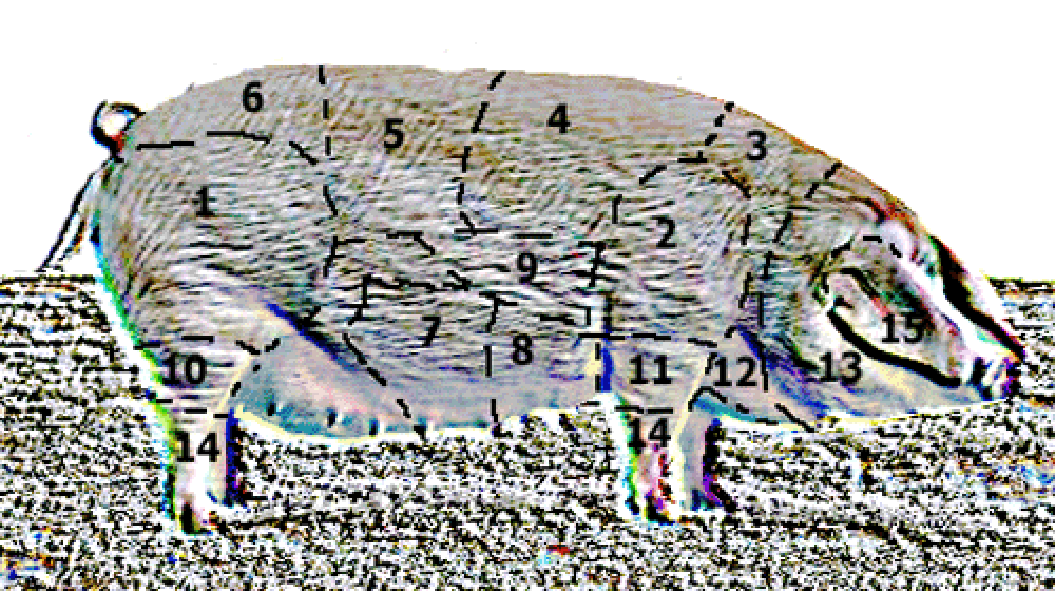 Cuts of Pork:
1 — Ham; typically preserved, boiled or roasted.
2 — Shoulder; typically roasted.
3 — Neck; a more economical cut that can be minced for frying or can be slowly braised.
4 — Spare Rib Rast; for roasting.
5 — Fillet; a tender cut for flash-frying or briefly roasting.
6 — Loin or Chump; a succulent cut for roasting.
7 — Belly; a fatty cut that needs to be slowly roasted or braised, excellent for Chinese braised dishes.
8 — Belly Spare Ribs; excellent for marinating and grilling or barbecuing.
9 — Flank; for roasting or stir-frying.
10 — Hind Leg; a large joint for roasting.
11 — Foreleg; a joint for roasting or steaks.
12 — Throat; for mincing and frying.
13 — Head; for boiling or making brawn.
14 — Trotters; for braising or making jellies.
15 — Ears/Tail; for braising and flavouring other dishes
The alphabetical list of all the pork-based recipes on this site follows, (limited to 100 recipes per page). There are 863 recipes in total:
Page 8 of 9
| Schweineschnitzel (Pork Schnitzels) Origin: Germany | Spaghetti alla Carbonara Origin: Italy | Sumen Plenum (Stuffed Sow's Belly) Origin: Roman |
| Schweinshaxe (Pork Hocks) Origin: Germany | Spaghetti with Duck Egg Carbonara Origin: Britain | Surbraten (Corned Pork) Origin: Germany |
| Scotch Hot Pot Origin: Scotland | Spaghetti with Sun-dried Tomato and Garlic Pesto Origin: Italy | Svinsko S Bel Bob (Pork with Beans) Origin: Bulgaria |
| Scottish Bacon and Potato Pie Origin: Scotland | Spam Fried Rice Origin: Nauru | Sweet and Sour Pork Origin: China |
| Selsig Cymreig Gyda Phinafal (Pigs in Blankets with Pineapple) Origin: Welsh | Spam Kelaguen Origin: Northern Mariana Islands | Székely Gulyas (Székely Goulash) Origin: Hungary |
| Selsyg Kernowek (Cornish Sausages) Origin: England | Spam Kelaguen Origin: Guam | Szalonnas Savanyu K'pszta (Sauerkraut with Bacon) Origin: Hungary |
| Serbian Burek Origin: Serbia | Spam Musubi Origin: Hawaii | Szechuan-style Pork and Pepper Origin: China |
| Sertesporkolt (Pork Porkolt) Origin: Hungary | Spare Ribs, Cabbage, and Sauerkraut Origin: American | Szeged Gulyasz (Pork Goulash with Sauerkraut) Origin: Czech |
| Sesame Pork Stir-fry Origin: Australia | Spareribs in Sweet and Sour Sauce Origin: China | Tacos de Carnitas (Pulled Pork Tacos) Origin: Mexico |
| Sheftalia (Grilled Spiced Meat Rolls) Origin: Cyprus | Speckkartoffel (Potatoes With Bacon) Origin: Germany | Tacos de Carnitas (Pulled Pork Tacos) Origin: Mexico |
| Shi Zi Tou (Lion’s Head Meatballs) Origin: China | Spicy Pork Ribs Origin: Britain | Tagliatelle con gli Stridoli (Tagliatelle with Bladder Campion) Origin: Italy |
| Shredded Pork and Noodle Soup Origin: China | Spicy Szechuan Pork Recipe Origin: China | Tagliatelle con gli Stridoli (Tagliatelle with Bladder Campion) Origin: San Marino |
| Siamban (Jambon) Origin: Ireland | Spring Rolls Origin: Fusion | Tagliatelle with Lucanian Sausage and Porcini Origin: Italy |
| Sic Farcies eam Sepiam Coctam (Stuffed and Cooked Cuttlefish) Origin: Roman | Spring Rolls with Pork and Shrimp Origin: China | Tangy Pork Fillet Origin: Britain |
| Sierra Leonean Pork Fried Rice Origin: Sierra Leone | Srpska Corba ot Graha (Serbian Bean Stew) Origin: Serbia | Tarte a L'oingon (Onion Tart) Origin: Haiti |
| Sierra Leonean Sausage Fried Rice Origin: Sierra Leone | St Lucian Pepper Pot Origin: Saint Lucia | Tarten Cig Moch â Thatws (Bacon and Potato Pie) Origin: Welsh |
| Simboro (Meat with Taro Leaves and Coconut Milk) Origin: Vanuatu | Stamppot (Potato-kale Mash with Sausage) Origin: Netherlands | Tarten Sibolau a Bacwn (Welsh Chipple and Bacon Pie) Origin: Welsh |
| Simple Fried Rice Origin: Zambia | Steamed Spareribs in Black Bean Sauce Origin: China | Tartes de Chare (Pies of Baked Meat) Origin: England |
| Singapore Hokkien Mee Origin: Singapore | Stecen Porc Gyda Caws Llŷn a Saws Bricyll (Pork Steaks with Llŷn Cheese and Apricot Sauce) Origin: Welsh | Tartes of Flesh (Meat Pie) Origin: England |
| Sinigang na Baboy (Pork Sinigang) Origin: Philippines | Stegt Flæsk (Danish Roast Pork with Potatoes and Parsley Sauce) Origin: Denmark | Tartlettes/Tartletes (Tartlets) Origin: England |
| Sint Eustatian Goat Water Origin: Sint Eustatius | Stewed Partridge Origin: Britain | Tatws Popty Porc (Pork and Potatoes in the Oven) Origin: Welsh |
| Sint Maarten Pork Ribs Origin: Sint Maarten | Stewed Pork in Red Sauce Origin: Sao Tome | Tatws Rhost a Bacwn (Baked Sliced Potatoes with Bacon) Origin: Welsh |
| Sisig Origin: Philippines | Stewed Pork with Chickpeas Origin: Fusion | Tchevapchitchi (Bulgarian Minced Meat Croquettes) Origin: Bulgaria |
| Skilpadjie (Afrikaans Faggots) Origin: South Africa | Stewed Venison Origin: British | Teisen Borc (Welsh Pork Cake) Origin: Welsh |
| Slow Cooker Pork Adobo Burritos Origin: Mexico | Sticky Asian-style Pork Neck Chops Origin: Britain | Terrine Hwyaden, Porc a Mafon (Duck, Pork and Raspberry Terrine) Origin: Welsh |
| Slow-Cooker Pork and Apple Curry Origin: America | Stir-fried Pork with Bamboo Shoots Origin: China | Texas-style Pork and Beef Chili Origin: American |
| Soft-wrapped Pork and Prawn Rolls Origin: Fusion | Strozzapreti (Penne Pasta with Cream and Bacon Sauce) Origin: San Marino | Thai Pork Curry in the Burmese Style Origin: Myanmar |
| Somerset Pork with Apples Origin: England | Studenetz (Jellied Ham Hocks) Origin: Ukraine | Tiopu Kuru (Breadfruit Stew) Origin: Cook Islands |
| Sopa de Trigo Origin: Portugal | Stuffed Breadfruit Origin: Dominica | Tjauw Min (Chowmein) Origin: Suriname |
| Sorpotel Origin: India | Stuffed Cabbage Rolls Origin: American | To Cure Back Bacon in the Wiltshire Way Origin: Britain |
| Soupe aux pois et la viande (Pea Soup and Meat) Origin: Guinea-Bissau | Stuffed Chicken Roll-ups Origin: Cornwall | To Cure Hams Origin: Britain |
| Soupe de Porc Fume (Smoked Pork Soup) Origin: Burkina Faso | Stuffed Poussin with Madeira Sauce Origin: Britain | To Dry Pigs' Cheeks Origin: Britain |
| Sour and Spicy Pork with Noodles Origin: China | Succotash Origin: Equatorial Guinea | |
| Souse Origin: Saint Lucia | Suffolk Pickle for Hams Origin: Britain |
Page 8 of 9