FabulousFusionFood's Pork-based Recipes 9th Page
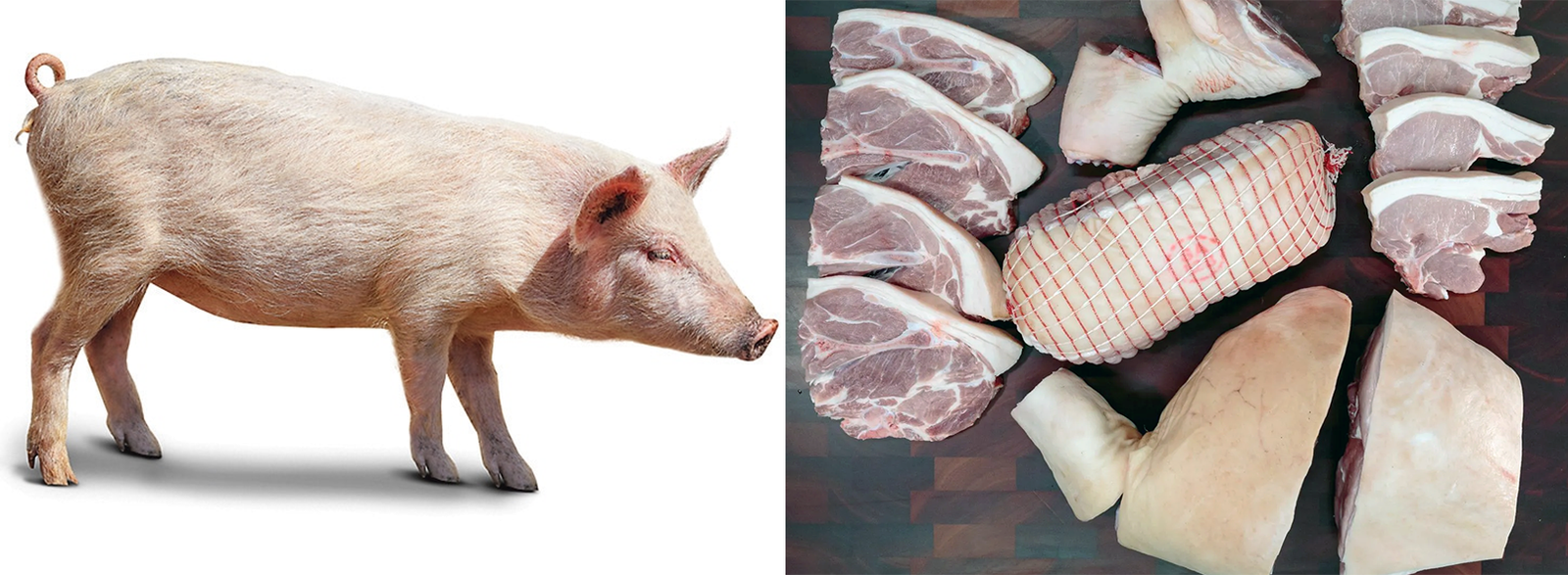 Image of a pig and a selection of pork cuts.
Welcome to FabulousFusionFood's Pork-based Recipes Page — The recipes presented here are all based on pig meat. Pork is the culinary name for the meat of the pig (Sus domesticus). It is the most commonly consumed meat worldwide, with evidence of pig husbandry dating back to 5000 BCE.
Pork is eaten both freshly cooked and preserved; curing extends the shelf life of pork products. Ham, gammon, bacon, and pork sausage are examples of preserved pork. Charcuterie is the branch of cooking devoted to prepared meat products, many from pork.
Pork is eaten both freshly cooked and preserved; curing extends the shelf life of pork products. Ham, gammon, bacon, and pork sausage are examples of preserved pork. Charcuterie is the branch of cooking devoted to prepared meat products, many from pork.
Archaeological evidence shows that pigs were domesticated from wild boar in the Near East in or around the Tigris Basin, being managed in a semi-wild state much as they are managed by some modern New Guineans. There were pigs in Cyprus more than 11,400 years ago, introduced from the mainland, implying domestication in the adjacent mainland by then. Pigs were separately domesticated in China, starting some 8,000 years ago. In the Near East, pig husbandry spread for the next few millennia. It reduced gradually during the Bronze Age, as rural populations instead focused on commodity-producing livestock, but it was sustained in cities.
Domestication did not involve reproductive isolation with population bottlenecks. Western Asian pigs were introduced into Europe, where they crossed with wild boar. There appears to have been interbreeding with a now extinct ghost population of wild pigs during the Pleistocene. The genomes of domestic pigs show strong selection for genes affecting behaviour and morphology. Human selection for domestic traits likely counteracted the homogenizing effect of gene flow from wild boars and created domestication islands in the genome. Pigs arrived in Europe from the Near East at least 8,500 years ago. Over the next 3,000 years they interbred with European wild boar until their genome showed less than 5% Near Eastern ancestry, yet retained their domesticated features.
Cuts of Pork:
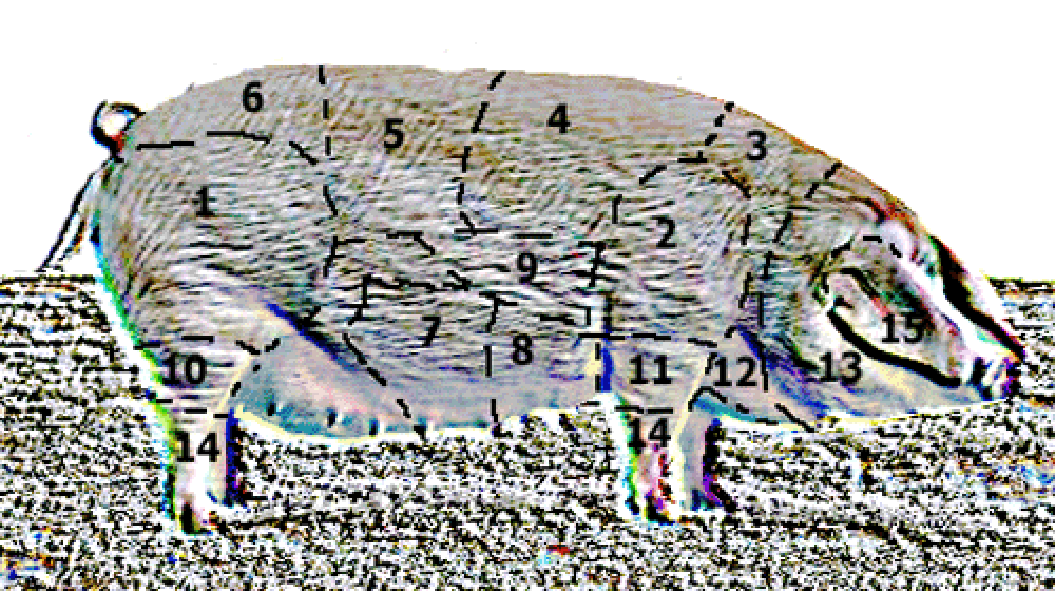 Cuts of Pork:
1 — Ham; typically preserved, boiled or roasted.
2 — Shoulder; typically roasted.
3 — Neck; a more economical cut that can be minced for frying or can be slowly braised.
4 — Spare Rib Rast; for roasting.
5 — Fillet; a tender cut for flash-frying or briefly roasting.
6 — Loin or Chump; a succulent cut for roasting.
7 — Belly; a fatty cut that needs to be slowly roasted or braised, excellent for Chinese braised dishes.
8 — Belly Spare Ribs; excellent for marinating and grilling or barbecuing.
9 — Flank; for roasting or stir-frying.
10 — Hind Leg; a large joint for roasting.
11 — Foreleg; a joint for roasting or steaks.
12 — Throat; for mincing and frying.
13 — Head; for boiling or making brawn.
14 — Trotters; for braising or making jellies.
15 — Ears/Tail; for braising and flavouring other dishes
The alphabetical list of all the pork-based recipes on this site follows, (limited to 100 recipes per page). There are 863 recipes in total:
Page 9 of 9
| To make a Collar of Brawn of a Breast of Pork Origin: Britain | Turks and Caicos Coconut Pie Origin: Turks Caicos | Wet Thar Hin (Pork Curry) Origin: Myanmar |
| To make a Frose Origin: England | Turks and Caicos Jerk Pork Origin: Turks Caicos | Wethani Kyet (Dry Burmese Pork Curry) Origin: Myanmar |
| To Pickle Pork Origin: Britain | Tuscan Sausage Gnocchi Origin: Britain | Wethani Kyet II (Dry Burmese Pork Curry II) Origin: Myanmar |
| To Salt Hams Origin: Britain | Ukrainian Sausage from Lviv Origin: Ukraine | White Curry Origin: Fusion |
| To Sowce a Pigge (Collar of Brawn) Origin: England | Ulster Pasties Origin: Northern Ireland | Whole Chicken Soup Origin: China |
| Toad in the Hole Origin: Britain | Vaca Atolada (Beef Ribs with Cassava) Origin: Brazil | Whole Meat Mould Origin: England |
| Tonkatsu Pork Origin: Japan | Valentine Pork au Poivre Origin: Britain | Wie man zerwúlawirstlach machen soll (How one should make Saveloy) Origin: Germany |
| Torresmo (Brazilian Pork Rinds) Origin: Brazil | Venison Liver Pâté Origin: Britain | Wieprozowina w Smietanie (Baked Pork Chops in Sour Cream) Origin: Poland |
| Torresmo (Portuguese Pork Rinds) Origin: Portugal | Ventrem Plenum (Stuffed Pig's Stomach) Origin: Roman | Wild Mustard Greens with Ham Hocks Origin: American |
| Tourte bretonne (Breton pie) Origin: France | Vepřo Knedlo Zelo (Pork with Sauerkraut and Bread Dumplings) Origin: Czech | Wonton Soup Origin: China |
| Tourtes parmeriennes (Parmesan Pies) Origin: France | Veprove S Krenem (Piquant Pork with Horseradish) Origin: Russia | Wontons Origin: China |
| Tourtière Origin: Canada | Vereshchaka (Pork and Beetroot Casserole) Origin: Russia | Wu Hua Rou (Five-flower Pork) Origin: China |
| Traditional Historic Bobotie Origin: South Africa | Victorian Pickled Vindaloo Origin: Anglo-Indian | Xerem de Festa (A Feast Dish) Origin: Cape Verde |
| Traditional Jerk Pork Origin: Jamaica | Vindaloush with Fungee Origin: Caribbean | Yakisoba Origin: Japan |
| Traditional Pork Pie Origin: Britain | Vine Leaves Stuffed with Fennel, Salami and Eggs Origin: Albania | Yuca con Chicharrón (Cassava with Pork Crackling) Origin: El Salvador |
| Traditional Thai Jungle Curry Origin: Thailand | Vodhino Stfadho (Grilled Pork Cutlets) Origin: Cyprus | Zürcher Eintopf (Zürich Style Hotpot) Origin: Switzerland |
| Travers de Porc Grillé (Barbecued Ribs of Pork) Origin: Mauritius | Vulvae [et] Steriles (Sterile Sow's Womb) Origin: Roman | Zalatina (Pork in Lemon and Vinegar Jelly) Origin: Cyprus |
| Trini Curried Pork Origin: Trinidad | Vulvulae Isiciatae (Forcemeat for Sow's Womb) Origin: Roman | Zalzett Malti (Maltese Sausages) Origin: Malta |
| Trinidadian Fried Wontons Origin: Trinidad | Vyne Grace Origin: England | Zelka Mandza (Macedonian Cabbage Stew) Origin: North Macedonia |
| Trinidadian Pepper Pot Origin: Trinidad | Westmoreland Cure for Sweet Hams Origin: Britain | Zimbabwean Sorpotel Origin: Zimbabwe |
| Trinxat (Cabbage and Potato Cake) Origin: Andorra | Wet Fry Pork, Kenyan Style Origin: Kenya | Zoldbableves (French Bean Soup) Origin: Hungary |
Page 9 of 9