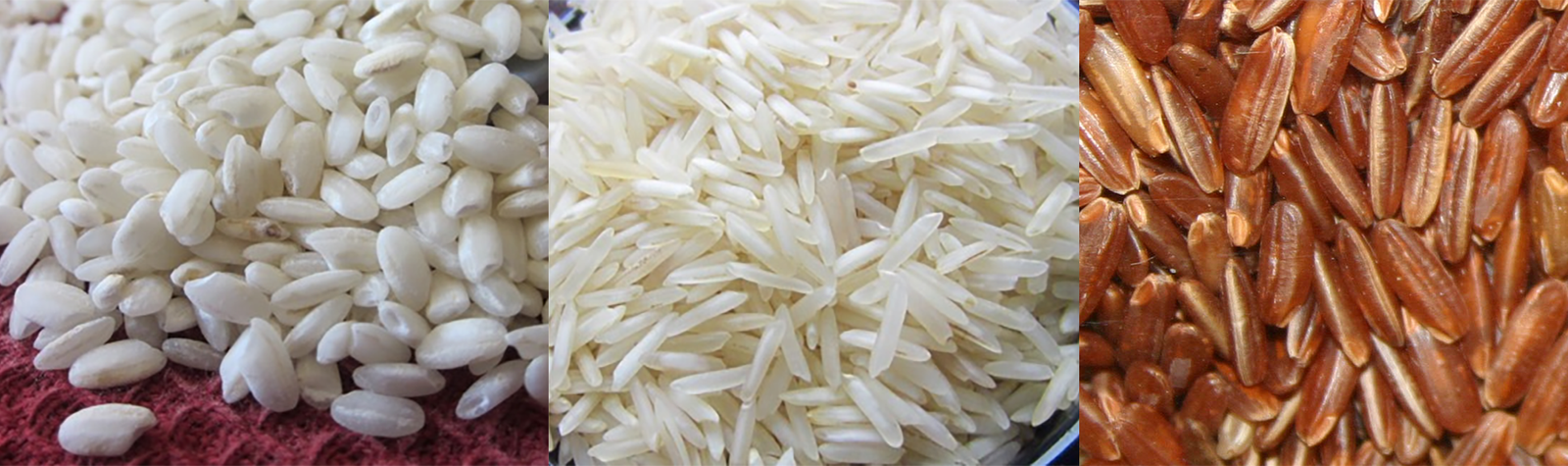
 Grains of Japonica (left), Indica (centre) and Glaberrima (right)
rice.
Welcome to the summary page for FabulousFusionFood's Cook's Guide entry for Rice along with all the recipes employing Rice presented on this site, with 921 recipes in total.
This is a continuation of an entire series of pages that will, I hope, allow my visitors to better navigate this site. As well as displaying recipes by name, country and region of origin I am now planning a whole series of pages where recipes can be located by meal type and main ingredient. This page gives a listing of all the Rice recipes added to this site.
These recipes, all contain Rice as a major wild food ingredient.
Rice is a cereal grain and in its domesticated form is the staple food of over half of the world's population, particularly in Asia and Africa. Rice is the seed of the grass species Oryza sativa (Asian rice)—or, much less commonly, Oryza glaberrima (African rice). Asian rice was domesticated in China some 13,500 to 8,200 years ago; African rice was domesticated in Africa about 3,000 years ago.
Oryza sativa rice was first domesticated in China 9,000 years ago, by people of Neolithic cultures in the Upper and Lower Yangtze, associated with Hmong-Mien-speakers and pre-Austronesians, respectively. The functional allele for nonshattering, the critical indicator of domestication in grains, as well as five other single-nucleotide polymorphisms, is identical in both indica and japonica. This implies a single domestication event for O. sativa. Both indica and japonica forms of Asian rice sprang from a single domestication event in China from the wild rice Oryza rufipogon. Despite this evidence, it appears that indica rice arose when japonica arrived in India about 4,500 years ago and hybridised with another rice, whether an undomesticated proto-indica or wild O. nivara.
Rice was introduced early into Sino-Tibetan cultures in northern China by around 6000 to 5600 years ago, and to the Korean peninsula and Japan by around 5500 to 3200 years ago. It was also carried into Taiwan by the Dapenkeng culture by 5500 to 4000 years ago, before spreading southwards via the Austronesian migrations to Island Southeast Asia, Madagascar, and Guam, but did not survive the voyage to the rest of the Pacific. It reached Austroasiatic and Kra-Dai-speakers in Mainland Southeast Asia and southern China by 5000 years ago.
Rice spread around the rest of the world through cultivation, migration and trade, eventually to the Americas as part of the Columbian exchange after 1492. The now less common Oryza glaberrima (African rice) was independently domesticated in Africa around 3,000 years ago, and introduced to the Americas by the Spanish. Italian Arborio rice is a cultivar of Oryza sativa subsp Japonica.
Dry rice grain is milled to remove the outer layers; depending on how much is removed, products range from brown rice to rice with germ and white rice. Some is parboiled to make it easy to cook. Rice contains no gluten; it provides protein but not all the essential amino acids needed for good health. Rice of different types is eaten around the world. Long-grain rice tends to stay intact on cooking; medium-grain rice is stickier, and is used for sweet dishes, and in Italy for risotto; and sticky short-grain rice is used in Japanese sushi as it keeps its shape when cooked. White rice when cooked contains 29% carbohydrate and 2% protein, with some manganese. Golden rice is a variety produced by genetic engineering to contain vitamin A.
This is a continuation of an entire series of pages that will, I hope, allow my visitors to better navigate this site. As well as displaying recipes by name, country and region of origin I am now planning a whole series of pages where recipes can be located by meal type and main ingredient. This page gives a listing of all the Rice recipes added to this site.
These recipes, all contain Rice as a major wild food ingredient.
Rice is a cereal grain and in its domesticated form is the staple food of over half of the world's population, particularly in Asia and Africa. Rice is the seed of the grass species Oryza sativa (Asian rice)—or, much less commonly, Oryza glaberrima (African rice). Asian rice was domesticated in China some 13,500 to 8,200 years ago; African rice was domesticated in Africa about 3,000 years ago.
Oryza sativa rice was first domesticated in China 9,000 years ago, by people of Neolithic cultures in the Upper and Lower Yangtze, associated with Hmong-Mien-speakers and pre-Austronesians, respectively. The functional allele for nonshattering, the critical indicator of domestication in grains, as well as five other single-nucleotide polymorphisms, is identical in both indica and japonica. This implies a single domestication event for O. sativa. Both indica and japonica forms of Asian rice sprang from a single domestication event in China from the wild rice Oryza rufipogon. Despite this evidence, it appears that indica rice arose when japonica arrived in India about 4,500 years ago and hybridised with another rice, whether an undomesticated proto-indica or wild O. nivara.
Rice was introduced early into Sino-Tibetan cultures in northern China by around 6000 to 5600 years ago, and to the Korean peninsula and Japan by around 5500 to 3200 years ago. It was also carried into Taiwan by the Dapenkeng culture by 5500 to 4000 years ago, before spreading southwards via the Austronesian migrations to Island Southeast Asia, Madagascar, and Guam, but did not survive the voyage to the rest of the Pacific. It reached Austroasiatic and Kra-Dai-speakers in Mainland Southeast Asia and southern China by 5000 years ago.
Rice spread around the rest of the world through cultivation, migration and trade, eventually to the Americas as part of the Columbian exchange after 1492. The now less common Oryza glaberrima (African rice) was independently domesticated in Africa around 3,000 years ago, and introduced to the Americas by the Spanish. Italian Arborio rice is a cultivar of Oryza sativa subsp Japonica.
Dry rice grain is milled to remove the outer layers; depending on how much is removed, products range from brown rice to rice with germ and white rice. Some is parboiled to make it easy to cook. Rice contains no gluten; it provides protein but not all the essential amino acids needed for good health. Rice of different types is eaten around the world. Long-grain rice tends to stay intact on cooking; medium-grain rice is stickier, and is used for sweet dishes, and in Italy for risotto; and sticky short-grain rice is used in Japanese sushi as it keeps its shape when cooked. White rice when cooked contains 29% carbohydrate and 2% protein, with some manganese. Golden rice is a variety produced by genetic engineering to contain vitamin A.
The alphabetical list of all Rice recipes on this site follows, (limited to 100 recipes per page). There are 921 recipes in total:
Page 1 of 10
| A Good Family Soup Origin: British | Arroz con Chorizo (Rice with Chorizo) Origin: Ecuador | Bahamian Crab and Rice Origin: Saint Barthelemy |
| A Potage of Roysons (A Pudding of Raisins) Origin: England | Arroz con Dulce (Puerto Rican Coconut Rice Pudding) Origin: Puerto Rico | Baked Rice Custard Origin: Australia |
| A rice-pudding baked Origin: British | Arroz con Gandules (Puerto Rican Rice and Beans with Sofrito) Origin: Puerto Rico | Baked Rice Pudding with Peanuts Origin: Tanzania |
| A Whitepot Origin: British | Arroz con Leche (Ecuadorian Rice Pudding) Origin: Ecuador | Baked Rice with Mixed Wild Mushrooms Origin: Britain |
| Adas Polo (Rice with Lentils) Origin: Iran | Arroz con Leche Origin: Mexico | Bakwan Jagung (Indonesian Corn Fritters) Origin: Indonesia |
| Ailes de Poulet au Riz et Poivron (Chicken Wings with Rice and Chillies) Origin: Senegal | Arroz con Leche Origin: Uruguay | Banana Akara Origin: Sierra Leone |
| Air Fryer Egg Fried Rice Origin: Britain | Arroz con Leche (Rice with Milk) Origin: Colombia | Bandeja Paisa (Paisa Platter) Origin: Colombia |
| Air Fryer White Rice Origin: Britain | Arroz con leche sin azúcar de absorción rápida (Sweet Rice Pudding, made by Rapid Absorption) Origin: Spain | Bánh đa kê (Sweet Stuffed Rice Crackers) Origin: Vietnam |
| Al Machboos (Emirati Spiced Rice With Chicken) Origin: UAE | Arroz con Pollo (Chicken with Saffron Rice) Origin: Spain | Barbecued Stuffed Tomatoes Origin: Britain |
| Alaisa fa'apopo (Samoan Coconut Rice) Origin: Samoa | Arroz Con Pollo (Costa Rican Arroz con Pollo) Origin: Costa Rica | Bariis iskukari Origin: Djibouti |
| Alaisa fa'apopo (Samoan Coconut Rice) Origin: American Samoa | Arroz con Pollo Guatemalteco (Chicken with Rice, Guatemalan Style) Origin: Guatemala | Bariis Iskukaris Origin: Somaliland |
| Aljota (Fish Soup) Origin: Malta | Arroz Con Pollo Panameño (Panamanian Arroz con Pollo) Origin: Panama | Basanti Pulao (Bengali Pilau Rice) Origin: India |
| Almond Shortbread Origin: Ireland | Arroz de Coco e Papaia (Rice with Coconut and Papaya) Origin: Angola | Basic Cajun Jambalaya Origin: Cajun |
| Amulatum Aliter II (Another Thick Sauce II) Origin: Roman | Arroz de Moringa (Rice with Moringa Leaves) Origin: Mozambique | Basic Dhokla (Basic Steamed Rice and Dhal Cake) Origin: India |
| Anguillan Rice and Peas Origin: Anguilla | Arroz de zanahoria salvadoreño (Salvadorean Carrot Rice) Origin: El Salvador | Basic Jollof Rice Origin: Nigeria |
| Angwa Mo (Ghanaian Rice Pilaf) Origin: Ghana | Arroz doce (Sao Tomean Rice Pudding) Origin: Sao Tome | Basic Microwave Steamed Rice Origin: Britain |
| Antiguan Rice Pudding Origin: Antigua | Arroz Integral com Mantiega de Amendoim e Bananas (Brown Rice with Peanut Mantiega and Bananas) Origin: Angola | Basmati Steamed Rice Origin: Britain |
| Antiguan Seasoned Rice Origin: Antigua | Arroz Negro con Marisco (Black Rice with Seafood) Origin: Spain | Bath Pudding Origin: British |
| Antipasto Rice Origin: Italy | Arroz Rojo (Mexican Red Rice) Origin: Mexico | Beef Burritos Origin: America |
| Apfel-Rosinen Risotto (Apple and Raisin Risotto) Origin: Namibia | Ascension Plo Origin: Ascension | Beef in Bistort Leaves Origin: Britain |
| Appa (Hoppers) Origin: Sri Lanka | Ataanme Nmliche (Tiger Nut Pudding) Origin: Ghana | Beefsteak Mushroom and Hen of the Woods Risotto Origin: Britain |
| Apple Cheesecakes Origin: Ireland | Atadwe Milkye (Silky Tigernut Pudding) Origin: Ghana | Beignet de Riz (Rice Fritters) Origin: Mali |
| Apple Snowballs Origin: British | Aumonières aux pommes et aux marrons (Apple and Chestnut Purses) Origin: France | Beignets de Banane au Lait de Coco (Banana Fritters with Coconut Milk) Origin: Togo |
| Apple Soufflé Origin: British | Authentic Belfast Bap Origin: Northern Ireland | Belizean Rice and Beans Origin: Belize |
| Arancini di Riso (Rice 'Oranges') Origin: Italy | Authentic Gochujang Origin: Korea | Beriani Origin: Brunei |
| Aros di Koko (Coconut Rice) Origin: Dominica | Ayimonlou (Togolese Rice and Beans) Origin: Togo | Bermuda Peas n' Rice Origin: Bermuda |
| Arroz a la Cubana (Cuban-style Rice) Origin: Philippines | Ayimonlou et N'gbagba (Togolese Rice and Beans with N'gbagba) Origin: Togo | Bhuna Kedgeree Origin: Anglo-Indian |
| Arroz al Horno con Perdiz (Baked Rice with Garlic) Origin: Spain | Ayrshire Shortbread Origin: Scotland | Bhuna Khichuri Origin: Bangladesh |
| Arroz Amarillo Con Achiote (Caribbean Yellow Rice) Origin: Cuba | Ayrshire Shortbread II Origin: Scotland | Bhutanese Red Rice Origin: Bhutan |
| Arroz com Camarão (Rice with Prawns) Origin: Brazil | Azerbaijani Plav (Azerbaijani Pilaf) Origin: Azerbaijan | Bhutanese Red Rice Origin: Bhutan |
| Arroz com Mariscos (Rice with Shellfish) Origin: Mozambique | Bánh lọt (Sweet Rice Pasta) Origin: Vietnam | Bibimap (Korean Mixed Rice with Meat and Assorted Vegetables) Origin: Korea |
| Arroz con Calamares (Rice with Squid) Origin: Spain | Baekse Karē (Korean Curry Rice) Origin: Korea | Bibinka (Savoury Coconut Rice Cake) Origin: East Timor |
| Arroz con Camarón (Rice with Prawns) Origin: Ecuador | Baghali Polo (Persian Dill Rice) Origin: Iran | |
| Arroz con Cerdo (Mexican Rice and Pork) Origin: Mexico | Baghali Shevid Polow (Lima Bean with Dill Rice) Origin: Iran |
Page 1 of 10