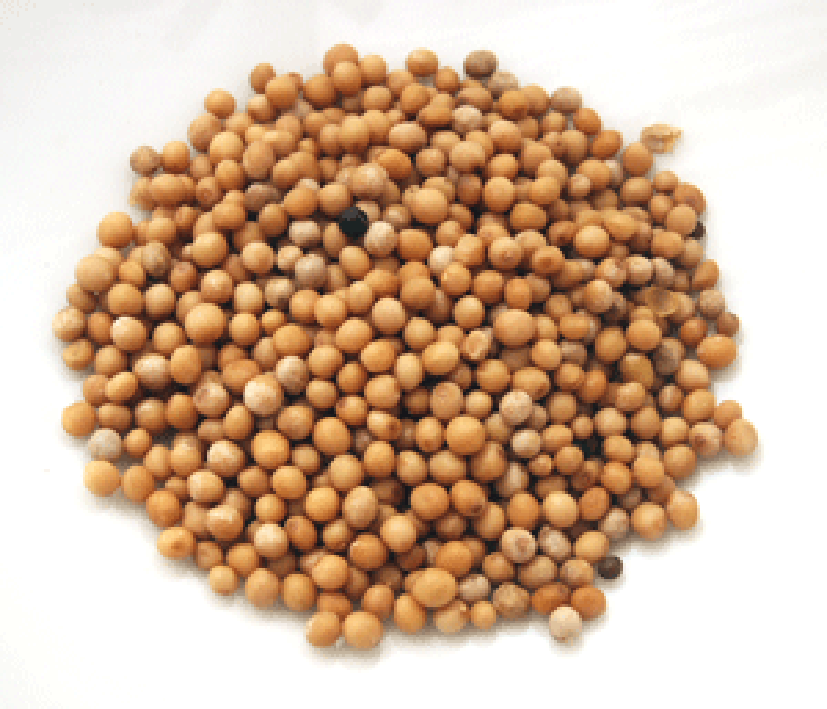
 Pile of white mustard seeds.
Welcome to the summary page for FabulousFusionFood's Cook's Guide entry for Mustard Seeds along with all the trcipes employing Mustard Seeds presented on this site, with 300 recipes in total.
This is a continuation of an entire series of pages that will, I hope, allow my visitors to better navigate this site. As well as displaying recipes by name, country and region of origin I am now planning a whole series of pages where recipes can be located by meal type and main ingredient. This page gives a listing of all the Mustard Seeds recipes added to this site.
These recipes, all contain Mustard Seeds as a major wild food ingredient.
Mustard seeds are the seeds of several plant species (all related to rapeseed) that produce seeds which are used as a spice. They are members of the Brassica family that includes broccoli, cauliflower, cabbage, kale and swedes. The green parts of many mustard plants are eaten as 'mustard greens'.
Mild white mustard (Brassica hirta) grows wild in North Africa, the Middle East and Mediterranean Europe and has spread farther by long cultivation (in Northern Europe early wild forms of Brassica rapa were probably used for their seeds which had a more mustard-like taste and less oil than modern cultivars as evidenced by the presence of their seeds in many neolithic burials); brown or Indian mustard (B. juncea), originally from the foothills of the Himalaya, is grown commercially in the UK, Canada and the US; black mustard (B. nigra) in Argentina, Chile, the US and some European countries.
Mustard seeds can be fried in oil until the seeds 'pop', yielding a flavoured oil, as is done in Indian cuisine. The seeds can also be ground and added to stews and meat dishes. In the west, the most common use of mustard seed is in the form of a prepared mustard condiment. This is made by mixing mustard powder with a liquid such as water, wine, honey or even milk to form the paste. The 'heat' of such mustards being reduced by mixing the ground mustard with flour. This kind of condiment was probably first prepared by the Romans who mixed ground mustard with unfermented grape juice to produce mustum ardens (burning must). As one of the few hot spices native to Europe mustards were very commonly used during the Medieval and Elizabethan periods, as exemplified by this recipe for Collar of Brawn and Mustard.
This is a continuation of an entire series of pages that will, I hope, allow my visitors to better navigate this site. As well as displaying recipes by name, country and region of origin I am now planning a whole series of pages where recipes can be located by meal type and main ingredient. This page gives a listing of all the Mustard Seeds recipes added to this site.
These recipes, all contain Mustard Seeds as a major wild food ingredient.
Mustard seeds are the seeds of several plant species (all related to rapeseed) that produce seeds which are used as a spice. They are members of the Brassica family that includes broccoli, cauliflower, cabbage, kale and swedes. The green parts of many mustard plants are eaten as 'mustard greens'.
Mild white mustard (Brassica hirta) grows wild in North Africa, the Middle East and Mediterranean Europe and has spread farther by long cultivation (in Northern Europe early wild forms of Brassica rapa were probably used for their seeds which had a more mustard-like taste and less oil than modern cultivars as evidenced by the presence of their seeds in many neolithic burials); brown or Indian mustard (B. juncea), originally from the foothills of the Himalaya, is grown commercially in the UK, Canada and the US; black mustard (B. nigra) in Argentina, Chile, the US and some European countries.
Mustard seeds can be fried in oil until the seeds 'pop', yielding a flavoured oil, as is done in Indian cuisine. The seeds can also be ground and added to stews and meat dishes. In the west, the most common use of mustard seed is in the form of a prepared mustard condiment. This is made by mixing mustard powder with a liquid such as water, wine, honey or even milk to form the paste. The 'heat' of such mustards being reduced by mixing the ground mustard with flour. This kind of condiment was probably first prepared by the Romans who mixed ground mustard with unfermented grape juice to produce mustum ardens (burning must). As one of the few hot spices native to Europe mustards were very commonly used during the Medieval and Elizabethan periods, as exemplified by this recipe for Collar of Brawn and Mustard.
The alphabetical list of all Mustard Seeds recipes on this site follows, (limited to 100 recipes per page). There are 300 recipes in total:
Page 1 of 4
| Achari Masala Origin: India | Black Mustard Dumplings Origin: Britain | Colombo Curry Paste Origin: Martinique |
| African Fish Curry Powder Origin: West Africa | Bo-Kaap Kerrie Poeier (Cape Malay Curry Powder) Origin: South Africa | Cornish Sole Curry with Cauliflower Rice Origin: England |
| Aliter Fabaciae (Green Beans, Another Way) Origin: Roman | Boiled Collar of Bacon with Creamy Mustard Sauce Origin: Ireland | Creole Mustard Origin: Louisiana |
| Aliter in Grue vel Qnate Elixa (Sauce for Boiled Crane or Duck, Another Way II) Origin: Roman | Bombay Aloo (Bombay Potatoes) Origin: Britain | Crockpot Corned Beef and Cabbage Origin: Ireland |
| Aliter Ius Frigidum in Aprum Elixum (Cold Sauce for Boiled Wild Boar, Another Way) Origin: Roman | Bombay Egg and Potato Curry Origin: Anglo-Indian | Curried Wild Mustard Greens with Beans Origin: Fusion |
| Aliter Leporem Conditum (Another, Seasoned Hare) Origin: Roman | Bombay Potatoes Origin: India | Daal and Vegetable Bhuna Origin: Britain |
| Alleppey Fish Curry Origin: India | Bonnie Prince Pudding Origin: Scotland | Dal Tadka (Lentil Curry, Restaurant Style) Origin: India |
| Aloo Bhaji Origin: India | Bottle Masala Origin: India | Dal Takda (Lentil Curry, Restaurant Style) Origin: India |
| Aloo Gobi Origin: Britain | Brine-pickled Himalayan Balsam Pods Origin: American | Dhal with Hogweed Shoots Origin: Britain |
| Aloo Masala (Potato Masala) Origin: India | Brine-pickled Radish Pods Origin: American | Dominica Colombo Curry Powder Origin: Dominica |
| Aloo Palya (Potato Curry) Origin: India | Burdock Flower Stem Gobi Origin: Britain | Durban Fish Curry Origin: South Africa |
| Alu Bhindi (Okra and Potato Curry) Origin: Fiji | Burdock Pickles Origin: Britain | Durban-style Watermelon Rind Curry Origin: South Africa |
| Alu Kesel (Sri Lankan Ash Plantain Curry) Origin: Sri Lanka | Bygan Dhal Origin: India | Egg Masala Origin: India |
| Am Ke Achar (Fijian Mango Pickle) Origin: Fiji | Cajun Blackening Spices Origin: Cajun | Elumas Curry (Mutton Curry) Origin: Sri Lanka |
| Amba Sauce Origin: Israel | Cape Curry Powder Origin: South Africa | Fijian Chicken and Potato Curry Origin: Fiji |
| Amchar Masala Origin: Trinidad | Cari (Vietnamese Curry Powder) Origin: Vietnam | Fijian Chicken Curry Origin: Fiji |
| Andhra Pappu Charu (Andhra-style Lentil Puree Curry) Origin: India | Carrot Rice Origin: India | Fijian Chicken Palau Origin: Fiji |
| Antiguan Curry Powder Origin: Antigua | Carrot Sambharo (Gujarati Carrot Salad) Origin: India | Fijian Crab Curry Origin: Fiji |
| Aruba Curry Powder Origin: Aruba | Catwad Ffa Dringo (Runner Bean Chutney) Origin: Welsh | Fijian Goat Curry Origin: Fiji |
| Ash Gourd Coconut Curry Origin: India | Catwad Pwmpen (Marrow Chutney) Origin: Welsh | Fijian Goat Curry 2 Origin: Fiji |
| Assam Fish Curry Origin: Malaysia | Cayman Curry Powder Origin: Cayman Islands | Fijian Khatar (Jackfruit Curry) Origin: Fiji |
| Atchar Origin: Southern Africa | Celtic Pork and Apple Stew Origin: Ancient | Fijian Suruwa (Fijian Fish Curry) Origin: Fiji |
| Badanekaayi Gojju (Brinjal Curry) Origin: India | Chemmeen Achar (Kerala-style Pickled Prawns) Origin: Britain | Filipino Yellow Curry Powder Origin: Philippines |
| Balti Tandoori Keema Origin: Britain | Chemmeen Manga Curry (Prawn and Mango Curry) Origin: India | Fish Molee (Keralan Fish Stew) Origin: India |
| Bangladeshi Vindaloo Origin: Britain | Chemmen Roast (Kerala Prawn Roast) Origin: India | Fragrant Fijian Chicken Curry Origin: Fiji |
| Basic Dhokla (Basic Steamed Rice and Dhal Cake) Origin: India | Chertha kozhi kari (Chicken and Cashew Nut Curry) Origin: India | Frankfurter Sausage Origin: Germany |
| Beef Koftas with Fruity Couscous Origin: Morocco | Cherupayar Curry (Whole Green Lentil Curry) Origin: India | Ga Lei Fan (Chinese Yellow Curry Powder) Origin: China |
| Beef Madras Origin: India | Chicken 65 Curry Origin: Britain | Garlic Mustard Greens Bhutuwa Origin: Fusion |
| Beetroot Sabzi (Beetroot Curry) Origin: India | Chicken Balti Origin: Britain | Gepekelde Haring (Soused Herring) Origin: Netherlands |
| Beetroot-stuffed Parathas Origin: India | Chicken Chana Dhal (Chicken with Lentils) Origin: India | Ghanaian Curry Powder Origin: Ghana |
| Bengali Fish Curry Origin: India | Chickpea, Spinach and Egg Curry Origin: Britain | Goan Curry Paste Origin: Anglo-Indian |
| Bermuda Curry Powder Origin: Bermuda | Classic Vindaloo Curry Origin: India | Goan Lamb Xacutti Origin: India |
| Bermuda Rockfish Coconut Curry Origin: Bermuda | Coconut Chutney Origin: India | |
| Black Curry Powder Origin: Sri Lanka | Cod with Mustard Sauce Origin: Scotland |
Page 1 of 4