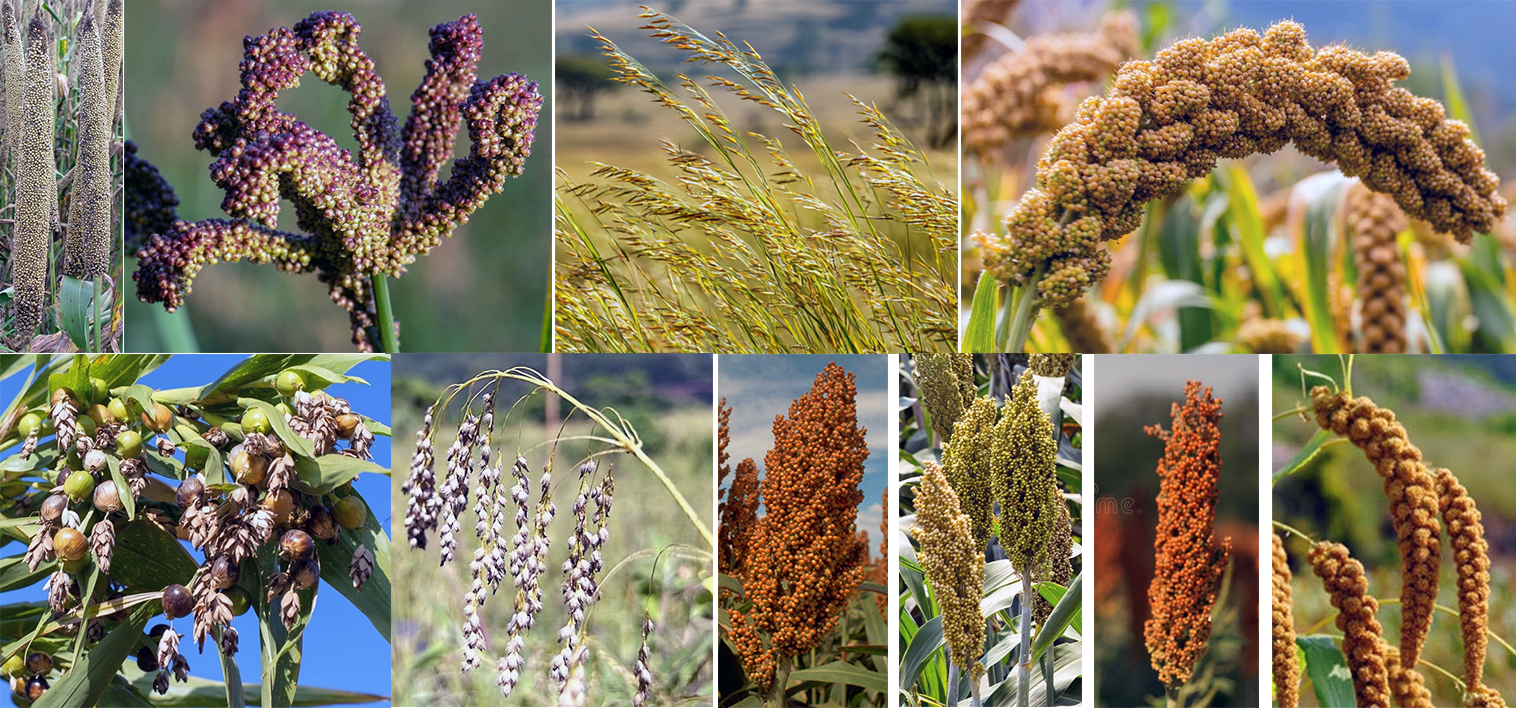
 The image above shows the seed heads from 10 millet species,
clockwise from top left: Pearl millet, Cenchrus
americanus; Finger millet, Eleusine coracana; Teff,
Eragrostis teff; Proso millet Panicum
millaceum; Foxtail millet Setaria italica; Japanese
barnyard millet, Echinochloa esculenta; Browntop millet,
Urochloa ramosa; Great millet/Sorghum, Sorghum
bicolor; Taiwan oil millet, Spodiopogon formosanus;
Jacob's tears, Coix lacryma-jobi..
Welcome to the summary page for FabulousFusionFood's Cook's Guide entry for Millet along with all the recipes employing Millet presented on this site, with 88 recipes in total.
This is a continuation of an entire series of pages that will, I hope, allow my visitors to better navigate this site. As well as displaying recipes by name, country and region of origin I am now planning a whole series of pages where recipes can be located by meal type and main ingredient. This page gives a listing of all the Millet recipes added to this site.
These recipes, all contain Millet as a major wild food ingredient.
Millets represent a diverse and highly varied group of small-seeded grasses, widely grown around the world as cereal crops or grains for fodder and human food. Millets are true grasses and members of the PACMAD clade (they are sisters to the BOP clade which contains the rices wheats, barley and oats). Most millets belong to the Panicoideae subfamily with a few in the Chloridoideae subfamily. They are small-grained, annual, warm-weather cereals belonging to the grass family. They are highly tolerant of drought and other extreme weather conditions and have a similar nutrient content to other major cereals.
In terms of human nutrition, millets are important crops in the semi-arid tropics of Asia and Africa, especially in India, Mali, Nigeria, and Niger, with 97% of production in developing countries. The crop is favoured for its productivity and short growing season under hot dry conditions. The millets are sometimes understood to include the widely cultivated sorghum; apart from that, pearl millet is the most commonly cultivated of the millet.
Millets are also probably one of the first grains foraged by human hunter-gatherers. They may also be amongst the first grains purposely farmed by humans. They appear to have been consumed by humans for about 7,000 years and potentially had "a pivotal role in the rise of multi-crop agriculture and settled farming societies". Evidence of their use dates back to ancient civilizations such as those of China and India. Over time, millets have spread to other regions, including Africa, Europe, and the Americas, where they have been adapted to suit local growing conditions and culinary traditions. Current archaeobotanical evidence has demonstrated that foxtail millet (Setaria italica) and broomcorn millet (Panicum miliaceum) were both cultivated in northern China no later than
8000 cal. BP. Millets were also cultivated in Africa, the Middle East, and Europe around the same time. These early farmers discovered that millets were easy to
grow, had a short growing cycle, and could be stored for a long time. They also found that millets were highly nutritious and could sustain human life for extended periods.
In Africa, millets remain an important food source, mainly in the Sahel region where they are a staple crop. Millets are also grown in other parts of Africa. Tef and fonio are among those millets that were domesticated in the African continent and are still grown there almost exclusively, where teff, a type of millet, is used to make injera, a sourdough flatbread that is a national dish, and Fonio is considered to be the oldest West African cereal and its cultivation is thought to date back to 5000 BCE.
The word millet is derived via Old French millet, millot from Latin millium, 'millet', ultimately from the proto-Indo-European root *mele-, 'to crush'.
Taxonomy: The different species of millets are not all closely related. All are members of the family Poaceae (the grasses), but they belong to different tribes and subfamilies. Commonly cultivated millets are:
Eragrostideae tribe in the subfamily Chloridoideae:
Eleusine coracana: Finger millet
Eragrostis tef: Teff (often not considered to be a millet)
Paniceae tribe in the subfamily Panicoideae:
Genus Panicum:
Panicum miliaceum: Proso millet (common millet, broomcorn millet, hog millet, or white millet, also known as baragu in Kannada, panivaragu in Tamil)
Panicum sumatrense: Little millet
Panicum hirticaule: Sonoran millet, cultivated in the American Southwest
Cenchrus americanus: Pearl millet
Setaria italica: Foxtail millet, Italian millet, panic
Genus Digitaria: of minor importance as crops
Digitaria exilis: known as white fonio, fonio millet, and hungry rice or acha rice
Digitaria iburua: Black fonio
Digitaria compacta: Raishan, cultivated in the Khasi Hills of northeast India
Digitaria sanguinalis: Polish millet
Genus Echinochloa: collectively, the members of this genus are called barnyard grasses or barnyard millets
Echinochloa esculenta: Japanese barnyard millet
Echinochloa frumentacea: Indian barnyard millet
Echinochloa stagnina: Burgu millet
Echinochloa crus-galli: Common barnyard grass (or cockspur grass)
Paspalum scrobiculatum: Kodo millet
Genus Urochloa (formerly Brachiaria)
Urochloa deflexa: Guinea millet
Urochloa ramosa: Browntop millet, southern India
Spodiopogon formosanus: Taiwan oil millet, endemic to Taiwan
Andropogoneae tribe, also in the subfamily Panicoideae:
Sorghum bicolor: Sorghum; usually considered a separate cereal, but sometimes known as great millet
Coix lacryma-jobi: Job's tears, also known as adlay millet
Per capita consumption of millets as food varies in different parts of the world, with consumption being the highest in Western Africa. Millet has local significance as a food in parts of some countries, such as China, India, Burma and North Korea.
Millet is a staple in the Sahel region of Africa, accounting for a large portion of total cereal food consumption in Burkina Faso, Chad and the Gambia. It can be ground and mixed with milk to make fura and brukina. Countries in Africa where millets are a major food source include Niger and Namibia where it forms over 65% of the cereals eaten; it is significant, too, in Mali, Senegal, Ethiopia, Nigeria and Uganda. Millet is important in the drier parts of many other countries, especially in eastern and central Africa, and in the northern coastal countries of western Africa. Fermented beverages are made with millet in the same regions.
In Ukraine, millet was historically a common ingredient in the diet of the Zaporozhian Cossacks, in the form of a porridge called kulish. This dish, primarily made with millet, served with stewed vegetables and meat, cooked in a cauldron, remains a part of modern Ukrainian cuisine. In Germany, it is eaten sweet, for example with milk and berries for breakfast. In Russia, millet porridge also remains common and is promoted for its health benefits. Millet porridge made with pumpkin is particularly common. In the Lipetsk Oblast, ritual and daily meals from millet include chichi (Russian: чичи), which are millet fritters.
Millet is commonly eaten in India and usually incorporated into dishes as a flour, although consumption is declining. In Karnataka, India, finger millet is made into ragi rotti flatbread and ragi mudde dough lumps. In the Himalayas, including in Nepal, Sikkim, and Darjeeling, millet is fermented into alcoholic beverages such as tongba and raksi. Millet is the main ingredient in bánh đa kê, a Vietnamese sweet snack. It contains a layer of smashed millet and mung bean topped with sliced dried coconut meat wrapped in a crunchy rice cake.
Note that the small grain millet, fonio is excluded from the list of recipes given below as fonio has its own page in this glossary.
This is a continuation of an entire series of pages that will, I hope, allow my visitors to better navigate this site. As well as displaying recipes by name, country and region of origin I am now planning a whole series of pages where recipes can be located by meal type and main ingredient. This page gives a listing of all the Millet recipes added to this site.
These recipes, all contain Millet as a major wild food ingredient.
Millets represent a diverse and highly varied group of small-seeded grasses, widely grown around the world as cereal crops or grains for fodder and human food. Millets are true grasses and members of the PACMAD clade (they are sisters to the BOP clade which contains the rices wheats, barley and oats). Most millets belong to the Panicoideae subfamily with a few in the Chloridoideae subfamily. They are small-grained, annual, warm-weather cereals belonging to the grass family. They are highly tolerant of drought and other extreme weather conditions and have a similar nutrient content to other major cereals.
In terms of human nutrition, millets are important crops in the semi-arid tropics of Asia and Africa, especially in India, Mali, Nigeria, and Niger, with 97% of production in developing countries. The crop is favoured for its productivity and short growing season under hot dry conditions. The millets are sometimes understood to include the widely cultivated sorghum; apart from that, pearl millet is the most commonly cultivated of the millet.
Millets are also probably one of the first grains foraged by human hunter-gatherers. They may also be amongst the first grains purposely farmed by humans. They appear to have been consumed by humans for about 7,000 years and potentially had "a pivotal role in the rise of multi-crop agriculture and settled farming societies". Evidence of their use dates back to ancient civilizations such as those of China and India. Over time, millets have spread to other regions, including Africa, Europe, and the Americas, where they have been adapted to suit local growing conditions and culinary traditions. Current archaeobotanical evidence has demonstrated that foxtail millet (Setaria italica) and broomcorn millet (Panicum miliaceum) were both cultivated in northern China no later than
8000 cal. BP. Millets were also cultivated in Africa, the Middle East, and Europe around the same time. These early farmers discovered that millets were easy to
grow, had a short growing cycle, and could be stored for a long time. They also found that millets were highly nutritious and could sustain human life for extended periods.
In Africa, millets remain an important food source, mainly in the Sahel region where they are a staple crop. Millets are also grown in other parts of Africa. Tef and fonio are among those millets that were domesticated in the African continent and are still grown there almost exclusively, where teff, a type of millet, is used to make injera, a sourdough flatbread that is a national dish, and Fonio is considered to be the oldest West African cereal and its cultivation is thought to date back to 5000 BCE.
The word millet is derived via Old French millet, millot from Latin millium, 'millet', ultimately from the proto-Indo-European root *mele-, 'to crush'.
Taxonomy: The different species of millets are not all closely related. All are members of the family Poaceae (the grasses), but they belong to different tribes and subfamilies. Commonly cultivated millets are:
Eragrostideae tribe in the subfamily Chloridoideae:
Eleusine coracana: Finger millet
Eragrostis tef: Teff (often not considered to be a millet)
Paniceae tribe in the subfamily Panicoideae:
Genus Panicum:
Panicum miliaceum: Proso millet (common millet, broomcorn millet, hog millet, or white millet, also known as baragu in Kannada, panivaragu in Tamil)
Panicum sumatrense: Little millet
Panicum hirticaule: Sonoran millet, cultivated in the American Southwest
Cenchrus americanus: Pearl millet
Setaria italica: Foxtail millet, Italian millet, panic
Genus Digitaria: of minor importance as crops
Digitaria exilis: known as white fonio, fonio millet, and hungry rice or acha rice
Digitaria iburua: Black fonio
Digitaria compacta: Raishan, cultivated in the Khasi Hills of northeast India
Digitaria sanguinalis: Polish millet
Genus Echinochloa: collectively, the members of this genus are called barnyard grasses or barnyard millets
Echinochloa esculenta: Japanese barnyard millet
Echinochloa frumentacea: Indian barnyard millet
Echinochloa stagnina: Burgu millet
Echinochloa crus-galli: Common barnyard grass (or cockspur grass)
Paspalum scrobiculatum: Kodo millet
Genus Urochloa (formerly Brachiaria)
Urochloa deflexa: Guinea millet
Urochloa ramosa: Browntop millet, southern India
Spodiopogon formosanus: Taiwan oil millet, endemic to Taiwan
Andropogoneae tribe, also in the subfamily Panicoideae:
Sorghum bicolor: Sorghum; usually considered a separate cereal, but sometimes known as great millet
Coix lacryma-jobi: Job's tears, also known as adlay millet
Per capita consumption of millets as food varies in different parts of the world, with consumption being the highest in Western Africa. Millet has local significance as a food in parts of some countries, such as China, India, Burma and North Korea.
Millet is a staple in the Sahel region of Africa, accounting for a large portion of total cereal food consumption in Burkina Faso, Chad and the Gambia. It can be ground and mixed with milk to make fura and brukina. Countries in Africa where millets are a major food source include Niger and Namibia where it forms over 65% of the cereals eaten; it is significant, too, in Mali, Senegal, Ethiopia, Nigeria and Uganda. Millet is important in the drier parts of many other countries, especially in eastern and central Africa, and in the northern coastal countries of western Africa. Fermented beverages are made with millet in the same regions.
In Ukraine, millet was historically a common ingredient in the diet of the Zaporozhian Cossacks, in the form of a porridge called kulish. This dish, primarily made with millet, served with stewed vegetables and meat, cooked in a cauldron, remains a part of modern Ukrainian cuisine. In Germany, it is eaten sweet, for example with milk and berries for breakfast. In Russia, millet porridge also remains common and is promoted for its health benefits. Millet porridge made with pumpkin is particularly common. In the Lipetsk Oblast, ritual and daily meals from millet include chichi (Russian: чичи), which are millet fritters.
Millet is commonly eaten in India and usually incorporated into dishes as a flour, although consumption is declining. In Karnataka, India, finger millet is made into ragi rotti flatbread and ragi mudde dough lumps. In the Himalayas, including in Nepal, Sikkim, and Darjeeling, millet is fermented into alcoholic beverages such as tongba and raksi. Millet is the main ingredient in bánh đa kê, a Vietnamese sweet snack. It contains a layer of smashed millet and mung bean topped with sliced dried coconut meat wrapped in a crunchy rice cake.
Note that the small grain millet, fonio is excluded from the list of recipes given below as fonio has its own page in this glossary.
The alphabetical list of all Millet recipes on this site follows, (limited to 100 recipes per page). There are 88 recipes in total:
Page 1 of 1
| Asida Origin: Sudan-a | Kunu Zaki (Millet Kunu Drink) Origin: Nigeria | Oshigali (Namibian Fermented Millet Porridge) Origin: Namibia |
| Awaoktoshi (Candied Puffed Millet) Origin: Japan | La Bouille du Tchad (Chadian Porridge) Origin: Chad | Ouaddaï (Fried Millet Dough) Origin: Chad |
| Bagobe Jwa Lerotse (Sorghum Porridge with Cooking Melons) Origin: Botswana | La Bouillie Origin: Chad | Panis cum Milo Fermento (Bread with Millet Leaven) Origin: Roman |
| Bajra Roti (Pearl Millet Flatbread) Origin: India | Lahooh Origin: Somalia | Pressure Cooker Steamed Millet Bread Origin: Britain |
| Bajra Roti (Pearl Millet Roti) Origin: India | Lahooh Origin: Yemen | Puffed Millet Origin: America |
| Baked Millet Biscuits Origin: Kenya | Lakh Origin: Senegal | Rabdi (Rajasthani Pearl Millet Drink) Origin: India |
| Baked Millet Flour Bread Origin: Kenya | Lakh (Sweet Millet Porridge) Origin: Senegal | Ragi Rava Ladoo Origin: India |
| Bánh đa kê (Sweet Stuffed Rice Crackers) Origin: Vietnam | Lakh Mauritanienne Origin: Mauritania | Ragi Roti Origin: India |
| Beignets Dougoub (Puffed Millet Doughnuts) Origin: Senegal | Lakhou bissap Origin: Senegal | Red Millet Asida (Brown Ugali) Origin: Uganda |
| Black Mustard Leaves, Tricorn Leek and Millet Origin: Fusion | Laxoox Origin: Djibouti | Rwandan Porridge Origin: Rwanda |
| Bouillie de Mil (Millet Porridge) Origin: Togo | Laxoox Origin: Somaliland | Süßer Hirsebrei (Sweet Millet Porridge) Origin: Namibia |
| Brabusko Origin: Niger | Laxoox/Canjeero (Sorghum Bread) Origin: Somalia | Sadza reZviyo (Finger Millet Pap) Origin: Zimbabwe |
| Breakfast Ting Origin: Botswana | Le Ouaddaï (Fried Millet Fingers) Origin: Chad | Salone-style Kibbeh Origin: Sierra Leone |
| Burundi Ugali Origin: Burundi | Le Tô Sauce Gombos (Tô with Okra Sauce) Origin: Burkina Faso | Sattoo Origin: India |
| Cambaabur Origin: Djibouti | Leksour (Mauritanian-style Pancakes with Sauce) Origin: Mauritania | Senegalese Vegetable Stew with Millet Origin: Senegal |
| Cambaabur Origin: Somalia | Leksour (Lamb Stew on Millet Pancakes) Origin: Mauritania | Steamed Millet Bread Origin: Kenya |
| Cherchem Origin: Mauritania | Maasa (Sweet Millet Fritters) Origin: Mali | Tô Origin: Burkina Faso |
| Chichi (Millet Fritters) Origin: Russia | Massa (Mini Millet Pancakes) Origin: Burkina Faso | Teff Injeera Origin: Ethiopia |
| Déguè II Origin: Senegal | Medeeda (Finger Millet Porridge with Yoghurt) Origin: Sudan-a | Thiéré Bassi (Millet Couscous Stew) Origin: Senegal |
| Dhido (Nepali Buckwheat Porridge) Origin: Nepal | Meichowski Krupnik na Serwatce (Polish Whey-millet Soup) Origin: Poland | Thiakry Origin: Guinea |
| Dundu Oniyeri Origin: Nigeria | Miechowski Krupnik na Serwatce (Miechowski Whey-millet Soup) Origin: Poland | Thiéré ak sow Origin: Senegal |
| Feuilles de Consoude Farcies (Stuffed Comfrey Leaves) Origin: France | Millet and Pumpkin Kasha Origin: Russia | Ting Origin: Botswana |
| Fondé de Mil (Millet Porridge) Origin: Senegal | Mohoto (Fermented Sorghum Porridge) Origin: Lesotho | Tomoso (Lesothan Fermentation Starter) Origin: Lesotho |
| Foubey (Millet Couscous with Moringa) Origin: Niger | Mopane Worms and Sorghum Porridge Origin: Botswana | Touwo Labchi (Millet Porridge) Origin: Niger |
| Fulani Boullie Origin: Central African Republic | Multi-grain Mix Origin: American | Tuwo Dawa (Sorghum Porridge) Origin: Nigeria |
| Funkaso (Millet Pancakes) Origin: Nigeria | Mushaari Origin: Somaliland | Ugali Origin: East Africa |
| Fura Gero da Nono Origin: Nigeria | Nyekoe (Lesotho Sorghum and Beans) Origin: Lesotho | West African Couscous Origin: West Africa |
| Imbila (Sour Porridge) Origin: South Africa | Ogi Origin: West Africa | Zviyo (Millet Porridge) Origin: Zimbabwe |
| Jowar Roti Origin: India | Omajova-Pilz-Ragout mit Hirse (Omajova Mushroom Ragout with Millet) Origin: Namibia | |
| Kulish Origin: Ukraine |
Page 1 of 1