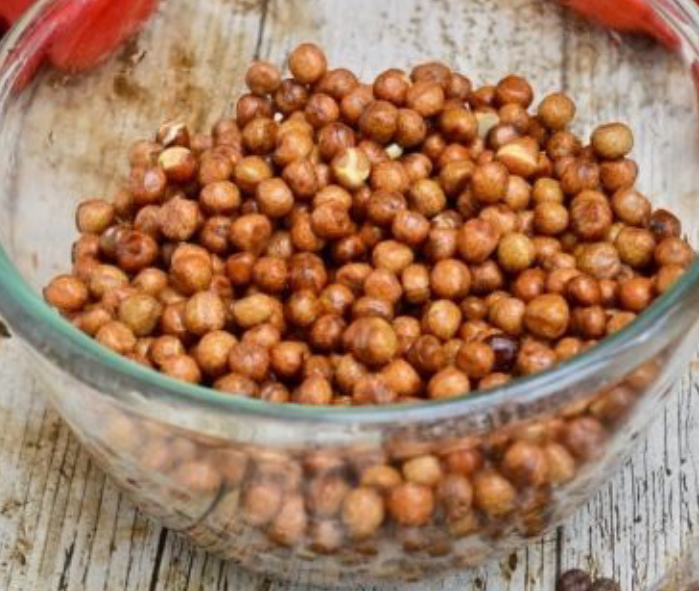
 The image above shows dried carlin peas in a glass bowl..
Welcome to the summary page for FabulousFusionFood's Cook's Guide entry for Carlin Peas along with all the recipes employing Carlin Peas presented on this site, with 17 recipes in total.
This is a continuation of an entire series of pages that will, I hope, allow my visitors to better navigate this site. As well as displaying recipes by name, country and region of origin I am now planning a whole series of pages where recipes can be located by meal type and main ingredient. This page gives a listing of all the Carlin Peas recipes added to this site.
These recipes, all contain Carlin Peas as a major wild food ingredient.
Carlin peas (also known as black peas, parched peas, dappled peas, maple peas, brown peas, brown badgers, magpie peas, pigeon peas and badger peas) are field peas of the pea variety Pisum sativum var. arvense. The peas are field peas, left to dry on the plant, as distinct from garden peas, picked green for fresh consumption. Records of the Carlin pea go back to the 12th century, though they raised to prominence during Elizabethan times.
I first encountered them in Manchester Christmas markets, sold as parched peas with vinegar and salt and are traditionally eaten from cups. They have a nutty and improved depth of flavour as compared with garden peas. These small, hard brown peas, have their name of ‘Carlin peas’ recorded during Elizabethan times. It has been suggested that the name 'Carlin' derives from 'Carling Sunday' or 'Care Sunday' after the population of Newcastle were saved from starvation in a siege of 1327 (Robert the Bruce) or 1644 (Civil War) when a ship arrived from Norway with a cargo of these peas on that day.
A children's rhyme counts out the Sundays of Lent as "Tid, Mid, Misere; Carlin, Palm, Paste-Egg Day", referring to the second Sunday when "Te Deum" was sung; the third when "Mi Deus" was sung; the Sunday when the "Misere Mei" was chanted; Carlin Sunday; Palm Sunday; and Paste Eggs on Easter Sunday.
Carlin peas are used to prepare a dish made in the northeast of England and parts of Cumbria. They are a traditional staple of Carlin Sunday (the Sunday before Palm Sunday). Carlin peas are boiled until tender, then fried briefly with butter or dripping. Salt is not added during cooking, as it is thought to stop the cooking process. They are then seasoned with vinegar and black pepper or sometimes rum and brown sugar. They may be eaten hot or cold.
Carlin peas are seasonal and traditionally available in autumn, which may explain why Carlin peas are associated with autumn and winter fares and as a traditional dish for bonfire night on the 5th of November.
They are classed as a heritage or heirloom variety, often referred to as the medieval mushy pea. They can be grown in the same way as sweet peas. The plants grow to about 185cm high, with white and purple flowers. The pods fill with small brown peas which can be used fresh, or dried.
Carlins are low in fat, and have 23g per 100g of protein and of fibre. They contain manganese, molybdenum and B vitamins, especially B1. Their red/blue colour derives from the presence of anthocyanins, which have desirable nutritional properties.
Carlin peas are not commonly available in British shops, though interest in them has grown recently. They can be bought on-line in dried, tinned and jarred forms. I usually buy mine dried and use them commonly for preparing mushy peas, which go very well with flavoursome fish like mackerel.
In culinary terms, carlin peas make an excellent British-grown substitute for chickpeas and they can be used as a direct substitute for any recipe calling for chickpeas — you really must try a carlin pea hummus (you can find the recipe in the linked recipes, below).
This is a continuation of an entire series of pages that will, I hope, allow my visitors to better navigate this site. As well as displaying recipes by name, country and region of origin I am now planning a whole series of pages where recipes can be located by meal type and main ingredient. This page gives a listing of all the Carlin Peas recipes added to this site.
These recipes, all contain Carlin Peas as a major wild food ingredient.
Carlin peas (also known as black peas, parched peas, dappled peas, maple peas, brown peas, brown badgers, magpie peas, pigeon peas and badger peas) are field peas of the pea variety Pisum sativum var. arvense. The peas are field peas, left to dry on the plant, as distinct from garden peas, picked green for fresh consumption. Records of the Carlin pea go back to the 12th century, though they raised to prominence during Elizabethan times.
I first encountered them in Manchester Christmas markets, sold as parched peas with vinegar and salt and are traditionally eaten from cups. They have a nutty and improved depth of flavour as compared with garden peas. These small, hard brown peas, have their name of ‘Carlin peas’ recorded during Elizabethan times. It has been suggested that the name 'Carlin' derives from 'Carling Sunday' or 'Care Sunday' after the population of Newcastle were saved from starvation in a siege of 1327 (Robert the Bruce) or 1644 (Civil War) when a ship arrived from Norway with a cargo of these peas on that day.
A children's rhyme counts out the Sundays of Lent as "Tid, Mid, Misere; Carlin, Palm, Paste-Egg Day", referring to the second Sunday when "Te Deum" was sung; the third when "Mi Deus" was sung; the Sunday when the "Misere Mei" was chanted; Carlin Sunday; Palm Sunday; and Paste Eggs on Easter Sunday.
Carlin peas are used to prepare a dish made in the northeast of England and parts of Cumbria. They are a traditional staple of Carlin Sunday (the Sunday before Palm Sunday). Carlin peas are boiled until tender, then fried briefly with butter or dripping. Salt is not added during cooking, as it is thought to stop the cooking process. They are then seasoned with vinegar and black pepper or sometimes rum and brown sugar. They may be eaten hot or cold.
Carlin peas are seasonal and traditionally available in autumn, which may explain why Carlin peas are associated with autumn and winter fares and as a traditional dish for bonfire night on the 5th of November.
They are classed as a heritage or heirloom variety, often referred to as the medieval mushy pea. They can be grown in the same way as sweet peas. The plants grow to about 185cm high, with white and purple flowers. The pods fill with small brown peas which can be used fresh, or dried.
Carlins are low in fat, and have 23g per 100g of protein and of fibre. They contain manganese, molybdenum and B vitamins, especially B1. Their red/blue colour derives from the presence of anthocyanins, which have desirable nutritional properties.
Carlin peas are not commonly available in British shops, though interest in them has grown recently. They can be bought on-line in dried, tinned and jarred forms. I usually buy mine dried and use them commonly for preparing mushy peas, which go very well with flavoursome fish like mackerel.
In culinary terms, carlin peas make an excellent British-grown substitute for chickpeas and they can be used as a direct substitute for any recipe calling for chickpeas — you really must try a carlin pea hummus (you can find the recipe in the linked recipes, below).
The alphabetical list of all Carlin Peas recipes on this site follows, (limited to 100 recipes per page). There are 17 recipes in total:
Page 1 of 1
| Carlin Pea and Chanterelle Ragout Origin: Britain | Carlin pea, kale and chorizo one pot Origin: Britain | Parched Peas 2 Origin: England |
| Carlin Pea and Glazed Halloumi Saag Origin: Britain | Carlin Pea, Pearl Barley and Tomato Stew Origin: Britain | Pork and Beans Pepper Soup with Wild Greens Origin: African Fusion |
| Carlin Pea Curry with Perpetual Spinach and Peanut Butter Origin: Britain | Carlin Pease Pudding Origin: Britain | Refried Carlin Peas Origin: Britain |
| Carlin Pea Hummus Origin: Britain | Cauliflower, Mushroom and Carlin Peas Curry Origin: Britain | Roasted Carlin Peas Origin: Britain |
| Carlin Pea Masala Origin: Britain | Leftover Chicken Curry with Carlin Peas, Himalayan Balsam Seed Pods and Oak Moss Tempering Origin: Britain | Spicy Carlin Pea Soup with Roasted Peppers Origin: Britain |
| Carlin Pea Ragu Origin: Britain | Parched Peas Origin: England |
Page 1 of 1