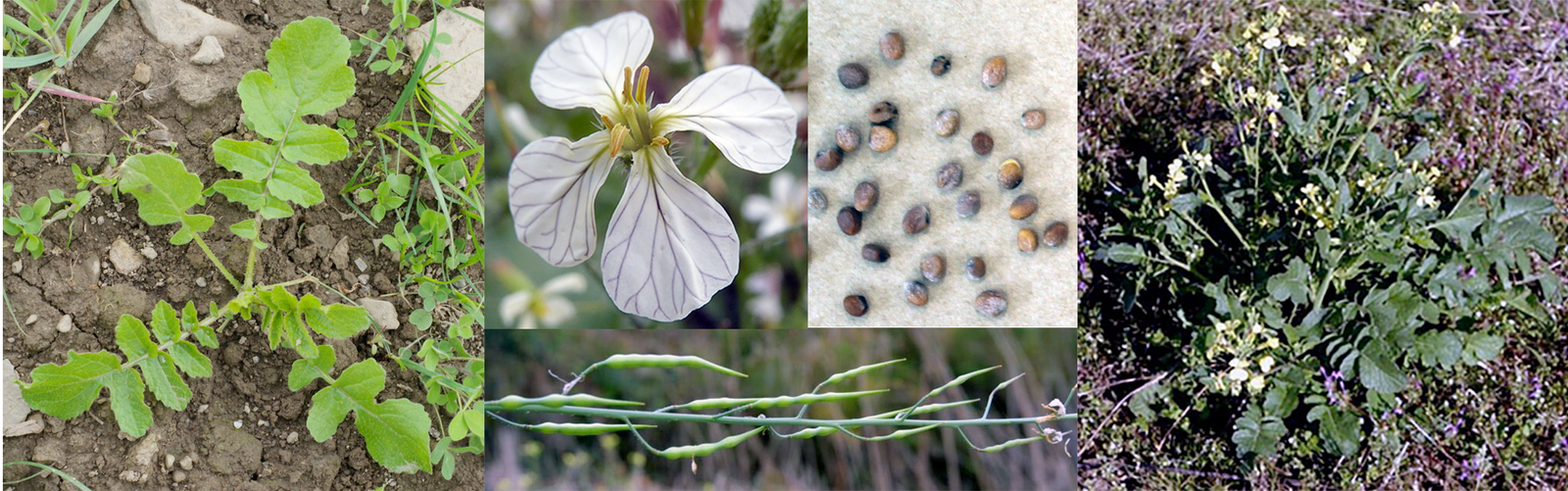
 Wild Radish (Raphanus raphanistrum), showing showing a
young plant (left), a close-up of a flower, the seeds, the seed
pods on the stem and a mature plant in flower (right)..
| Common Name: Wild Radish |
| Scientific Name: Raphanus raphanistrum |
| Other Names: white charlock or jointed charlock |
| Family: Brassicaceae |
| Range: Europe, including Britain, from Norway south to N. Africa. |
Physical Characteristics Sea Radish, Raphanus raphanistrum It is not frost tender. The species is hermaphrodite (has both male and female organs) and is pollinated by Bees, flies.
Suitable: light (sandy), medium (loamy) and heavy (clay) soils. Suitable pH: mildly acid, neutral and basic (mildly alkaline) soils. It can grow in semi-shade (light woodland) or no shade. It prefers moist soil. |
| Edible Parts: Flowers, Leaves, Seed Pods, Seeds, Oli |
 Edibility Rating: 3 Edibility Rating: 3 
|
 Known Hazards: None Known. Known Hazards: None Known.
|
Monthly Availability: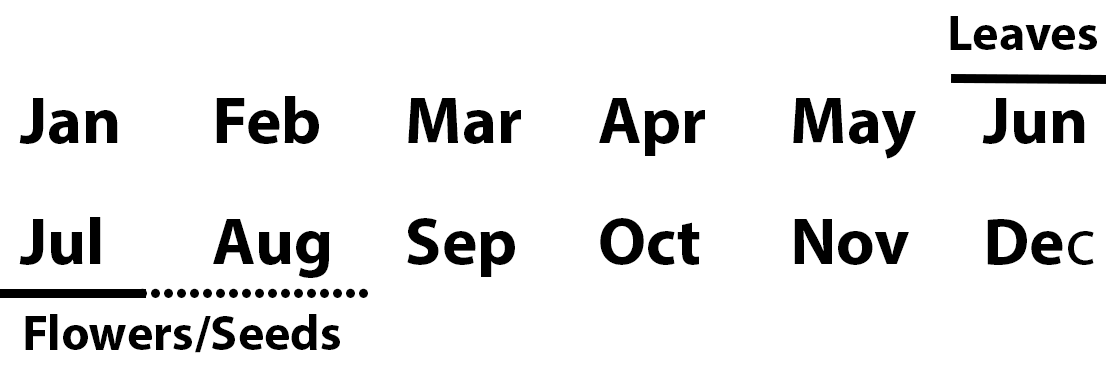
|
Welcome to the summary page for FabulousFusionFood's Wild Food guide to Wild Radish along with all the Wild Radish containing recipes presented on this site, with 3 recipes in total.
These recipes, all contain Wild Radish as a major wild food ingredient.
Wild Radish (Raphanus raphanistrum is a flowering plant in the family Brassicaceae. The species is native to western Asia, Europe and parts of Northern Africa. It has been introduced into most parts of the world and is regarded as a habitat threatening invasive species in many areas, for example, Australia. It spreads rapidly and is often found growing on roadsides or in other places where the ground has been disturbed. The cultivated radish, widely used as a root vegetable, is sometimes considered to be one of its subspecies as Raphanus raphanistrum subsp. sativus.
Wild radish is an annual that grows up to 75 centimetres (30 in) tall, variously branched to multi-stemmed, with a distinct slender taproot which does not swell like that of the cultivated radish. The stems are green and sometimes purple at the base and nodes, round in cross section and slightly ridged, and bristly-hairy all over. It has a basal rosette of pinnate leaves to 38 cm (15 in) long, with a 3-cm stalk (petiole) and a large rounded terminal lobe that has a undulate margin; the lateral lobes sometimes overlap the midrib. The stem leaves become progressively less lobed as they ascend, and more acutely serrated. Both the upper and lower surface of each leaf is roughly hairy, as are the leaf margins, which have minutely bulbous-based hairs projecting horizontally. The leaves have green or purple tips (hydathodes) on each tooth
The flowering period is between May and October in northern Europe, or between June and August in Minnesota.[5] The inflorescence is a lax raceme, terminal or arising from the leaf axil, up to 34 cm long with up to 42 flowers. The flowers have four white (sometimes yellow or purple) petals, up to 24 mm long, sometimes with dark veins (especially on the underside). Each petal has a rounded "limb" above a narrow "claw", both about the same length. The four upright sepals are shorter than the petals, green or purple, and have sparse bulbous-based hairs. There are 6 stamens (2 short and 4 long) and one style with two stigmas.
The fruits are borne on bristly-hairy pedicels about 3 cm long and held vertically (whether the rhachis is erect or sprawling). Each fruit consists of a pod with two segments: the lower one is about 1-2 mm long and sterile (just occasionally with one seed), while the upper one is up to 8 cm long and has 1–10 fertile segments (mericarps), each containing one oval seed up to 3 mm long. At the tip of the pod is a sterile beak up to 2.5 cm long. The fruits are terete, smooth or slightly ridged, and glabrous to roughly hairy, with a peppery taste. At the tip of the beak is the persistent, sessile white stigma
Personally, I'm a big fan of radishes, not so much the ones with the swollen roots, but the ones that produce edible seed pods... delicious. So when I found out we had aa wild sea radish that yielded edible pods I had to find it. Even better it was right on the coast and on my doorstep! Even better the seed pods of sea radish is a direct substitute for the radish pods used in many recipes on this site.
All tender parts of the plant are edible. The leaves and flowers have a spicy taste or aftertaste. The seedpods can be eaten, as can the outer skin of the root (after being washed). It is said that John Walker cultivated sea radish root as an alternative to horseradish after discovering the plant on the west coast of Scotland as early as 1753. The young leaves can be eaten raw or cooked. Raw they have a somewhat hot taste and are best finely shredded and used as a garnish. They work well as a potherb (ie blanched in water before use). Older leaves become bitter but can be used in African-style stews if boiled in salted water for 3–4 minutes beforehand. The seeds can be eaten raw or cooked and have a pungent flavour. When ground to a paste, the seeds can be used to make radish mustard. The sprouted seeds have a somewhat hot spicy flavour and are a tasty addition to salads. The flowers can be eaten raw and make a good addition to salads. They can also be battered and make good tempura. Note that the young flowers are best as quickly become tough and fibrous. An edible oil is extracted from the seeds.
[2]. Huxley, A. The New RHS Dictionary of Gardening. 1999
[3]. Tanaka, T. Tanaka's Cyclopaedia of Edible Plants of the World.
[4]. Lim T.K. Edible Medicinal And Non-Medicinal Plants, Vols 1–12.
[5]. Thomas, G. S. Perennial Garden Plants, 2004
[6]. Milner, E. Trees of Britain and Ireland, 2011
[7]. Rose, F. & O'Reilly, C. The Wild Flower Key (Revised Edition) — How to identify wild plants, trees and shrubs in Britain and Ireland, 2006
[8]. Streeter, D. & Garrard, I. The Wild Flowers of the British Isles, 1983
[9]. Clapham, A.R.; Tutin, T.G. & Moore, D.M. Flora of the British Isles, 1987
[10]. Phillips, R. Mushrooms, 2006
[11]. Jordan, P. & Wheeler, S. The Complete Book of Mushrooms: An Illustrated Encyclopedia of Edible Mushrooms, 2011
[12]. Bunker, F. Seaweeds of Britain and Ireland, Second Edition, 2017
[13]. Facciola, S. Cornucopia II — A Source Book of Edible Plants, 1998
[14]. Hartford, R. Edible and Medicinal Wild Plants of Britain and Ireland: A Foraging and Photographic Identification Guide
(Note that the above book links are Amazon Affiliate links)
These recipes, all contain Wild Radish as a major wild food ingredient.
Wild Radish (Raphanus raphanistrum is a flowering plant in the family Brassicaceae. The species is native to western Asia, Europe and parts of Northern Africa. It has been introduced into most parts of the world and is regarded as a habitat threatening invasive species in many areas, for example, Australia. It spreads rapidly and is often found growing on roadsides or in other places where the ground has been disturbed. The cultivated radish, widely used as a root vegetable, is sometimes considered to be one of its subspecies as Raphanus raphanistrum subsp. sativus.
Wild radish is an annual that grows up to 75 centimetres (30 in) tall, variously branched to multi-stemmed, with a distinct slender taproot which does not swell like that of the cultivated radish. The stems are green and sometimes purple at the base and nodes, round in cross section and slightly ridged, and bristly-hairy all over. It has a basal rosette of pinnate leaves to 38 cm (15 in) long, with a 3-cm stalk (petiole) and a large rounded terminal lobe that has a undulate margin; the lateral lobes sometimes overlap the midrib. The stem leaves become progressively less lobed as they ascend, and more acutely serrated. Both the upper and lower surface of each leaf is roughly hairy, as are the leaf margins, which have minutely bulbous-based hairs projecting horizontally. The leaves have green or purple tips (hydathodes) on each tooth
The flowering period is between May and October in northern Europe, or between June and August in Minnesota.[5] The inflorescence is a lax raceme, terminal or arising from the leaf axil, up to 34 cm long with up to 42 flowers. The flowers have four white (sometimes yellow or purple) petals, up to 24 mm long, sometimes with dark veins (especially on the underside). Each petal has a rounded "limb" above a narrow "claw", both about the same length. The four upright sepals are shorter than the petals, green or purple, and have sparse bulbous-based hairs. There are 6 stamens (2 short and 4 long) and one style with two stigmas.
The fruits are borne on bristly-hairy pedicels about 3 cm long and held vertically (whether the rhachis is erect or sprawling). Each fruit consists of a pod with two segments: the lower one is about 1-2 mm long and sterile (just occasionally with one seed), while the upper one is up to 8 cm long and has 1–10 fertile segments (mericarps), each containing one oval seed up to 3 mm long. At the tip of the pod is a sterile beak up to 2.5 cm long. The fruits are terete, smooth or slightly ridged, and glabrous to roughly hairy, with a peppery taste. At the tip of the beak is the persistent, sessile white stigma
Personally, I'm a big fan of radishes, not so much the ones with the swollen roots, but the ones that produce edible seed pods... delicious. So when I found out we had aa wild sea radish that yielded edible pods I had to find it. Even better it was right on the coast and on my doorstep! Even better the seed pods of sea radish is a direct substitute for the radish pods used in many recipes on this site.
All tender parts of the plant are edible. The leaves and flowers have a spicy taste or aftertaste. The seedpods can be eaten, as can the outer skin of the root (after being washed). It is said that John Walker cultivated sea radish root as an alternative to horseradish after discovering the plant on the west coast of Scotland as early as 1753. The young leaves can be eaten raw or cooked. Raw they have a somewhat hot taste and are best finely shredded and used as a garnish. They work well as a potherb (ie blanched in water before use). Older leaves become bitter but can be used in African-style stews if boiled in salted water for 3–4 minutes beforehand. The seeds can be eaten raw or cooked and have a pungent flavour. When ground to a paste, the seeds can be used to make radish mustard. The sprouted seeds have a somewhat hot spicy flavour and are a tasty addition to salads. The flowers can be eaten raw and make a good addition to salads. They can also be battered and make good tempura. Note that the young flowers are best as quickly become tough and fibrous. An edible oil is extracted from the seeds.
References:
[1]. David Evans Notes from field observations, tastings and cookery experiments.[2]. Huxley, A. The New RHS Dictionary of Gardening. 1999
[3]. Tanaka, T. Tanaka's Cyclopaedia of Edible Plants of the World.
[4]. Lim T.K. Edible Medicinal And Non-Medicinal Plants, Vols 1–12.
[5]. Thomas, G. S. Perennial Garden Plants, 2004
[6]. Milner, E. Trees of Britain and Ireland, 2011
[7]. Rose, F. & O'Reilly, C. The Wild Flower Key (Revised Edition) — How to identify wild plants, trees and shrubs in Britain and Ireland, 2006
[8]. Streeter, D. & Garrard, I. The Wild Flowers of the British Isles, 1983
[9]. Clapham, A.R.; Tutin, T.G. & Moore, D.M. Flora of the British Isles, 1987
[10]. Phillips, R. Mushrooms, 2006
[11]. Jordan, P. & Wheeler, S. The Complete Book of Mushrooms: An Illustrated Encyclopedia of Edible Mushrooms, 2011
[12]. Bunker, F. Seaweeds of Britain and Ireland, Second Edition, 2017
[13]. Facciola, S. Cornucopia II — A Source Book of Edible Plants, 1998
[14]. Hartford, R. Edible and Medicinal Wild Plants of Britain and Ireland: A Foraging and Photographic Identification Guide
(Note that the above book links are Amazon Affiliate links)
The alphabetical list of all Wild Radish recipes on this site follows, (limited to 100 recipes per page). There are 3 recipes in total:
Page 1 of 1
| Brine-pickled Radish Pods Origin: American | Pickled Radish Pods Origin: Britain | Sneezewort Arroz de Jambú Origin: Britain |
Page 1 of 1