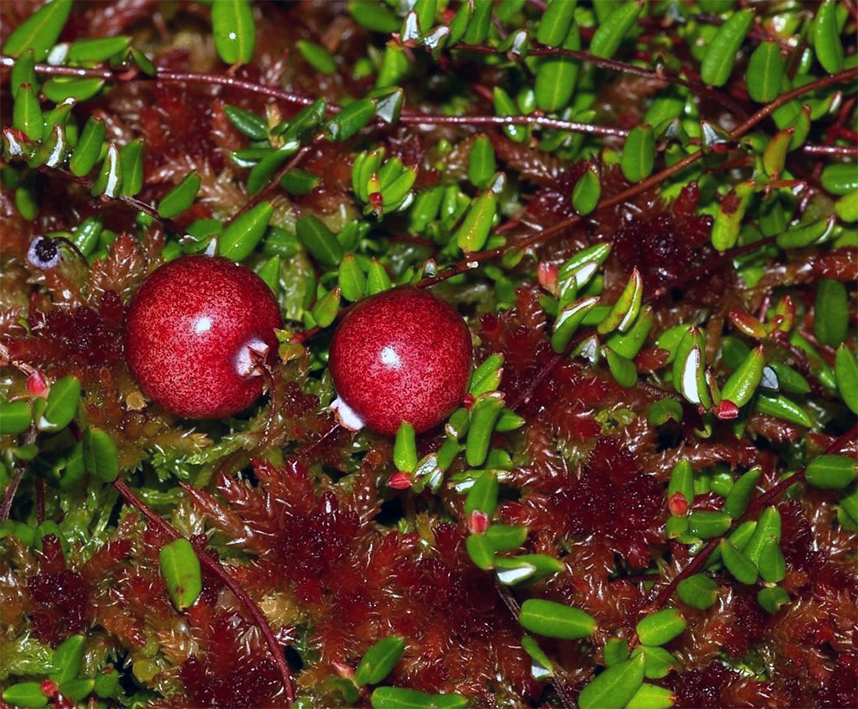
 The image, above, (Vaccinium oxycoccos,/em>) showing the full
plant and two ripe fruit in waterlogged sphagnum moss..
|
Common Name: Cranberry |
| Scientific Name: Vaccinium oxycoccos |
|
Other Names: fenberry, common cranberry, northern cranberry, wild cranberry, small cranberry, marshberry, bog cranberry, swamp cranberry and llugaeron [CY] |
| Family: Ericaceae |
| Range: Temperate Northern Hemisphere, including northern Europe, northern Asia and northern North America. |
Physical Characteristics Vaccinium oxycoccos is an evergreen dwarf shrub or trailing vine, small 5–10mm evergreen leaves, with an inrolled margin. The flowers are dark pink, with a purple central spike, produced on finely hairy stalks. The fruit is a small pale pink to red berry, with a refreshing sharp acidic flavour.
Suitable: moist to wet soils which are low in nitrogen and have a high water table. |
| Edible Parts: Fruit |
 Edibility Rating: 4 Edibility Rating: 4 
|
 Known Hazards: The fresh leaves contain the toxin hydrogen cyanide, though details of quantities. Fresh and dried leaves have been used for centuries to prepared redcurrant teas, though the process of drying will help eliminate any cyanogenic compounds in the leaves, as will the addition of boiling water. Known Hazards: The fresh leaves contain the toxin hydrogen cyanide, though details of quantities. Fresh and dried leaves have been used for centuries to prepared redcurrant teas, though the process of drying will help eliminate any cyanogenic compounds in the leaves, as will the addition of boiling water.
|
Monthly Availability:
|
Welcome to the summary page for FabulousFusionFood's Wild Food guide to Wild Cranberry along with all the Wild Cranberry containing recipes presented on this site, with 3 recipes in total.
These recipes, all contain Wild Cranberry as a major wild food ingredient.
The Cranberry, Vaccinium oxycoccos, (also known as fenberry, common cranberry, northern cranberry, wild cranberry, small cranberry, marshberry, bog cranberry, swamp cranberry and llugaeron [CY]) is an evergreen dwarf shrub or trailing vine normally growing to 5–10cm tall, with small 5–10mm evergreen leaves, with an inrolled margin. The flowers are dark pink, with a purple central spike, produced on finely hairy stalks. The fruit is a pink or red berry which has spots when young. It measures up to 1.2 cm (1⁄2 in) wide.[4][8] The plant forms mycorrhizal associations. It mainly reproduces vegetatively. Its fruit persists for an average of 200 days, and bears an average of 7 seeds per fruit. Fruits average 86.4% water, and their dry weight includes 4.2% carbohydrates and 1.8% lipids. The fruit ) fruit season in the UK runs from September to November. The berries ripen in early autumn and are at their peak for foraging before the first frosts hit.
In Britain, cranberry may refer to the native species Vaccinium oxycoccos, while in North America, cranberry may refer to Vaccinium macrocarpon. Vaccinium oxycoccos is cultivated in central and northern Europe, whilst V. macrocarpon is cultivated throughout the northern United States, Canada and Chile.
The name cranberry derives from the Middle Low German kraanbere (English translation, craneberry), first named as cranberry in English by the missionary John Eliot in 1647. Around 1694, German and Dutch colonists in New England used the word, cranberry, to represent the expanding flower, stem, calyx, and petals resembling the neck, head, and bill of a crane. The traditional English name for the plant more common in Europe, Vaccinium oxycoccos, fenberry, originated from plants with small red berries found growing in fen (marsh) lands of England.
Cranberries can be stored by pickling, turning into jam or drying (commercial dried cranberries commonly sweetened by adding sucrose with up to 17 times of their natural sugar content. The drying process also eliminates the fruit's natural vitamin C.) One common use of cranberries is in the production of cranberry sauce to accompany Thanksgiving or Christmas turkey (it also marries well with pork).
Raw cranberries, cranberry juice and cranberry extracts are a source of polyphenols — including proanthocyanidins, flavonols[42] and quercetin. These phytochemical compounds are being studied in vivo and in vitro for possible effects on the cardiovascular system, immune system and cancer.
[2]. Huxley, A. The New RHS Dictionary of Gardening. 1999
[3]. Tanaka, T. Tanaka's Cyclopaedia of Edible Plants of the World.
[4]. Lim T.K. Edible Medicinal And Non-Medicinal Plants, Vols 1–12.
[5]. Thomas, G. S. Perennial Garden Plants, 2004
[6]. Milner, E. Trees of Britain and Ireland, 2011
[7]. Rose, F. & O'Reilly, C. The Wild Flower Key (Revised Edition) — How to identify wild plants, trees and shrubs in Britain and Ireland, 2006
[8]. Streeter, D. & Garrard, I. The Wild Flowers of the British Isles, 1983
[9]. Clapham, A.R.; Tutin, T.G. & Moore, D.M. Flora of the British Isles, 1987
[10]. Phillips, R. Mushrooms, 2006
[11]. Jordan, P. & Wheeler, S. The Complete Book of Mushrooms: An Illustrated Encyclopedia of Edible Mushrooms, 2011
[12]. Bunker, F. Seaweeds of Britain and Ireland, Second Edition, 2017
[13]. Facciola, S. Cornucopia II — A Source Book of Edible Plants, 1998
[14]. Hartford, R. Edible and Medicinal Wild Plants of Britain and Ireland: A Foraging and Photographic Identification Guide
(Note that the above book links are Amazon Affiliate links)
These recipes, all contain Wild Cranberry as a major wild food ingredient.
The Cranberry, Vaccinium oxycoccos, (also known as fenberry, common cranberry, northern cranberry, wild cranberry, small cranberry, marshberry, bog cranberry, swamp cranberry and llugaeron [CY]) is an evergreen dwarf shrub or trailing vine normally growing to 5–10cm tall, with small 5–10mm evergreen leaves, with an inrolled margin. The flowers are dark pink, with a purple central spike, produced on finely hairy stalks. The fruit is a pink or red berry which has spots when young. It measures up to 1.2 cm (1⁄2 in) wide.[4][8] The plant forms mycorrhizal associations. It mainly reproduces vegetatively. Its fruit persists for an average of 200 days, and bears an average of 7 seeds per fruit. Fruits average 86.4% water, and their dry weight includes 4.2% carbohydrates and 1.8% lipids. The fruit ) fruit season in the UK runs from September to November. The berries ripen in early autumn and are at their peak for foraging before the first frosts hit.
In Britain, cranberry may refer to the native species Vaccinium oxycoccos, while in North America, cranberry may refer to Vaccinium macrocarpon. Vaccinium oxycoccos is cultivated in central and northern Europe, whilst V. macrocarpon is cultivated throughout the northern United States, Canada and Chile.
The name cranberry derives from the Middle Low German kraanbere (English translation, craneberry), first named as cranberry in English by the missionary John Eliot in 1647. Around 1694, German and Dutch colonists in New England used the word, cranberry, to represent the expanding flower, stem, calyx, and petals resembling the neck, head, and bill of a crane. The traditional English name for the plant more common in Europe, Vaccinium oxycoccos, fenberry, originated from plants with small red berries found growing in fen (marsh) lands of England.
Cranberries can be stored by pickling, turning into jam or drying (commercial dried cranberries commonly sweetened by adding sucrose with up to 17 times of their natural sugar content. The drying process also eliminates the fruit's natural vitamin C.) One common use of cranberries is in the production of cranberry sauce to accompany Thanksgiving or Christmas turkey (it also marries well with pork).
Raw cranberries, cranberry juice and cranberry extracts are a source of polyphenols — including proanthocyanidins, flavonols[42] and quercetin. These phytochemical compounds are being studied in vivo and in vitro for possible effects on the cardiovascular system, immune system and cancer.
References:
[1]. David Evans Notes from field observations, tastings and cookery experiments.[2]. Huxley, A. The New RHS Dictionary of Gardening. 1999
[3]. Tanaka, T. Tanaka's Cyclopaedia of Edible Plants of the World.
[4]. Lim T.K. Edible Medicinal And Non-Medicinal Plants, Vols 1–12.
[5]. Thomas, G. S. Perennial Garden Plants, 2004
[6]. Milner, E. Trees of Britain and Ireland, 2011
[7]. Rose, F. & O'Reilly, C. The Wild Flower Key (Revised Edition) — How to identify wild plants, trees and shrubs in Britain and Ireland, 2006
[8]. Streeter, D. & Garrard, I. The Wild Flowers of the British Isles, 1983
[9]. Clapham, A.R.; Tutin, T.G. & Moore, D.M. Flora of the British Isles, 1987
[10]. Phillips, R. Mushrooms, 2006
[11]. Jordan, P. & Wheeler, S. The Complete Book of Mushrooms: An Illustrated Encyclopedia of Edible Mushrooms, 2011
[12]. Bunker, F. Seaweeds of Britain and Ireland, Second Edition, 2017
[13]. Facciola, S. Cornucopia II — A Source Book of Edible Plants, 1998
[14]. Hartford, R. Edible and Medicinal Wild Plants of Britain and Ireland: A Foraging and Photographic Identification Guide
(Note that the above book links are Amazon Affiliate links)
The alphabetical list of all Wild Cranberry recipes on this site follows, (limited to 100 recipes per page). There are 3 recipes in total:
Page 1 of 1
| Cadw Ffrwythau Drwy Dinio (Preserving Wild Fruit by Canning) Origin: Welsh | Pwdin Llugaeron (Cranberry Pudding) Origin: Welsh | Steamed Cranberry Pudding with Hard Sauce Origin: England |
Page 1 of 1