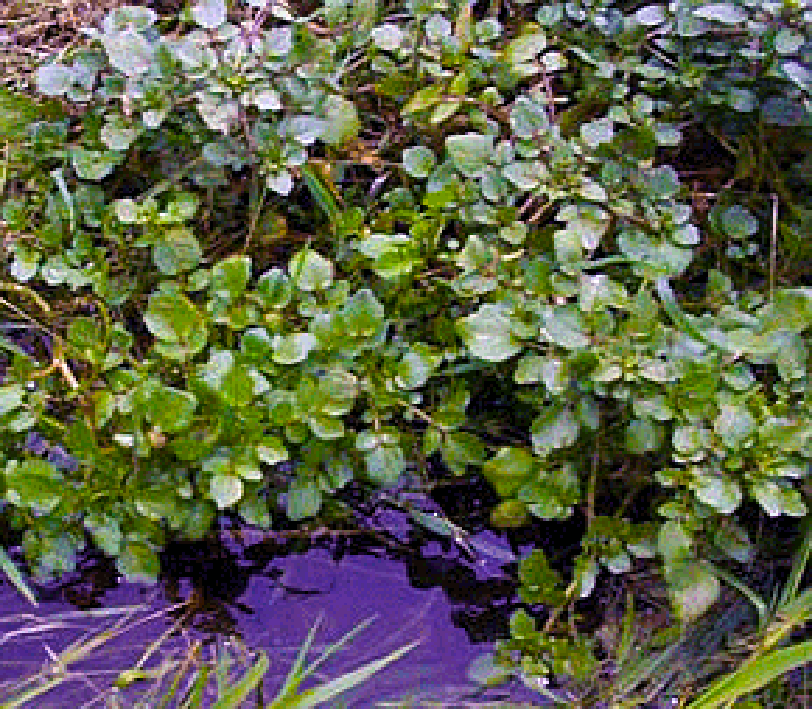
 The image, above, shows the Watercress plant (Nasturtium
officinale) growing on the banks of a stream (top). Also
shown is a bunch of watercress (bottom left) and a close-up of a
watercress leaf (bottom right)..
| Common Name: Watercress |
| Scientific Name: Nasturtium nasturtium-aquaticum (syn Nasturtium officinale) |
| Other Names: Yellowcress |
| Family: Cruciferae |
| Range: Europe, including Britain, from Sweden and Denmark south and east to N. Africa and W. Asia |
Physical Characteristics Nasturtium officinale is a hardy Perennial plant, growing to 50cm (1 ft 8 in) by 1m (3 ft 3 in) in size. It is hardy to zone 6 and is not frost tender. The plant flowers from May to October and seeds ripen from July to October. The flowers are hermaphrodite and are pollinated by bees and flies. The plant also self-fertilizes and is notable as a wildlife attractant.
|
| Edible Parts: Leaves, Seeds |
 Edibility Rating: 4 Edibility Rating: 4 
|
 Known Hazards: Whilst the plant is very tasty and nutritious, some care should be taken if harvesting it from the wild. Any plants growing in water that drains from fields where animals, particularly sheep, graze should not be used raw. This is due to the risk of it being infested with the liver fluke parasite. Cooking the leaves, however, will destroy any parasites and render the plant perfectly safe to eat. There is some evidence that watercress may inhibit the metabolism of paracetamol. Known Hazards: Whilst the plant is very tasty and nutritious, some care should be taken if harvesting it from the wild. Any plants growing in water that drains from fields where animals, particularly sheep, graze should not be used raw. This is due to the risk of it being infested with the liver fluke parasite. Cooking the leaves, however, will destroy any parasites and render the plant perfectly safe to eat. There is some evidence that watercress may inhibit the metabolism of paracetamol.
|
Monthly Availability:
|
Welcome to the summary page for FabulousFusionFood's Wild Food guide to Watercress along with all the Watercress containing recipes presented on this site, with 73 recipes in total.
These recipes, all contain Watercress as a major wild food ingredient.
Watercress, Nasturtium officinale, (syn Rorippa nasturtium-aquaticum Hayek and Sisymbrium nasturtium-aquaticum L.) is a fast growing aquatic (or sometimes semi-aquatic) perennial of the Brassicaceae (cabbage) family. Botanically it is a close relative of both garden cress and mustard (they all have a tangy, peppery, flavour). Watercress is native from Europe to central Asia and is one of the oldest of the leaf vegetables known to be consumed by humans.
As an aquatic plant the stems of watercress float and the leaves are pinnately compound. The plants produce clusters of small white and green flowers. Cultivation of watercress is practical on both a large scale and a garden scale. Being semi-aquatic, watercress is well-suited to hydroponic cultivation, thriving best in water that is slightly alkaline. It is frequently produced around the headwaters of chalk streams. Watercress seeds are commercially available and should be planted in damp compost within pots. These pots can then be placed in ponds (watercress is an excellent oxygenator and helps to keep ponds clear) or they can be placed in polythene-lined pits that are topped-up with water.
Unharvested or mature wild watercress can grow to a maximum height of 120cm and plants harvested about two days after germination are sometimes sold as sprouts. The older the plants the more pronounced the flavour, though the leaves tend to become bitter and unpalatable when in flower. Wild watercress tends to grow wild in fast-flowing streams and they prefer alkaline waters. As a result you will tend to find watercress most commonly near the headwaters of chalk streams. If you pick wild watercress make sure you cook it before consumption as it can harbour the larvae of liver-fluke. Commercially-grown watercress is safe to consume raw in salads. Watercress also makes an excellent green soup.
Cultivated watercress, Nasturtium officinale was domesticated from wild watercress. Watercress is listed in some sources as belonging to the genus Rorippa, although molecular evidence shows those aquatic species with hollow stems are more closely related to Cardamine than Rorippa.
Watercress can be eaten raw or cooked. Typically it's used in salads or as garnishes for other dishes, but it's also good added at the last minute to stir-fries. It is also good added to sandwiches. The leaves are exceptionally rich in vitamins and minerals, especially iron. The plant has a spicy, mustard-like flavour. Indeed, the seeds can be ground to a powder and used as a mustard substitute (it can be used as a spice and for making mustard paste). Just like mustard, the pungency of watercress develops when cold water is added to the ground-up seed. Chemically, an enzyme (myrosin) acts on a glycoside (sinigrin) to produce a sulphur compound. The reaction takes 10–15 minutes. Mixing with hot water or vinegar, or adding salt, inhibits the enzyme and produces a mild but bitter mustard
[2]. Huxley, A. The New RHS Dictionary of Gardening. 1999
[3]. Tanaka, T. Tanaka's Cyclopaedia of Edible Plants of the World.
[4]. Lim T.K. Edible Medicinal And Non-Medicinal Plants, Vols 1–12.
[5]. Thomas, G. S. Perennial Garden Plants, 2004
[6]. Milner, E. Trees of Britain and Ireland, 2011
[7]. Rose, F. & O'Reilly, C. The Wild Flower Key (Revised Edition) — How to identify wild plants, trees and shrubs in Britain and Ireland, 2006
[8]. Streeter, D. & Garrard, I. The Wild Flowers of the British Isles, 1983
[9]. Clapham, A.R.; Tutin, T.G. & Moore, D.M. Flora of the British Isles, 1987
[10]. Phillips, R. Mushrooms, 2006
[11]. Jordan, P. & Wheeler, S. The Complete Book of Mushrooms: An Illustrated Encyclopedia of Edible Mushrooms, 2011
[12]. Bunker, F. Seaweeds of Britain and Ireland, Second Edition, 2017
[13]. Facciola, S. Cornucopia II — A Source Book of Edible Plants, 1998
[14]. Hartford, R. Edible and Medicinal Wild Plants of Britain and Ireland: A Foraging and Photographic Identification Guide
(Note that the above book links are Amazon Affiliate links)
These recipes, all contain Watercress as a major wild food ingredient.
Watercress, Nasturtium officinale, (syn Rorippa nasturtium-aquaticum Hayek and Sisymbrium nasturtium-aquaticum L.) is a fast growing aquatic (or sometimes semi-aquatic) perennial of the Brassicaceae (cabbage) family. Botanically it is a close relative of both garden cress and mustard (they all have a tangy, peppery, flavour). Watercress is native from Europe to central Asia and is one of the oldest of the leaf vegetables known to be consumed by humans.
As an aquatic plant the stems of watercress float and the leaves are pinnately compound. The plants produce clusters of small white and green flowers. Cultivation of watercress is practical on both a large scale and a garden scale. Being semi-aquatic, watercress is well-suited to hydroponic cultivation, thriving best in water that is slightly alkaline. It is frequently produced around the headwaters of chalk streams. Watercress seeds are commercially available and should be planted in damp compost within pots. These pots can then be placed in ponds (watercress is an excellent oxygenator and helps to keep ponds clear) or they can be placed in polythene-lined pits that are topped-up with water.
Unharvested or mature wild watercress can grow to a maximum height of 120cm and plants harvested about two days after germination are sometimes sold as sprouts. The older the plants the more pronounced the flavour, though the leaves tend to become bitter and unpalatable when in flower. Wild watercress tends to grow wild in fast-flowing streams and they prefer alkaline waters. As a result you will tend to find watercress most commonly near the headwaters of chalk streams. If you pick wild watercress make sure you cook it before consumption as it can harbour the larvae of liver-fluke. Commercially-grown watercress is safe to consume raw in salads. Watercress also makes an excellent green soup.
Cultivated watercress, Nasturtium officinale was domesticated from wild watercress. Watercress is listed in some sources as belonging to the genus Rorippa, although molecular evidence shows those aquatic species with hollow stems are more closely related to Cardamine than Rorippa.
Watercress can be eaten raw or cooked. Typically it's used in salads or as garnishes for other dishes, but it's also good added at the last minute to stir-fries. It is also good added to sandwiches. The leaves are exceptionally rich in vitamins and minerals, especially iron. The plant has a spicy, mustard-like flavour. Indeed, the seeds can be ground to a powder and used as a mustard substitute (it can be used as a spice and for making mustard paste). Just like mustard, the pungency of watercress develops when cold water is added to the ground-up seed. Chemically, an enzyme (myrosin) acts on a glycoside (sinigrin) to produce a sulphur compound. The reaction takes 10–15 minutes. Mixing with hot water or vinegar, or adding salt, inhibits the enzyme and produces a mild but bitter mustard
References:
[1]. David Evans Notes from field observations, tastings and cookery experiments.[2]. Huxley, A. The New RHS Dictionary of Gardening. 1999
[3]. Tanaka, T. Tanaka's Cyclopaedia of Edible Plants of the World.
[4]. Lim T.K. Edible Medicinal And Non-Medicinal Plants, Vols 1–12.
[5]. Thomas, G. S. Perennial Garden Plants, 2004
[6]. Milner, E. Trees of Britain and Ireland, 2011
[7]. Rose, F. & O'Reilly, C. The Wild Flower Key (Revised Edition) — How to identify wild plants, trees and shrubs in Britain and Ireland, 2006
[8]. Streeter, D. & Garrard, I. The Wild Flowers of the British Isles, 1983
[9]. Clapham, A.R.; Tutin, T.G. & Moore, D.M. Flora of the British Isles, 1987
[10]. Phillips, R. Mushrooms, 2006
[11]. Jordan, P. & Wheeler, S. The Complete Book of Mushrooms: An Illustrated Encyclopedia of Edible Mushrooms, 2011
[12]. Bunker, F. Seaweeds of Britain and Ireland, Second Edition, 2017
[13]. Facciola, S. Cornucopia II — A Source Book of Edible Plants, 1998
[14]. Hartford, R. Edible and Medicinal Wild Plants of Britain and Ireland: A Foraging and Photographic Identification Guide
(Note that the above book links are Amazon Affiliate links)
The alphabetical list of all Watercress recipes on this site follows, (limited to 100 recipes per page). There are 73 recipes in total:
Page 1 of 1
| A Messe of Greens Origin: Britain | Lafet Time (Honey-glazed Pork with Salad) Origin: Vanuatu | Scrambled Eggs with Woodlice Origin: Britain |
| Angels on Horseback Origin: Britain | Magrets de canard rôtis aux pruneaux et à l'armagnac (Roast Duck Breasts with Prunes and Armagnac) Origin: France | Sewin Gyda Saws Perlysiau (Sea Trout with Herb Sauce) Origin: Welsh |
| Another English Salad Origin: British | Microwave Duck à l'Orange Origin: Britain | Smoked Chicken, Leek and Mushroom Pie Origin: Australia |
| Arbroath Smokies Origin: Scotland | Microwave Waldorf Chicken Salad Origin: Britain | Spiced Mackerel with Horseradish Potato Salad Origin: Britain |
| Aromatic Pork and Potato Casserole Origin: Ireland | Mixed Wild Greens with Himalayan Balsam Seed Dressing Origin: British | Spring Flower Salad with Dandelion Greens Origin: Britain |
| Baked New Potatoes with Wilted Wild Garlic Origin: Britain | Mofo Sakay (Spiced Fritters) Origin: Madagascar | Swedish Chicken Salad Origin: Sweden |
| Boiled Meats Ordinary Origin: British | Montpelier Butter Origin: France | Tabasco Steaks with Watercress Butter Origin: Fusion |
| Cawl Berw Dŵr â Thatws (Watercress and Potato Soup) Origin: Welsh | Nwa Mee Hinga (Oxtail and Watercress) Origin: Myanmar | Three-cornered Leek Kookoo Sabzi (Seasoned Vegetable Frittata with Three-cornered Leeks) Origin: Fusion |
| Cawl Cennin a Thatws (Leek and Potato Soup) Origin: Welsh | Nyaba Origin: Sudan | Traditional Roast Grouse Origin: Scotland |
| Chicken and Ham Escalopes Origin: Scotland | Orange Salad Origin: Scotland | Vary Amin'anana (Rice with Greens and Minced Beef) Origin: Madagascar |
| Cornish Crab Sandwich Origin: Britain | Other grand Sallet of Watercresses. Origin: British | Vary Amin'Anana (Hot Pepper Beef) Origin: Madagascar |
| Coronation Chicken Origin: Britain | Patina Fusilis (A Dish of Wild Herbs) Origin: Roman | Warm Potato, Watercress and Bacon Salad Origin: Britain |
| Crème Verde Origin: France | Poached Sea Trout with Green Mayonnaise Origin: Britain | Watercress and Cobnut Soup Origin: Britain |
| Crab and Watercress Quiche Origin: Britain | Potato Salad with Thyme, Watercress and Lovage Origin: Britain | Watercress and Ramson Soup Origin: British |
| Cream of Nettle and Watercress Soup Origin: Britain | Poto no Tucupi (Brazilian Tucupi and Duck Soup) Origin: Brazil | Watercress and Roast Garlic Soup Origin: British |
| Cream of Vegetable Soup Origin: Britain | Primavera Origin: Welsh (Patagonia) | Watercress and Spinach Soup Origin: Britain |
| Curried Turkey and Pineapple Salad Origin: Britain | Rôti de Lapin aux Herbes (Roast Rabbit with Herbs) Origin: France | Watercress Greens Origin: Britain |
| Devils on Horseback Origin: Britain | Roast Goose with Sour Cherry Sauce Origin: Britain | Watercress Sauce Origin: British |
| Fava Pure e Cicorielle (Mashed Broad Beans with Potatoes and Chicory) Origin: Italy | Roast Turkey with Herbs Origin: Britain | Watercress Soup Origin: Britain |
| French Salad Origin: British | Salat (Salad) Origin: England | Wild Greens Kimchi Origin: Fusion |
| Grand Sallet (Great Salad) Origin: Britain | Salmagundi with Herby Rack of Lamb Origin: Britain | Wild Rocket, Nasturtium and Herb Salad Origin: Britain |
| Herbae Rusticae (Country Herbs) Origin: Roman | Salmon with Hot Beetroot Relish Origin: Britain | Wild Spring Greens Soup Origin: British |
| Ijjah Bil Tawabel (Seasoned Herby Frittata) Origin: Algeria | Sarda ita fit (Stuffed Bonito) Origin: Roman | Xinxim (Brazilian Chicken and Crayfish in Peanut Sauce) Origin: Brazil |
| Kookoo Sabzi (Seasoned Savoury Cakes) Origin: North Africa | Sausage and Bacon Mustard Hotdogs with Caramelized Onions Origin: Britain | |
| Kräutlsuppe (Bavarian Herb Soup) Origin: Germany | Scallop Angels on Horseback Origin: Britain |
Page 1 of 1