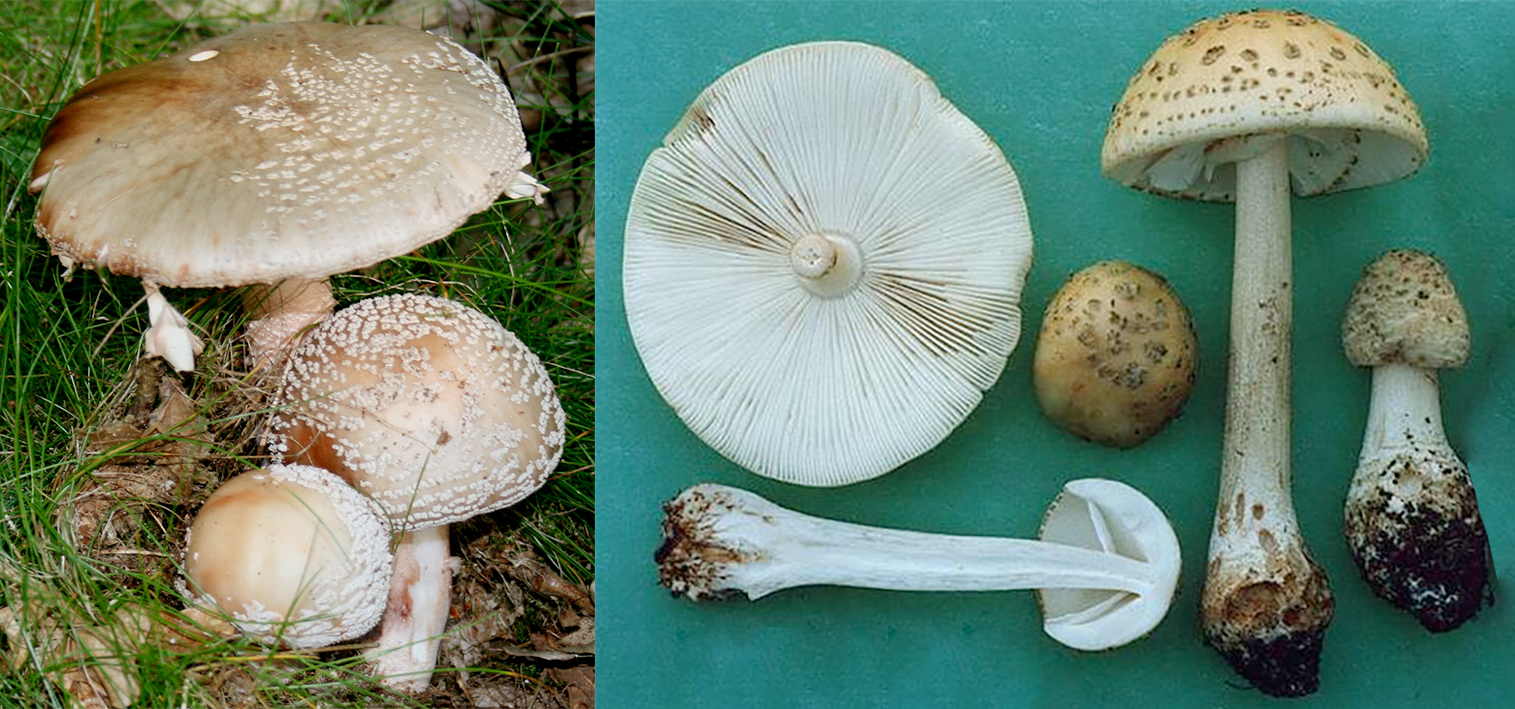
 The image, above, shows The Blusher (Amanita rubescens)
mushroom with three different growth stages in the wild (left)
along with images of an inverted mushroom, a slice through a
young mushroom along with two different growth stages against a
green background (right).
| Common Name: The Blusher |
| Scientific Name: Amanita rubescens |
| Other Names: Blushing Amanita, Amanita Wridog (CY) |
| Family: Amanitaceae |
| Range: Europe and Asia (the related A. novinupta in North America). |
Physical Characteristics Amanita rubescens is a medium-sized mycorrhizal fungus a reddish-brown convex pileus (cap), which is 5–15 centimetres (2–6 inches) across, and strewn with small white-to-mahogany warts. It is sometimes covered with an ochre-yellow flush which can be washed by the rain. The flesh of the mushroom is white, becoming pink when bruised or exposed to air. The stipe (stem) is white with flushes of the cap colour, and grows to 5–15 cm. The gills are white and free of the stem, and display red spots when damaged. The ring is striate (i.e. has ridges) on its upper side. The spores are white, ovate, amyloid, and approximately 8 by 5 μm in size. The flavour of the uncooked flesh is mild, but has a faint acrid aftertaste. The smell is not strong. A. rubescens is common throughout much of Europe and Asia. It grows on poor soils as well as in deciduous and coniferous woodlands, appearing from June through to November in the United Kingdom.
|
| Edible Parts: Caps |
 Spore Print: White Spore Print: White
|
 Cap: Flat Cap: Flat
|
 Hymenium: Free Hymenium: Free
|
 Pores: Gills on hymenium Pores: Gills on hymenium
|
 Stipe: Has a Ring Stipe: Has a Ring
|
 Edibility Rating: 4 Edibility Rating: 4 
|
 Known Hazards: A. rubescens contains a toxic haemolytic protein in its raw state, although it is not apparently harmful to consume (at least in moderate quantities) and can be destroyed by cooking. Known Hazards: A. rubescens contains a toxic haemolytic protein in its raw state, although it is not apparently harmful to consume (at least in moderate quantities) and can be destroyed by cooking.
|
Monthly Availability:
|
Welcome to the summary page for FabulousFusionFood's Wild Food guide to The Blusher along with all the The Blusher containing recipes presented on this site, with 2 recipes in total.
These recipes, all contain The Blusher as a major wild food ingredient.
The Blusher, Amanita rubescens (also known as the Blushing Amanita) is a frequently large species with a light brown to a darker red/brown sometimes with a yellow flush and covered in off-white to grey scales. The cap is spherical to convex to flat. that grows to 8–12cm in diameter. The gills are crowded and free of the stem. Can develop pink to red spots where damaged. The stem is 9-12 cm long, 1-2.5 cm diameter. Scaly and off white to grey/red/brown below the skirt, generally smoother and whiter above. The skirt is superior; it provides is an important identification tool as the top has fine grooves or striations running from the stem outwards. Young Blushers have an obvious volva but as the mushroom matures the bottom of the stem is bulbous rather than being marginate. The flesh is white but ‘blushing’ pink to red when bruised or exposed to air. The smell is initially faint, then becoming slightly acrid when fresh, tasty when cooked.
This mild-flavoured species with a pleasant flavour. It is edible after being cooked, though toxic when raw. Many sources say that this mushroom should be avoided, though that is mainly due to its being in the same family, the Amanitaceae as the very toxic species: Death Cap (Amanita phalloides), Destroying Angel (Amanita virosa or Amanita verna) and Panther Cap (Amanita pantherina). Fortunately, the tawny grisette looks nothing like the toxic Amanitas and has consistent and obvious characteristics that make it unmistakeable: there is the upward-tapering stem that lacks a ring, the white volva (sheath) at the base of the stem (this is discoloured in places with orange/brown) that occasionally sticks as a broad membraned to the cap and the orange/brown cap with its conspicuous radiating groves near the rim.
This is a good edible species, but needs to be cooked before consumption to denature haemolytic toxins in the raw flesh. It should not be picked by inexperienced foragers, get to know the Amanitas, particularly the toxic ones first and be certain of your identification. As always with mushrooms, if uncertain leave it alone.
Possible confusion: It may be confused with the toxic Panthercap (Amanita pantherina) The main difference is that the Blusher has lines or striations on its skirt running from the stem out, the Panthercap skirt is smooth. Other differences are the Blusher has a lighter cap, the scales on the cap are off-white to grey rather than white, the Blusher stem is bulbous at the bottom the Panthercap growing from a volval sack and has a rim or ‘gutter’ at the top of the volva (marginate) and finally, the Blusher ‘blushes’ red when damaged or exposed to air. The Grey Spotted Amanita (Amanita excelsa), generally has a darker cap but is very similar looking but this should not be a problem as it is edible.
Care should always be taken when identifying Amanitas.
For other edible mushrooms, see the guide to edible mushrooms
[2]. Huxley, A. The New RHS Dictionary of Gardening. 1999
[3]. Tanaka, T. Tanaka's Cyclopaedia of Edible Plants of the World.
[4]. Lim T.K. Edible Medicinal And Non-Medicinal Plants, Vols 1–12.
[5]. Thomas, G. S. Perennial Garden Plants, 2004
[6]. Milner, E. Trees of Britain and Ireland, 2011
[7]. Rose, F. & O'Reilly, C. The Wild Flower Key (Revised Edition) — How to identify wild plants, trees and shrubs in Britain and Ireland, 2006
[8]. Streeter, D. & Garrard, I. The Wild Flowers of the British Isles, 1983
[9]. Clapham, A.R.; Tutin, T.G. & Moore, D.M. Flora of the British Isles, 1987
[10]. Phillips, R. Mushrooms, 2006
[11]. Jordan, P. & Wheeler, S. The Complete Book of Mushrooms: An Illustrated Encyclopedia of Edible Mushrooms, 2011
[12]. Bunker, F. Seaweeds of Britain and Ireland, Second Edition, 2017
[13]. Facciola, S. Cornucopia II — A Source Book of Edible Plants, 1998
[14]. Hartford, R. Edible and Medicinal Wild Plants of Britain and Ireland: A Foraging and Photographic Identification Guide
(Note that the above book links are Amazon Affiliate links)
These recipes, all contain The Blusher as a major wild food ingredient.
The Blusher, Amanita rubescens (also known as the Blushing Amanita) is a frequently large species with a light brown to a darker red/brown sometimes with a yellow flush and covered in off-white to grey scales. The cap is spherical to convex to flat. that grows to 8–12cm in diameter. The gills are crowded and free of the stem. Can develop pink to red spots where damaged. The stem is 9-12 cm long, 1-2.5 cm diameter. Scaly and off white to grey/red/brown below the skirt, generally smoother and whiter above. The skirt is superior; it provides is an important identification tool as the top has fine grooves or striations running from the stem outwards. Young Blushers have an obvious volva but as the mushroom matures the bottom of the stem is bulbous rather than being marginate. The flesh is white but ‘blushing’ pink to red when bruised or exposed to air. The smell is initially faint, then becoming slightly acrid when fresh, tasty when cooked.
This mild-flavoured species with a pleasant flavour. It is edible after being cooked, though toxic when raw. Many sources say that this mushroom should be avoided, though that is mainly due to its being in the same family, the Amanitaceae as the very toxic species: Death Cap (Amanita phalloides), Destroying Angel (Amanita virosa or Amanita verna) and Panther Cap (Amanita pantherina). Fortunately, the tawny grisette looks nothing like the toxic Amanitas and has consistent and obvious characteristics that make it unmistakeable: there is the upward-tapering stem that lacks a ring, the white volva (sheath) at the base of the stem (this is discoloured in places with orange/brown) that occasionally sticks as a broad membraned to the cap and the orange/brown cap with its conspicuous radiating groves near the rim.
This is a good edible species, but needs to be cooked before consumption to denature haemolytic toxins in the raw flesh. It should not be picked by inexperienced foragers, get to know the Amanitas, particularly the toxic ones first and be certain of your identification. As always with mushrooms, if uncertain leave it alone.
Possible confusion: It may be confused with the toxic Panthercap (Amanita pantherina) The main difference is that the Blusher has lines or striations on its skirt running from the stem out, the Panthercap skirt is smooth. Other differences are the Blusher has a lighter cap, the scales on the cap are off-white to grey rather than white, the Blusher stem is bulbous at the bottom the Panthercap growing from a volval sack and has a rim or ‘gutter’ at the top of the volva (marginate) and finally, the Blusher ‘blushes’ red when damaged or exposed to air. The Grey Spotted Amanita (Amanita excelsa), generally has a darker cap but is very similar looking but this should not be a problem as it is edible.
Care should always be taken when identifying Amanitas.
For other edible mushrooms, see the guide to edible mushrooms
References:
[1]. David Evans Notes from field observations, tastings and cookery experiments.[2]. Huxley, A. The New RHS Dictionary of Gardening. 1999
[3]. Tanaka, T. Tanaka's Cyclopaedia of Edible Plants of the World.
[4]. Lim T.K. Edible Medicinal And Non-Medicinal Plants, Vols 1–12.
[5]. Thomas, G. S. Perennial Garden Plants, 2004
[6]. Milner, E. Trees of Britain and Ireland, 2011
[7]. Rose, F. & O'Reilly, C. The Wild Flower Key (Revised Edition) — How to identify wild plants, trees and shrubs in Britain and Ireland, 2006
[8]. Streeter, D. & Garrard, I. The Wild Flowers of the British Isles, 1983
[9]. Clapham, A.R.; Tutin, T.G. & Moore, D.M. Flora of the British Isles, 1987
[10]. Phillips, R. Mushrooms, 2006
[11]. Jordan, P. & Wheeler, S. The Complete Book of Mushrooms: An Illustrated Encyclopedia of Edible Mushrooms, 2011
[12]. Bunker, F. Seaweeds of Britain and Ireland, Second Edition, 2017
[13]. Facciola, S. Cornucopia II — A Source Book of Edible Plants, 1998
[14]. Hartford, R. Edible and Medicinal Wild Plants of Britain and Ireland: A Foraging and Photographic Identification Guide
(Note that the above book links are Amazon Affiliate links)
The alphabetical list of all The Blusher recipes on this site follows, (limited to 100 recipes per page). There are 2 recipes in total:
Page 1 of 1
| Dried Mushrooms Origin: Britain | Wild Mushroom Soup Origin: Britain |
Page 1 of 1