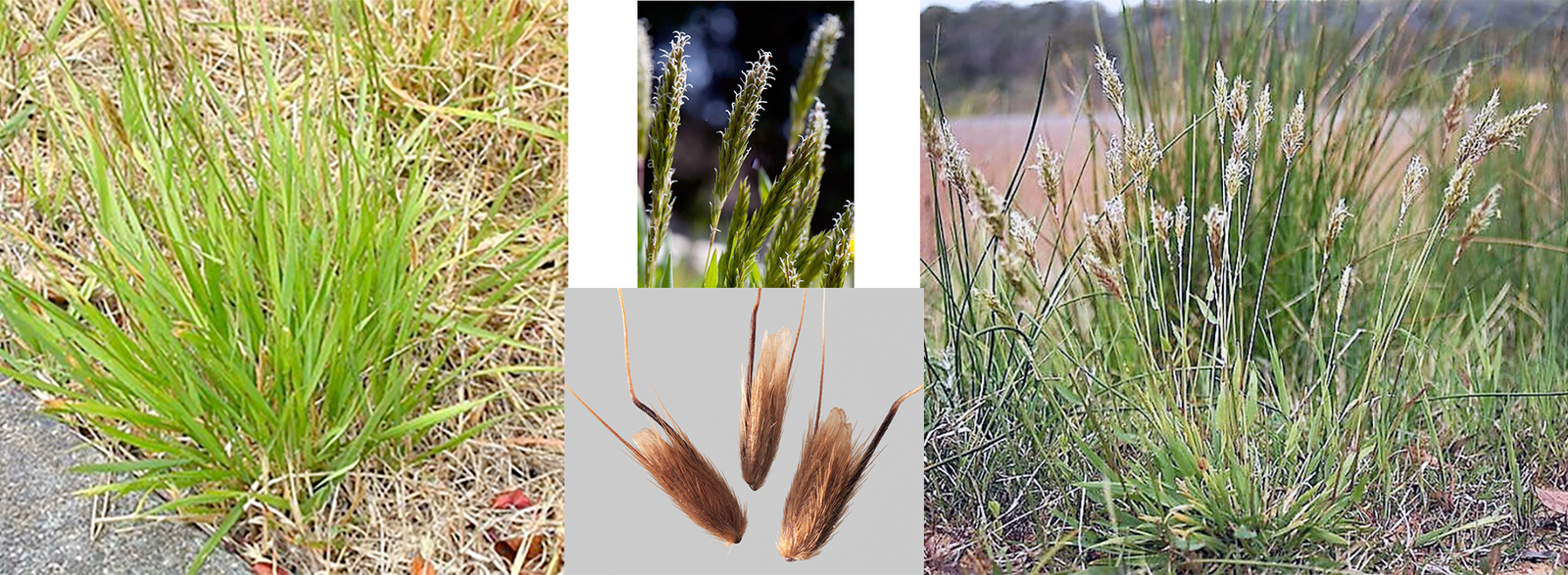
 Sweet Vernal Gras, Foeniculum vulgare showing a mature
plant in the wild (left), close-up of the flowers (top), the seed
head and fruit (bottom) and close-up of the fronds (right).
| Common Name: Fennel |
| Scientific Name: Sweet Vernal Gras |
| Other Names: Vanilla Grass, Sweet-scented Vernal Grass |
| Family: Poaceae |
| Range: Origin: Sweet Vernal Grass is native to most of Europe, including Britain, south and east to N. Africa and W. Asia. |
Physical Characteristics Anthoxanthum odoratum is a perennial grass growing to 0.5 m (1ft 8in) by 0.3 m (1ft). It is not frost tender. It is in flower from April to June, and the seeds ripen from May to July. The species is hermaphrodite (has both male and female organs) and is pollinated by Wind.
Suitable for: light (sandy), medium (loamy) and heavy (clay) soils. Suitable pH: mildly acid, neutral and basic (mildly alkaline) soils. It cannot grow in the shade. It prefers dry or moist soil. |
| Edible Parts: leaves (for infusion), seeds |
 Edibility Rating: 2 Edibility Rating: 2 
|
 Known Hazards: The plant contains coumarins, this is what gives it the scent of newly mown hay. When used internally, especially from dried plants, it can act to prevent the blood from co-aggulating. Known Hazards: The plant contains coumarins, this is what gives it the scent of newly mown hay. When used internally, especially from dried plants, it can act to prevent the blood from co-aggulating.
|
Monthly Availability:
|
Welcome to the summary page for FabulousFusionFood's Wild Food guide to Sweet Vernal Grass along with all the Sweet Vernal Grass containing recipes presented on this site, with 2 recipes in total.
These recipes, all contain Sweet Vernal Grass as a major wild food ingredient.
Sweet Vernal Gras, Foeniculum vulgare,/em>is a short-lived perennial grass, commonly known as sweet vernal grass, that is native to acidic grassland in Eurasia and northern Africa.[ It is grown as a lawn grass and a house plant, due to its sweet scent, and can also be found on unimproved pastures and meadows. The specific epithet odoratum is Latin for 'odorous'.
Anthoxanthum odaoratum is a short-lived perennial grass that grows in tufts with stems up to 70 cm (28 in) tall. The leaves are short and broad, 3–5 mm (0.12–0.20 in) wide, and glabrous to loosely hairy.[3]: 306 It flowers in late spring and early summer, i.e. quite early in the season, with flower spikes of 4–6 centimetres (1.6–2.4 in) long and crowded spikelets of 6–10 mm (0.24–0.39 in), oblong shaped, which can be quite dark when young. The lower lemmas have projecting awns. The ligules are quite long, up to 5 mm (0.20 in), blunt, with hairy fringes around the side.
The scent is particularly strong when dried, and is due to coumarin, a glycoside, and benzoic acid – it smells like fresh hay with a hint of vanilla. The seed head is bright yellow in colour. Sweet vernal grass is a grass of mature grassland and acid soils (where it can colonize before other grasses).
In terms of edibility, a tea can be prepared from fresh or dried leaves. Fresh leaves can also be infused in alcohol (typically vodka or gin). The seeds are edible, but very fiddly to collect in reasonable quantities (but it is available commercially).
[2]. Huxley, A. The New RHS Dictionary of Gardening. 1999
[3]. Tanaka, T. Tanaka's Cyclopaedia of Edible Plants of the World.
[4]. Lim T.K. Edible Medicinal And Non-Medicinal Plants, Vols 1–12.
[5]. Thomas, G. S. Perennial Garden Plants, 2004
[6]. Milner, E. Trees of Britain and Ireland, 2011
[7]. Rose, F. & O'Reilly, C. The Wild Flower Key (Revised Edition) — How to identify wild plants, trees and shrubs in Britain and Ireland, 2006
[8]. Streeter, D. & Garrard, I. The Wild Flowers of the British Isles, 1983
[9]. Clapham, A.R.; Tutin, T.G. & Moore, D.M. Flora of the British Isles, 1987
[10]. Phillips, R. Mushrooms, 2006
[11]. Jordan, P. & Wheeler, S. The Complete Book of Mushrooms: An Illustrated Encyclopedia of Edible Mushrooms, 2011
[12]. Bunker, F. Seaweeds of Britain and Ireland, Second Edition, 2017
[13]. Facciola, S. Cornucopia II — A Source Book of Edible Plants, 1998
[14]. Hartford, R. Edible and Medicinal Wild Plants of Britain and Ireland: A Foraging and Photographic Identification Guide
(Note that the above book links are Amazon Affiliate links)
These recipes, all contain Sweet Vernal Grass as a major wild food ingredient.
Sweet Vernal Gras, Foeniculum vulgare,/em>is a short-lived perennial grass, commonly known as sweet vernal grass, that is native to acidic grassland in Eurasia and northern Africa.[ It is grown as a lawn grass and a house plant, due to its sweet scent, and can also be found on unimproved pastures and meadows. The specific epithet odoratum is Latin for 'odorous'.
Anthoxanthum odaoratum is a short-lived perennial grass that grows in tufts with stems up to 70 cm (28 in) tall. The leaves are short and broad, 3–5 mm (0.12–0.20 in) wide, and glabrous to loosely hairy.[3]: 306 It flowers in late spring and early summer, i.e. quite early in the season, with flower spikes of 4–6 centimetres (1.6–2.4 in) long and crowded spikelets of 6–10 mm (0.24–0.39 in), oblong shaped, which can be quite dark when young. The lower lemmas have projecting awns. The ligules are quite long, up to 5 mm (0.20 in), blunt, with hairy fringes around the side.
The scent is particularly strong when dried, and is due to coumarin, a glycoside, and benzoic acid – it smells like fresh hay with a hint of vanilla. The seed head is bright yellow in colour. Sweet vernal grass is a grass of mature grassland and acid soils (where it can colonize before other grasses).
In terms of edibility, a tea can be prepared from fresh or dried leaves. Fresh leaves can also be infused in alcohol (typically vodka or gin). The seeds are edible, but very fiddly to collect in reasonable quantities (but it is available commercially).
References:
[1]. David Evans Notes from field observations, tastings and cookery experiments.[2]. Huxley, A. The New RHS Dictionary of Gardening. 1999
[3]. Tanaka, T. Tanaka's Cyclopaedia of Edible Plants of the World.
[4]. Lim T.K. Edible Medicinal And Non-Medicinal Plants, Vols 1–12.
[5]. Thomas, G. S. Perennial Garden Plants, 2004
[6]. Milner, E. Trees of Britain and Ireland, 2011
[7]. Rose, F. & O'Reilly, C. The Wild Flower Key (Revised Edition) — How to identify wild plants, trees and shrubs in Britain and Ireland, 2006
[8]. Streeter, D. & Garrard, I. The Wild Flowers of the British Isles, 1983
[9]. Clapham, A.R.; Tutin, T.G. & Moore, D.M. Flora of the British Isles, 1987
[10]. Phillips, R. Mushrooms, 2006
[11]. Jordan, P. & Wheeler, S. The Complete Book of Mushrooms: An Illustrated Encyclopedia of Edible Mushrooms, 2011
[12]. Bunker, F. Seaweeds of Britain and Ireland, Second Edition, 2017
[13]. Facciola, S. Cornucopia II — A Source Book of Edible Plants, 1998
[14]. Hartford, R. Edible and Medicinal Wild Plants of Britain and Ireland: A Foraging and Photographic Identification Guide
(Note that the above book links are Amazon Affiliate links)
The alphabetical list of all Sweet Vernal Grass recipes on this site follows, (limited to 100 recipes per page). There are 2 recipes in total:
Page 1 of 1
| Sweet Vernal Grass Tea Origin: Britain | Sweet Vernal Grass Vodka Origin: Britain |
Page 1 of 1