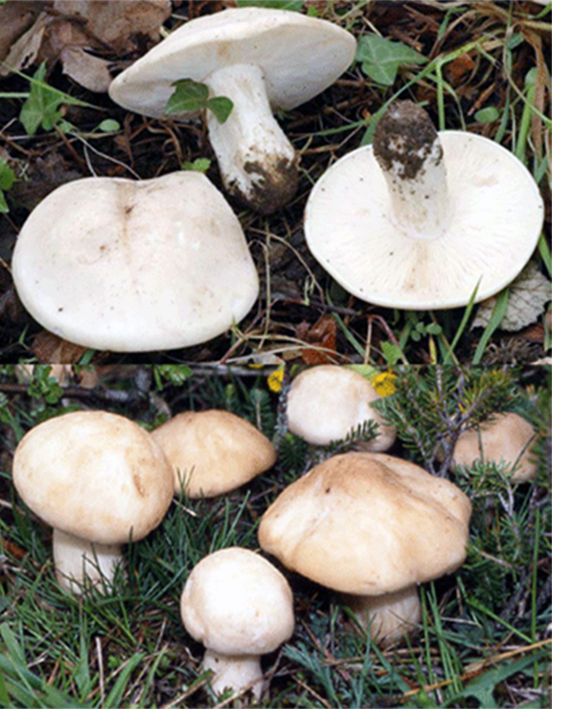
 The image, above, shows a range of pictures of St George's
mushrooms (Calocybe gambosa), showing the different
sizes and shapes of the fruiting bodies. Also shown are the white
gils of the mushroom and its prominent frill and stipe ring..
| Common Name: St George's mushrooms |
| Scientific Name: Calocybe gambosa |
| Other Names: |
| Family: Lyophyllaceae |
| Range: Europe |
Physical Characteristics Calocybe gambosa is a mycorrhizal fungus, growing to 10cm (4 in) by 15cm (6 in) in size. It is typically associated with fields and grassy areas and fruits from late April to May.
|
| Edible Parts: Caps, Stipes |
 Spore Print: White Spore Print: White
|
 Cap: Convex Cap: Convex
|
 Hymenium: Sinuate Hymenium: Sinuate
|
 Gills: Gills on hymenium Gills: Gills on hymenium
|
 Stipe: Bare Stipe: Bare
|
 Edibility Rating: 4 Edibility Rating: 4 
|
 Known Hazards: None known. Known Hazards: None known.
|
Monthly Availability:
|
Welcome to the summary page for FabulousFusionFood's Wild Food guide to St George's Mushroom along with all the St George's Mushroom containing recipes presented on this site, with 21 recipes in total.
These recipes, all contain St George's Mushroom as a major wild food ingredient.
The St George's Mushroom, Calocybe gambosa (formerly Tricholoma gambosum), is a mycorrhizal fungus (has a symbiotic relationship with tree roots) and is a member of the Tricholomataceae (white, pink and yellow-spored) family of fungi and is a cousin of the Agarisuc family. It grows on the verges of wooded areas or at the base of hedges but can also be found in parks and open grassland. It is a native of Western Europe and is harvested commercially in Romania. It is one of the earliest of the edible mushrooms, first appearing in Late April (hence the name, as it is associated with St George's Day) and most prominent in May though June. It has a very chunky texture and mealy smell (reminiscent of old leather) which many find unpleasant. As a result it's often left off the list of edible species. But it is edible and good and is useful in that it's abundant and spring-fruiting. Personally I like it very much and make a point of foraging for it. So try a few and see what you think.
It grows gregariously, and often in large fairy rings (which can be many centuries old). Young specimens are domed buttons and the cap, stipe (stem) and gills are all milky white. The cap is dry and fleshy and remains domed throughout its development, smelling strongly either mealy or having a cucumber-like odour. The cap has inrolled edges when young but flattens as the fungus ages. The stipe is ringless and tends to have a bulbous base. The mushroom is smooth with no scales. As the fungus ages the cap flattens and becomes deeper in colour to a pale tan.
The spore print is white and can only be seen on dark paper. The stipe (stem) is broad and solid often with a curve or kink in the middle. The cap measures from 5-15 cm in diameter and has a smooth texture and has ridges on it and the fungus grows to some 10 to 15 cm tall. Personally I think it's excellent (and is much appreciated in Germany) and well worth picking, especially as it's one of the few spring mushrooms worth foraging for (morels being the other). It can be eaten raw, cooked, dried or pickled. It is considered a delicacy when simply fried in butter.
If picking, care should be taken not to confuse it with the uncommon but deadly poisonous Red-Staining Inocybe Inocybe patouilarde which grows in the similar habitat but is distinguished by its fruity smell which becomes foetid in older specimens. It is distinctly bell-shaped with a raised dome even at the button stage, its olive green gills and cut stem are distinctive and they slowly colour red when cut. The fungus bruises brick red, often in radial lines from the cap. As it ages the uneven radial margins of the cap tend to split.
Its firm texture makes the St George's Mushroom excellent for pickling and preserving by drying.
For other edible mushrooms, see the guide to edible mushrooms
[2]. Huxley, A. The New RHS Dictionary of Gardening. 1999
[3]. Tanaka, T. Tanaka's Cyclopaedia of Edible Plants of the World.
[4]. Lim T.K. Edible Medicinal And Non-Medicinal Plants, Vols 1–12.
[5]. Thomas, G. S. Perennial Garden Plants, 2004
[6]. Milner, E. Trees of Britain and Ireland, 2011
[7]. Rose, F. & O'Reilly, C. The Wild Flower Key (Revised Edition) — How to identify wild plants, trees and shrubs in Britain and Ireland, 2006
[8]. Streeter, D. & Garrard, I. The Wild Flowers of the British Isles, 1983
[9]. Clapham, A.R.; Tutin, T.G. & Moore, D.M. Flora of the British Isles, 1987
[10]. Phillips, R. Mushrooms, 2006
[11]. Jordan, P. & Wheeler, S. The Complete Book of Mushrooms: An Illustrated Encyclopedia of Edible Mushrooms, 2011
[12]. Bunker, F. Seaweeds of Britain and Ireland, Second Edition, 2017
[13]. Facciola, S. Cornucopia II — A Source Book of Edible Plants, 1998
[14]. Hartford, R. Edible and Medicinal Wild Plants of Britain and Ireland: A Foraging and Photographic Identification Guide
(Note that the above book links are Amazon Affiliate links)
These recipes, all contain St George's Mushroom as a major wild food ingredient.
The St George's Mushroom, Calocybe gambosa (formerly Tricholoma gambosum), is a mycorrhizal fungus (has a symbiotic relationship with tree roots) and is a member of the Tricholomataceae (white, pink and yellow-spored) family of fungi and is a cousin of the Agarisuc family. It grows on the verges of wooded areas or at the base of hedges but can also be found in parks and open grassland. It is a native of Western Europe and is harvested commercially in Romania. It is one of the earliest of the edible mushrooms, first appearing in Late April (hence the name, as it is associated with St George's Day) and most prominent in May though June. It has a very chunky texture and mealy smell (reminiscent of old leather) which many find unpleasant. As a result it's often left off the list of edible species. But it is edible and good and is useful in that it's abundant and spring-fruiting. Personally I like it very much and make a point of foraging for it. So try a few and see what you think.
It grows gregariously, and often in large fairy rings (which can be many centuries old). Young specimens are domed buttons and the cap, stipe (stem) and gills are all milky white. The cap is dry and fleshy and remains domed throughout its development, smelling strongly either mealy or having a cucumber-like odour. The cap has inrolled edges when young but flattens as the fungus ages. The stipe is ringless and tends to have a bulbous base. The mushroom is smooth with no scales. As the fungus ages the cap flattens and becomes deeper in colour to a pale tan.
The spore print is white and can only be seen on dark paper. The stipe (stem) is broad and solid often with a curve or kink in the middle. The cap measures from 5-15 cm in diameter and has a smooth texture and has ridges on it and the fungus grows to some 10 to 15 cm tall. Personally I think it's excellent (and is much appreciated in Germany) and well worth picking, especially as it's one of the few spring mushrooms worth foraging for (morels being the other). It can be eaten raw, cooked, dried or pickled. It is considered a delicacy when simply fried in butter.
If picking, care should be taken not to confuse it with the uncommon but deadly poisonous Red-Staining Inocybe Inocybe patouilarde which grows in the similar habitat but is distinguished by its fruity smell which becomes foetid in older specimens. It is distinctly bell-shaped with a raised dome even at the button stage, its olive green gills and cut stem are distinctive and they slowly colour red when cut. The fungus bruises brick red, often in radial lines from the cap. As it ages the uneven radial margins of the cap tend to split.
Its firm texture makes the St George's Mushroom excellent for pickling and preserving by drying.
For other edible mushrooms, see the guide to edible mushrooms
References:
[1]. David Evans Notes from field observations, tastings and cookery experiments.[2]. Huxley, A. The New RHS Dictionary of Gardening. 1999
[3]. Tanaka, T. Tanaka's Cyclopaedia of Edible Plants of the World.
[4]. Lim T.K. Edible Medicinal And Non-Medicinal Plants, Vols 1–12.
[5]. Thomas, G. S. Perennial Garden Plants, 2004
[6]. Milner, E. Trees of Britain and Ireland, 2011
[7]. Rose, F. & O'Reilly, C. The Wild Flower Key (Revised Edition) — How to identify wild plants, trees and shrubs in Britain and Ireland, 2006
[8]. Streeter, D. & Garrard, I. The Wild Flowers of the British Isles, 1983
[9]. Clapham, A.R.; Tutin, T.G. & Moore, D.M. Flora of the British Isles, 1987
[10]. Phillips, R. Mushrooms, 2006
[11]. Jordan, P. & Wheeler, S. The Complete Book of Mushrooms: An Illustrated Encyclopedia of Edible Mushrooms, 2011
[12]. Bunker, F. Seaweeds of Britain and Ireland, Second Edition, 2017
[13]. Facciola, S. Cornucopia II — A Source Book of Edible Plants, 1998
[14]. Hartford, R. Edible and Medicinal Wild Plants of Britain and Ireland: A Foraging and Photographic Identification Guide
(Note that the above book links are Amazon Affiliate links)
The alphabetical list of all St George's Mushroom recipes on this site follows, (limited to 100 recipes per page). There are 21 recipes in total:
Page 1 of 1
Page 1 of 1