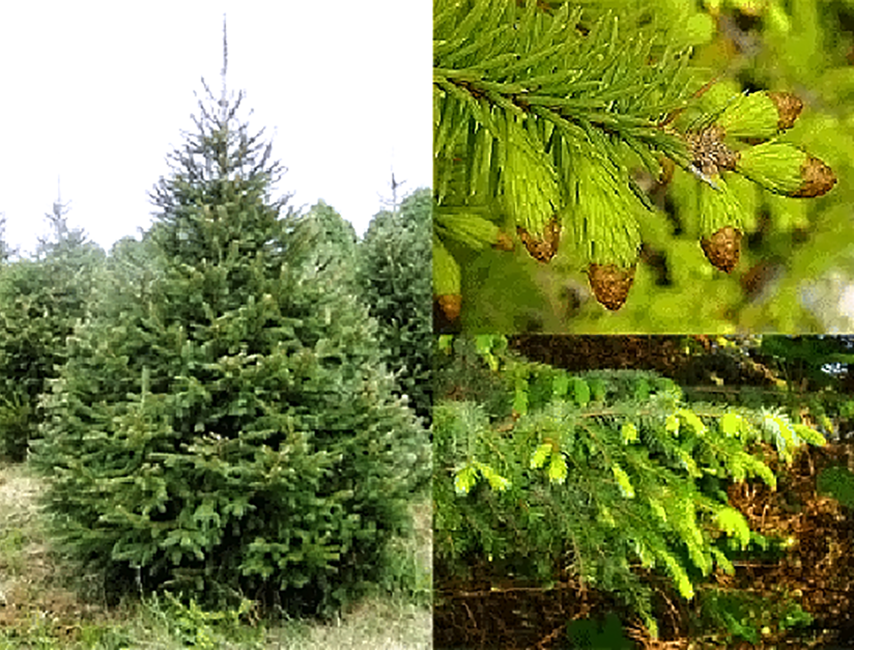
 The image, above, shows a young Norway Spruce tree (Picea
abies), left. Also shown are the emerging leaf buds, top
right and slightly more mature (but still edible) leaf shoot,
bottom right..
| Common Name: Spruce |
| Scientific Name: Picea spp. (typically Picea abies or Picea sitchensis) |
|
Other Names: Norway Spruce, Sitka Spruce |
| Family: Pinaceae |
| Range: Eurasia, North America (depending on species) |
Physical Characteristics
 Picea spp are hardy evergreen trees, growing to 30m (98 ft) by 10m (32 ft) in size. They are hardy to zone 4 and is not frost tender. The tree is in leaf year-round and flowers from May to June. The seeds ripen from October to November. The flowers are monoecious (individual flowers are either male or female, but both sexes can be found on the same tree) and are wind pollinated.
|
| Edible Parts: Flowers, Young Leaves, Inner Bark, Seeds, Pollen, young cones |
 Edibility Rating: 2 Edibility Rating: 2 
|
 Known Hazards: The wood, sawdust and resins from various species of pine can cause dermatitis in sensitive people Known Hazards: The wood, sawdust and resins from various species of pine can cause dermatitis in sensitive people
|
Welcome to the summary page for FabulousFusionFood's Wild Food guide to Spruce along with all the Spruce containing recipes presented on this site, with 17 recipes in total.
These recipes, all contain Spruce as a major wild food ingredient.
Spruce, Picea spp, represents a genus of about 35 species of coniferous evergreen trees in the family Pinaceae, found in the northern temperate and boreal (taiga) regions of the earth, with the type species being Picea abies. Typically, spruces are large trees, from 20–60 metres (66–200 ft) tall when mature, and can be distinguished by their whorled branches and conical form. The needles, or leaves, of spruce trees are attached singly to the branches in a spiral fashion, each needle on a small peg-like structure called a pulvinus. The needles are shed when 4–10 years old, leaving the branches rough with the retained pulvinus (an easy means of distinguishing them from other similar genera, where the branches are fairly smooth). Spruce is one of the most important woods for paper uses, as it has long wood fibres which bind together to make strong paper. Spruces are cultivated over vast areas for this purpose. Also, they are useful for building wood. They are also the original Christmas trees. As a result large tracts of spruces have been planted in many temperate countries (in Europe, this tends to be Picea abies, Norway Spruce; and in North America either Picea sitchensis, Sitka spruce or Picea mariana Black Spruce).
During spring, the tips of the branches open into lime green spruce tips that shed their papery cover. These spruce tips (see the right-hand images above) are both edible and tasty. They can be added sparingly to salads or boiled like a leaf green. They can also be used to flavour cakes, oils and vinegars. These spruce tips are a rich source of vitamin C and are useful in preventing scurvy in Northern latitudes where meat is the primary source of energy in the diet. In Northern Europe, spruce tips are a traditional flavouring for beer.
In my own culinary experimentation, I have found that young pine needles or pine leaf buds and fresh tips can be chopped and used in many recipes that call for rosemary. They work particularly well with chicken, lamb and goat meat.
As well as the young leaf tips, the young male catkins can be eaten raw or cooked. They can also be used as a flavouring for desserts, meads and honey. Pollen from the male catkins can also be gathered in spring by shaking. This can be stored and used as a flour substitute or as a thickener for stews and soups it can also be added to smoothies and waffle or pancake batters. The immature female cones can also be eaten when cooked. The central portion of the immature female cones, particularly, when roasted are sweet and syrupy and make an excellent snack or base for a dessert; they can also be used for preparing wine. The inner bark (cambium) of the tree, particularly near the base, is edible and can be dried and ground into a powder that's used as a thickener for soups and stews or which can be mixed with flour as an adulterant in preparing bread. It can also be sliced into thin slivers and when fried in flavoured oil (eg coconut, grapeseed) this makes a tasty snack. The bark can be seeped in water for its sugar and the water drunk.
Very young immature female pine cones make an excellent flavouring and can be substituted for juniper berries in many recipes (though they are more resinous in flavour). They can be used as a garnish for salads or can be added to beers and wines to give a refreshing, slightly-resinous, taste.
The seeds (pine kernels), extracted from the cones, can be eaten raw. They are rich in essential oils and have a pleasant, slightly resinous, flavour (but they are small and fiddly to handle). The young leaf shoot tips, when infused in boiling water, make a refreshing tea rich in vitamin C.
The pollen is also edible and like many pine species spruce male cones produce copious amounts of pollen. Just when the new growth of needles appear the male cones are produced. When ripe, these will produce clouds of pollen when disturbed. To collect, carefully place a plastic bag over a cone then tap to displace the pollen. This can be used in any recipe on this site that calls for pollen or it can be added to flour as an adulterant that ups the protein content.
[2]. Huxley, A. The New RHS Dictionary of Gardening. 1999
[3]. Tanaka, T. Tanaka's Cyclopaedia of Edible Plants of the World.
[4]. Lim T.K. Edible Medicinal And Non-Medicinal Plants, Vols 1–12.
[5]. Thomas, G. S. Perennial Garden Plants, 2004
[6]. Milner, E. Trees of Britain and Ireland, 2011
[7]. Rose, F. & O'Reilly, C. The Wild Flower Key (Revised Edition) — How to identify wild plants, trees and shrubs in Britain and Ireland, 2006
[8]. Streeter, D. & Garrard, I. The Wild Flowers of the British Isles, 1983
[9]. Clapham, A.R.; Tutin, T.G. & Moore, D.M. Flora of the British Isles, 1987
[10]. Phillips, R. Mushrooms, 2006
[11]. Jordan, P. & Wheeler, S. The Complete Book of Mushrooms: An Illustrated Encyclopedia of Edible Mushrooms, 2011
[12]. Bunker, F. Seaweeds of Britain and Ireland, Second Edition, 2017
[13]. Facciola, S. Cornucopia II — A Source Book of Edible Plants, 1998
[14]. Hartford, R. Edible and Medicinal Wild Plants of Britain and Ireland: A Foraging and Photographic Identification Guide
(Note that the above book links are Amazon Affiliate links)
These recipes, all contain Spruce as a major wild food ingredient.
Spruce, Picea spp, represents a genus of about 35 species of coniferous evergreen trees in the family Pinaceae, found in the northern temperate and boreal (taiga) regions of the earth, with the type species being Picea abies. Typically, spruces are large trees, from 20–60 metres (66–200 ft) tall when mature, and can be distinguished by their whorled branches and conical form. The needles, or leaves, of spruce trees are attached singly to the branches in a spiral fashion, each needle on a small peg-like structure called a pulvinus. The needles are shed when 4–10 years old, leaving the branches rough with the retained pulvinus (an easy means of distinguishing them from other similar genera, where the branches are fairly smooth). Spruce is one of the most important woods for paper uses, as it has long wood fibres which bind together to make strong paper. Spruces are cultivated over vast areas for this purpose. Also, they are useful for building wood. They are also the original Christmas trees. As a result large tracts of spruces have been planted in many temperate countries (in Europe, this tends to be Picea abies, Norway Spruce; and in North America either Picea sitchensis, Sitka spruce or Picea mariana Black Spruce).
During spring, the tips of the branches open into lime green spruce tips that shed their papery cover. These spruce tips (see the right-hand images above) are both edible and tasty. They can be added sparingly to salads or boiled like a leaf green. They can also be used to flavour cakes, oils and vinegars. These spruce tips are a rich source of vitamin C and are useful in preventing scurvy in Northern latitudes where meat is the primary source of energy in the diet. In Northern Europe, spruce tips are a traditional flavouring for beer.
In my own culinary experimentation, I have found that young pine needles or pine leaf buds and fresh tips can be chopped and used in many recipes that call for rosemary. They work particularly well with chicken, lamb and goat meat.
As well as the young leaf tips, the young male catkins can be eaten raw or cooked. They can also be used as a flavouring for desserts, meads and honey. Pollen from the male catkins can also be gathered in spring by shaking. This can be stored and used as a flour substitute or as a thickener for stews and soups it can also be added to smoothies and waffle or pancake batters. The immature female cones can also be eaten when cooked. The central portion of the immature female cones, particularly, when roasted are sweet and syrupy and make an excellent snack or base for a dessert; they can also be used for preparing wine. The inner bark (cambium) of the tree, particularly near the base, is edible and can be dried and ground into a powder that's used as a thickener for soups and stews or which can be mixed with flour as an adulterant in preparing bread. It can also be sliced into thin slivers and when fried in flavoured oil (eg coconut, grapeseed) this makes a tasty snack. The bark can be seeped in water for its sugar and the water drunk.
Very young immature female pine cones make an excellent flavouring and can be substituted for juniper berries in many recipes (though they are more resinous in flavour). They can be used as a garnish for salads or can be added to beers and wines to give a refreshing, slightly-resinous, taste.
The seeds (pine kernels), extracted from the cones, can be eaten raw. They are rich in essential oils and have a pleasant, slightly resinous, flavour (but they are small and fiddly to handle). The young leaf shoot tips, when infused in boiling water, make a refreshing tea rich in vitamin C.
The pollen is also edible and like many pine species spruce male cones produce copious amounts of pollen. Just when the new growth of needles appear the male cones are produced. When ripe, these will produce clouds of pollen when disturbed. To collect, carefully place a plastic bag over a cone then tap to displace the pollen. This can be used in any recipe on this site that calls for pollen or it can be added to flour as an adulterant that ups the protein content.
References:
[1]. David Evans Notes from field observations, tastings and cookery experiments.[2]. Huxley, A. The New RHS Dictionary of Gardening. 1999
[3]. Tanaka, T. Tanaka's Cyclopaedia of Edible Plants of the World.
[4]. Lim T.K. Edible Medicinal And Non-Medicinal Plants, Vols 1–12.
[5]. Thomas, G. S. Perennial Garden Plants, 2004
[6]. Milner, E. Trees of Britain and Ireland, 2011
[7]. Rose, F. & O'Reilly, C. The Wild Flower Key (Revised Edition) — How to identify wild plants, trees and shrubs in Britain and Ireland, 2006
[8]. Streeter, D. & Garrard, I. The Wild Flowers of the British Isles, 1983
[9]. Clapham, A.R.; Tutin, T.G. & Moore, D.M. Flora of the British Isles, 1987
[10]. Phillips, R. Mushrooms, 2006
[11]. Jordan, P. & Wheeler, S. The Complete Book of Mushrooms: An Illustrated Encyclopedia of Edible Mushrooms, 2011
[12]. Bunker, F. Seaweeds of Britain and Ireland, Second Edition, 2017
[13]. Facciola, S. Cornucopia II — A Source Book of Edible Plants, 1998
[14]. Hartford, R. Edible and Medicinal Wild Plants of Britain and Ireland: A Foraging and Photographic Identification Guide
(Note that the above book links are Amazon Affiliate links)
The alphabetical list of all Spruce recipes on this site follows, (limited to 100 recipes per page). There are 17 recipes in total:
Page 1 of 1
| Alaskan Spruce Tip Syrup Origin: Britain | Pine Pollen Noodles Origin: Fusion | Spruce Tip Shortbread Origin: Britain |
| Alpine Dock and Spruce Tip Crumble Origin: Britain | Pine Pollen Pancakes Origin: Britain | Spruce Tip Sorbet Origin: Britain |
| Egg Noodles with Pine Pollen Origin: Britain | Pine Pollen Waffles Origin: Britain | Spruce Tip Tea Origin: Britain |
| Pickled Spruce Tips Origin: Canada | Raparperi ja Spruce Vihje juoma (Rhubarb and Spruce Tip Drink) Origin: Finland | Spruce Tip Vinegar Origin: American |
| Pickled Spruce Tips Rémoulade Sauce Origin: Canada | Rhubarb and Spruce Tip Crumble Origin: Britain | Spruce Tips Ice Cream Origin: Britain |
| Pine Pollen Bread Origin: France | Spruce Tip Infused Olive Oil Origin: Britain |
Page 1 of 1