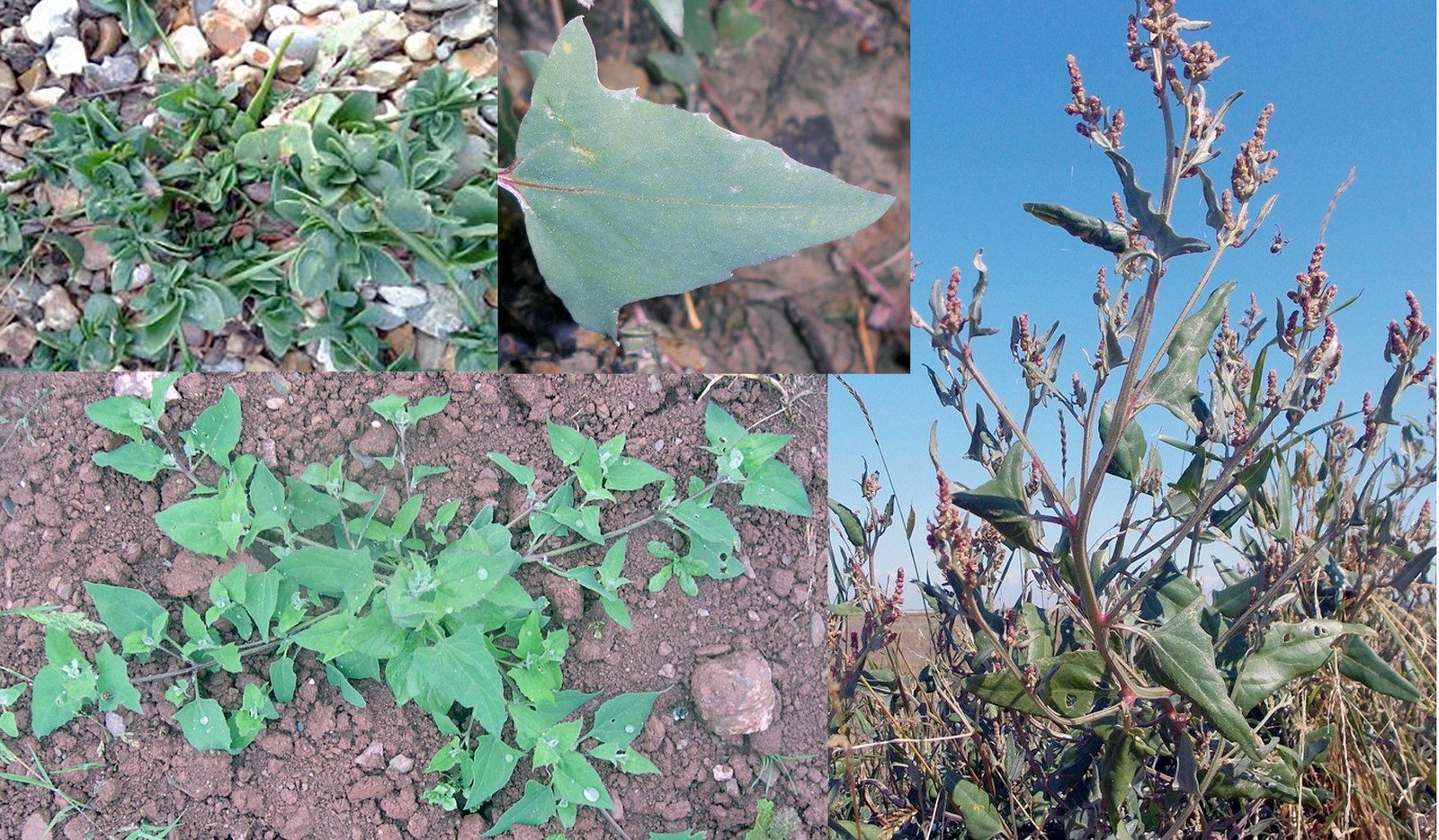
 Spear-leaved Orache (Atriplex prostrata) showing a young plant
(top left) a more mature plant (bottom left), a close-up of a
leaf and an image of the flowers..
| Common Name: Spear-leaved Orache |
| Scientific Name: Atriplex prostrata |
| Other Names: spear-leaved orache, hastate orache, thin-leaf orache, triangle orache and creeping saltbush |
| Family: Amaranthaceae |
| Range: Origin: Spear-leaved Orache is native to Europe, Macaronesia, northern Africa, Ethiopia, the Middle East, western Siberia, and Central Asia. It has been naturalised in temperate North America, South America, Australia, New Zealand, Korea, Japan, and Primorsky Krai in far eastern Russia and is an invasive weed in several regions. |
Physical Characteristics Atriplex prostrata is a prostate, facultative, herbaceous annual, of beaches, saltmarshes and other open, often wet, saline habitats near the sea; also as an inland weed in disturbed areas on moist, fertile, neutral to basic soils, such as the margins of ditches and ponds, by canals, reservoirs, rivers and sewage works, on cultivated land, refuse tips, waste ground and churchyards. It also occurs in inland saltmarshes and along salt-treated roadsides. Generally lowland, but reaching 570 m in some places.
Suitable for: moist, fertile, neutral to basic soils It prefers saline soil.
Atriplex prostrata is a prostate, facultative, herbaceous annual, of beaches, saltmarshes and other open, often wet, saline habitats near the sea; also as an inland weed in disturbed areas on moist, fertile, neutral to basic soils, such as the margins of ditches and ponds, by canals, reservoirs, rivers and sewage works, on cultivated land, refuse tips, waste ground and churchyards. It also occurs in inland saltmarshes and along salt-treated roadsides. Generally lowland, but reaching 570 m in some places.
Suitable for: moist, fertile, neutral to basic soils It prefers saline soil.
|
| Edible Parts: leaves and young stems |
 Edibility Rating: 2 Edibility Rating: 2 
|
 Known Hazards: None Known Known Hazards: None Known
|
Monthly Availability:
|
Welcome to the summary page for FabulousFusionFood's Wild Food guide to Spear-leaved Orache along with all the Spear-leaved Orache containing recipes presented on this site, with 4 recipes in total.
These recipes, all contain Spear-leaved Orache as a major wild food ingredient.
Spear-leaved Orache, Atriplex prostrata is a species of flowering annual herbaceous plant in the family Amaranthaceae, native to Europe, Macaronesia, northern Africa, Ethiopia, the Middle East, western Siberia, and Central Asia. Spear-leaved orache is a low-growing plant that typically grows up to 30 cm in height. It has a prostrate growth habit, meaning that it grows horizontally along the ground. The leaves of this plant are spear-shaped, hence its common name, and are often grey-green or blue-green in colour. The plant produces small, greenish-yellow flowers that are arranged in clusters. These flowers are not particularly showy and are often overlooked.
Spear-leaved orache plays an important role in its native habitats as it is a pioneer species, meaning that it is one of the first plants to colonize disturbed areas. The plant is also tolerant of salty soils, making it an important species in coastal areas where saltwater intrusion can be a problem. The plant provides habitat and food for a variety of insects and small mammals, including bees and butterflies. In addition to its medicinal and culinary uses (see below), spear-leaved orache is sometimes used for erosion control and soil stabilization. Its deep roots help to anchor soil and prevent erosion in areas that are prone to landslides or other soil disturbances. Spear-leaved orache has also been studied for its potential use in phytoremediation, which is the process of using plants to remove contaminants from soil or water. The plant has been found to be effective in removing heavy metals from contaminated soil, making it a potentially useful tool in environmental remediation efforts.
Spear-leaved orache is also sometimes used in landscaping and ornamental gardening. Its low-growing habit and attractive foliage make it a popular choice for ground cover or border planting. The plant is relatively easy to grow and can thrive in a variety of soil types and growing conditions.
Spear-leaved orache has a long history of use in traditional medicine. In some cultures, the plant was used to treat digestive problems and respiratory ailments. The leaves of the plant were also used as a food source, either cooked or raw. Today, the plant is sometimes used as a culinary herb or as a leafy vegetable. It is sometimes added to salads or soups and can be used as a substitute for spinach.
The Spear-Leaved Orache, is a mealy, upright, annual plant that is member of a broad family of edible plants, often called Saltbushes, due to their salty tang and coastal habit. They are closely related to common orache, Fat Hen (Lamb's Quarters) and look a little similar and the leaves of spear-leaved orache can be substituted in most recipes that call for these greens. The Spear-Leaved Orache can often be found inland (though it's typically a coastal plant), growing on wasteland or roadsides, particularly if the road surface is gritted with salt over the winter (it has used these roads to colonize inland), and produces small pink flower spikes between July–September. The young goosefoot-shaped leaves and shoots can be added to salads and with their slightly salty tang are a welcome addition to spring salads. Older leaves can be cooked and used as spinach substitute. As they naturally retain salt, they don't often need to be seasoned whilst cooking.
[2]. Huxley, A. The New RHS Dictionary of Gardening. 1999
[3]. Tanaka, T. Tanaka's Cyclopaedia of Edible Plants of the World.
[4]. Lim T.K. Edible Medicinal And Non-Medicinal Plants, Vols 1–12.
[5]. Thomas, G. S. Perennial Garden Plants, 2004
[6]. Milner, E. Trees of Britain and Ireland, 2011
[7]. Rose, F. & O'Reilly, C. The Wild Flower Key (Revised Edition) — How to identify wild plants, trees and shrubs in Britain and Ireland, 2006
[8]. Streeter, D. & Garrard, I. The Wild Flowers of the British Isles, 1983
[9]. Clapham, A.R.; Tutin, T.G. & Moore, D.M. Flora of the British Isles, 1987
[10]. Phillips, R. Mushrooms, 2006
[11]. Jordan, P. & Wheeler, S. The Complete Book of Mushrooms: An Illustrated Encyclopedia of Edible Mushrooms, 2011
[12]. Bunker, F. Seaweeds of Britain and Ireland, Second Edition, 2017
[13]. Facciola, S. Cornucopia II — A Source Book of Edible Plants, 1998
[14]. Hartford, R. Edible and Medicinal Wild Plants of Britain and Ireland: A Foraging and Photographic Identification Guide
(Note that the above book links are Amazon Affiliate links)
These recipes, all contain Spear-leaved Orache as a major wild food ingredient.
Spear-leaved Orache, Atriplex prostrata is a species of flowering annual herbaceous plant in the family Amaranthaceae, native to Europe, Macaronesia, northern Africa, Ethiopia, the Middle East, western Siberia, and Central Asia. Spear-leaved orache is a low-growing plant that typically grows up to 30 cm in height. It has a prostrate growth habit, meaning that it grows horizontally along the ground. The leaves of this plant are spear-shaped, hence its common name, and are often grey-green or blue-green in colour. The plant produces small, greenish-yellow flowers that are arranged in clusters. These flowers are not particularly showy and are often overlooked.
Spear-leaved orache plays an important role in its native habitats as it is a pioneer species, meaning that it is one of the first plants to colonize disturbed areas. The plant is also tolerant of salty soils, making it an important species in coastal areas where saltwater intrusion can be a problem. The plant provides habitat and food for a variety of insects and small mammals, including bees and butterflies. In addition to its medicinal and culinary uses (see below), spear-leaved orache is sometimes used for erosion control and soil stabilization. Its deep roots help to anchor soil and prevent erosion in areas that are prone to landslides or other soil disturbances. Spear-leaved orache has also been studied for its potential use in phytoremediation, which is the process of using plants to remove contaminants from soil or water. The plant has been found to be effective in removing heavy metals from contaminated soil, making it a potentially useful tool in environmental remediation efforts.
Spear-leaved orache is also sometimes used in landscaping and ornamental gardening. Its low-growing habit and attractive foliage make it a popular choice for ground cover or border planting. The plant is relatively easy to grow and can thrive in a variety of soil types and growing conditions.
Spear-leaved orache has a long history of use in traditional medicine. In some cultures, the plant was used to treat digestive problems and respiratory ailments. The leaves of the plant were also used as a food source, either cooked or raw. Today, the plant is sometimes used as a culinary herb or as a leafy vegetable. It is sometimes added to salads or soups and can be used as a substitute for spinach.
The Spear-Leaved Orache, is a mealy, upright, annual plant that is member of a broad family of edible plants, often called Saltbushes, due to their salty tang and coastal habit. They are closely related to common orache, Fat Hen (Lamb's Quarters) and look a little similar and the leaves of spear-leaved orache can be substituted in most recipes that call for these greens. The Spear-Leaved Orache can often be found inland (though it's typically a coastal plant), growing on wasteland or roadsides, particularly if the road surface is gritted with salt over the winter (it has used these roads to colonize inland), and produces small pink flower spikes between July–September. The young goosefoot-shaped leaves and shoots can be added to salads and with their slightly salty tang are a welcome addition to spring salads. Older leaves can be cooked and used as spinach substitute. As they naturally retain salt, they don't often need to be seasoned whilst cooking.
References:
[1]. David Evans Notes from field observations, tastings and cookery experiments.[2]. Huxley, A. The New RHS Dictionary of Gardening. 1999
[3]. Tanaka, T. Tanaka's Cyclopaedia of Edible Plants of the World.
[4]. Lim T.K. Edible Medicinal And Non-Medicinal Plants, Vols 1–12.
[5]. Thomas, G. S. Perennial Garden Plants, 2004
[6]. Milner, E. Trees of Britain and Ireland, 2011
[7]. Rose, F. & O'Reilly, C. The Wild Flower Key (Revised Edition) — How to identify wild plants, trees and shrubs in Britain and Ireland, 2006
[8]. Streeter, D. & Garrard, I. The Wild Flowers of the British Isles, 1983
[9]. Clapham, A.R.; Tutin, T.G. & Moore, D.M. Flora of the British Isles, 1987
[10]. Phillips, R. Mushrooms, 2006
[11]. Jordan, P. & Wheeler, S. The Complete Book of Mushrooms: An Illustrated Encyclopedia of Edible Mushrooms, 2011
[12]. Bunker, F. Seaweeds of Britain and Ireland, Second Edition, 2017
[13]. Facciola, S. Cornucopia II — A Source Book of Edible Plants, 1998
[14]. Hartford, R. Edible and Medicinal Wild Plants of Britain and Ireland: A Foraging and Photographic Identification Guide
(Note that the above book links are Amazon Affiliate links)
The alphabetical list of all Spear-leaved Orache recipes on this site follows, (limited to 100 recipes per page). There are 4 recipes in total:
Page 1 of 1
| A Messe of Greens Origin: Britain | Early Spring Salad Origin: Britain |
| Arni Gemisto me Horta ke Feta (Leg of Lamb Stuffed with Greens and Feta) Origin: Greece | Wild Greens Fritters Origin: Britain |
Page 1 of 1