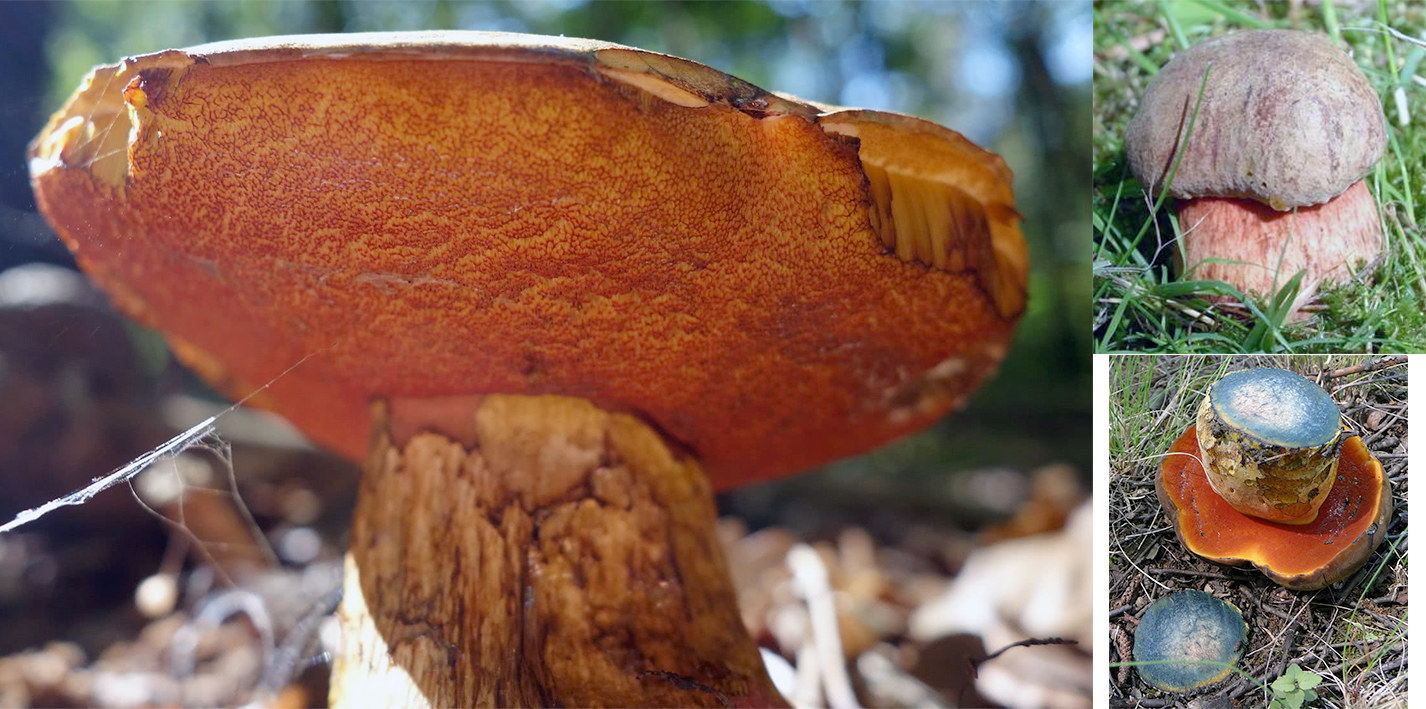
 The image, above, shows an image of a mature scarletina bolete
(Neoboletus luridiformis) mushroom with smaller images
of a young specimen and an inverted specimen with the stem cut to
show it staining blue..
| Common Name: Scarletina Bolete |
| Scientific Name: Neoboletus luridiformis (formerly Boletus luridiformis) |
| Other Names: Red Foot Bolete, Dotted Stemmed Bolete, Dotted Stem Bolete, Cap Tyllog Brithgoch (CY) |
| Family: Boletaceae |
| Range: Northern Europe and north America. |
Physical Characteristics Neoboletus luridiformis is large, solid fungus has a bay-brown hemispherical to convex cap that can grow up to 20 cm (8 in) wide and is initially velvety. It is native to Europe and North America. In Europe it is found growing in deciduous or coniferous woodland in summer and autumn. In North America it is is especially common under spruce.
|
| Edible Parts: Caps and Stipes |
 Spore Print: Olive-brown Spore Print: Olive-brown
|
 Cap: Convex Cap: Convex
|
 Hymenium: Adnate Hymenium: Adnate
|
 Pores: Pores on hymenium
|
 Stipe: Bare Stipe: Bare
|
 Edibility Rating: 3 Edibility Rating: 3 
|
 Known Hazards: When raw or insufficiently cooked it can cause gastroenteritis and even when well cooked it may cause illness in some people, as a result caution should be taken if consuming for the first time. Known Hazards: When raw or insufficiently cooked it can cause gastroenteritis and even when well cooked it may cause illness in some people, as a result caution should be taken if consuming for the first time.
|
Monthly Availability:
|
Welcome to the summary page for FabulousFusionFood's Wild Food guide to Scarletina Bolete along with all the Scarletina Bolete containing recipes presented on this site, with 43 recipes in total.
These recipes, all contain Scarletina Bolete as a major wild food ingredient.
Scarletina Bolete, Neoboletus luridiformis (formerly Boletus luridiformis and previously known as Boletus badia and Xerocomus badius) is frequently a very large species with a highly variable cap colour that can be dark chocolate brown, pale brown or even, as in this fine specimen, coppery bronze. The cap flesh is yellow, rapidly bluing when cut or bruised. Orange at first, the round, crowded pores soon become bright red and then rusty brown with age. The spore tubes are lemon yellow, but they very quickly turn blue-green when cut or bruised. The pores are initially yellow when young and rusty with age (lending it the name 'scarletina bolete'); these bruise blue to black. The tubes are yellowish-green and become blue quickly on cutting.
This mild-flavoured species is said to be edible after being well cooked, although some people are adversely affected by it. When raw or insufficiently cooked it can cause gastroenteritis, for this same reason it is not recommended for drying. Caution is advised as it resembles other potentially hazardous blue-staining boletes and should thus be avoided by novice mushroom hunters. It is, however, commonly collected in several European countries. In Sweden it's appreciated as the base for mushroom soups.
I was lucky to find three specimens in October growing in association with oak from the stump of an oak tree.
Genetic analysis published in 2013 showed that B. luridiformis and many (but not all) red-pored boletes were part of a dupainii clade (named for Boletus dupainii), well-removed from the core group of Boletus edulis and relatives within the Boletineae. This indicated that it needed to be placed in a new genus. It became the type species of the new genus Neoboletus in 2014.
Possible confusion: The Lurid Bolete (Suillellus luridus) can look similar but has a red mesh on the stem, unlike the red dots on the Scarletina. Most toxic Boletes will have a mesh pattern on the stem rather than dots. n particular the Devil’s Bolete (Rubroboletus satanas) is a really toxic species, but again it’s possible to tell the two apart by the spots of red on the stem of the Scarletina while the Devils Bolete has a red mesh. Also the cap of the Devil’s Bolete being a chalky white but this is less reliable as the cap can fade on older Scarletina Boletes. Suillellus satanas has a chalky white cap and a bulbous stem covered in a bright red net pattern on a yellow background; it is poisonous. Deceiving bolete (Suillellus queletii) also has dots on the stem but they’re yellow to buff/grey and not red. When cut in cross section it also turns blue but the flesh at the base of the stem should have a vinaceous red colour. Confusing the two would be a harmless mistake as both are edible after cooking and very good. The Neoboletus group has a second species, currently named Neoboletus xanthopus, that is extremely similar to the Scarletina Bolete and impossible to differentiate without a DNA analysis. Thankfully this second species is equally edible.
For other edible mushrooms, see the guide to edible mushrooms
[2]. Huxley, A. The New RHS Dictionary of Gardening. 1999
[3]. Tanaka, T. Tanaka's Cyclopaedia of Edible Plants of the World.
[4]. Lim T.K. Edible Medicinal And Non-Medicinal Plants, Vols 1–12.
[5]. Thomas, G. S. Perennial Garden Plants, 2004
[6]. Milner, E. Trees of Britain and Ireland, 2011
[7]. Rose, F. & O'Reilly, C. The Wild Flower Key (Revised Edition) — How to identify wild plants, trees and shrubs in Britain and Ireland, 2006
[8]. Streeter, D. & Garrard, I. The Wild Flowers of the British Isles, 1983
[9]. Clapham, A.R.; Tutin, T.G. & Moore, D.M. Flora of the British Isles, 1987
[10]. Phillips, R. Mushrooms, 2006
[11]. Jordan, P. & Wheeler, S. The Complete Book of Mushrooms: An Illustrated Encyclopedia of Edible Mushrooms, 2011
[12]. Bunker, F. Seaweeds of Britain and Ireland, Second Edition, 2017
[13]. Facciola, S. Cornucopia II — A Source Book of Edible Plants, 1998
[14]. Hartford, R. Edible and Medicinal Wild Plants of Britain and Ireland: A Foraging and Photographic Identification Guide
(Note that the above book links are Amazon Affiliate links)
These recipes, all contain Scarletina Bolete as a major wild food ingredient.
Scarletina Bolete, Neoboletus luridiformis (formerly Boletus luridiformis and previously known as Boletus badia and Xerocomus badius) is frequently a very large species with a highly variable cap colour that can be dark chocolate brown, pale brown or even, as in this fine specimen, coppery bronze. The cap flesh is yellow, rapidly bluing when cut or bruised. Orange at first, the round, crowded pores soon become bright red and then rusty brown with age. The spore tubes are lemon yellow, but they very quickly turn blue-green when cut or bruised. The pores are initially yellow when young and rusty with age (lending it the name 'scarletina bolete'); these bruise blue to black. The tubes are yellowish-green and become blue quickly on cutting.
This mild-flavoured species is said to be edible after being well cooked, although some people are adversely affected by it. When raw or insufficiently cooked it can cause gastroenteritis, for this same reason it is not recommended for drying. Caution is advised as it resembles other potentially hazardous blue-staining boletes and should thus be avoided by novice mushroom hunters. It is, however, commonly collected in several European countries. In Sweden it's appreciated as the base for mushroom soups.
I was lucky to find three specimens in October growing in association with oak from the stump of an oak tree.
Genetic analysis published in 2013 showed that B. luridiformis and many (but not all) red-pored boletes were part of a dupainii clade (named for Boletus dupainii), well-removed from the core group of Boletus edulis and relatives within the Boletineae. This indicated that it needed to be placed in a new genus. It became the type species of the new genus Neoboletus in 2014.
Possible confusion: The Lurid Bolete (Suillellus luridus) can look similar but has a red mesh on the stem, unlike the red dots on the Scarletina. Most toxic Boletes will have a mesh pattern on the stem rather than dots. n particular the Devil’s Bolete (Rubroboletus satanas) is a really toxic species, but again it’s possible to tell the two apart by the spots of red on the stem of the Scarletina while the Devils Bolete has a red mesh. Also the cap of the Devil’s Bolete being a chalky white but this is less reliable as the cap can fade on older Scarletina Boletes. Suillellus satanas has a chalky white cap and a bulbous stem covered in a bright red net pattern on a yellow background; it is poisonous. Deceiving bolete (Suillellus queletii) also has dots on the stem but they’re yellow to buff/grey and not red. When cut in cross section it also turns blue but the flesh at the base of the stem should have a vinaceous red colour. Confusing the two would be a harmless mistake as both are edible after cooking and very good. The Neoboletus group has a second species, currently named Neoboletus xanthopus, that is extremely similar to the Scarletina Bolete and impossible to differentiate without a DNA analysis. Thankfully this second species is equally edible.
For other edible mushrooms, see the guide to edible mushrooms
References:
[1]. David Evans Notes from field observations, tastings and cookery experiments.[2]. Huxley, A. The New RHS Dictionary of Gardening. 1999
[3]. Tanaka, T. Tanaka's Cyclopaedia of Edible Plants of the World.
[4]. Lim T.K. Edible Medicinal And Non-Medicinal Plants, Vols 1–12.
[5]. Thomas, G. S. Perennial Garden Plants, 2004
[6]. Milner, E. Trees of Britain and Ireland, 2011
[7]. Rose, F. & O'Reilly, C. The Wild Flower Key (Revised Edition) — How to identify wild plants, trees and shrubs in Britain and Ireland, 2006
[8]. Streeter, D. & Garrard, I. The Wild Flowers of the British Isles, 1983
[9]. Clapham, A.R.; Tutin, T.G. & Moore, D.M. Flora of the British Isles, 1987
[10]. Phillips, R. Mushrooms, 2006
[11]. Jordan, P. & Wheeler, S. The Complete Book of Mushrooms: An Illustrated Encyclopedia of Edible Mushrooms, 2011
[12]. Bunker, F. Seaweeds of Britain and Ireland, Second Edition, 2017
[13]. Facciola, S. Cornucopia II — A Source Book of Edible Plants, 1998
[14]. Hartford, R. Edible and Medicinal Wild Plants of Britain and Ireland: A Foraging and Photographic Identification Guide
(Note that the above book links are Amazon Affiliate links)
The alphabetical list of all Scarletina Bolete recipes on this site follows, (limited to 100 recipes per page). There are 43 recipes in total:
Page 1 of 1
Page 1 of 1