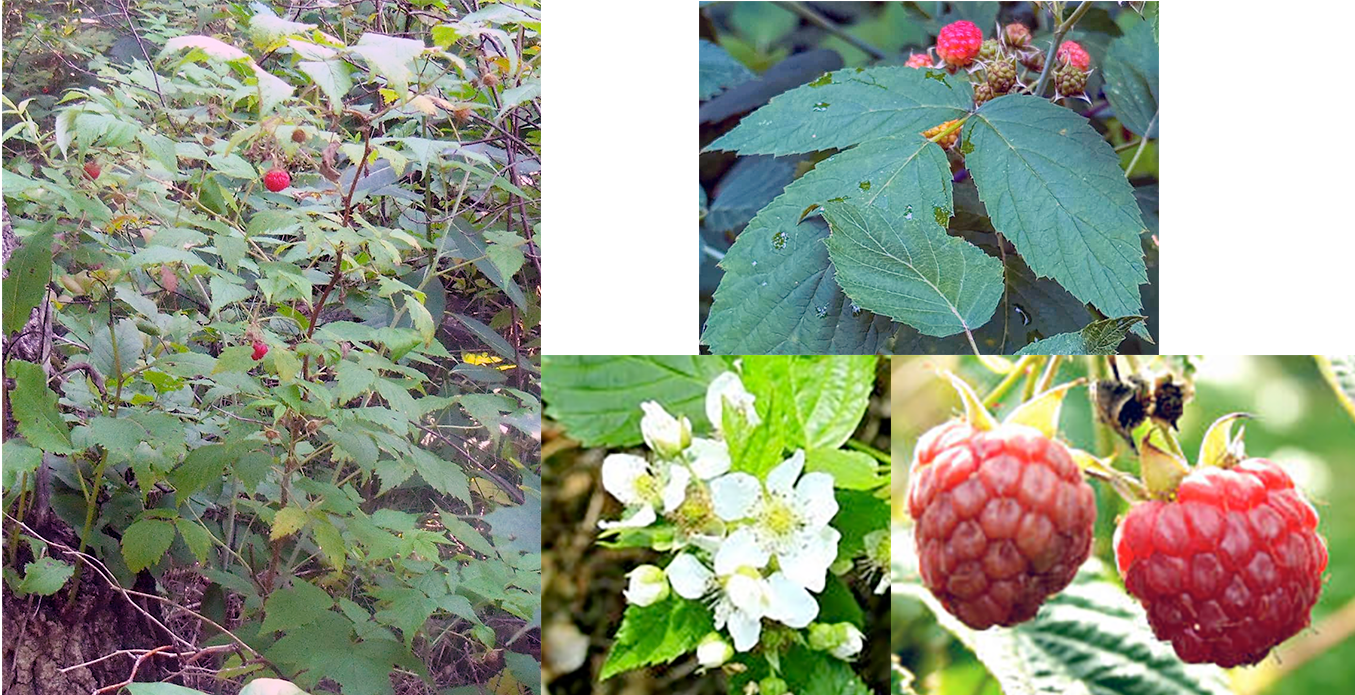
 The image, above, shows the full raspberry plant (Rubus
idaeus), showing the whole plant plant, its leaves, flowers
and fruit..
|
Common Name: Raspberry |
| Scientific Name: Rubus idaeus |
| Other Names: red raspberry or occasionally European red raspberry, Grayleaf red raspberry |
| Family: Roasceae |
| Range: Europe, including Britain, from Iceland south and east to Spain and temperate Asia. |
Physical Characteristics Rubus idaeus is a is a deciduous Shrub growing to 2 m (6ft) by 1.5 m (5ft) at a medium rate. It is hardy to UK zone 3 and is not frost tender. It is in leaf from April to November, in flower from June to August, and the seeds ripen from July to September. The species is hermaphrodite (has both male and female organs) and is pollinated by Bees, flies. The plant is self-fertile.
Suitable: light (sandy), medium (loamy) and heavy (clay) soils and prefers well-drained soil. Suitable pH: mildly acid, neutral and basic (mildly alkaline) soils. It can grow in semi-shade (light woodland) or no shade. It prefers moist soil. |
| Edible Parts: Fruit, Root, Leaves, Flowers, Shoots, Stems |
 Edibility Rating: 5 Edibility Rating: 5 
|
 Known Hazards: None Known. Known Hazards: None Known.
|
Monthly Availability:
|
Welcome to the summary page for FabulousFusionFood's Wild Food guide to Raspberry along with all the Raspberry containing recipes presented on this site, with 38 recipes in total.
These recipes, all contain Raspberry as a major wild food ingredient.
Raspberry, Rubus idaeus plants are generally perennials, which bear biennial stems ("canes") from a perennial root system. In its first year, a new, unbranched stem ("primocane") grows vigorously to its full height of 1.5–2.5 m (5.0–8.3 feet), bearing large pinnately compound leaves with five or seven leaflets, but usually no flowers. In its second year (as a "floricane"), a stem does not grow taller, but produces several side shoots, which bear smaller leaves with three or five leaflets. The flowers are produced in late spring on short racemes on the tips of these side shoots, each flower about 1 cm (0.4 inches) diameter with five white petals. The fruit is red, edible, and sweet but tart-flavoured, produced in summer or early autumn; in botanical terminology, it is not a berry at all, but an aggregate fruit of numerous drupelets around a central core. In raspberries (various species of Rubus subgenus Idaeobatus), the drupelets separate from the core when picked, leaving a hollow fruit, whereas in blackberries and most other species of Rubus, the drupelets stay attached to the core.
A closely related plant in North America, sometimes regarded as the variety Rubus idaeus var. strigosus, is more commonly treated as a distinct species, Rubus strigosus (American red raspberry), as is done here.
Wild raspberries tend to be smaller plants and bear smaller fruit than cultivated raspberries. The fruit of the wild species are also much smaller than cultivated raspberries and often fall apart when picked. In may places in Britain, particularly near railways you will find stouter canes that have escaped cultivation from the Victorian gardens of railway pointsmen. I was lucky in 2025 to find a large stand of yellow raspberries that had escape into the wild and which fruited in September. These produced many fruit and allowed me to make a pie and a suet pudding. Wild raspberries can be used in any recipe that calls for farmed/cultivated raspberries as long as you can collect enough of them.
I've also encountered unusual plants that are various hybrids of raspberries and blackberries. Often with a growth from that's more blackberry like but with raspberry-type fruit.
The root can be eaten cooked, but when picked (it should neither be too young or too old) it requires a lot of boiling to soften. Young shoots, which should be peeled and can be eaten raw or cooked like asparagus. They are harvested as they emerge through the ground in the spring and whilst they are still tender. A herb tea is made from the dried leaves. The leaves (once any spines are removed) can be baked on the base of cakes (like geranium) to flavour them. The shoots or cane tips can be trimmed, stripped of their spines, cut into chunks and candied or preserved just like blackberry tips. They can also be added to curries and stir-fries.
[2]. Huxley, A. The New RHS Dictionary of Gardening. 1999
[3]. Tanaka, T. Tanaka's Cyclopaedia of Edible Plants of the World.
[4]. Lim T.K. Edible Medicinal And Non-Medicinal Plants, Vols 1–12.
[5]. Thomas, G. S. Perennial Garden Plants, 2004
[6]. Milner, E. Trees of Britain and Ireland, 2011
[7]. Rose, F. & O'Reilly, C. The Wild Flower Key (Revised Edition) — How to identify wild plants, trees and shrubs in Britain and Ireland, 2006
[8]. Streeter, D. & Garrard, I. The Wild Flowers of the British Isles, 1983
[9]. Clapham, A.R.; Tutin, T.G. & Moore, D.M. Flora of the British Isles, 1987
[10]. Phillips, R. Mushrooms, 2006
[11]. Jordan, P. & Wheeler, S. The Complete Book of Mushrooms: An Illustrated Encyclopedia of Edible Mushrooms, 2011
[12]. Bunker, F. Seaweeds of Britain and Ireland, Second Edition, 2017
[13]. Facciola, S. Cornucopia II — A Source Book of Edible Plants, 1998
[14]. Hartford, R. Edible and Medicinal Wild Plants of Britain and Ireland: A Foraging and Photographic Identification Guide
(Note that the above book links are Amazon Affiliate links)
These recipes, all contain Raspberry as a major wild food ingredient.
Raspberry, Rubus idaeus plants are generally perennials, which bear biennial stems ("canes") from a perennial root system. In its first year, a new, unbranched stem ("primocane") grows vigorously to its full height of 1.5–2.5 m (5.0–8.3 feet), bearing large pinnately compound leaves with five or seven leaflets, but usually no flowers. In its second year (as a "floricane"), a stem does not grow taller, but produces several side shoots, which bear smaller leaves with three or five leaflets. The flowers are produced in late spring on short racemes on the tips of these side shoots, each flower about 1 cm (0.4 inches) diameter with five white petals. The fruit is red, edible, and sweet but tart-flavoured, produced in summer or early autumn; in botanical terminology, it is not a berry at all, but an aggregate fruit of numerous drupelets around a central core. In raspberries (various species of Rubus subgenus Idaeobatus), the drupelets separate from the core when picked, leaving a hollow fruit, whereas in blackberries and most other species of Rubus, the drupelets stay attached to the core.
A closely related plant in North America, sometimes regarded as the variety Rubus idaeus var. strigosus, is more commonly treated as a distinct species, Rubus strigosus (American red raspberry), as is done here.
Wild raspberries tend to be smaller plants and bear smaller fruit than cultivated raspberries. The fruit of the wild species are also much smaller than cultivated raspberries and often fall apart when picked. In may places in Britain, particularly near railways you will find stouter canes that have escaped cultivation from the Victorian gardens of railway pointsmen. I was lucky in 2025 to find a large stand of yellow raspberries that had escape into the wild and which fruited in September. These produced many fruit and allowed me to make a pie and a suet pudding. Wild raspberries can be used in any recipe that calls for farmed/cultivated raspberries as long as you can collect enough of them.
I've also encountered unusual plants that are various hybrids of raspberries and blackberries. Often with a growth from that's more blackberry like but with raspberry-type fruit.
The root can be eaten cooked, but when picked (it should neither be too young or too old) it requires a lot of boiling to soften. Young shoots, which should be peeled and can be eaten raw or cooked like asparagus. They are harvested as they emerge through the ground in the spring and whilst they are still tender. A herb tea is made from the dried leaves. The leaves (once any spines are removed) can be baked on the base of cakes (like geranium) to flavour them. The shoots or cane tips can be trimmed, stripped of their spines, cut into chunks and candied or preserved just like blackberry tips. They can also be added to curries and stir-fries.
References:
[1]. David Evans Notes from field observations, tastings and cookery experiments.[2]. Huxley, A. The New RHS Dictionary of Gardening. 1999
[3]. Tanaka, T. Tanaka's Cyclopaedia of Edible Plants of the World.
[4]. Lim T.K. Edible Medicinal And Non-Medicinal Plants, Vols 1–12.
[5]. Thomas, G. S. Perennial Garden Plants, 2004
[6]. Milner, E. Trees of Britain and Ireland, 2011
[7]. Rose, F. & O'Reilly, C. The Wild Flower Key (Revised Edition) — How to identify wild plants, trees and shrubs in Britain and Ireland, 2006
[8]. Streeter, D. & Garrard, I. The Wild Flowers of the British Isles, 1983
[9]. Clapham, A.R.; Tutin, T.G. & Moore, D.M. Flora of the British Isles, 1987
[10]. Phillips, R. Mushrooms, 2006
[11]. Jordan, P. & Wheeler, S. The Complete Book of Mushrooms: An Illustrated Encyclopedia of Edible Mushrooms, 2011
[12]. Bunker, F. Seaweeds of Britain and Ireland, Second Edition, 2017
[13]. Facciola, S. Cornucopia II — A Source Book of Edible Plants, 1998
[14]. Hartford, R. Edible and Medicinal Wild Plants of Britain and Ireland: A Foraging and Photographic Identification Guide
(Note that the above book links are Amazon Affiliate links)
The alphabetical list of all Raspberry recipes on this site follows, (limited to 100 recipes per page). There are 38 recipes in total:
Page 1 of 1
Page 1 of 1