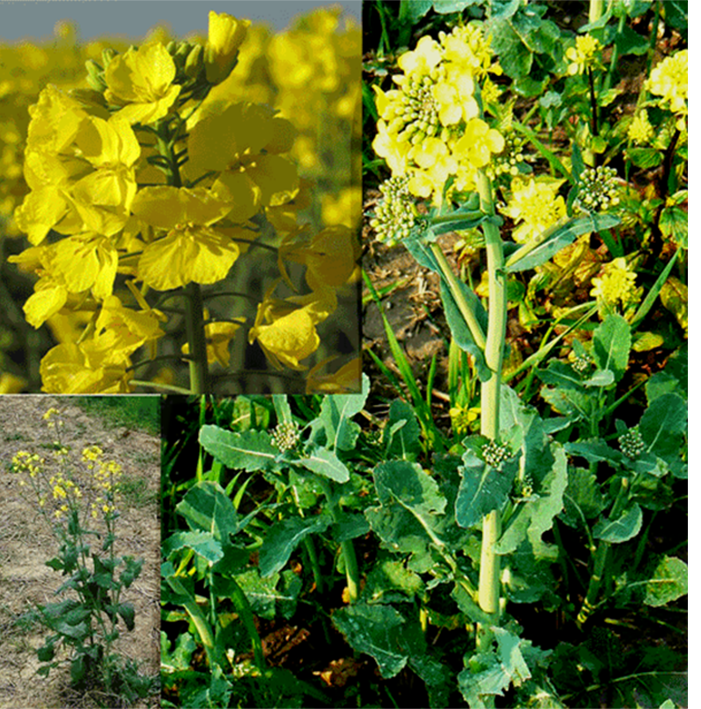
 The image, above, shows the full Rapeseed plant (Brassica
napus), left, with maturing seeds. The top, centre, image
shows the flower heads and the top, right, image shows the
maturing seed heads. Bottom right, the edible leaves and leaf
petioles (stems) are shown..
| Common Name: Rapeseed |
| Scientific Name: Brassica napus |
| Other Names: Rape, Oilseed Rape, Rapa, Rappi, Edible Rape, Flowering Edible Rape, Green Choy Sum, Tender Greens, Yau Choi, Nanohana, Colza, Canola |
| Family: Cruciferae |
| Range: Mediterranean Europe. Naturalized in Britain |
Physical Characteristics Brassica napus is a hardy Annual/Biennial plant, growing to 1.2m (4ft) by 30cmm (1 ft) in size. It is hardy to zone 7 and is not frost tender. The plant flowers from May to August and its seeds ripen from August to September. The flowers are hermaphrodite and are pollinated by bees. The plant also self-pollinates.
|
| Edible Parts: Leaves, Stems, Flowers, Seeds |
 Edibility Rating: 4 Edibility Rating: 4 
|
 Known Hazards: The oil contained in the seed of some varieties (particularly wild) of this species can be rich in erucic acid which is toxic. However, modern cultivars have been selected which are almost free of erucic acid and most forms in the UK are escapes from agriculture. Known Hazards: The oil contained in the seed of some varieties (particularly wild) of this species can be rich in erucic acid which is toxic. However, modern cultivars have been selected which are almost free of erucic acid and most forms in the UK are escapes from agriculture.
|
Welcome to the summary page for FabulousFusionFood's Wild Food guide to Rapeseed along with all the Rapeseed containing recipes presented on this site, with 8 recipes in total.
These recipes, all contain Rapeseed as a major wild food ingredient.
Rapeseed, Brassica napus, (also known as Rape, Oilseed rape, Rapa, Rappi, Edible Rape, Flowering Edible Rape, Green Choy Sum, Tender Greens, Yau Choi, Nanohana, Colza and, in the case of some cultivars, Canola) is a bright yellow flowering member of the Brassicaceae (mustard and cabbage) family of flowering plants. The plant is an annual or biennial growing to about 1.2m in height and is frost-hardy. It is in flower from May to August, typically, but can flower well into autumn. The flowers are bright yellow, typically four-petaled and are pollinated by bees. It is native to the Mediterranean region of Europe, but is naturalized in Britain.
Rapeseed has been grown for centuries, however, there has been a resurgence in the past decades due to its being grown for its oil, indeed, rapeseed is the world's third-leading source of vegetable oil. The wild type varieties have seeds rich in erucic acid which is toxic (the oil can contain up to 50% erucic acid). Wild type seeds also contain high levels of glucosinolates (mustard oil glucosindes), chemical compounds that significantly lowered the nutritional value of rape seed press cakes for animal feed. However, modern cultivars, particularly the Canola variety originally bred in Canada to reduce the amount of glucosinolates, yielding a more palatable oil; this also had the side-effect of reducing the levels of erucic acid. There are now other cultivars with the same properties as Canola and it is the seeds from these plants that are harvested and processed into rapeseed oil for human consumption.
Because rapeseed is grown on such a large scale, many plants escape from cultivation and can be found on the banks of streams, roadside verges and the banks of ditches all over Britain, particularly near arable fields.
The leaves of the plant are edible, as are the stems and they have a mustardy slightly bitter flavour (think strong spring greens in a mustard dressing). They can be added to salads (particularly the young leaves and sprouts) or used as a potherb (blanched or fried to wilt before cooking). The immature flower stems (before the flowers have opened) can also be cooked like broccoli. The flower heads can also be battered and fried, in the same way that wall rocket flower heads are cooked. In Asian cuisine, the leaves and flower stems are often cooked in a similar manner to the related bok choy or kale. Some varieties of rapeseed (called 油菜, yóu cài, (literally 'oil vegetable') in Chinese; yau choy in Cantonese; cải dầu in Vietnamese; phak kat kan khao [ผักกาดก้านขาว] in Thai; and nanohana [菜の花]/nabana [菜花] in Japanese) are sold as greens, primarily in Asian groceries, including those in California where it is known as yao choy or tender greens. They are eaten as sag (spinach) in Indian and Nepalese cuisine, usually stir-fried with salt, garlic and spices. In the West, the sprouted seed is often used as the mustard component of the mixture known as 'mustard and cress'.
The English word rape in the various name of rapeseed ultimately derives from the Latin rāpa or rāpum and is first recorded in 14th Century Middle English (previously turnips and rape had been distinguished by the epithets 'round' and 'long', respectively, referring to the shapes of the roots).
The plant's leaves are edible and can be consumed raw or cooked. They can be added to salads or they can be cooked and used as a potherb. The leaves are also fermented (like sauerkraut) so that they can be stored for later use. The immature flower stems can be cooked rather like broccoli. An oil is prepared commercially from the seeds. This is typically used for cooking, but also makes a good salad oil. The sprouted seed is often substituted for mustard in the mustard part of mustard and cress. The seed can be ground and used as a mustard flavouring. The flowers are edible and can be added to salads or cooked as fritters.
[2]. Huxley, A. The New RHS Dictionary of Gardening. 1999
[3]. Tanaka, T. Tanaka's Cyclopaedia of Edible Plants of the World.
[4]. Lim T.K. Edible Medicinal And Non-Medicinal Plants, Vols 1–12.
[5]. Thomas, G. S. Perennial Garden Plants, 2004
[6]. Milner, E. Trees of Britain and Ireland, 2011
[7]. Rose, F. & O'Reilly, C. The Wild Flower Key (Revised Edition) — How to identify wild plants, trees and shrubs in Britain and Ireland, 2006
[8]. Streeter, D. & Garrard, I. The Wild Flowers of the British Isles, 1983
[9]. Clapham, A.R.; Tutin, T.G. & Moore, D.M. Flora of the British Isles, 1987
[10]. Phillips, R. Mushrooms, 2006
[11]. Jordan, P. & Wheeler, S. The Complete Book of Mushrooms: An Illustrated Encyclopedia of Edible Mushrooms, 2011
[12]. Bunker, F. Seaweeds of Britain and Ireland, Second Edition, 2017
[13]. Facciola, S. Cornucopia II — A Source Book of Edible Plants, 1998
[14]. Hartford, R. Edible and Medicinal Wild Plants of Britain and Ireland: A Foraging and Photographic Identification Guide
(Note that the above book links are Amazon Affiliate links)
These recipes, all contain Rapeseed as a major wild food ingredient.
Rapeseed, Brassica napus, (also known as Rape, Oilseed rape, Rapa, Rappi, Edible Rape, Flowering Edible Rape, Green Choy Sum, Tender Greens, Yau Choi, Nanohana, Colza and, in the case of some cultivars, Canola) is a bright yellow flowering member of the Brassicaceae (mustard and cabbage) family of flowering plants. The plant is an annual or biennial growing to about 1.2m in height and is frost-hardy. It is in flower from May to August, typically, but can flower well into autumn. The flowers are bright yellow, typically four-petaled and are pollinated by bees. It is native to the Mediterranean region of Europe, but is naturalized in Britain.
Rapeseed has been grown for centuries, however, there has been a resurgence in the past decades due to its being grown for its oil, indeed, rapeseed is the world's third-leading source of vegetable oil. The wild type varieties have seeds rich in erucic acid which is toxic (the oil can contain up to 50% erucic acid). Wild type seeds also contain high levels of glucosinolates (mustard oil glucosindes), chemical compounds that significantly lowered the nutritional value of rape seed press cakes for animal feed. However, modern cultivars, particularly the Canola variety originally bred in Canada to reduce the amount of glucosinolates, yielding a more palatable oil; this also had the side-effect of reducing the levels of erucic acid. There are now other cultivars with the same properties as Canola and it is the seeds from these plants that are harvested and processed into rapeseed oil for human consumption.
Because rapeseed is grown on such a large scale, many plants escape from cultivation and can be found on the banks of streams, roadside verges and the banks of ditches all over Britain, particularly near arable fields.
The leaves of the plant are edible, as are the stems and they have a mustardy slightly bitter flavour (think strong spring greens in a mustard dressing). They can be added to salads (particularly the young leaves and sprouts) or used as a potherb (blanched or fried to wilt before cooking). The immature flower stems (before the flowers have opened) can also be cooked like broccoli. The flower heads can also be battered and fried, in the same way that wall rocket flower heads are cooked. In Asian cuisine, the leaves and flower stems are often cooked in a similar manner to the related bok choy or kale. Some varieties of rapeseed (called 油菜, yóu cài, (literally 'oil vegetable') in Chinese; yau choy in Cantonese; cải dầu in Vietnamese; phak kat kan khao [ผักกาดก้านขาว] in Thai; and nanohana [菜の花]/nabana [菜花] in Japanese) are sold as greens, primarily in Asian groceries, including those in California where it is known as yao choy or tender greens. They are eaten as sag (spinach) in Indian and Nepalese cuisine, usually stir-fried with salt, garlic and spices. In the West, the sprouted seed is often used as the mustard component of the mixture known as 'mustard and cress'.
The English word rape in the various name of rapeseed ultimately derives from the Latin rāpa or rāpum and is first recorded in 14th Century Middle English (previously turnips and rape had been distinguished by the epithets 'round' and 'long', respectively, referring to the shapes of the roots).
The plant's leaves are edible and can be consumed raw or cooked. They can be added to salads or they can be cooked and used as a potherb. The leaves are also fermented (like sauerkraut) so that they can be stored for later use. The immature flower stems can be cooked rather like broccoli. An oil is prepared commercially from the seeds. This is typically used for cooking, but also makes a good salad oil. The sprouted seed is often substituted for mustard in the mustard part of mustard and cress. The seed can be ground and used as a mustard flavouring. The flowers are edible and can be added to salads or cooked as fritters.
References:
[1]. David Evans Notes from field observations, tastings and cookery experiments.[2]. Huxley, A. The New RHS Dictionary of Gardening. 1999
[3]. Tanaka, T. Tanaka's Cyclopaedia of Edible Plants of the World.
[4]. Lim T.K. Edible Medicinal And Non-Medicinal Plants, Vols 1–12.
[5]. Thomas, G. S. Perennial Garden Plants, 2004
[6]. Milner, E. Trees of Britain and Ireland, 2011
[7]. Rose, F. & O'Reilly, C. The Wild Flower Key (Revised Edition) — How to identify wild plants, trees and shrubs in Britain and Ireland, 2006
[8]. Streeter, D. & Garrard, I. The Wild Flowers of the British Isles, 1983
[9]. Clapham, A.R.; Tutin, T.G. & Moore, D.M. Flora of the British Isles, 1987
[10]. Phillips, R. Mushrooms, 2006
[11]. Jordan, P. & Wheeler, S. The Complete Book of Mushrooms: An Illustrated Encyclopedia of Edible Mushrooms, 2011
[12]. Bunker, F. Seaweeds of Britain and Ireland, Second Edition, 2017
[13]. Facciola, S. Cornucopia II — A Source Book of Edible Plants, 1998
[14]. Hartford, R. Edible and Medicinal Wild Plants of Britain and Ireland: A Foraging and Photographic Identification Guide
(Note that the above book links are Amazon Affiliate links)
The alphabetical list of all Rapeseed recipes on this site follows, (limited to 100 recipes per page). There are 8 recipes in total:
Page 1 of 1
| Avocado Toasts with Flowers and Soft-boiled Eggs Origin: Australia | Red Saag and Omra Origin: Anglo-Indian | Sarson Saag Gosht (Lamb and Rapeseed Greens Curry with Yoghurt) Origin: India |
| Nanohana no Karashi Miso-ae (Rape Blossoms in a Spicy Miso Sauce) Origin: Japan | Saag Aloo (Stir-fried Potatoes with Rapeseed Greens) Origin: India | Wild Greens Saag Paneer Origin: Fusion |
| Nanohana no Shiro-ae (Tofu-dressed Rapeseed Shoots) Origin: Japan | Sarson Aloo Origin: Fusion |
Page 1 of 1