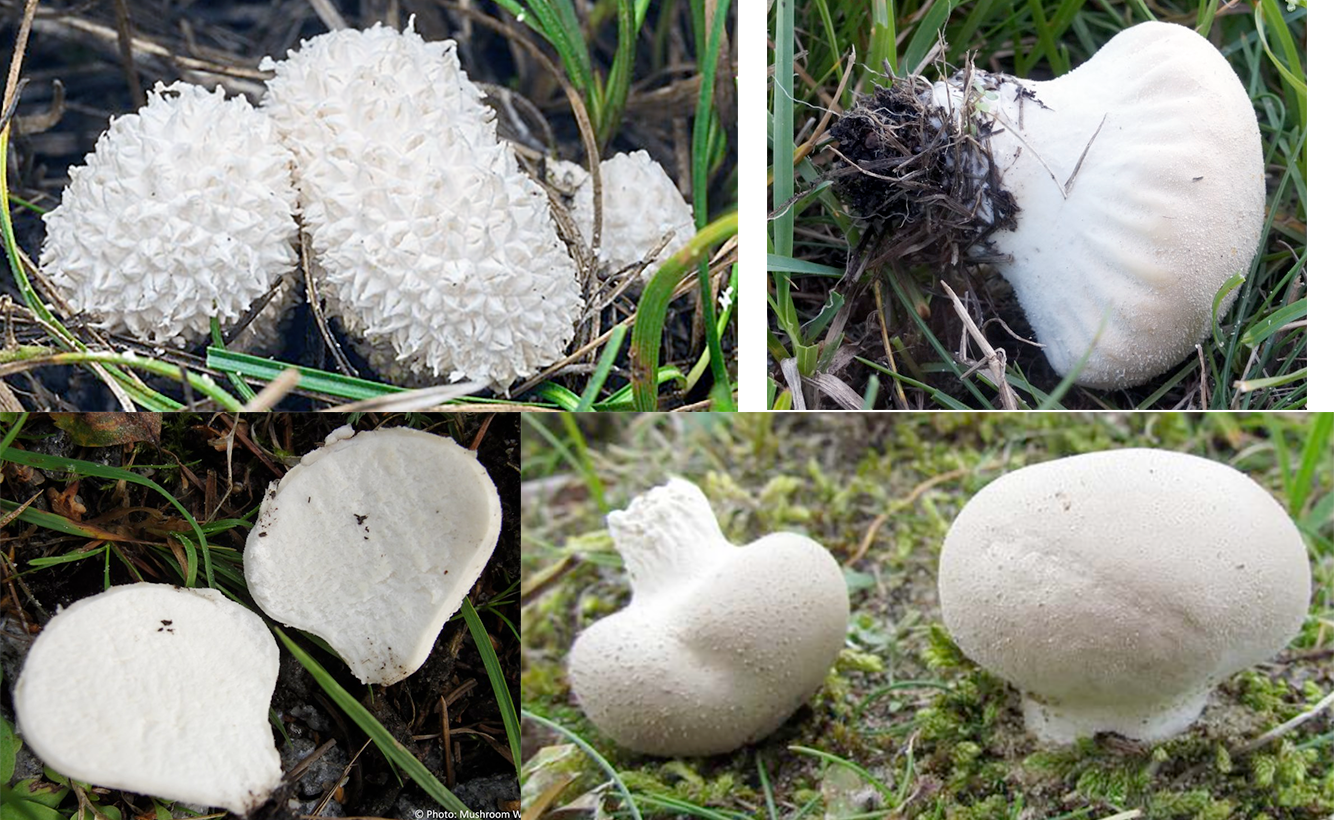
 The image, above, shows a range of pictures of meadow puffball
mushrooms (Lycoperdon pratense), with the spiky very
immature form, a more mature form on its side, one split into two
halves and two in moss with one on its side..
| Common Name: Meadow Puffball |
| Scientific Name: Lycoperdon perlatum |
| Other Names: |
| Family: Agaricaceae |
| Range: Temperate Europe. Common in Britain and occasional in North America. |
Physical Characteristics Lycoperdon pratense is a mycorrhizal fungus, growing to 4 centimetres wide and 5 cm tall. It possesses a stump-like stem which distinguishes it from the giant puffball. In the early stages of its development the skin is scruffy and not smooth as in its larger relatives. It is found in Great Britain and Ireland, including the Outer Hebrides, mainland Europe, and occasionally in North America, and is commonly seen in sand dune systems, where it can be abundant in dune slacks as well as in grassland and lawns.
|
| Edible Parts: Fruiting Body |
 Spore Mass: Light brown, eventually becoming dark brown when fully mature Spore Mass: Light brown, eventually becoming dark brown when fully mature
|
 Cap: Not Distinct Cap: Not Distinct
|
 Hymenium: Glebal Hymenium: Glebal
|
| Stipe: None Present |
 Edibility Rating: 3 Edibility Rating: 3 
|
 Known Hazards: Meadow puffballs are safe to eat when immature (the flesh will be pure white all the way through). However, when the spores have begun to form they can cause stomach upsets when ingested (at this stage the flesh will begin yellowing before turning brown). The air-borne spores are also harmful to humans and if breathed in quantity. They can be found fruiting from June through to October. Known Hazards: Meadow puffballs are safe to eat when immature (the flesh will be pure white all the way through). However, when the spores have begun to form they can cause stomach upsets when ingested (at this stage the flesh will begin yellowing before turning brown). The air-borne spores are also harmful to humans and if breathed in quantity. They can be found fruiting from June through to October.
|
Monthly Availability:
|
Welcome to the summary page for FabulousFusionFood's Wild Food guide to Meadow Puffball along with all the Meadow Puffball containing recipes presented on this site, with 14 recipes in total.
These recipes, all contain Meadow Puffball as a major wild food ingredient.
The Meadow puffball, Lycoperdon pratense is also known as the meadow puffball and its specific epithet pratenseLycoperdon literally translates to 'wolf's flatulence'.
In the early stages of development, its skin is scruffy whereas its bigger relatives have smooth skins. The fruitbody is elongated ovoid form 4 to 8cm across and 2 to 4cm tall, with a short sterile stem typically half the width of the fruitbody; the stem is separated from fertile upper section by a skin-like membrane; the outer surface is white and scurfy with an irregular scattering of short spines (see left) when young, becoming smooth and eventually turning brown and rupturing at the apex; internally white at first, turning olive and finally brown as the spore mass matures; spores disperse through a large apical hole. The stem is 1 to 2cm tall and typically 1.5cm diameter, swollen towards the base; colour as the fertile head but with shorter spines. In appearance it looks like a baby giant puffball.
The spores are spherical, with finely warted surfaces; 3–5.5µm in diameter. The inner spore mass is ight brown, eventually becoming dark brown when fully mature. It is most commonly found in permanent pastures, old lawns, dune slacks, golf courses and parks; occasionally also on roadside verges.
Lycoperdon pratense is edible when young but not highly valued. This species and can make a good meal if prepared and cooked properly. Here are a couple of tips. The first important step is to remove the outer skin — a fiddly job perhaps best done with a sharp knife. The second point is all to do with quality: use only fresh young fruitbodies which, when cut in half along the vertical axis, are white all through. Discard any that have begun turning yellow, olive or brown, as this indicates that the spores are maturing and the flavour will be seriously marred if you include them in your dish. Probably the simplest meal that you can make with puffballs is a mushroom omelette; they can also be fried or used to make soups.
The Meadow Puffball must be pure white inside if it is to be consumed. Any specimens that have any sign of yellowing, or worse browning, should be discarded as they will cause severe gastric distress. Like the giant puffball, meadow puffballs should be peeled before cooking. The meadow puffball can also be dried and powdered, just like the giant puffball.
Possible Confusion:
There are ball-shaped fungi known as earthballs, and some of them can look quite similar to Meadow Puffballs; however, their spore-bearing inner material starts off very pale grey and gradually becomes brown or black as the spores mature. Earthballs are inedible and some of them can cause serious poisoning. The most common of these, sometimes found along with meadow puffballs on woodland edges), is Scleroderma citrinum, the Common Earthball. The differences in features between puffballs and earthballs are quite obvious once you know what to look for, but it is important to learn how to distinguish these two groups if you plan on gathering edible puffballs for the pot.
For other edible mushrooms, see the guide to edible mushrooms
[2]. Huxley, A. The New RHS Dictionary of Gardening. 1999
[3]. Tanaka, T. Tanaka's Cyclopaedia of Edible Plants of the World.
[4]. Lim T.K. Edible Medicinal And Non-Medicinal Plants, Vols 1–12.
[5]. Thomas, G. S. Perennial Garden Plants, 2004
[6]. Milner, E. Trees of Britain and Ireland, 2011
[7]. Rose, F. & O'Reilly, C. The Wild Flower Key (Revised Edition) — How to identify wild plants, trees and shrubs in Britain and Ireland, 2006
[8]. Streeter, D. & Garrard, I. The Wild Flowers of the British Isles, 1983
[9]. Clapham, A.R.; Tutin, T.G. & Moore, D.M. Flora of the British Isles, 1987
[10]. Phillips, R. Mushrooms, 2006
[11]. Jordan, P. & Wheeler, S. The Complete Book of Mushrooms: An Illustrated Encyclopedia of Edible Mushrooms, 2011
[12]. Bunker, F. Seaweeds of Britain and Ireland, Second Edition, 2017
[13]. Facciola, S. Cornucopia II — A Source Book of Edible Plants, 1998
[14]. Hartford, R. Edible and Medicinal Wild Plants of Britain and Ireland: A Foraging and Photographic Identification Guide
(Note that the above book links are Amazon Affiliate links)
These recipes, all contain Meadow Puffball as a major wild food ingredient.
The Meadow puffball, Lycoperdon pratense is also known as the meadow puffball and its specific epithet pratenseLycoperdon literally translates to 'wolf's flatulence'.
In the early stages of development, its skin is scruffy whereas its bigger relatives have smooth skins. The fruitbody is elongated ovoid form 4 to 8cm across and 2 to 4cm tall, with a short sterile stem typically half the width of the fruitbody; the stem is separated from fertile upper section by a skin-like membrane; the outer surface is white and scurfy with an irregular scattering of short spines (see left) when young, becoming smooth and eventually turning brown and rupturing at the apex; internally white at first, turning olive and finally brown as the spore mass matures; spores disperse through a large apical hole. The stem is 1 to 2cm tall and typically 1.5cm diameter, swollen towards the base; colour as the fertile head but with shorter spines. In appearance it looks like a baby giant puffball.
The spores are spherical, with finely warted surfaces; 3–5.5µm in diameter. The inner spore mass is ight brown, eventually becoming dark brown when fully mature. It is most commonly found in permanent pastures, old lawns, dune slacks, golf courses and parks; occasionally also on roadside verges.
Lycoperdon pratense is edible when young but not highly valued. This species and can make a good meal if prepared and cooked properly. Here are a couple of tips. The first important step is to remove the outer skin — a fiddly job perhaps best done with a sharp knife. The second point is all to do with quality: use only fresh young fruitbodies which, when cut in half along the vertical axis, are white all through. Discard any that have begun turning yellow, olive or brown, as this indicates that the spores are maturing and the flavour will be seriously marred if you include them in your dish. Probably the simplest meal that you can make with puffballs is a mushroom omelette; they can also be fried or used to make soups.
The Meadow Puffball must be pure white inside if it is to be consumed. Any specimens that have any sign of yellowing, or worse browning, should be discarded as they will cause severe gastric distress. Like the giant puffball, meadow puffballs should be peeled before cooking. The meadow puffball can also be dried and powdered, just like the giant puffball.
Possible Confusion:
There are ball-shaped fungi known as earthballs, and some of them can look quite similar to Meadow Puffballs; however, their spore-bearing inner material starts off very pale grey and gradually becomes brown or black as the spores mature. Earthballs are inedible and some of them can cause serious poisoning. The most common of these, sometimes found along with meadow puffballs on woodland edges), is Scleroderma citrinum, the Common Earthball. The differences in features between puffballs and earthballs are quite obvious once you know what to look for, but it is important to learn how to distinguish these two groups if you plan on gathering edible puffballs for the pot.
For other edible mushrooms, see the guide to edible mushrooms
References:
[1]. David Evans Notes from field observations, tastings and cookery experiments.[2]. Huxley, A. The New RHS Dictionary of Gardening. 1999
[3]. Tanaka, T. Tanaka's Cyclopaedia of Edible Plants of the World.
[4]. Lim T.K. Edible Medicinal And Non-Medicinal Plants, Vols 1–12.
[5]. Thomas, G. S. Perennial Garden Plants, 2004
[6]. Milner, E. Trees of Britain and Ireland, 2011
[7]. Rose, F. & O'Reilly, C. The Wild Flower Key (Revised Edition) — How to identify wild plants, trees and shrubs in Britain and Ireland, 2006
[8]. Streeter, D. & Garrard, I. The Wild Flowers of the British Isles, 1983
[9]. Clapham, A.R.; Tutin, T.G. & Moore, D.M. Flora of the British Isles, 1987
[10]. Phillips, R. Mushrooms, 2006
[11]. Jordan, P. & Wheeler, S. The Complete Book of Mushrooms: An Illustrated Encyclopedia of Edible Mushrooms, 2011
[12]. Bunker, F. Seaweeds of Britain and Ireland, Second Edition, 2017
[13]. Facciola, S. Cornucopia II — A Source Book of Edible Plants, 1998
[14]. Hartford, R. Edible and Medicinal Wild Plants of Britain and Ireland: A Foraging and Photographic Identification Guide
(Note that the above book links are Amazon Affiliate links)
The alphabetical list of all Meadow Puffball recipes on this site follows, (limited to 100 recipes per page). There are 14 recipes in total:
Page 1 of 1
| Cream of Giant Puffball Soup Origin: Britain | Large Fungal Caps a Cotoletta Origin: Britain | Puffball Tempura Origin: Britain |
| Cream of Puffball Soup Origin: Britain | Pickled Field Mushrooms Origin: American | Sienimunaskas-kääryle (Wild Mushroom Omelette Roll) Origin: Finland |
| Duxelle Origin: France | Pickled St George's Mushrooms Origin: Britain | Wild Mushroom Soup Origin: Britain |
| Fresh Puffball Mushroom Ragú Origin: Britain | Puffball Patties Origin: Britain | Wok-smoked Mushrooms Origin: Britain |
| Fried Giant Puffball Slices Origin: Britain | Puffball Schnitzel Origin: Germany |
Page 1 of 1