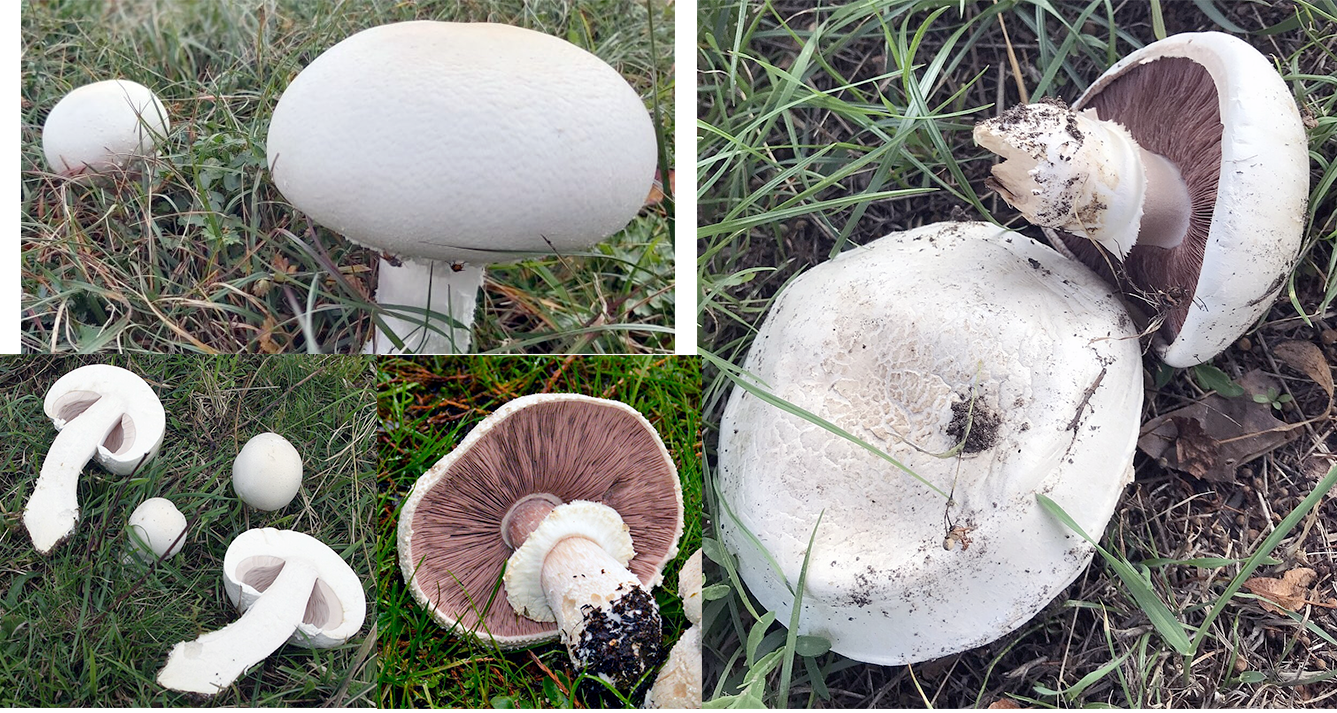
 The image, above, shows a range of pictures of Macro mushrooms
(Agaricus urinascens), showing two sizes of closed cap
form, a young mushroom split open, a mature mushroom on its side
showing the gills, stipe and frill and two mature mushrooms, one
on its site..
| Common Name: Macro Mushroom |
| Scientific Name: Agaricus urinascens |
| Other Names: |
| Family: Agaricaceae |
| Range: Europe |
Physical Characteristics
 Agaricus urinascens is a saprophytic fungus, growing to 30 centimetres (12 in) wide and 12 cm (4+3⁄4 in) tall.. It is typically associated with fields and grassy areas and fruits from June to September (but is most common during August and September).
|
| Edible Parts: Caps, Stipes |
 Spore Print: Brown Spore Print: Brown
|
 Cap: Convex Cap: Convex
|
 Hymenium: Free Hymenium: Free
|
 Gills: Gills on hymenium Gills: Gills on hymenium
|
 Stipe: Has a delicate Ring Stipe: Has a delicate Ring
|
 Edibility Rating: 4 Edibility Rating: 4 
|
 Known Hazards: None known. The macro mushroom is regarded as one of the most delicious edible fungi, although the fruitbodies of this and other yellow-staining Agaricus species often have a build-up of heavy metals, such as cadmium and copper. Known Hazards: None known. The macro mushroom is regarded as one of the most delicious edible fungi, although the fruitbodies of this and other yellow-staining Agaricus species often have a build-up of heavy metals, such as cadmium and copper.
|
Monthly Availability:
|
Welcome to the summary page for FabulousFusionFood's Wild Food guide to Macro Mushroom along with all the Macro Mushroom containing recipes presented on this site, with 73 recipes in total.
These recipes, all contain Macro Mushroom as a major wild food ingredient.
The Macro Mushroom, Agaricus urinascens, is a basidiomycete fungus (filamentous fungi composed of hyphae that reproduce sexually) and is a member of the Agaricaceae (Agaricus) family of fungi and is one of the largest (in terms of size) members of that family. It prefers grassy areas and can grows in fairy rings. It is typically found fields, meadows and parks. It is native to Europe. It is most common in Autumn (during September and October) but can fe found from June through to November.
It is saprophytic (survives by decomposing dead or decaying matter), grows alone (ie it is not dependent on tree species), gregariously, and often in large fairy rings. Young specimens are domed buttons with grey-white gills that are enclosed in a white veil at the button stage. These gills darken and become a chocolate brown as they age. The cap itself matures flat and large as the mushroom ages (they can reach 20cm or more in diameter). The mushrooms start out white and tend to yellow on age (they can also yellow on handling). The veil tends to be large and persistent (this is a notable feature of the species) and the cap margins may develop scales in older mushrooms.
The spore print is brown and the mushroom tends to have a slightly aniseedy smell, though older specimens gradually acquire and urine-like smell (hence the Latin epithet urinascens). When young the cap is smooth, as it grows they flatten out, becoming convex with age, darken slightly and develop rough scales, often splitting at their edges. The stems are white and have a delicate skirt. The stem is smooth above the skirt and scaly below. Quite stout. Around 7-12 cm long and when cut it will stain slightly reddish-brown. The gills are crowded and free, being whitish in very young specimens then darkening to pink and becoming brown with age. he young specimens have been mistaken for Amanita species in the past, so inexperienced foragers should only collect more mature examples who’s gills have darkened, as the gills of Amanitas stay white.
If picking in meadows and away from trees it is most often confused with the Horse Mushroom or Field Mushroom, which are both safe and good to eat. The easiest way to distinguish the horse and macro mushrooms is that the former has a stem that's smooth, except at the base whilst the latter has a stem that's woolly all the way up to the ring. The flesh of the horse mushroom is pure white, which slowly bruises yellow, whilst the flesh of the macro mushroom remains pure white and tends to be thicker. When cut the stem of the macro mushroom stains slightly reddish brown.
Care, however, should be taken not to confuse it with the poisonous Yellow Staining Mushroom Agaricus xanthodermus which grows in the same habitat but is distinguished by an unpleasant ink-like smell, its flattened top at the button stage, its white or grey gills (when young) and the cut stem that rapidly yellows. The same is true if you bruise the fungus margin with your thumb. Whilst not fatal it can cause severer gastric upset and diarrhoea in some for several days. The Yellow-staining mushroom is occasional being much commoner in some years than others. Like all Agaricus species horse mushrooms lend themselves well to preserving by drying.
The macro mushroom is a good edible mushroom, and can be served cooked it also dries well and can be used in mushroom powders.
For other edible mushrooms, see the guide to edible mushrooms
[2]. Huxley, A. The New RHS Dictionary of Gardening. 1999
[3]. Tanaka, T. Tanaka's Cyclopaedia of Edible Plants of the World.
[4]. Lim T.K. Edible Medicinal And Non-Medicinal Plants, Vols 1–12.
[5]. Thomas, G. S. Perennial Garden Plants, 2004
[6]. Milner, E. Trees of Britain and Ireland, 2011
[7]. Rose, F. & O'Reilly, C. The Wild Flower Key (Revised Edition) — How to identify wild plants, trees and shrubs in Britain and Ireland, 2006
[8]. Streeter, D. & Garrard, I. The Wild Flowers of the British Isles, 1983
[9]. Clapham, A.R.; Tutin, T.G. & Moore, D.M. Flora of the British Isles, 1987
[10]. Phillips, R. Mushrooms, 2006
[11]. Jordan, P. & Wheeler, S. The Complete Book of Mushrooms: An Illustrated Encyclopedia of Edible Mushrooms, 2011
[12]. Bunker, F. Seaweeds of Britain and Ireland, Second Edition, 2017
[13]. Facciola, S. Cornucopia II — A Source Book of Edible Plants, 1998
[14]. Hartford, R. Edible and Medicinal Wild Plants of Britain and Ireland: A Foraging and Photographic Identification Guide
(Note that the above book links are Amazon Affiliate links)
These recipes, all contain Macro Mushroom as a major wild food ingredient.
The Macro Mushroom, Agaricus urinascens, is a basidiomycete fungus (filamentous fungi composed of hyphae that reproduce sexually) and is a member of the Agaricaceae (Agaricus) family of fungi and is one of the largest (in terms of size) members of that family. It prefers grassy areas and can grows in fairy rings. It is typically found fields, meadows and parks. It is native to Europe. It is most common in Autumn (during September and October) but can fe found from June through to November.
It is saprophytic (survives by decomposing dead or decaying matter), grows alone (ie it is not dependent on tree species), gregariously, and often in large fairy rings. Young specimens are domed buttons with grey-white gills that are enclosed in a white veil at the button stage. These gills darken and become a chocolate brown as they age. The cap itself matures flat and large as the mushroom ages (they can reach 20cm or more in diameter). The mushrooms start out white and tend to yellow on age (they can also yellow on handling). The veil tends to be large and persistent (this is a notable feature of the species) and the cap margins may develop scales in older mushrooms.
The spore print is brown and the mushroom tends to have a slightly aniseedy smell, though older specimens gradually acquire and urine-like smell (hence the Latin epithet urinascens). When young the cap is smooth, as it grows they flatten out, becoming convex with age, darken slightly and develop rough scales, often splitting at their edges. The stems are white and have a delicate skirt. The stem is smooth above the skirt and scaly below. Quite stout. Around 7-12 cm long and when cut it will stain slightly reddish-brown. The gills are crowded and free, being whitish in very young specimens then darkening to pink and becoming brown with age. he young specimens have been mistaken for Amanita species in the past, so inexperienced foragers should only collect more mature examples who’s gills have darkened, as the gills of Amanitas stay white.
If picking in meadows and away from trees it is most often confused with the Horse Mushroom or Field Mushroom, which are both safe and good to eat. The easiest way to distinguish the horse and macro mushrooms is that the former has a stem that's smooth, except at the base whilst the latter has a stem that's woolly all the way up to the ring. The flesh of the horse mushroom is pure white, which slowly bruises yellow, whilst the flesh of the macro mushroom remains pure white and tends to be thicker. When cut the stem of the macro mushroom stains slightly reddish brown.
Care, however, should be taken not to confuse it with the poisonous Yellow Staining Mushroom Agaricus xanthodermus which grows in the same habitat but is distinguished by an unpleasant ink-like smell, its flattened top at the button stage, its white or grey gills (when young) and the cut stem that rapidly yellows. The same is true if you bruise the fungus margin with your thumb. Whilst not fatal it can cause severer gastric upset and diarrhoea in some for several days. The Yellow-staining mushroom is occasional being much commoner in some years than others. Like all Agaricus species horse mushrooms lend themselves well to preserving by drying.
The macro mushroom is a good edible mushroom, and can be served cooked it also dries well and can be used in mushroom powders.
For other edible mushrooms, see the guide to edible mushrooms
References:
[1]. David Evans Notes from field observations, tastings and cookery experiments.[2]. Huxley, A. The New RHS Dictionary of Gardening. 1999
[3]. Tanaka, T. Tanaka's Cyclopaedia of Edible Plants of the World.
[4]. Lim T.K. Edible Medicinal And Non-Medicinal Plants, Vols 1–12.
[5]. Thomas, G. S. Perennial Garden Plants, 2004
[6]. Milner, E. Trees of Britain and Ireland, 2011
[7]. Rose, F. & O'Reilly, C. The Wild Flower Key (Revised Edition) — How to identify wild plants, trees and shrubs in Britain and Ireland, 2006
[8]. Streeter, D. & Garrard, I. The Wild Flowers of the British Isles, 1983
[9]. Clapham, A.R.; Tutin, T.G. & Moore, D.M. Flora of the British Isles, 1987
[10]. Phillips, R. Mushrooms, 2006
[11]. Jordan, P. & Wheeler, S. The Complete Book of Mushrooms: An Illustrated Encyclopedia of Edible Mushrooms, 2011
[12]. Bunker, F. Seaweeds of Britain and Ireland, Second Edition, 2017
[13]. Facciola, S. Cornucopia II — A Source Book of Edible Plants, 1998
[14]. Hartford, R. Edible and Medicinal Wild Plants of Britain and Ireland: A Foraging and Photographic Identification Guide
(Note that the above book links are Amazon Affiliate links)
The alphabetical list of all Macro Mushroom recipes on this site follows, (limited to 100 recipes per page). There are 73 recipes in total:
Page 1 of 1
Page 1 of 1