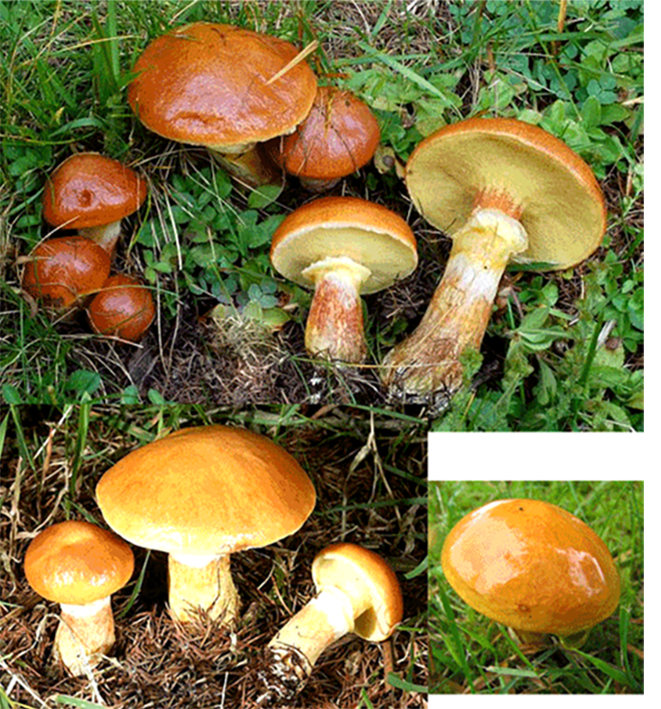
 The image, above, shows an image of larch bolete (Suillus
grevillei) mushrooms at different life stages. The top image
shows a cluster at different stage from closed cap to open cap,
with two mushrooms on their sides to reveal the stipes, rings and
gills. The image, bottom left shows a group of three mushrooms
and the image bottom right shows a single specimen with a glossy
cap at its peak of edibility..
| Common Name: Larch Bolete |
| Scientific Name: Suillus grevillei |
| Other Names: Greville's Bolete, Buttery Mushroom and Bovine Bolete |
| Family: Boletaceae |
| Range: Widespread in North America and Europe, recorded in Taiwan |
Physical Characteristics Suillus grevillei is a mycorrhizal fungus, growing to 12cm (5 in) by 10cm (4 in) in size. It is typically associated with coniferous larch trees and fruits from June to November (but is most commonly found between August and October.
|
| Edible Parts: Caps and Stipes |
 Spore Print: Ochre Spore Print: Ochre
|
 Cap: Convex Cap: Convex
|
 Hymenium: Adnate Hymenium: Adnate
|
 Pores: Pores on hymenium Pores: Pores on hymenium
|
 Stipe: Has a Ring Stipe: Has a Ring
|
 Edibility Rating: 4 Edibility Rating: 4 
|
 Known Hazards: Though not reported as toxic per se this species might cause allergic reactions in those susceptible and caution should be taken if consuming for the first time. Known Hazards: Though not reported as toxic per se this species might cause allergic reactions in those susceptible and caution should be taken if consuming for the first time.
|
Welcome to the summary page for FabulousFusionFood's Wild Food guide to Larch Bolete along with all the Larch Bolete containing recipes presented on this site, with 43 recipes in total.
These recipes, all contain Larch Bolete as a major wild food ingredient.
Larch Bolete, Suillus grevillei (also known as Greville's Bolete, Buttery Mushroom and Bovine Bolete) is an edible species of mycorrhizal fungus (fungi that are symbiotic with the roots of the host plant, the larch tree in this case) and is a member of the Boletaceae (Bolete) family of mushrooms with a yellow-brown spore print. It is widespread in Europe and much of the Northern Hemisphere. It is always associated with coniferous larch trees and forms mycorrhiza with them. Typically it fruits from June to November (but is most common from August to October) and can be locally very common. It is always found in association with larch trees and this is one of its distinguishing features. The mushroom is medium sized (growing maximally to about 10cm tall) and the cap is orange, growing to 12cm in diameter. When young the cap is domed and covered in a glutinous layer. This flattens and turns golden yellow as the mushroom ages and the glutinous layer dries and becomes shiny. The pores are initially covered with a pale-yellow, membranous veil. It becomes angular as it ages, turning sulphur yellow and bruising rusty brown. The stem is typically slim (about 1.5cm in diameter), yellow in colour, but with rusty streaks below the floppy ring (this soon disappears, leaving a light-coloured zone. The base itself grows, maximally, to about 7cm in diameter. The cap is orange, highly-domed, convex and firm, then flattening and becoming soft to the touch. There is no overhanging margin. Rather than gills, this mushroom has tubes on the underside, these are yellow, adnate to slightly decurrent. The stem tapers from the base. The flesh of the larch bolete is soft, pale yellow, but flushing lilac at the cap and blue in the stem. On cutting there is not colour change and only a very faint mushroomy smell.
The larch bolete is not one of the most sought-after members of the bolete family. Mostly because of its slimy cap and its unassuming taste. However, the surface of the cap is easily peeled off (and this should be done before cooking — it is also generally recommended that the tubes be discarded). Typically it is used in soups and stews to bulk out the dish. Like the majority of boletes, it dries and re-constitutes very well (for how to dry, see the dried mushrooms recipe) and drying intensifies the flavour.
The colour, shape, season of fruiting and association with larch trees means, in the UK at least, that there are no poisonous species with which it can be confused, though it is easy to confuse with a few other Sullis species (eg L aeruginascens has a grey-yellow slimy cap. L tridentinus has an orange cap but is less sticky and mostly compound and the pores are orange. Both are edible. As always, however, if you are uncertain of the identification of a mushroom, do not pick it and, if you have not eaten a mushroom before, cook it well and only eat a small amount the first time, in case you are susceptible.
For other edible mushrooms, see the guide to edible mushrooms
[2]. Huxley, A. The New RHS Dictionary of Gardening. 1999
[3]. Tanaka, T. Tanaka's Cyclopaedia of Edible Plants of the World.
[4]. Lim T.K. Edible Medicinal And Non-Medicinal Plants, Vols 1–12.
[5]. Thomas, G. S. Perennial Garden Plants, 2004
[6]. Milner, E. Trees of Britain and Ireland, 2011
[7]. Rose, F. & O'Reilly, C. The Wild Flower Key (Revised Edition) — How to identify wild plants, trees and shrubs in Britain and Ireland, 2006
[8]. Streeter, D. & Garrard, I. The Wild Flowers of the British Isles, 1983
[9]. Clapham, A.R.; Tutin, T.G. & Moore, D.M. Flora of the British Isles, 1987
[10]. Phillips, R. Mushrooms, 2006
[11]. Jordan, P. & Wheeler, S. The Complete Book of Mushrooms: An Illustrated Encyclopedia of Edible Mushrooms, 2011
[12]. Bunker, F. Seaweeds of Britain and Ireland, Second Edition, 2017
[13]. Facciola, S. Cornucopia II — A Source Book of Edible Plants, 1998
[14]. Hartford, R. Edible and Medicinal Wild Plants of Britain and Ireland: A Foraging and Photographic Identification Guide
(Note that the above book links are Amazon Affiliate links)
These recipes, all contain Larch Bolete as a major wild food ingredient.
Larch Bolete, Suillus grevillei (also known as Greville's Bolete, Buttery Mushroom and Bovine Bolete) is an edible species of mycorrhizal fungus (fungi that are symbiotic with the roots of the host plant, the larch tree in this case) and is a member of the Boletaceae (Bolete) family of mushrooms with a yellow-brown spore print. It is widespread in Europe and much of the Northern Hemisphere. It is always associated with coniferous larch trees and forms mycorrhiza with them. Typically it fruits from June to November (but is most common from August to October) and can be locally very common. It is always found in association with larch trees and this is one of its distinguishing features. The mushroom is medium sized (growing maximally to about 10cm tall) and the cap is orange, growing to 12cm in diameter. When young the cap is domed and covered in a glutinous layer. This flattens and turns golden yellow as the mushroom ages and the glutinous layer dries and becomes shiny. The pores are initially covered with a pale-yellow, membranous veil. It becomes angular as it ages, turning sulphur yellow and bruising rusty brown. The stem is typically slim (about 1.5cm in diameter), yellow in colour, but with rusty streaks below the floppy ring (this soon disappears, leaving a light-coloured zone. The base itself grows, maximally, to about 7cm in diameter. The cap is orange, highly-domed, convex and firm, then flattening and becoming soft to the touch. There is no overhanging margin. Rather than gills, this mushroom has tubes on the underside, these are yellow, adnate to slightly decurrent. The stem tapers from the base. The flesh of the larch bolete is soft, pale yellow, but flushing lilac at the cap and blue in the stem. On cutting there is not colour change and only a very faint mushroomy smell.
The larch bolete is not one of the most sought-after members of the bolete family. Mostly because of its slimy cap and its unassuming taste. However, the surface of the cap is easily peeled off (and this should be done before cooking — it is also generally recommended that the tubes be discarded). Typically it is used in soups and stews to bulk out the dish. Like the majority of boletes, it dries and re-constitutes very well (for how to dry, see the dried mushrooms recipe) and drying intensifies the flavour.
The colour, shape, season of fruiting and association with larch trees means, in the UK at least, that there are no poisonous species with which it can be confused, though it is easy to confuse with a few other Sullis species (eg L aeruginascens has a grey-yellow slimy cap. L tridentinus has an orange cap but is less sticky and mostly compound and the pores are orange. Both are edible. As always, however, if you are uncertain of the identification of a mushroom, do not pick it and, if you have not eaten a mushroom before, cook it well and only eat a small amount the first time, in case you are susceptible.
For other edible mushrooms, see the guide to edible mushrooms
References:
[1]. David Evans Notes from field observations, tastings and cookery experiments.[2]. Huxley, A. The New RHS Dictionary of Gardening. 1999
[3]. Tanaka, T. Tanaka's Cyclopaedia of Edible Plants of the World.
[4]. Lim T.K. Edible Medicinal And Non-Medicinal Plants, Vols 1–12.
[5]. Thomas, G. S. Perennial Garden Plants, 2004
[6]. Milner, E. Trees of Britain and Ireland, 2011
[7]. Rose, F. & O'Reilly, C. The Wild Flower Key (Revised Edition) — How to identify wild plants, trees and shrubs in Britain and Ireland, 2006
[8]. Streeter, D. & Garrard, I. The Wild Flowers of the British Isles, 1983
[9]. Clapham, A.R.; Tutin, T.G. & Moore, D.M. Flora of the British Isles, 1987
[10]. Phillips, R. Mushrooms, 2006
[11]. Jordan, P. & Wheeler, S. The Complete Book of Mushrooms: An Illustrated Encyclopedia of Edible Mushrooms, 2011
[12]. Bunker, F. Seaweeds of Britain and Ireland, Second Edition, 2017
[13]. Facciola, S. Cornucopia II — A Source Book of Edible Plants, 1998
[14]. Hartford, R. Edible and Medicinal Wild Plants of Britain and Ireland: A Foraging and Photographic Identification Guide
(Note that the above book links are Amazon Affiliate links)
The alphabetical list of all Larch Bolete recipes on this site follows, (limited to 100 recipes per page). There are 43 recipes in total:
Page 1 of 1
Page 1 of 1