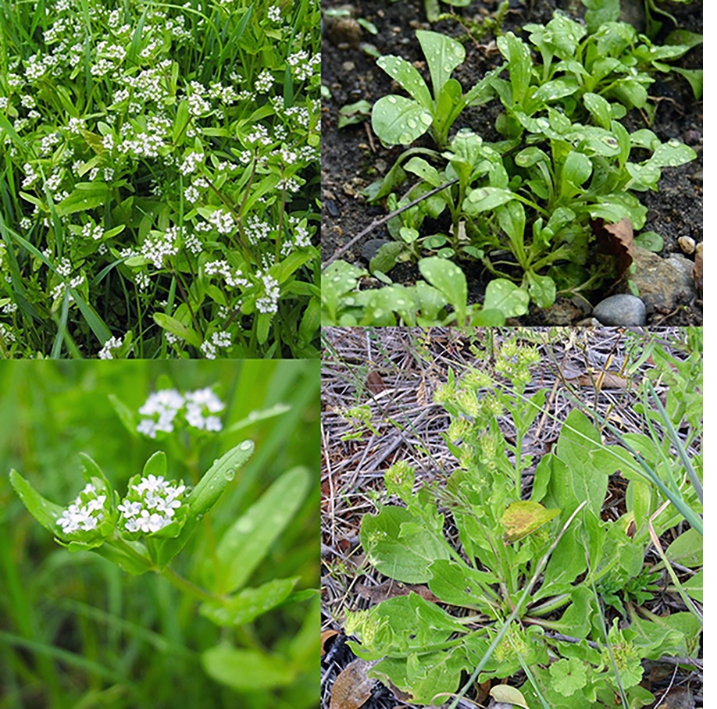
 The image, above, shows the full lamb's lettuce (corn salad)
plant (Valerianella locusta) in various aspects.
Clockwise from top right: the young plants, the mature plant with
seed heads, close-up of the flowers and finally, top left, the
mature plant in flower..
| Common Name: Lamb's Lettuce |
| Scientific Name: Valerianella locusta |
| Other Names: Corn Salad, Cornsalad, Common Cornsalad, Lewiston Cornsalad, Fetticus, Mâche, Doucette, Rampon, Rampien, Rapunzel and Field Salad |
| Family: Valerianaceae |
| Range: Europe, including Britain, from Scandanavia south and east to N. Africa and W. Asia. |
Physical Characteristics Valerianella locusta is a hardy Annual plant, growing to 30cm (1 ft) in height. It is hardy to zone 5 and is not frost tender. The plant flowers from April to June and seeds ripen from May to July. The flowers are hermaphrodite and are self pollinated. The plant is self-fertile.
|
| Edible Parts: Leaves, Flowers |
 Edibility Rating: 4 Edibility Rating: 4 
|
 Known Hazards: None Known. Known Hazards: None Known.
|
Monthly Availability:
|
Welcome to the summary page for FabulousFusionFood's Wild Food guide to Lamb's Lettuce along with all the Lamb's Lettuce containing recipes presented on this site, with 5 recipes in total.
These recipes, all contain Lamb's Lettuce as a major wild food ingredient.
Lamb's Lettuce, Valerianella locusta (also known as Valerianella olitoria (L) Poll, Corn Salad, Cornsalad, Common Cornsalad, Lewiston Cornsalad, Fetticus, Mâche, Doucette, Rampon, Rampien, Rapunzel and Field Salad) is small, annual, dicotyledonous plant and a member of the Valerianaceae (valerian) family of flowering plants. Typically it grows as a low rosette with with spatulate leaves up to 15.2cm long. These leaves sometimes bear teeth near the base. The flowers are very small, five-petalled, blue in colour and symmetrical (typically less than 2mm across) and are borne in dense terminal clusters that can bolt up to 70cm tall. Generally they appear in April and May. There are often additional, solitary, flowers on the axils of the branches. Typically common cornsalad (the commonest wild form) grows on walls, by tracks in sand dunes on horticultural land (but not often arable land). They are native to Europe, northern Africa and western Asia but have been naturalized in North America. It is a hardy plant and in mild climates can be grown as a winter green, in warmer conditions, however, it has a tendency to bolt and run to seed.
In the past it was foraged by European peasants, however, de la Quintinie, the royal gardener of Louis XIV of France introduced it into cultivation and today many cultivars exist as salad greens. Wild common corn salad leaves have a succulent texture but a very mild flavour. They are, nonetheless, and useful addition to any salad and are best picked before the flowers appear. This mild salad green is best served with a sharp dressing.
The flowers and flowering stems can also be eaten raw in salads or they can be dipped in batter and cooked as tempura or fritters.
[2]. Huxley, A. The New RHS Dictionary of Gardening. 1999
[3]. Tanaka, T. Tanaka's Cyclopaedia of Edible Plants of the World.
[4]. Lim T.K. Edible Medicinal And Non-Medicinal Plants, Vols 1–12.
[5]. Thomas, G. S. Perennial Garden Plants, 2004
[6]. Milner, E. Trees of Britain and Ireland, 2011
[7]. Rose, F. & O'Reilly, C. The Wild Flower Key (Revised Edition) — How to identify wild plants, trees and shrubs in Britain and Ireland, 2006
[8]. Streeter, D. & Garrard, I. The Wild Flowers of the British Isles, 1983
[9]. Clapham, A.R.; Tutin, T.G. & Moore, D.M. Flora of the British Isles, 1987
[10]. Phillips, R. Mushrooms, 2006
[11]. Jordan, P. & Wheeler, S. The Complete Book of Mushrooms: An Illustrated Encyclopedia of Edible Mushrooms, 2011
[12]. Bunker, F. Seaweeds of Britain and Ireland, Second Edition, 2017
[13]. Facciola, S. Cornucopia II — A Source Book of Edible Plants, 1998
[14]. Hartford, R. Edible and Medicinal Wild Plants of Britain and Ireland: A Foraging and Photographic Identification Guide
(Note that the above book links are Amazon Affiliate links)
These recipes, all contain Lamb's Lettuce as a major wild food ingredient.
Lamb's Lettuce, Valerianella locusta (also known as Valerianella olitoria (L) Poll, Corn Salad, Cornsalad, Common Cornsalad, Lewiston Cornsalad, Fetticus, Mâche, Doucette, Rampon, Rampien, Rapunzel and Field Salad) is small, annual, dicotyledonous plant and a member of the Valerianaceae (valerian) family of flowering plants. Typically it grows as a low rosette with with spatulate leaves up to 15.2cm long. These leaves sometimes bear teeth near the base. The flowers are very small, five-petalled, blue in colour and symmetrical (typically less than 2mm across) and are borne in dense terminal clusters that can bolt up to 70cm tall. Generally they appear in April and May. There are often additional, solitary, flowers on the axils of the branches. Typically common cornsalad (the commonest wild form) grows on walls, by tracks in sand dunes on horticultural land (but not often arable land). They are native to Europe, northern Africa and western Asia but have been naturalized in North America. It is a hardy plant and in mild climates can be grown as a winter green, in warmer conditions, however, it has a tendency to bolt and run to seed.
In the past it was foraged by European peasants, however, de la Quintinie, the royal gardener of Louis XIV of France introduced it into cultivation and today many cultivars exist as salad greens. Wild common corn salad leaves have a succulent texture but a very mild flavour. They are, nonetheless, and useful addition to any salad and are best picked before the flowers appear. This mild salad green is best served with a sharp dressing.
The flowers and flowering stems can also be eaten raw in salads or they can be dipped in batter and cooked as tempura or fritters.
References:
[1]. David Evans Notes from field observations, tastings and cookery experiments.[2]. Huxley, A. The New RHS Dictionary of Gardening. 1999
[3]. Tanaka, T. Tanaka's Cyclopaedia of Edible Plants of the World.
[4]. Lim T.K. Edible Medicinal And Non-Medicinal Plants, Vols 1–12.
[5]. Thomas, G. S. Perennial Garden Plants, 2004
[6]. Milner, E. Trees of Britain and Ireland, 2011
[7]. Rose, F. & O'Reilly, C. The Wild Flower Key (Revised Edition) — How to identify wild plants, trees and shrubs in Britain and Ireland, 2006
[8]. Streeter, D. & Garrard, I. The Wild Flowers of the British Isles, 1983
[9]. Clapham, A.R.; Tutin, T.G. & Moore, D.M. Flora of the British Isles, 1987
[10]. Phillips, R. Mushrooms, 2006
[11]. Jordan, P. & Wheeler, S. The Complete Book of Mushrooms: An Illustrated Encyclopedia of Edible Mushrooms, 2011
[12]. Bunker, F. Seaweeds of Britain and Ireland, Second Edition, 2017
[13]. Facciola, S. Cornucopia II — A Source Book of Edible Plants, 1998
[14]. Hartford, R. Edible and Medicinal Wild Plants of Britain and Ireland: A Foraging and Photographic Identification Guide
(Note that the above book links are Amazon Affiliate links)
The alphabetical list of all Lamb's Lettuce recipes on this site follows, (limited to 100 recipes per page). There are 5 recipes in total:
Page 1 of 1
| Bacon-wrapped Trout Origin: Britain | Lamb's Lettuce Pesto Origin: Britain | Spring Flower Salad with Dandelion Greens Origin: Britain |
| French Salad Origin: British | Mâche Sabayon with Parmesan Shavings Origin: France |
Page 1 of 1