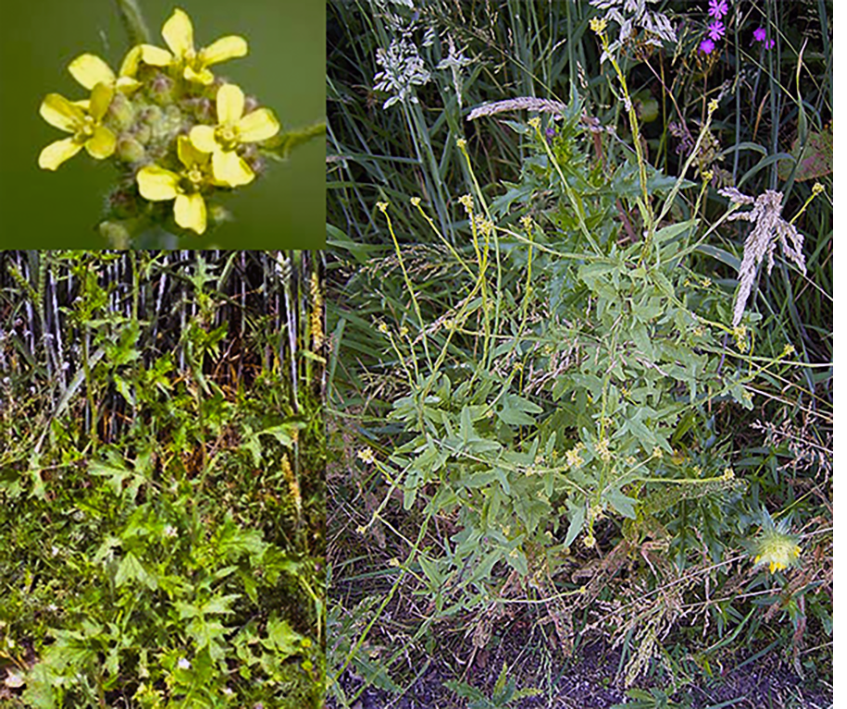
 The image, above, shows the full hedge mustard plant
(Sisymbrium officinale), in its young form, bottom left
and its mature flowering form, right. Also shown is a closeup of
the plant's flower..
| Common Name: Hedge Mustard |
| Scientific Name: Sisymbrium officinale |
| Other Names: |
| Family: Cruciferae |
| Range: Europe, including Britain, south and east from Scandanavia to N. Africa and the Near East |
Physical Characteristics Sisymbrium officinale is a hardy Annual plant, growing to 60cm (2 ft) by 0.3m (1 ft) in size. It is hardy to zone 6 and is not frost tender. The plant flowers from June to July and seeds ripen from July to August. The flowers are hermaphrodite and are self pollinated.
|
| Edible Parts: Leaves, Seeds |
 Edibility Rating: 1 Edibility Rating: 1 
|
 Known Hazards: None Known. Known Hazards: None Known.
|
Welcome to the summary page for FabulousFusionFood's Wild Food guide to Hedge Mustard along with all the Hedge Mustard containing recipes presented on this site, with 5 recipes in total.
These recipes, all contain Hedge Mustard as a major wild food ingredient.
Hedge Mustard, Sisymbrium officinale is a member of the family Cruciferae (mustard or cabbage). It is found on roadsides, wasteland and as a weed of arable land as well as being common near ruined buildings. A native of Europe, North Africa and the Near East, it is now well-established throughout the world. The plant has a rather scrubby appearance with rigid, spreading branches, and spikes of tiny pale yellow flowers, quickly followed by awl-shaped pods that are closely appressed to the stem.
This plant is widely cultivated across Europe for its edible leaves and seeds and it is commonly used as a condiment in Northern Europe (particularly Denmark, Norway and Germany), where the seeds are turned into a paste, similar to mustard. The leaves have a bitter cabbage-like flavour and they are used either in salads or cooked as a pot herb (in cultivar versions). Historically, the seeds have been used to make mustard pastes in Europe. They can also be ground and added to soups and stews to give a subtle mustard-like flavour.
[2]. Huxley, A. The New RHS Dictionary of Gardening. 1999
[3]. Tanaka, T. Tanaka's Cyclopaedia of Edible Plants of the World.
[4]. Lim T.K. Edible Medicinal And Non-Medicinal Plants, Vols 1–12.
[5]. Thomas, G. S. Perennial Garden Plants, 2004
[6]. Milner, E. Trees of Britain and Ireland, 2011
[7]. Rose, F. & O'Reilly, C. The Wild Flower Key (Revised Edition) — How to identify wild plants, trees and shrubs in Britain and Ireland, 2006
[8]. Streeter, D. & Garrard, I. The Wild Flowers of the British Isles, 1983
[9]. Clapham, A.R.; Tutin, T.G. & Moore, D.M. Flora of the British Isles, 1987
[10]. Phillips, R. Mushrooms, 2006
[11]. Jordan, P. & Wheeler, S. The Complete Book of Mushrooms: An Illustrated Encyclopedia of Edible Mushrooms, 2011
[12]. Bunker, F. Seaweeds of Britain and Ireland, Second Edition, 2017
[13]. Facciola, S. Cornucopia II — A Source Book of Edible Plants, 1998
[14]. Hartford, R. Edible and Medicinal Wild Plants of Britain and Ireland: A Foraging and Photographic Identification Guide
(Note that the above book links are Amazon Affiliate links)
These recipes, all contain Hedge Mustard as a major wild food ingredient.
Hedge Mustard, Sisymbrium officinale is a member of the family Cruciferae (mustard or cabbage). It is found on roadsides, wasteland and as a weed of arable land as well as being common near ruined buildings. A native of Europe, North Africa and the Near East, it is now well-established throughout the world. The plant has a rather scrubby appearance with rigid, spreading branches, and spikes of tiny pale yellow flowers, quickly followed by awl-shaped pods that are closely appressed to the stem.
This plant is widely cultivated across Europe for its edible leaves and seeds and it is commonly used as a condiment in Northern Europe (particularly Denmark, Norway and Germany), where the seeds are turned into a paste, similar to mustard. The leaves have a bitter cabbage-like flavour and they are used either in salads or cooked as a pot herb (in cultivar versions). Historically, the seeds have been used to make mustard pastes in Europe. They can also be ground and added to soups and stews to give a subtle mustard-like flavour.
References:
[1]. David Evans Notes from field observations, tastings and cookery experiments.[2]. Huxley, A. The New RHS Dictionary of Gardening. 1999
[3]. Tanaka, T. Tanaka's Cyclopaedia of Edible Plants of the World.
[4]. Lim T.K. Edible Medicinal And Non-Medicinal Plants, Vols 1–12.
[5]. Thomas, G. S. Perennial Garden Plants, 2004
[6]. Milner, E. Trees of Britain and Ireland, 2011
[7]. Rose, F. & O'Reilly, C. The Wild Flower Key (Revised Edition) — How to identify wild plants, trees and shrubs in Britain and Ireland, 2006
[8]. Streeter, D. & Garrard, I. The Wild Flowers of the British Isles, 1983
[9]. Clapham, A.R.; Tutin, T.G. & Moore, D.M. Flora of the British Isles, 1987
[10]. Phillips, R. Mushrooms, 2006
[11]. Jordan, P. & Wheeler, S. The Complete Book of Mushrooms: An Illustrated Encyclopedia of Edible Mushrooms, 2011
[12]. Bunker, F. Seaweeds of Britain and Ireland, Second Edition, 2017
[13]. Facciola, S. Cornucopia II — A Source Book of Edible Plants, 1998
[14]. Hartford, R. Edible and Medicinal Wild Plants of Britain and Ireland: A Foraging and Photographic Identification Guide
(Note that the above book links are Amazon Affiliate links)
The alphabetical list of all Hedge Mustard recipes on this site follows, (limited to 100 recipes per page). There are 5 recipes in total:
Page 1 of 1
| A Messe of Greens Origin: Britain | Honey Mushroom Stuffing Origin: American | Springtime Sauce for Lamb Origin: Britain |
| Hedgerow Salad Origin: Ancient | Mushroom Cobbler Origin: Britain |
Page 1 of 1