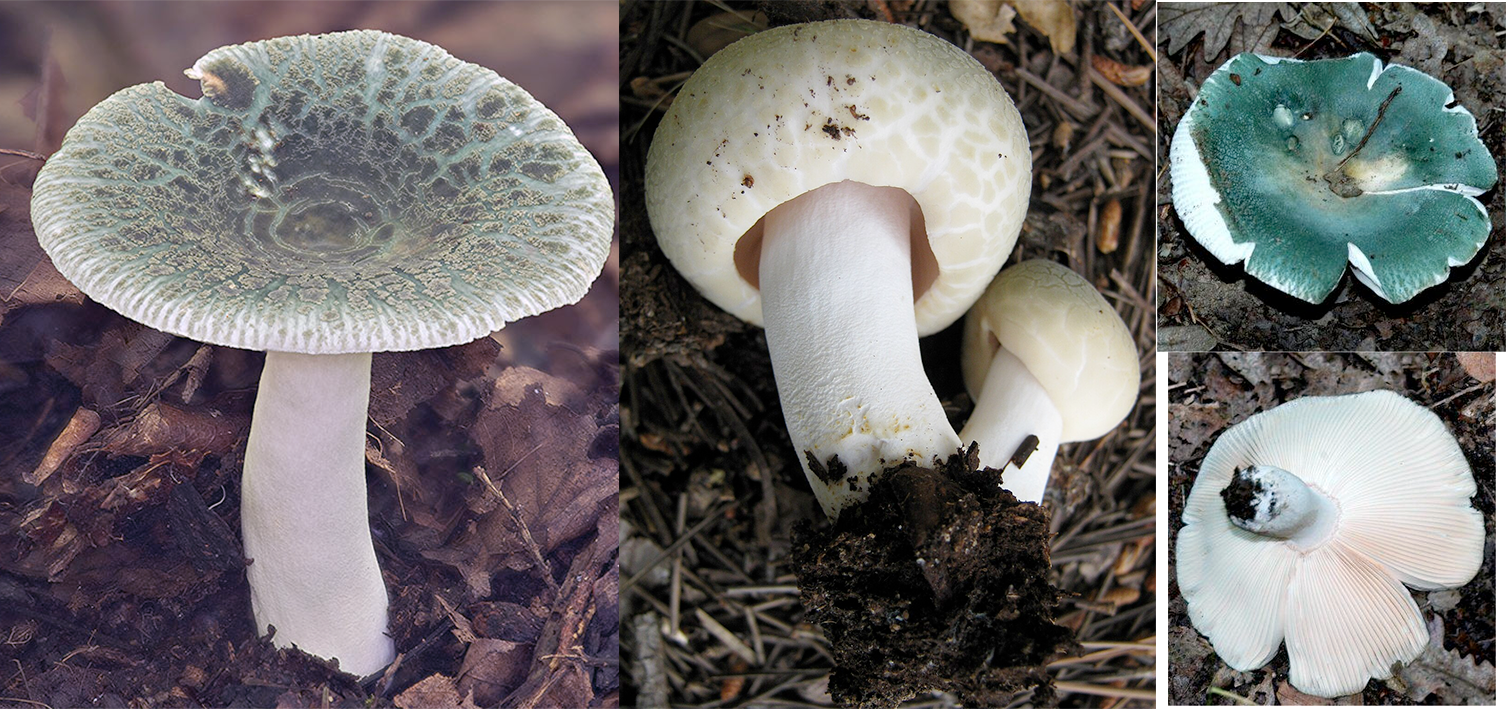
 The image, above, shows an various images of the Greencracked
Brittlegill (Russula virescens) mushrooms showing a
mature specimen (left), two immature specimens (centre) and a
very green version shown upright and then inverted to reveal the
gills (right)..
| Common Name: Greencracked Brittlegill |
| Scientific Name: Russula virescens |
| Other Names: Green Cracking Russula, Quilted Green Russula, Green Brittlegill, Tegyll Brau Craciog (CY) |
| Family: Russulaceae |
| Range: Native to Eurasia, North Africa, and possibly Central America |
Physical Characteristics
 Russula virescens is s a basidiomycete mushroom, with a cap growing to 4–18cm in diameter and 5#x2013;10 cm tall. It is typically associated with beech woodland (but can be found in other deciduous woodland) and fruits from august to October (but can sometimes be found in July the charcoal burner can be very variable in form and has numerous lookalikes (though all are edible).
|
| Edible Parts: Caps and Stipes |
 Spore Print: White to Yellow Spore Print: White to Yellow
|
  Cap: Convex to flat Cap: Convex to flat
|
 Hymenium: Adnate Hymenium: Adnate
|
 Pores: Gills on hymenium Pores: Gills on hymenium
|
 Stipe: Bare Stipe: Bare
|
 Edibility Rating: 4 Edibility Rating: 4 
|
 Known Hazards: None known Known Hazards: None known
|
Monthly Availability:
|
Welcome to the summary page for FabulousFusionFood's Wild Food guide to Greencracked Brittlegill along with all the Greencracked Brittlegill containing recipes presented on this site, with 11 recipes in total.
These recipes, all contain Greencracked Brittlegill as a major wild food ingredient.
Greencracked Brittlegill, Russula virescens (also known as Variegated Russula) is a choice edible species of basidomycete fungus and is a member of the Russulaceae (brittlegill) family of mushrooms with a white to yellow spore print. Like all Russulas, it is a mycorrhizal fungus which forms relationships with a variety of trees, including oaks (Quercus), European beech (Fagus sylvatica), and aspen (Populus tremula). Preliminary investigations suggest that the fungus also associates with at least ten species of Dipterocarpaceae, an important tree family prevalent in the tropical lowland forests of Southeast Asia. Fruit bodies may appear singly or in groups, reappear in the same spots year after year, and are not common. In Europe, fruiting occurs mainly during the months of summer to early autumn.
The he cap is at first dome or barrel-shaped, becoming convex and flattened with age with a diameter of up to 15 cm (6 in). The cap center is often depressed. The cuticle of the cap is green, most profoundly in the centre, with patches of the same colour dispersed radially around the center in an areolate pattern. The colour of the cuticle is often of variable shade, ranging from gray to verdigris to grass-green. The extent of the patching of the cuticle is also variable, giving specimens with limited patches a resemblance to other green-capped species of Russula, such as R. aeruginea. The green patches of the cap lie on a white to pale green background. The cap, while frequently round, may also exhibit irregular lobes and cracks. The cap cuticle is thin, and can be readily peeled off the surface to a distance of about halfway towards the cap centre. The gills are white to cream colored, and fairly crowded together; they are mostly free from attachment to the stipe. Gills are interconnected at their bases by veins. The stipe is cylindrical, white, and of variable height, up to 8cm tall and 4cm wide; it is roughly the same thickness at both the top and the base. The top portion of the stipe may be farinose — covered with a white, mealy powder. It may turn slightly brown with age, or when it is injured or bruised from handling. Like other mushrooms in the Russulales, the flesh is brittle, owing to the sphaerocyst cytoarchitecture—cylindrical cells that contrast with the typical fibrous, filamentous hyphae present in other orders of the basidiomycota.
The spores of R. virescens are elliptical or ellipsoid with warts, translucent (hyaline), and produce a white, pale or pale yellow spore print; the spore dimensions are 6–9 by 5–7 μm. A partial reticulum (net-like pattern of ridges) interconnects the warts. The spore-bearing cells, the basidia, are club-shaped and have dimensions of 24–33 by 6–7.5 μm; they are colourless, and each hold from two to four spores. The pleurocystidia (cystidia on the gill face) are 40–85 by 6–8 μm and end abruptly in a sharp point.
Gills white/cream coloured, fairly crowded and like most brittlegills are brittle when handled.
The Greencracked Brittlegill is an excellent edible spices, and considered one of the best tasting of its genus. Its smell is not distinctive, but its taste has been described as mild, nutty fruity, or even sweet. Old specimens may smell of herrings. Drying the mushrooms enhances the nutty flavour and the green colour disappears with cooking. Mushrooms can be sautéed; young specimens prepared this way have a potato taste that pairs well with shallots. It can also be used raw in salads.
Possible confusion: It is difficult to confuse this mushroom with any other Russula or fungi in the British Isles but the taste test with Russulas is always a safe way to identify members of this family, with the taste being mild and mushroomy you know it is edible, if it is hot and acrid it's a poisonous Russula. The taste test should only be carried out on members of the Russula family. Young specimens are pale and can be hard to identify, but the characteristic pattern of older fruit bodies makes them hard to confuse with other species. When collecting R. virescens for consumption, caution is of vital importance to avoid confusion with the dangerously poisonous Amanita phalloides (the death cap), a mushroom that can be most easily identified by its volva and ring.
For other edible mushrooms, see the guide to edible mushrooms
[2]. Huxley, A. The New RHS Dictionary of Gardening. 1999
[3]. Tanaka, T. Tanaka's Cyclopaedia of Edible Plants of the World.
[4]. Lim T.K. Edible Medicinal And Non-Medicinal Plants, Vols 1–12.
[5]. Thomas, G. S. Perennial Garden Plants, 2004
[6]. Milner, E. Trees of Britain and Ireland, 2011
[7]. Rose, F. & O'Reilly, C. The Wild Flower Key (Revised Edition) — How to identify wild plants, trees and shrubs in Britain and Ireland, 2006
[8]. Streeter, D. & Garrard, I. The Wild Flowers of the British Isles, 1983
[9]. Clapham, A.R.; Tutin, T.G. & Moore, D.M. Flora of the British Isles, 1987
[10]. Phillips, R. Mushrooms, 2006
[11]. Jordan, P. & Wheeler, S. The Complete Book of Mushrooms: An Illustrated Encyclopedia of Edible Mushrooms, 2011
[12]. Bunker, F. Seaweeds of Britain and Ireland, Second Edition, 2017
[13]. Facciola, S. Cornucopia II — A Source Book of Edible Plants, 1998
[14]. Hartford, R. Edible and Medicinal Wild Plants of Britain and Ireland: A Foraging and Photographic Identification Guide
(Note that the above book links are Amazon Affiliate links)
These recipes, all contain Greencracked Brittlegill as a major wild food ingredient.
Greencracked Brittlegill, Russula virescens (also known as Variegated Russula) is a choice edible species of basidomycete fungus and is a member of the Russulaceae (brittlegill) family of mushrooms with a white to yellow spore print. Like all Russulas, it is a mycorrhizal fungus which forms relationships with a variety of trees, including oaks (Quercus), European beech (Fagus sylvatica), and aspen (Populus tremula). Preliminary investigations suggest that the fungus also associates with at least ten species of Dipterocarpaceae, an important tree family prevalent in the tropical lowland forests of Southeast Asia. Fruit bodies may appear singly or in groups, reappear in the same spots year after year, and are not common. In Europe, fruiting occurs mainly during the months of summer to early autumn.
The he cap is at first dome or barrel-shaped, becoming convex and flattened with age with a diameter of up to 15 cm (6 in). The cap center is often depressed. The cuticle of the cap is green, most profoundly in the centre, with patches of the same colour dispersed radially around the center in an areolate pattern. The colour of the cuticle is often of variable shade, ranging from gray to verdigris to grass-green. The extent of the patching of the cuticle is also variable, giving specimens with limited patches a resemblance to other green-capped species of Russula, such as R. aeruginea. The green patches of the cap lie on a white to pale green background. The cap, while frequently round, may also exhibit irregular lobes and cracks. The cap cuticle is thin, and can be readily peeled off the surface to a distance of about halfway towards the cap centre. The gills are white to cream colored, and fairly crowded together; they are mostly free from attachment to the stipe. Gills are interconnected at their bases by veins. The stipe is cylindrical, white, and of variable height, up to 8cm tall and 4cm wide; it is roughly the same thickness at both the top and the base. The top portion of the stipe may be farinose — covered with a white, mealy powder. It may turn slightly brown with age, or when it is injured or bruised from handling. Like other mushrooms in the Russulales, the flesh is brittle, owing to the sphaerocyst cytoarchitecture—cylindrical cells that contrast with the typical fibrous, filamentous hyphae present in other orders of the basidiomycota.
The spores of R. virescens are elliptical or ellipsoid with warts, translucent (hyaline), and produce a white, pale or pale yellow spore print; the spore dimensions are 6–9 by 5–7 μm. A partial reticulum (net-like pattern of ridges) interconnects the warts. The spore-bearing cells, the basidia, are club-shaped and have dimensions of 24–33 by 6–7.5 μm; they are colourless, and each hold from two to four spores. The pleurocystidia (cystidia on the gill face) are 40–85 by 6–8 μm and end abruptly in a sharp point.
Gills white/cream coloured, fairly crowded and like most brittlegills are brittle when handled.
The Greencracked Brittlegill is an excellent edible spices, and considered one of the best tasting of its genus. Its smell is not distinctive, but its taste has been described as mild, nutty fruity, or even sweet. Old specimens may smell of herrings. Drying the mushrooms enhances the nutty flavour and the green colour disappears with cooking. Mushrooms can be sautéed; young specimens prepared this way have a potato taste that pairs well with shallots. It can also be used raw in salads.
Possible confusion: It is difficult to confuse this mushroom with any other Russula or fungi in the British Isles but the taste test with Russulas is always a safe way to identify members of this family, with the taste being mild and mushroomy you know it is edible, if it is hot and acrid it's a poisonous Russula. The taste test should only be carried out on members of the Russula family. Young specimens are pale and can be hard to identify, but the characteristic pattern of older fruit bodies makes them hard to confuse with other species. When collecting R. virescens for consumption, caution is of vital importance to avoid confusion with the dangerously poisonous Amanita phalloides (the death cap), a mushroom that can be most easily identified by its volva and ring.
For other edible mushrooms, see the guide to edible mushrooms
References:
[1]. David Evans Notes from field observations, tastings and cookery experiments.[2]. Huxley, A. The New RHS Dictionary of Gardening. 1999
[3]. Tanaka, T. Tanaka's Cyclopaedia of Edible Plants of the World.
[4]. Lim T.K. Edible Medicinal And Non-Medicinal Plants, Vols 1–12.
[5]. Thomas, G. S. Perennial Garden Plants, 2004
[6]. Milner, E. Trees of Britain and Ireland, 2011
[7]. Rose, F. & O'Reilly, C. The Wild Flower Key (Revised Edition) — How to identify wild plants, trees and shrubs in Britain and Ireland, 2006
[8]. Streeter, D. & Garrard, I. The Wild Flowers of the British Isles, 1983
[9]. Clapham, A.R.; Tutin, T.G. & Moore, D.M. Flora of the British Isles, 1987
[10]. Phillips, R. Mushrooms, 2006
[11]. Jordan, P. & Wheeler, S. The Complete Book of Mushrooms: An Illustrated Encyclopedia of Edible Mushrooms, 2011
[12]. Bunker, F. Seaweeds of Britain and Ireland, Second Edition, 2017
[13]. Facciola, S. Cornucopia II — A Source Book of Edible Plants, 1998
[14]. Hartford, R. Edible and Medicinal Wild Plants of Britain and Ireland: A Foraging and Photographic Identification Guide
(Note that the above book links are Amazon Affiliate links)
The alphabetical list of all Greencracked Brittlegill recipes on this site follows, (limited to 100 recipes per page). There are 11 recipes in total:
Page 1 of 1
| Blodsoppsvampsoppa (Scarletina Bolete Mushroom Soup) Origin: Sweden | Saffron Milk Cap Pâté Origin: Britain | Wild Mushroom Omelette Origin: Britain |
| Brine-pickled Mushrooms with Herbs Origin: Britain | Sienimunaskas-kääryle (Wild Mushroom Omelette Roll) Origin: Finland | Wild Mushroom Soup Origin: Britain |
| Dried Mushrooms Origin: Britain | Torta di patate e Funghi selvatici (Wild Mushroom and Potato Cake) Origin: Italy | Wild Mushroom Stuffed Potato Cakes Origin: Britain |
| Fried Charcoal Burner Mushrooms Origin: Britain | Wild Mushroom Compote Origin: Britain |
Page 1 of 1