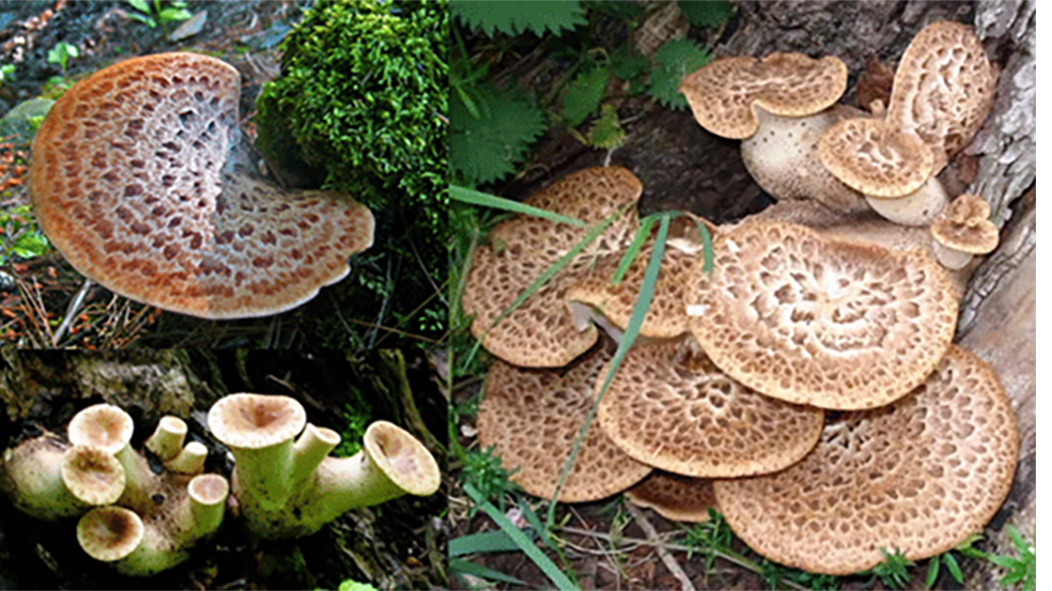
 The image, above, shows images of Dryad's Saddle mushroom
(Cerioporus squamosus), showing the mature form, top
left, the edible immature form, bottom left and shelves of the
fungus at different sizes, right. The mature forms shows the
mottled pattern that gives this mushroom it's alternate name of
'Pheasant's Back Mushroom'..
| Common Name: Dryad's Saddle |
| Scientific Name: Cerioporus squamosus |
| Other Names: Scaly Polypore and Pheasant's Back Mushroom |
| Family: Polyporaceae |
| Range: Europe, USA (east of the Rocky Mountains), Australia and Asia |
Physical Characteristics
 Edibility Rating: 5 Edibility Rating: 5  Cerioporus squamosus is a saprophytic fungus, growing to 40cm (16 in) in diameter and 10cm (8 in) thick. They are typically parasitic on on a broad range of broad-leaved trees, most especially elm, ash, sycamore and beech. The mushroom fruits from May, with a second fruiting in September.
|
| Edible Parts: Caps |
 Spore Print: White Spore Print: White
|
  Cap: Depressed or Offset Cap: Depressed or Offset
|
 Hymenium: Decurrent Hymenium: Decurrent
|
 Pores: Pores on hymenium Pores: Pores on hymenium
|
 Stipe: Bare Stipe: Bare
|
Edibility Rating: 4 
|
 Known Hazards: There are no reports of toxicity for this mushroom, however like all bracket fungi it may leach toxins from its host tree. As a result it should not be consumed if growing on elm. Known Hazards: There are no reports of toxicity for this mushroom, however like all bracket fungi it may leach toxins from its host tree. As a result it should not be consumed if growing on elm.
|
Welcome to the summary page for FabulousFusionFood's Wild Food guide to Dryad's Saddle along with all the Dryad's Saddle containing recipes presented on this site, with 1 recipes in total.
These recipes, all contain Dryad's Saddle as a major wild food ingredient.
Dryad's Saddle, Cerioporus squamosus (also known as Scaly Polypore and Pheasant's Back Mushroom) is a very distinctive species of polyporaceous basidomycete bracket fungus (filamentous fungi composed of hyphae that reproduce sexually) and is a member of the Polyporaceae family of the Polyporales order that have white spore prints. It is a fairly common species that is typically thrives on dead wood and can be found on a broad range of broad-leaved trees, most especially elm, ash, sycamore and beech. Typically it fruits during May with a second fruiting in September and can be found from April right through to November. The fungus typically grows gregariously in 'shelves' of brackets that, individually, are about 10 to 40cm broad and up to 10cm thick. It is native to Western Europe and the Western United States. The fungus is broadly hemispherical in shape and is attached to its host by a single stem. The fungus has an undersurface of pale cream, polygonal, pores with a short, black, stem whilst the upper surface is typically creamy yellow with distinctive concentric rings of brown scales (the squamules). Young bracts are tubular with several flat-topped stalks that broaden and become fan-shaped as they mature. The flesh is creamy white, soft and meaty whilst young but becoming more corky with age. The smell is generally described as 'mealy' and is stronger than many other bracket fungus, but the flavour, when cooked, is much milder than the smell. To me, the mushroom looks very much like an old-fashioned iron tractor's seat, but the common name of 'Dryad's Saddle' comes from it's supposed use as a horse saddle by Dryads, which are Greek horse-riding wood nymphs.
Typically, the dryad's saddle is not included in a list of edible fungi. It is in no way poisonous and cannot be easily mistaken for any other mushroom, but older specimens do become corky and unpleasant in texture. However, if picked young I do consider the dryad's saddle to be worth picking. Just make certain you only pick young specimens and use only the tenderest parts (the flesh of the outer edges, furthest away from the stalk. Deep frying and flash frying is the best way to prepare, as over-cooking makes the flesh tough.
Young specimens are preferred, as they can become infested with maggots and become firm and inedible as they mature. Cookbooks dealing with preparation generally recommend gathering these while young, slicing them into small pieces and cooking them over a low heat. Interestingly the sliced mushroom's aroma strongly resembles that of watermelon rind.
The colour, shape, large size and location of this species, most especially the concentric rings of scales means that the dryad's saddle cannot readily be confused with any other fungal species and makes it safe to pick.
For other edible mushrooms, see the guide to edible mushrooms
[2]. Huxley, A. The New RHS Dictionary of Gardening. 1999
[3]. Tanaka, T. Tanaka's Cyclopaedia of Edible Plants of the World.
[4]. Lim T.K. Edible Medicinal And Non-Medicinal Plants, Vols 1–12.
[5]. Thomas, G. S. Perennial Garden Plants, 2004
[6]. Milner, E. Trees of Britain and Ireland, 2011
[7]. Rose, F. & O'Reilly, C. The Wild Flower Key (Revised Edition) — How to identify wild plants, trees and shrubs in Britain and Ireland, 2006
[8]. Streeter, D. & Garrard, I. The Wild Flowers of the British Isles, 1983
[9]. Clapham, A.R.; Tutin, T.G. & Moore, D.M. Flora of the British Isles, 1987
[10]. Phillips, R. Mushrooms, 2006
[11]. Jordan, P. & Wheeler, S. The Complete Book of Mushrooms: An Illustrated Encyclopedia of Edible Mushrooms, 2011
[12]. Bunker, F. Seaweeds of Britain and Ireland, Second Edition, 2017
[13]. Facciola, S. Cornucopia II — A Source Book of Edible Plants, 1998
[14]. Hartford, R. Edible and Medicinal Wild Plants of Britain and Ireland: A Foraging and Photographic Identification Guide
(Note that the above book links are Amazon Affiliate links)
These recipes, all contain Dryad's Saddle as a major wild food ingredient.
Dryad's Saddle, Cerioporus squamosus (also known as Scaly Polypore and Pheasant's Back Mushroom) is a very distinctive species of polyporaceous basidomycete bracket fungus (filamentous fungi composed of hyphae that reproduce sexually) and is a member of the Polyporaceae family of the Polyporales order that have white spore prints. It is a fairly common species that is typically thrives on dead wood and can be found on a broad range of broad-leaved trees, most especially elm, ash, sycamore and beech. Typically it fruits during May with a second fruiting in September and can be found from April right through to November. The fungus typically grows gregariously in 'shelves' of brackets that, individually, are about 10 to 40cm broad and up to 10cm thick. It is native to Western Europe and the Western United States. The fungus is broadly hemispherical in shape and is attached to its host by a single stem. The fungus has an undersurface of pale cream, polygonal, pores with a short, black, stem whilst the upper surface is typically creamy yellow with distinctive concentric rings of brown scales (the squamules). Young bracts are tubular with several flat-topped stalks that broaden and become fan-shaped as they mature. The flesh is creamy white, soft and meaty whilst young but becoming more corky with age. The smell is generally described as 'mealy' and is stronger than many other bracket fungus, but the flavour, when cooked, is much milder than the smell. To me, the mushroom looks very much like an old-fashioned iron tractor's seat, but the common name of 'Dryad's Saddle' comes from it's supposed use as a horse saddle by Dryads, which are Greek horse-riding wood nymphs.
Typically, the dryad's saddle is not included in a list of edible fungi. It is in no way poisonous and cannot be easily mistaken for any other mushroom, but older specimens do become corky and unpleasant in texture. However, if picked young I do consider the dryad's saddle to be worth picking. Just make certain you only pick young specimens and use only the tenderest parts (the flesh of the outer edges, furthest away from the stalk. Deep frying and flash frying is the best way to prepare, as over-cooking makes the flesh tough.
Young specimens are preferred, as they can become infested with maggots and become firm and inedible as they mature. Cookbooks dealing with preparation generally recommend gathering these while young, slicing them into small pieces and cooking them over a low heat. Interestingly the sliced mushroom's aroma strongly resembles that of watermelon rind.
The colour, shape, large size and location of this species, most especially the concentric rings of scales means that the dryad's saddle cannot readily be confused with any other fungal species and makes it safe to pick.
For other edible mushrooms, see the guide to edible mushrooms
References:
[1]. David Evans Notes from field observations, tastings and cookery experiments.[2]. Huxley, A. The New RHS Dictionary of Gardening. 1999
[3]. Tanaka, T. Tanaka's Cyclopaedia of Edible Plants of the World.
[4]. Lim T.K. Edible Medicinal And Non-Medicinal Plants, Vols 1–12.
[5]. Thomas, G. S. Perennial Garden Plants, 2004
[6]. Milner, E. Trees of Britain and Ireland, 2011
[7]. Rose, F. & O'Reilly, C. The Wild Flower Key (Revised Edition) — How to identify wild plants, trees and shrubs in Britain and Ireland, 2006
[8]. Streeter, D. & Garrard, I. The Wild Flowers of the British Isles, 1983
[9]. Clapham, A.R.; Tutin, T.G. & Moore, D.M. Flora of the British Isles, 1987
[10]. Phillips, R. Mushrooms, 2006
[11]. Jordan, P. & Wheeler, S. The Complete Book of Mushrooms: An Illustrated Encyclopedia of Edible Mushrooms, 2011
[12]. Bunker, F. Seaweeds of Britain and Ireland, Second Edition, 2017
[13]. Facciola, S. Cornucopia II — A Source Book of Edible Plants, 1998
[14]. Hartford, R. Edible and Medicinal Wild Plants of Britain and Ireland: A Foraging and Photographic Identification Guide
(Note that the above book links are Amazon Affiliate links)
The alphabetical list of all Dryad's Saddle recipes on this site follows, (limited to 100 recipes per page). There are 1 recipes in total:
Page 1 of 1
| Mushroom Pudding Origin: Britain |
Page 1 of 1