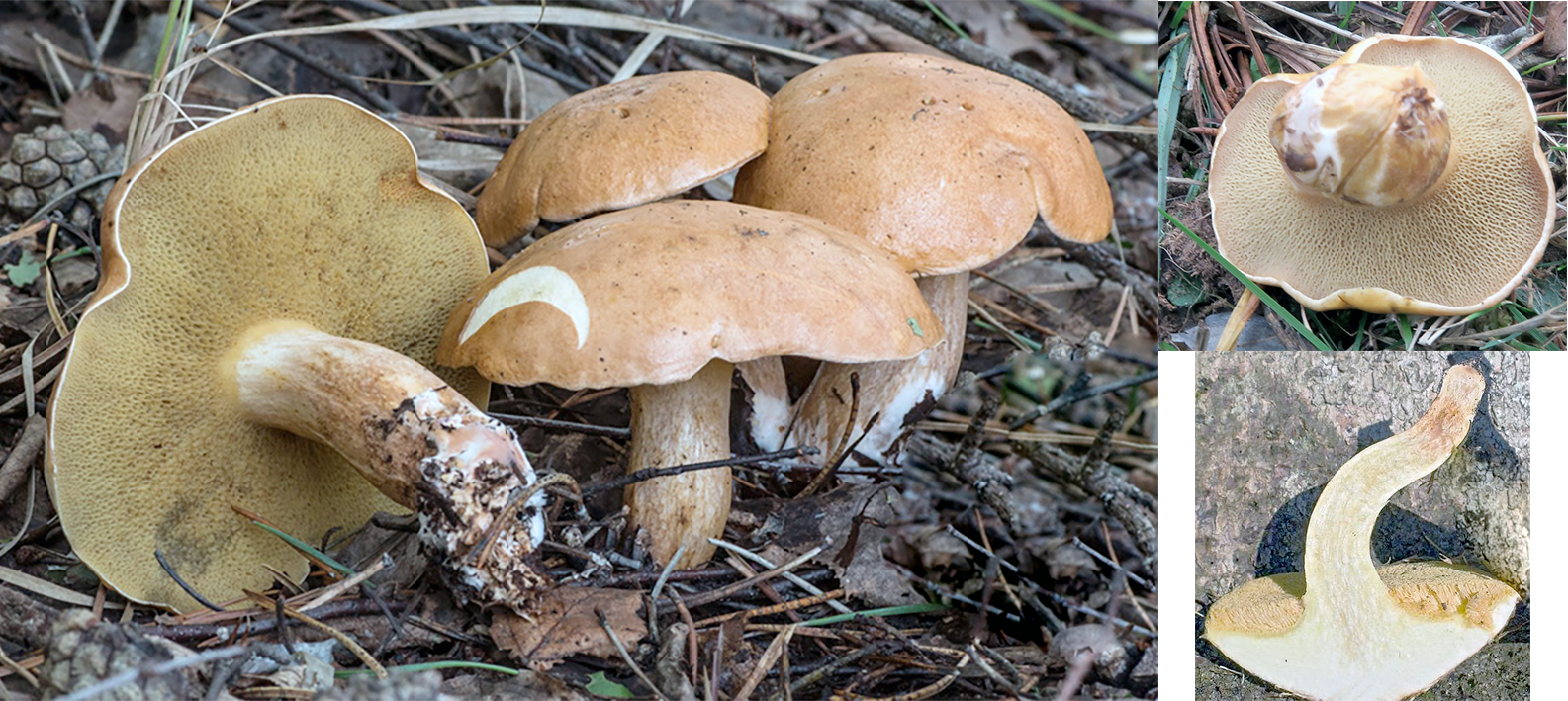
 The image, above, shows an image of cow bolete (Suillus
bovinus) mushrooms growing in pine needle litter with one
mushroom on its side. Inset are images of an inverted cow bolete
and a cow bolete split in half..
| Common Name: Cow Bolete |
| Scientific Name: Suillus bovinus |
| Other Names: Bovine Bolete, Jersey Cow Mushroom, Jersey Jack, Goat Mushroom, Boled yr Ych (CY) |
| Family: Boletaceae |
| Range: it is native to Eurasia and has been introduced to North America and Australia.. |
Physical Characteristics
 Suillus bovinus is a basidocarpal mushroom, growing to 3–10cm in diameter, with a sticky skin. The flesh is whitish, yellowish or clay-coloured and has a fruity smell. Sometimes turning a pink tinge when bruised, the flesh is spongy and rubbery. Like other boletes, it has pores instead of gills that make up the hymenophore on the underside of the cap. The fungus grows in coniferous forests in its native range, and pine plantations in countries where it has become naturalised.
|
| Edible Parts: Caps and Stipes |
 Spore Print: Olive-brown Spore Print: Olive-brown
|
 Cap: Convex Cap: Convex
|
  Hymenium: Adnate or decurrent Hymenium: Adnate or decurrent
|
 Pores: Pores on hymenium Pores: Pores on hymenium
|
 Stipe: Bare Stipe: Bare
|
 Edibility Rating: 3 Edibility Rating: 3 
|
 Known Hazards: None known Known Hazards: None known
|
Monthly Availability:
|
Welcome to the summary page for FabulousFusionFood's Wild Food guide to Cow Bolete along with all the Cow Bolete containing recipes presented on this site, with 43 recipes in total.
These recipes, all contain Cow Bolete as a major wild food ingredient.
Cow Bolete, Leccinum scabrum (also known as Rough-stemmed Bolete, Scaber Stalk and Birch Bolete) is an edible species of mycorrhizal fungus and is a member of the Boletaceae (Bolete) family of mushrooms with an olive-brown spore print. It is widespread in Eurasia. It is always associated with pine trees and forms mycorrhiza with them. Typically it fruits from August to November and where it occurs can be very common. It is always found in association with pine trees and this is one of its distinguishing features.
The cap is typically 3 to 10cm across and often irregular and wavy at the margin, the caps of Suillus bovinus vary from pale yellow to deep orange, usually somewhat paler at the margin. When cut, the white to clay pink flesh of the cap does not change colour. The tubes terminate in large compound pores (divided into usually two compartments). The pores are yellow, becoming gray-green and turning darker when bruised. Nearer to the stem the pores are progressively more elongated, and at the point of attachment, the tubes are sometimes slightly decurrent to the stem.
Club-shaped in young specimens, the clay-coloured stipe of Suillus bovinus soon becomes more or less parallel-sided; it is typically 6 to 10mm in diameter and 5 to 8cm tall and, unlike many members of the Suillus genus, it does not have a stem ring. The whitish stem flesh has a pink tinge near the base of the stem.
The spores are Subfusiform, smooth, 8-10 x 3-4μm with a spore print that's olive brown.
The mushroom is best when young as it readily becomes maggot infested and the older mushrooms become rubbery. The Bovine Bolete is classified as a low-quality edible mushroom: safe to eat, mild-tasting, but not particularly rich in flavour. The flesh is soft and somewhat gelatinous when cooked. It is suitable for frying, stewing, pickling, or drying. Its flavour improves when combined with stronger mushrooms. It's often said that the mushroom's flavour improves when sliced, dried, re-hydrated and then cooked. It can also be used to flavour stocks. It has a lightly fruity mushroomy odour and a faintly sweet taste.
It is one of the few fungi that various ungulates (cattle, deer, sheep, goats) will graze on. The origin of the common name apparently comes from medieval knights, they loved a mushroom called the Yellow Knight (Tricholoma equestre) — the yellow knight is currently (2022) a bit up for debate on edibility — which also grows with Pine and they ignored the Bovine Bolete as they considered them to only be fit for cattle drovers.
Possible confusion: Other Suillus species but as none are toxic this should not prove a problem. The Larch Bolete (Suillus grevillei) looks similar but has a ring zone on the stem. Suillus granulatus is also similar but has milky droplets beneath its cap and it has simple rather than compound pores. Though not a choice edible it's one of the safer mushrooms for beginners to forage for.
For other edible mushrooms, see the guide to edible mushrooms
[2]. Huxley, A. The New RHS Dictionary of Gardening. 1999
[3]. Tanaka, T. Tanaka's Cyclopaedia of Edible Plants of the World.
[4]. Lim T.K. Edible Medicinal And Non-Medicinal Plants, Vols 1–12.
[5]. Thomas, G. S. Perennial Garden Plants, 2004
[6]. Milner, E. Trees of Britain and Ireland, 2011
[7]. Rose, F. & O'Reilly, C. The Wild Flower Key (Revised Edition) — How to identify wild plants, trees and shrubs in Britain and Ireland, 2006
[8]. Streeter, D. & Garrard, I. The Wild Flowers of the British Isles, 1983
[9]. Clapham, A.R.; Tutin, T.G. & Moore, D.M. Flora of the British Isles, 1987
[10]. Phillips, R. Mushrooms, 2006
[11]. Jordan, P. & Wheeler, S. The Complete Book of Mushrooms: An Illustrated Encyclopedia of Edible Mushrooms, 2011
[12]. Bunker, F. Seaweeds of Britain and Ireland, Second Edition, 2017
[13]. Facciola, S. Cornucopia II — A Source Book of Edible Plants, 1998
[14]. Hartford, R. Edible and Medicinal Wild Plants of Britain and Ireland: A Foraging and Photographic Identification Guide
(Note that the above book links are Amazon Affiliate links)
These recipes, all contain Cow Bolete as a major wild food ingredient.
Cow Bolete, Leccinum scabrum (also known as Rough-stemmed Bolete, Scaber Stalk and Birch Bolete) is an edible species of mycorrhizal fungus and is a member of the Boletaceae (Bolete) family of mushrooms with an olive-brown spore print. It is widespread in Eurasia. It is always associated with pine trees and forms mycorrhiza with them. Typically it fruits from August to November and where it occurs can be very common. It is always found in association with pine trees and this is one of its distinguishing features.
The cap is typically 3 to 10cm across and often irregular and wavy at the margin, the caps of Suillus bovinus vary from pale yellow to deep orange, usually somewhat paler at the margin. When cut, the white to clay pink flesh of the cap does not change colour. The tubes terminate in large compound pores (divided into usually two compartments). The pores are yellow, becoming gray-green and turning darker when bruised. Nearer to the stem the pores are progressively more elongated, and at the point of attachment, the tubes are sometimes slightly decurrent to the stem.
Club-shaped in young specimens, the clay-coloured stipe of Suillus bovinus soon becomes more or less parallel-sided; it is typically 6 to 10mm in diameter and 5 to 8cm tall and, unlike many members of the Suillus genus, it does not have a stem ring. The whitish stem flesh has a pink tinge near the base of the stem.
The spores are Subfusiform, smooth, 8-10 x 3-4μm with a spore print that's olive brown.
The mushroom is best when young as it readily becomes maggot infested and the older mushrooms become rubbery. The Bovine Bolete is classified as a low-quality edible mushroom: safe to eat, mild-tasting, but not particularly rich in flavour. The flesh is soft and somewhat gelatinous when cooked. It is suitable for frying, stewing, pickling, or drying. Its flavour improves when combined with stronger mushrooms. It's often said that the mushroom's flavour improves when sliced, dried, re-hydrated and then cooked. It can also be used to flavour stocks. It has a lightly fruity mushroomy odour and a faintly sweet taste.
It is one of the few fungi that various ungulates (cattle, deer, sheep, goats) will graze on. The origin of the common name apparently comes from medieval knights, they loved a mushroom called the Yellow Knight (Tricholoma equestre) — the yellow knight is currently (2022) a bit up for debate on edibility — which also grows with Pine and they ignored the Bovine Bolete as they considered them to only be fit for cattle drovers.
Possible confusion: Other Suillus species but as none are toxic this should not prove a problem. The Larch Bolete (Suillus grevillei) looks similar but has a ring zone on the stem. Suillus granulatus is also similar but has milky droplets beneath its cap and it has simple rather than compound pores. Though not a choice edible it's one of the safer mushrooms for beginners to forage for.
For other edible mushrooms, see the guide to edible mushrooms
References:
[1]. David Evans Notes from field observations, tastings and cookery experiments.[2]. Huxley, A. The New RHS Dictionary of Gardening. 1999
[3]. Tanaka, T. Tanaka's Cyclopaedia of Edible Plants of the World.
[4]. Lim T.K. Edible Medicinal And Non-Medicinal Plants, Vols 1–12.
[5]. Thomas, G. S. Perennial Garden Plants, 2004
[6]. Milner, E. Trees of Britain and Ireland, 2011
[7]. Rose, F. & O'Reilly, C. The Wild Flower Key (Revised Edition) — How to identify wild plants, trees and shrubs in Britain and Ireland, 2006
[8]. Streeter, D. & Garrard, I. The Wild Flowers of the British Isles, 1983
[9]. Clapham, A.R.; Tutin, T.G. & Moore, D.M. Flora of the British Isles, 1987
[10]. Phillips, R. Mushrooms, 2006
[11]. Jordan, P. & Wheeler, S. The Complete Book of Mushrooms: An Illustrated Encyclopedia of Edible Mushrooms, 2011
[12]. Bunker, F. Seaweeds of Britain and Ireland, Second Edition, 2017
[13]. Facciola, S. Cornucopia II — A Source Book of Edible Plants, 1998
[14]. Hartford, R. Edible and Medicinal Wild Plants of Britain and Ireland: A Foraging and Photographic Identification Guide
(Note that the above book links are Amazon Affiliate links)
The alphabetical list of all Cow Bolete recipes on this site follows, (limited to 100 recipes per page). There are 43 recipes in total:
Page 1 of 1
Page 1 of 1