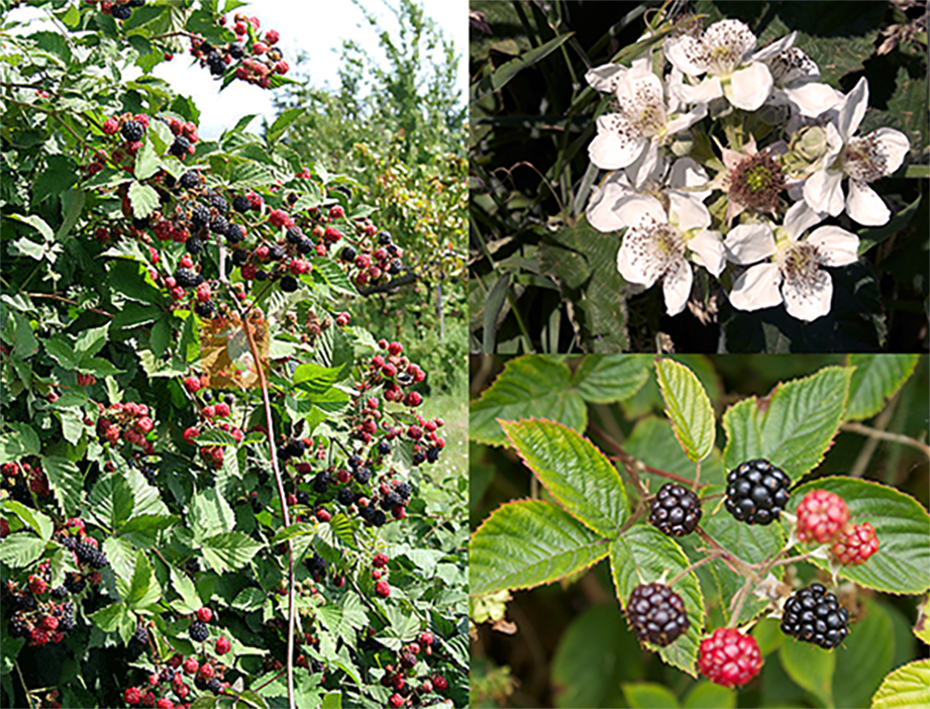
 The image, above, shows the full blackberry (bramble) plant
(Rubus fruticosus), left, with the plant bearing fruit.
The flowers are shown top, right and the edible fruit and leaves
are shown bottom, right..
|
Common Name: Blackberry |
| Scientific Name: Rubus fruticosus |
| Other Names: Brambles, Bramble Raspberry, Shrubby Blackberry |
| Family: Roasceae |
| Range: Europe, including Britain, to the Mediterranean and Macaronesia. |
Physical Characteristics Rubus fruticosus is a hardy deciduous shrub, growing to 3m (10 ft) by 3m (10 ft) in size. It is hardy to zone 6 and is not frost tender. The plant flowers in May to September and the fruit ripen from July to October. The flowers are hermaphrodite and are pollinated by bees and insects. The flowers are also self-fertile.
|
| Edible Parts: Fruit, Leaves, Flowers, Plant Tips |
 Edibility Rating: 5 Edibility Rating: 5 
|
 Known Hazards: None Known. Known Hazards: None Known.
|
Monthly Availability:
|
Welcome to the summary page for FabulousFusionFood's Wild Food guide to Common Blackberry along with all the Common Blackberry containing recipes presented on this site, with 10 recipes in total.
These recipes, all contain Common Blackberry as a major wild food ingredient.
The Common Blackberry, Rubus fruticosus, (also known as Brambles, Bramble Raspberry) is a rambling shrub and a member of the Rosaceae (rose) family. A single plant can grow to 3m tall and up to 5m in diameter. The blackberry plant grows as a tangle of dense arching stems that bear short curved very sharp spines and the plant propagates itself by the branches rooting from the node tip when they reach the ground. It is very pervasive and grows at a very noticeable daily rate. This is a very common plant on hedgerows, in woods, scrub, and seldom-grazed hillsides. It has palmate or pinnate compound leaves of three to five leaflets with flowers of white or pink appearing from May to August, ripening to a black or dark purple fruit, which is also known as a 'blackberry'.
In strict botanical terms, however, a blackberry isn't truly a fruit, but rather is an aggregate fruit comprised of numerous 'drupelets' (individual fruit). Blackberries produce an abundance of fruit in late autumn and it can be assumed that they have been consumed by humans for many thousands of years as they are easy to pick in quantities. Though almost all wild blackberries are from one species, Rubus fruticosus it is estimated that there are 400 micro-species in the UK alone, each differing in the size, acidity, ripening quality and number of fruit produced. A tea can be made by steeping the leaves which has a light blackberry-like flavour. But it is the fruit that are most commonly consumed. These are very versatile and can be made into many kinds of desserts, from sorbets through puddings, cakes, coulis and tarts. Blackberries also work well with lamb and can be added to lamb stews or made into sauces to accompany lamb dishes. The flower petals are edible, but are fiddly to collect in any worthwhile quantities.
The young growing bramble plant tips are also edible and are best in early spring. Collect when they are still flexible and when the spines can be easily wiped away with a cloth. The slightly bizarre thing about bramble tips is that they have a mild coconut-like flavour. This means that they work well in sweet and savoury dishes. For example they are a great addition to curries and stir-fries. They can also be candied in sugar and preserved in vinegar or brined vinegar. The leaves, both fresh and most especially dried, make a very pleasant tisane (herb tea).
[2]. Huxley, A. The New RHS Dictionary of Gardening. 1999
[3]. Tanaka, T. Tanaka's Cyclopaedia of Edible Plants of the World.
[4]. Lim T.K. Edible Medicinal And Non-Medicinal Plants, Vols 1–12.
[5]. Thomas, G. S. Perennial Garden Plants, 2004
[6]. Milner, E. Trees of Britain and Ireland, 2011
[7]. Rose, F. & O'Reilly, C. The Wild Flower Key (Revised Edition) — How to identify wild plants, trees and shrubs in Britain and Ireland, 2006
[8]. Streeter, D. & Garrard, I. The Wild Flowers of the British Isles, 1983
[9]. Clapham, A.R.; Tutin, T.G. & Moore, D.M. Flora of the British Isles, 1987
[10]. Phillips, R. Mushrooms, 2006
[11]. Jordan, P. & Wheeler, S. The Complete Book of Mushrooms: An Illustrated Encyclopedia of Edible Mushrooms, 2011
[12]. Bunker, F. Seaweeds of Britain and Ireland, Second Edition, 2017
[13]. Facciola, S. Cornucopia II — A Source Book of Edible Plants, 1998
[14]. Hartford, R. Edible and Medicinal Wild Plants of Britain and Ireland: A Foraging and Photographic Identification Guide
(Note that the above book links are Amazon Affiliate links)
These recipes, all contain Common Blackberry as a major wild food ingredient.
The Common Blackberry, Rubus fruticosus, (also known as Brambles, Bramble Raspberry) is a rambling shrub and a member of the Rosaceae (rose) family. A single plant can grow to 3m tall and up to 5m in diameter. The blackberry plant grows as a tangle of dense arching stems that bear short curved very sharp spines and the plant propagates itself by the branches rooting from the node tip when they reach the ground. It is very pervasive and grows at a very noticeable daily rate. This is a very common plant on hedgerows, in woods, scrub, and seldom-grazed hillsides. It has palmate or pinnate compound leaves of three to five leaflets with flowers of white or pink appearing from May to August, ripening to a black or dark purple fruit, which is also known as a 'blackberry'.
In strict botanical terms, however, a blackberry isn't truly a fruit, but rather is an aggregate fruit comprised of numerous 'drupelets' (individual fruit). Blackberries produce an abundance of fruit in late autumn and it can be assumed that they have been consumed by humans for many thousands of years as they are easy to pick in quantities. Though almost all wild blackberries are from one species, Rubus fruticosus it is estimated that there are 400 micro-species in the UK alone, each differing in the size, acidity, ripening quality and number of fruit produced. A tea can be made by steeping the leaves which has a light blackberry-like flavour. But it is the fruit that are most commonly consumed. These are very versatile and can be made into many kinds of desserts, from sorbets through puddings, cakes, coulis and tarts. Blackberries also work well with lamb and can be added to lamb stews or made into sauces to accompany lamb dishes. The flower petals are edible, but are fiddly to collect in any worthwhile quantities.
The young growing bramble plant tips are also edible and are best in early spring. Collect when they are still flexible and when the spines can be easily wiped away with a cloth. The slightly bizarre thing about bramble tips is that they have a mild coconut-like flavour. This means that they work well in sweet and savoury dishes. For example they are a great addition to curries and stir-fries. They can also be candied in sugar and preserved in vinegar or brined vinegar. The leaves, both fresh and most especially dried, make a very pleasant tisane (herb tea).
References:
[1]. David Evans Notes from field observations, tastings and cookery experiments.[2]. Huxley, A. The New RHS Dictionary of Gardening. 1999
[3]. Tanaka, T. Tanaka's Cyclopaedia of Edible Plants of the World.
[4]. Lim T.K. Edible Medicinal And Non-Medicinal Plants, Vols 1–12.
[5]. Thomas, G. S. Perennial Garden Plants, 2004
[6]. Milner, E. Trees of Britain and Ireland, 2011
[7]. Rose, F. & O'Reilly, C. The Wild Flower Key (Revised Edition) — How to identify wild plants, trees and shrubs in Britain and Ireland, 2006
[8]. Streeter, D. & Garrard, I. The Wild Flowers of the British Isles, 1983
[9]. Clapham, A.R.; Tutin, T.G. & Moore, D.M. Flora of the British Isles, 1987
[10]. Phillips, R. Mushrooms, 2006
[11]. Jordan, P. & Wheeler, S. The Complete Book of Mushrooms: An Illustrated Encyclopedia of Edible Mushrooms, 2011
[12]. Bunker, F. Seaweeds of Britain and Ireland, Second Edition, 2017
[13]. Facciola, S. Cornucopia II — A Source Book of Edible Plants, 1998
[14]. Hartford, R. Edible and Medicinal Wild Plants of Britain and Ireland: A Foraging and Photographic Identification Guide
(Note that the above book links are Amazon Affiliate links)
The alphabetical list of all Common Blackberry recipes on this site follows, (limited to 100 recipes per page). There are 10 recipes in total:
Page 1 of 1
| Ashkenazi Charoset Origin: Jewish | Blueberry Cheese Tart Origin: Britain | Pickled Bramble Tips Origin: Britain |
| Bilberry Cheese Tart Origin: Britain | Cheesecake with Blackberry Jewel Topping Origin: Britain | Rapeseed and Peanut Butter Cupcakes Origin: British |
| Blackberry Leaf Tea Origin: Britain | Croatian Nut Meringue and Jam Biscuits Origin: Croatia | |
| Blackberry Stem Candies Origin: Britain | Halloween Sparkle Punch Origin: America |
Page 1 of 1