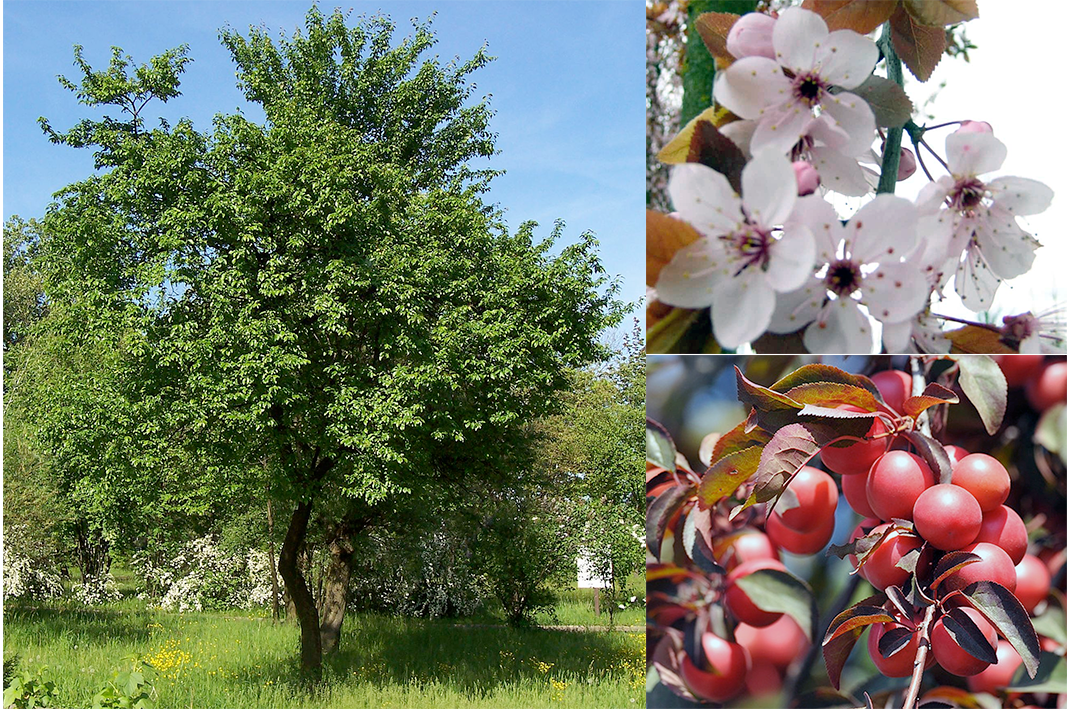
 Cherry Plum, Prunus cerasifera showing the mature tree,
a close up of the flowers and bunches of fruit..
| Common Name: Cherry Plum |
| Scientific Name: Prunus cerasifera |
| Other Names: myrobalan plum |
| Family: Rosaceae |
| Range: Origin: Cherry Plum is probably native to Western Asia, though due to extensive planting and introduction the original habitat remains obscure. It has commonly been planted in parks, hedgerows and as an ornamental due to its early flowering in Britain. |
Physical Characteristics Prunus cerasifera is a s a deciduous fruit Tree growing to 9m by 9m at a medium rate. It is in flower in March, and the fruit ripen from August to September. The species is hermaphrodite (has both male and female organs) and is pollinated by Bees.
Suitable for: ight (sandy), medium (loamy) and heavy (clay) soils, prefers well-drained soil and can grow in heavy clay soil. Suitable pH: mildly acid, neutral and basic (mildly alkaline) soils. It can grow in semi-shade (light woodland) or no shade. It prefers moist soil.
Prunus cerasifera is a s a deciduous fruit Tree growing to 9m by 9m at a medium rate. It is in flower in March, and the fruit ripen from August to September. The species is hermaphrodite (has both male and female organs) and is pollinated by Bees.
Suitable for: ight (sandy), medium (loamy) and heavy (clay) soils, prefers well-drained soil and can grow in heavy clay soil. Suitable pH: mildly acid, neutral and basic (mildly alkaline) soils. It can grow in semi-shade (light woodland) or no shade. It prefers moist soil.
|
| Edible Parts: Flowers, Fruit and seeds |
 Edibility Rating: 2 Edibility Rating: 2 
|
 Known Hazards: Like most members of the Rosaceae, the seeds and leaves of the plant contain hydrogen cyanide (the poison that gives almonds their characteristic flavour). Usually it is present in low quantities, but as it is denoted by bitterness, if the seed or fruit taste bitter they should not be eaten. In large quantities hydrogen cyanide can lead to respiratory failure. Known Hazards: Like most members of the Rosaceae, the seeds and leaves of the plant contain hydrogen cyanide (the poison that gives almonds their characteristic flavour). Usually it is present in low quantities, but as it is denoted by bitterness, if the seed or fruit taste bitter they should not be eaten. In large quantities hydrogen cyanide can lead to respiratory failure.
|
Monthly Availability: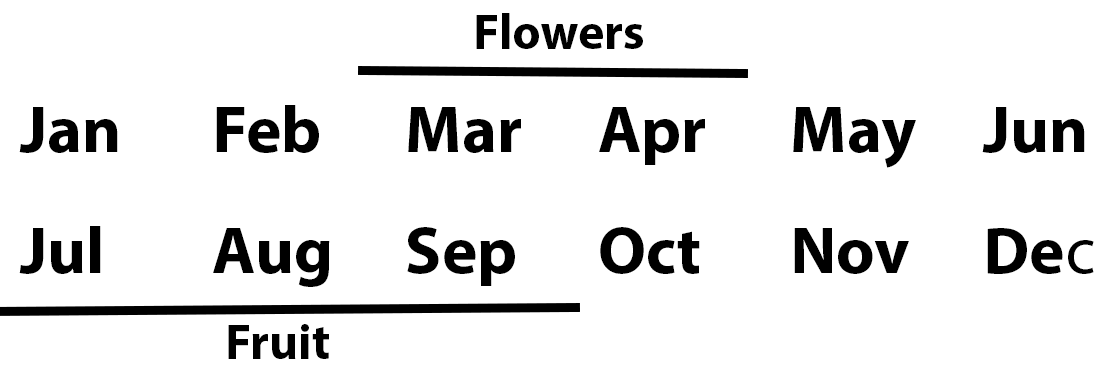
|
Welcome to the summary page for FabulousFusionFood's Wild Food guide to Cherry Plum along with all the Cherry Plum containing recipes presented on this site, with 5 recipes in total.
These recipes, all contain Cherry Plum as a major wild food ingredient.
Cherry Plum, Prunus cerasifera is a species of flowering fruit tree known by the common names cherry plum and myrobalan plum. Native to Eurasia and naturalized elsewhere. P. cerasifera is believed to be one of the parents of the cultivated plum, Prunus domestica, perhaps crossing with the sloe, Prunus spinosa, or perhaps the sole parent. This would make it a parent of most of the commercial varieties of plum in the UK and mainland Europe: Victoria, greengages, bullace, etc.
Wild types are large shrubs or small trees reaching 8–12 metres (26–39 ft) tall, sometimes spiny, with glabrous, ovate deciduous leaves 3–7 cm (1–3 in) long. It is one of the first European trees to flower in spring, often starting in mid-February before the leaves have opened. The flowers are white or pale pink and about 2 cm (3⁄4 in) across, with five petals and many stamens. The fruit is an edible drupe, 2–3 cm in diameter, ripening to yellow or red from early July to mid-September. They are self-fertile but can also be pollinated by other Prunus varieties such as the Victoria plum. The plant propagates by seed or by suckering, and is often used as the rootstock for other Prunus species and cultivars.
Prunus cerasifera is native to Southeast Europe and Western Asia, and is naturalised in the British Isles and scattered locations in North America. It is also naturalized in parts of Southeast Australia where it is considered to be a mildly invasive weed of bushland near urban centres. The cherry plum is a popular ornamental tree for garden and landscaping use, grown for its very early flowering. Numerous cultivars have been developed, many of them selected for purple foliage, such as P. cerasifera var pissardii (Carrière) L.H. Bailey (P. 'Atropurpurea'). The cultivar 'Nigra' with black foliage and pink flowers. Cultivated cherry plums can have fruits, foliage, and flowers in any of several colours.
The fruits are edible and are about 30mm in diameter and contains one large seed Some varieties have sweet fruits that can be eaten fresh, while others are sour and better for making jam. Cherry plums are a key ingredient in Georgian cuisine where they are used to produce tkemali sauce, as well as a number of popular dishes, such as kharcho soup and chakapuli stew. It is a popular tree in Romania where its fruits are used for souring soups when immature, for eating raw when ripened, and for making moonshine when overripe because of their high sugar content. Some cultivars have fruit that never truly ripen and require bletting. They are too sour to eat directly but can still be used in jam making.
The seeds are edible (but see the note regarding toxicity and do not eat if bitter) and are eaten raw or cooked. Like most members of the Rosaceae the flower petals are also edible.
[2]. Huxley, A. The New RHS Dictionary of Gardening. 1999
[3]. Tanaka, T. Tanaka's Cyclopaedia of Edible Plants of the World.
[4]. Lim T.K. Edible Medicinal And Non-Medicinal Plants, Vols 1–12.
[5]. Thomas, G. S. Perennial Garden Plants, 2004
[6]. Milner, E. Trees of Britain and Ireland, 2011
[7]. Rose, F. & O'Reilly, C. The Wild Flower Key (Revised Edition) — How to identify wild plants, trees and shrubs in Britain and Ireland, 2006
[8]. Streeter, D. & Garrard, I. The Wild Flowers of the British Isles, 1983
[9]. Clapham, A.R.; Tutin, T.G. & Moore, D.M. Flora of the British Isles, 1987
[10]. Phillips, R. Mushrooms, 2006
[11]. Jordan, P. & Wheeler, S. The Complete Book of Mushrooms: An Illustrated Encyclopedia of Edible Mushrooms, 2011
[12]. Bunker, F. Seaweeds of Britain and Ireland, Second Edition, 2017
[13]. Facciola, S. Cornucopia II — A Source Book of Edible Plants, 1998
[14]. Hartford, R. Edible and Medicinal Wild Plants of Britain and Ireland: A Foraging and Photographic Identification Guide
(Note that the above book links are Amazon Affiliate links)
These recipes, all contain Cherry Plum as a major wild food ingredient.
Cherry Plum, Prunus cerasifera is a species of flowering fruit tree known by the common names cherry plum and myrobalan plum. Native to Eurasia and naturalized elsewhere. P. cerasifera is believed to be one of the parents of the cultivated plum, Prunus domestica, perhaps crossing with the sloe, Prunus spinosa, or perhaps the sole parent. This would make it a parent of most of the commercial varieties of plum in the UK and mainland Europe: Victoria, greengages, bullace, etc.
Wild types are large shrubs or small trees reaching 8–12 metres (26–39 ft) tall, sometimes spiny, with glabrous, ovate deciduous leaves 3–7 cm (1–3 in) long. It is one of the first European trees to flower in spring, often starting in mid-February before the leaves have opened. The flowers are white or pale pink and about 2 cm (3⁄4 in) across, with five petals and many stamens. The fruit is an edible drupe, 2–3 cm in diameter, ripening to yellow or red from early July to mid-September. They are self-fertile but can also be pollinated by other Prunus varieties such as the Victoria plum. The plant propagates by seed or by suckering, and is often used as the rootstock for other Prunus species and cultivars.
Prunus cerasifera is native to Southeast Europe and Western Asia, and is naturalised in the British Isles and scattered locations in North America. It is also naturalized in parts of Southeast Australia where it is considered to be a mildly invasive weed of bushland near urban centres. The cherry plum is a popular ornamental tree for garden and landscaping use, grown for its very early flowering. Numerous cultivars have been developed, many of them selected for purple foliage, such as P. cerasifera var pissardii (Carrière) L.H. Bailey (P. 'Atropurpurea'). The cultivar 'Nigra' with black foliage and pink flowers. Cultivated cherry plums can have fruits, foliage, and flowers in any of several colours.
The fruits are edible and are about 30mm in diameter and contains one large seed Some varieties have sweet fruits that can be eaten fresh, while others are sour and better for making jam. Cherry plums are a key ingredient in Georgian cuisine where they are used to produce tkemali sauce, as well as a number of popular dishes, such as kharcho soup and chakapuli stew. It is a popular tree in Romania where its fruits are used for souring soups when immature, for eating raw when ripened, and for making moonshine when overripe because of their high sugar content. Some cultivars have fruit that never truly ripen and require bletting. They are too sour to eat directly but can still be used in jam making.
The seeds are edible (but see the note regarding toxicity and do not eat if bitter) and are eaten raw or cooked. Like most members of the Rosaceae the flower petals are also edible.
References:
[1]. David Evans Notes from field observations, tastings and cookery experiments.[2]. Huxley, A. The New RHS Dictionary of Gardening. 1999
[3]. Tanaka, T. Tanaka's Cyclopaedia of Edible Plants of the World.
[4]. Lim T.K. Edible Medicinal And Non-Medicinal Plants, Vols 1–12.
[5]. Thomas, G. S. Perennial Garden Plants, 2004
[6]. Milner, E. Trees of Britain and Ireland, 2011
[7]. Rose, F. & O'Reilly, C. The Wild Flower Key (Revised Edition) — How to identify wild plants, trees and shrubs in Britain and Ireland, 2006
[8]. Streeter, D. & Garrard, I. The Wild Flowers of the British Isles, 1983
[9]. Clapham, A.R.; Tutin, T.G. & Moore, D.M. Flora of the British Isles, 1987
[10]. Phillips, R. Mushrooms, 2006
[11]. Jordan, P. & Wheeler, S. The Complete Book of Mushrooms: An Illustrated Encyclopedia of Edible Mushrooms, 2011
[12]. Bunker, F. Seaweeds of Britain and Ireland, Second Edition, 2017
[13]. Facciola, S. Cornucopia II — A Source Book of Edible Plants, 1998
[14]. Hartford, R. Edible and Medicinal Wild Plants of Britain and Ireland: A Foraging and Photographic Identification Guide
(Note that the above book links are Amazon Affiliate links)
The alphabetical list of all Cherry Plum recipes on this site follows, (limited to 100 recipes per page). There are 5 recipes in total:
Page 1 of 1
| Bozartma (Lamb Stewed with Vegetables and Cherry Plums) Origin: Azerbaijan | Cherry Plum Jam Origin: Britain | Tkemali Sauce Origin: Georgia |
| Chakapuli (Georgian Lamb and Tarragon Stew) Origin: Georgia | Kharcho Soup (Georgian Beef and Rice Soup) Origin: Georgia |
Page 1 of 1