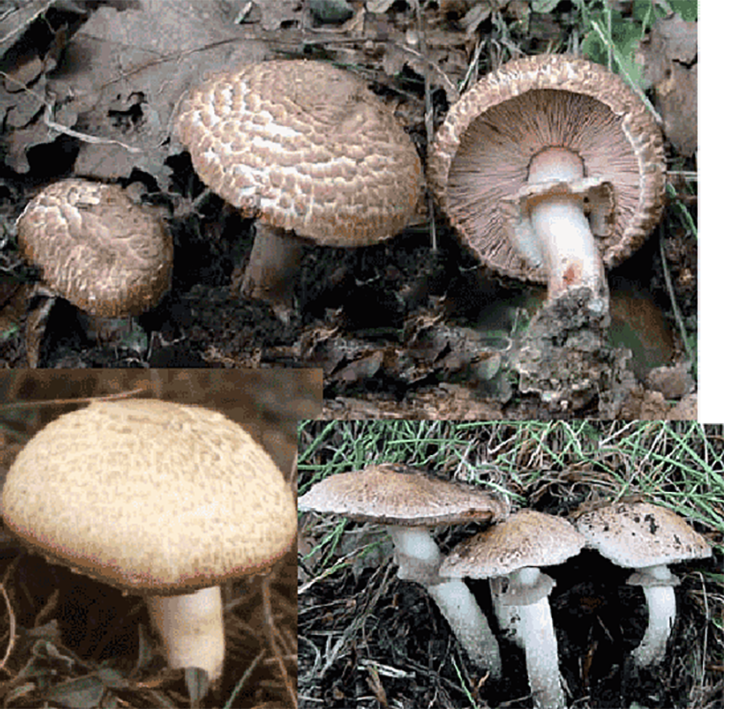
 The image, above, shows images of Brown Wood Mushroom
(Agaricus silvaticus) mushroom sowing its distinctive
cap. Bottom left, is a young specimen with a pale cap. Bottom
right are three more mature specimens showing the ring on the
stipe. Top is a small mushroom and two mature mushrooms —
one of the mushrooms is on its side, revealing the stipe and the
gills..
| Common Name: Brown Wood Mushroom |
| Scientific Name: Agaricus silvaticus |
| Other Names: Scaly Wood Mushroom or Blushing Wood Mushroom |
| Family: Agaricaceae |
| Range: Europe, North Africa and North America |
Physical Characteristics
 Agaricus silvaticus is a mycorrhizal fungus, growing to 10cm (4 in) in diameter and 8cm (3 in) tall. It is typically associated with coniferous woodland and fruits from August to October (but is most commonly found between September and October).
|
| Edible Parts: Cap, Stipe |
 Spore Print: Chocolate Brown Spore Print: Chocolate Brown
|
 Cap: Flat Cap: Flat
|
| Hymenium: Attachment not applicable |
 Gills: Gills on hymenium Gills: Gills on hymenium
|
 Stipe: Has a Ring Stipe: Has a Ring
|
 Edibility Rating: 4 Edibility Rating: 4 
|
 Known Hazards: None Known. Known Hazards: None Known.
|
Welcome to the summary page for FabulousFusionFood's Wild Food guide to Brown Wood Mushroom along with all the Brown Wood Mushroom containing recipes presented on this site, with 74 recipes in total.
These recipes, all contain Brown Wood Mushroom as a major wild food ingredient.
The Brown Wood Mushroom, Agaricus silvaticus (also known as Scaly Wood Mushroom or Blushing Wood Mushroom) is an edible species of basidiomycete fungus (filamentous fungi composed of hyphae that reproduce sexually) and is a member of the Agaricaceae (Agaricus) family of fungi. It is by far the commonest mushroom in coniferous woodlands. It is associated with coniferous woodlands, is typically common and can be locally very abundant. Usually it fruits in late Summer from August to October (but is most common in September and October) and can be locally very frequent, often growing in small groups. The mushroom is quite large when mature (growing maximally to about 8–12cm in heigh). The cap can grow up to 10cm in diameter and typically has a pale background that is covered in brown fibrils or scales (but can be very variable). When young, the caps are convex (button mushroom shaped), flattening as the mushroom matures. The gills are enclosed in a white veil and are grey-pink when young. They become deep brown as the mushroom ages, are crowded, narrow and free. The spore print is very dark brown (chocolate brown). The stipe (stem) is set in the centre, maximally about 8cm in height and can be up to 1cm in diameter with a bulbous base. It dirty white and hollow, has a large, pale grey, drooping ring, below which the stem is typically scaly. The flesh of this mushrooms is quite thin in the cap, is white and firm and becomes orange-red and then blood red on cutting (though the flesh of older specimens will be brown and may not noticeably redden. It has a pleasant, mild, scent and taste.
This is an good eating fungus and can be prepared in the same way as field mushrooms, St George's mushrooms and horse mushroom (to which it is closely related). It also dries well, so if you find a large number it is always good to take them home for drying (for how to dry, see the dried mushrooms recipe.) It can be used in any recipe where you would use field mushrooms or store-bought mushrooms.
In Britain, there are two main lookalikes, both members of the Agaricus family and both edible. In broad-leaved, it is possible to mistake the Bleeding Brown Mushroom Agaricus haemorrhoidarius for the Brown Wood Mushroom, the main difference being the habitat, and that the gills of the Bleeding Brown Mushroom bruise red (but it is a good eating species). Though not common, it can also be confused with the Prince mushroom Agaricus augustus, an excellent eating species which is larger than the Brown Wood Mushroom (its cap grows up to 20cm in diameter). The Prince can be distinguished by its scaly cap that bruises yellow, the stem that also bruises yellow, the thick flesh that does not redden on cutting and the almond flavour of the flesh. Inedible Tricholoma vaccinum can look similar and though it grows in coniferous woodland it is not common, has no gills, develops reddish-brown gills and has a white spore-print.
For other edible mushrooms, see the guide to edible mushrooms
[2]. Huxley, A. The New RHS Dictionary of Gardening. 1999
[3]. Tanaka, T. Tanaka's Cyclopaedia of Edible Plants of the World.
[4]. Lim T.K. Edible Medicinal And Non-Medicinal Plants, Vols 1–12.
[5]. Thomas, G. S. Perennial Garden Plants, 2004
[6]. Milner, E. Trees of Britain and Ireland, 2011
[7]. Rose, F. & O'Reilly, C. The Wild Flower Key (Revised Edition) — How to identify wild plants, trees and shrubs in Britain and Ireland, 2006
[8]. Streeter, D. & Garrard, I. The Wild Flowers of the British Isles, 1983
[9]. Clapham, A.R.; Tutin, T.G. & Moore, D.M. Flora of the British Isles, 1987
[10]. Phillips, R. Mushrooms, 2006
[11]. Jordan, P. & Wheeler, S. The Complete Book of Mushrooms: An Illustrated Encyclopedia of Edible Mushrooms, 2011
[12]. Bunker, F. Seaweeds of Britain and Ireland, Second Edition, 2017
[13]. Facciola, S. Cornucopia II — A Source Book of Edible Plants, 1998
[14]. Hartford, R. Edible and Medicinal Wild Plants of Britain and Ireland: A Foraging and Photographic Identification Guide
(Note that the above book links are Amazon Affiliate links)
These recipes, all contain Brown Wood Mushroom as a major wild food ingredient.
The Brown Wood Mushroom, Agaricus silvaticus (also known as Scaly Wood Mushroom or Blushing Wood Mushroom) is an edible species of basidiomycete fungus (filamentous fungi composed of hyphae that reproduce sexually) and is a member of the Agaricaceae (Agaricus) family of fungi. It is by far the commonest mushroom in coniferous woodlands. It is associated with coniferous woodlands, is typically common and can be locally very abundant. Usually it fruits in late Summer from August to October (but is most common in September and October) and can be locally very frequent, often growing in small groups. The mushroom is quite large when mature (growing maximally to about 8–12cm in heigh). The cap can grow up to 10cm in diameter and typically has a pale background that is covered in brown fibrils or scales (but can be very variable). When young, the caps are convex (button mushroom shaped), flattening as the mushroom matures. The gills are enclosed in a white veil and are grey-pink when young. They become deep brown as the mushroom ages, are crowded, narrow and free. The spore print is very dark brown (chocolate brown). The stipe (stem) is set in the centre, maximally about 8cm in height and can be up to 1cm in diameter with a bulbous base. It dirty white and hollow, has a large, pale grey, drooping ring, below which the stem is typically scaly. The flesh of this mushrooms is quite thin in the cap, is white and firm and becomes orange-red and then blood red on cutting (though the flesh of older specimens will be brown and may not noticeably redden. It has a pleasant, mild, scent and taste.
This is an good eating fungus and can be prepared in the same way as field mushrooms, St George's mushrooms and horse mushroom (to which it is closely related). It also dries well, so if you find a large number it is always good to take them home for drying (for how to dry, see the dried mushrooms recipe.) It can be used in any recipe where you would use field mushrooms or store-bought mushrooms.
In Britain, there are two main lookalikes, both members of the Agaricus family and both edible. In broad-leaved, it is possible to mistake the Bleeding Brown Mushroom Agaricus haemorrhoidarius for the Brown Wood Mushroom, the main difference being the habitat, and that the gills of the Bleeding Brown Mushroom bruise red (but it is a good eating species). Though not common, it can also be confused with the Prince mushroom Agaricus augustus, an excellent eating species which is larger than the Brown Wood Mushroom (its cap grows up to 20cm in diameter). The Prince can be distinguished by its scaly cap that bruises yellow, the stem that also bruises yellow, the thick flesh that does not redden on cutting and the almond flavour of the flesh. Inedible Tricholoma vaccinum can look similar and though it grows in coniferous woodland it is not common, has no gills, develops reddish-brown gills and has a white spore-print.
For other edible mushrooms, see the guide to edible mushrooms
References:
[1]. David Evans Notes from field observations, tastings and cookery experiments.[2]. Huxley, A. The New RHS Dictionary of Gardening. 1999
[3]. Tanaka, T. Tanaka's Cyclopaedia of Edible Plants of the World.
[4]. Lim T.K. Edible Medicinal And Non-Medicinal Plants, Vols 1–12.
[5]. Thomas, G. S. Perennial Garden Plants, 2004
[6]. Milner, E. Trees of Britain and Ireland, 2011
[7]. Rose, F. & O'Reilly, C. The Wild Flower Key (Revised Edition) — How to identify wild plants, trees and shrubs in Britain and Ireland, 2006
[8]. Streeter, D. & Garrard, I. The Wild Flowers of the British Isles, 1983
[9]. Clapham, A.R.; Tutin, T.G. & Moore, D.M. Flora of the British Isles, 1987
[10]. Phillips, R. Mushrooms, 2006
[11]. Jordan, P. & Wheeler, S. The Complete Book of Mushrooms: An Illustrated Encyclopedia of Edible Mushrooms, 2011
[12]. Bunker, F. Seaweeds of Britain and Ireland, Second Edition, 2017
[13]. Facciola, S. Cornucopia II — A Source Book of Edible Plants, 1998
[14]. Hartford, R. Edible and Medicinal Wild Plants of Britain and Ireland: A Foraging and Photographic Identification Guide
(Note that the above book links are Amazon Affiliate links)
The alphabetical list of all Brown Wood Mushroom recipes on this site follows, (limited to 100 recipes per page). There are 74 recipes in total:
Page 1 of 1
Page 1 of 1