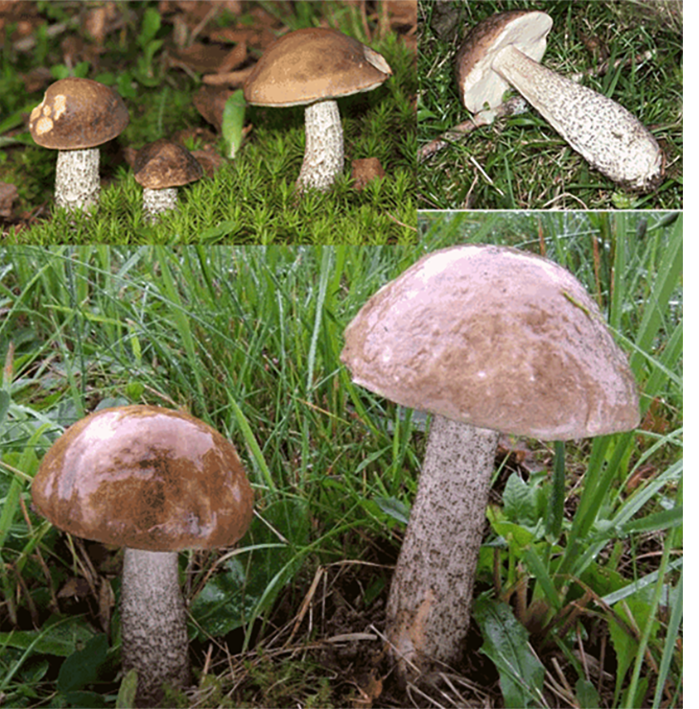
 The image, above, shows an image of brown birch bolete
(Leccinum scabrum) mushrooms growing in grass (bottom)
and in mossy leaf-litter (top left). Also shown, top right, is an
image of the mushroom on its side showing its stem and the
tubules under the cap. The bottom left images clearly show the
glossy nature of the young mushroom cap..
| Common Name: Brown Birch Bolete |
| Scientific Name: Leccinum scabrum |
| Other Names: Rough-stemmed Bolete, Scaber Stalk, Orange Birch Bolete and Birch Bolete, Cap Tyllog Brown Bedw (CY) |
| Family: Boletaceae |
| Range: Widespread in Europe, in the Himalayas in Asia, and elsewhere in the Northern Hemisphere. Introduced in Australia and New Zealand. |
Physical Characteristics
 Leccinum scabrum is a mycorrhizal mushroom, growing to 15cm (6 in) by 15cm (6 in) in size. It is typically associated with birch woodland and fruits from June to October (but is most commonly found between September and October.
|
| Edible Parts: Caps and Stipes |
 Spore Print: Olive Spore Print: Olive
|
 Cap: Convex Cap: Convex
|
 Hymenium: Adnate Hymenium: Adnate
|
 Pores: Pores on hymenium Pores: Pores on hymenium
|
 Stipe: Bare Stipe: Bare
|
 Edibility Rating: 4 Edibility Rating: 4 
|
 Known Hazards: None known Known Hazards: None known
|
Monthly Availability: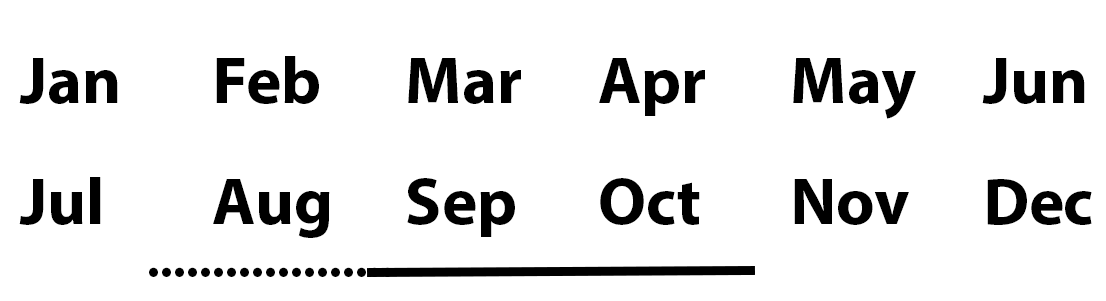
|
Welcome to the summary page for FabulousFusionFood's Wild Food guide to Brown Birch Bolete along with all the Brown Birch Bolete containing recipes presented on this site, with 43 recipes in total.
These recipes, all contain Brown Birch Bolete as a major wild food ingredient.
Brown Birch Bolete, Leccinum scabrum (also known as Rough-stemmed Bolete, Scaber Stalk and Birch Bolete) is an edible species of basidomycete fungus (filamentous fungi composed of hyphae that reproduce sexually) and is a member of the Boletaceae (Bolete) family of mushrooms with a snuff-brown spore print. It is widespread in Europe and much of the Northern Hemisphere and is the commonest species of Leccinium in Britain. It is always associated with birch trees and forms mycorrhiza with them. Typically it fruits from June to October (but is most common in September and October) and can be locally very common. It is always found in association with birch trees and this is one of its distinguishing features. The mushroom is medium sized (growing maximally to about 15cm tall) and the cap is brown, growing to 10cm in diameter and becomes sticky (but not slimy) when it rains. As it ages the cap becomes spongy and can split, revealing white scars. The pores are small and bruise brown. The stem is typically slim, white and covered with brown-black scales that are denser at the base. The base itself grows, maximally, to about 3cm in diameter. The cap is pale to grey brown, convex and firm, then flattening and becoming soft to the touch. There is no overhanging margin. Rather than gills, this mushroom has tubes on the underside, these are dirty white, almost free, with a moat of shorter tubes surrounding the stem. The stem tapers from the base, is white and covered with small brown-black scales that are sparser near the top. The flesh of the brown birch bolete is soft, white and unchanging (or sometimes prone to a very faint pinking) on cutting and has a pleasant smell.
The brown birch bolete is an excellent eating species, but it is recommended that only young, firm-fleshed specimens are picked (older specimens tend to go spongy and are often maggot and slug infested) and that the tubes are discarded. Typically it is used in soups and stews and its is frequently pickled in vinegar or brine and is commonly added as a component of mixed-mushroom dishes. Unusually for mushrooms it can be steamed and when chopped can be added to steamed rice dishes. Like the majority of boletes, it dries and re-constitutes very well (for how to dry, see the dried mushrooms recipe).
The Orange Birch Bolete is edible when firm. It is a very common Autumn mushroom and though not as firm and tasty as the best boletes, it's still OK mixed with other mushrooms. Because it’s a very common mushroom it can really help to bulk your basket and it’s a really easy one for beginners.
The colour, shape, season of fruiting and association with birch trees means, in the UK at least, that there are no poisonous species with which it can be confused, though it is easy to confuse with a number of other Leccinum species (eg L variicolor has a bluish stipe. L oxydabile has firmer, pinkish flesh and a different pileus skin structure. L melaneum is darker in colour and has yellowish hues under the skin of the pileus and stipe. L holopus is paler and whitish in all parts and L versipelle, which has a larger, orange, cap and an overhanging margin, but all these are edible). As always, however, if you are uncertain of the identification of a mushroom, do not pick it and, if you have not eaten a mushroom before, cook it well and only eat a small amount the first time, in case you are susceptible.
For other edible mushrooms, see the guide to edible mushrooms
[2]. Huxley, A. The New RHS Dictionary of Gardening. 1999
[3]. Tanaka, T. Tanaka's Cyclopaedia of Edible Plants of the World.
[4]. Lim T.K. Edible Medicinal And Non-Medicinal Plants, Vols 1–12.
[5]. Thomas, G. S. Perennial Garden Plants, 2004
[6]. Milner, E. Trees of Britain and Ireland, 2011
[7]. Rose, F. & O'Reilly, C. The Wild Flower Key (Revised Edition) — How to identify wild plants, trees and shrubs in Britain and Ireland, 2006
[8]. Streeter, D. & Garrard, I. The Wild Flowers of the British Isles, 1983
[9]. Clapham, A.R.; Tutin, T.G. & Moore, D.M. Flora of the British Isles, 1987
[10]. Phillips, R. Mushrooms, 2006
[11]. Jordan, P. & Wheeler, S. The Complete Book of Mushrooms: An Illustrated Encyclopedia of Edible Mushrooms, 2011
[12]. Bunker, F. Seaweeds of Britain and Ireland, Second Edition, 2017
[13]. Facciola, S. Cornucopia II — A Source Book of Edible Plants, 1998
[14]. Hartford, R. Edible and Medicinal Wild Plants of Britain and Ireland: A Foraging and Photographic Identification Guide
(Note that the above book links are Amazon Affiliate links)
These recipes, all contain Brown Birch Bolete as a major wild food ingredient.
Brown Birch Bolete, Leccinum scabrum (also known as Rough-stemmed Bolete, Scaber Stalk and Birch Bolete) is an edible species of basidomycete fungus (filamentous fungi composed of hyphae that reproduce sexually) and is a member of the Boletaceae (Bolete) family of mushrooms with a snuff-brown spore print. It is widespread in Europe and much of the Northern Hemisphere and is the commonest species of Leccinium in Britain. It is always associated with birch trees and forms mycorrhiza with them. Typically it fruits from June to October (but is most common in September and October) and can be locally very common. It is always found in association with birch trees and this is one of its distinguishing features. The mushroom is medium sized (growing maximally to about 15cm tall) and the cap is brown, growing to 10cm in diameter and becomes sticky (but not slimy) when it rains. As it ages the cap becomes spongy and can split, revealing white scars. The pores are small and bruise brown. The stem is typically slim, white and covered with brown-black scales that are denser at the base. The base itself grows, maximally, to about 3cm in diameter. The cap is pale to grey brown, convex and firm, then flattening and becoming soft to the touch. There is no overhanging margin. Rather than gills, this mushroom has tubes on the underside, these are dirty white, almost free, with a moat of shorter tubes surrounding the stem. The stem tapers from the base, is white and covered with small brown-black scales that are sparser near the top. The flesh of the brown birch bolete is soft, white and unchanging (or sometimes prone to a very faint pinking) on cutting and has a pleasant smell.
The brown birch bolete is an excellent eating species, but it is recommended that only young, firm-fleshed specimens are picked (older specimens tend to go spongy and are often maggot and slug infested) and that the tubes are discarded. Typically it is used in soups and stews and its is frequently pickled in vinegar or brine and is commonly added as a component of mixed-mushroom dishes. Unusually for mushrooms it can be steamed and when chopped can be added to steamed rice dishes. Like the majority of boletes, it dries and re-constitutes very well (for how to dry, see the dried mushrooms recipe).
The Orange Birch Bolete is edible when firm. It is a very common Autumn mushroom and though not as firm and tasty as the best boletes, it's still OK mixed with other mushrooms. Because it’s a very common mushroom it can really help to bulk your basket and it’s a really easy one for beginners.
The colour, shape, season of fruiting and association with birch trees means, in the UK at least, that there are no poisonous species with which it can be confused, though it is easy to confuse with a number of other Leccinum species (eg L variicolor has a bluish stipe. L oxydabile has firmer, pinkish flesh and a different pileus skin structure. L melaneum is darker in colour and has yellowish hues under the skin of the pileus and stipe. L holopus is paler and whitish in all parts and L versipelle, which has a larger, orange, cap and an overhanging margin, but all these are edible). As always, however, if you are uncertain of the identification of a mushroom, do not pick it and, if you have not eaten a mushroom before, cook it well and only eat a small amount the first time, in case you are susceptible.
For other edible mushrooms, see the guide to edible mushrooms
References:
[1]. David Evans Notes from field observations, tastings and cookery experiments.[2]. Huxley, A. The New RHS Dictionary of Gardening. 1999
[3]. Tanaka, T. Tanaka's Cyclopaedia of Edible Plants of the World.
[4]. Lim T.K. Edible Medicinal And Non-Medicinal Plants, Vols 1–12.
[5]. Thomas, G. S. Perennial Garden Plants, 2004
[6]. Milner, E. Trees of Britain and Ireland, 2011
[7]. Rose, F. & O'Reilly, C. The Wild Flower Key (Revised Edition) — How to identify wild plants, trees and shrubs in Britain and Ireland, 2006
[8]. Streeter, D. & Garrard, I. The Wild Flowers of the British Isles, 1983
[9]. Clapham, A.R.; Tutin, T.G. & Moore, D.M. Flora of the British Isles, 1987
[10]. Phillips, R. Mushrooms, 2006
[11]. Jordan, P. & Wheeler, S. The Complete Book of Mushrooms: An Illustrated Encyclopedia of Edible Mushrooms, 2011
[12]. Bunker, F. Seaweeds of Britain and Ireland, Second Edition, 2017
[13]. Facciola, S. Cornucopia II — A Source Book of Edible Plants, 1998
[14]. Hartford, R. Edible and Medicinal Wild Plants of Britain and Ireland: A Foraging and Photographic Identification Guide
(Note that the above book links are Amazon Affiliate links)
The alphabetical list of all Brown Birch Bolete recipes on this site follows, (limited to 100 recipes per page). There are 43 recipes in total:
Page 1 of 1
Page 1 of 1