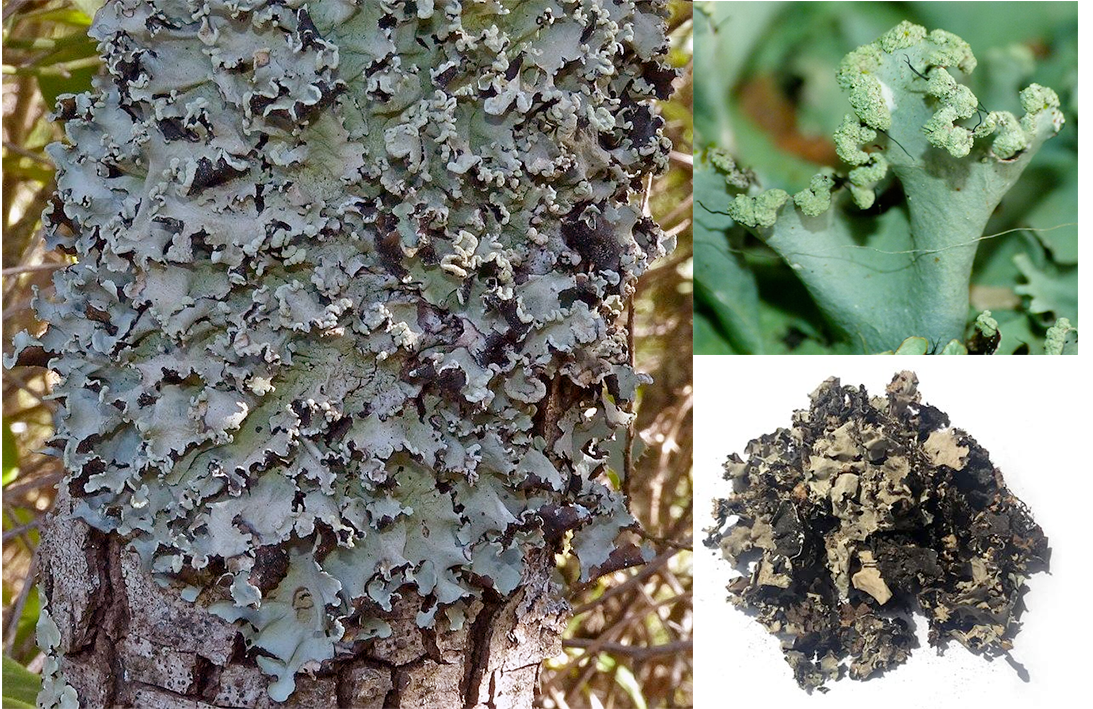
 Black Stone Flower, Parmotrema perlatum is a species of
lichen in the family Parmeliaceae, native to Africa, North and
South America, Asia, Australasia, Europe, and islands in the
Atlantic and Pacific oceans. It is primarily found near seas in
temperate areas..
| Common Name: Black stone flower |
|
Scientific Name: |
| Other Names: stone flower, stone lichen, sea lichen, kalpasi, kalpas, kalpashi, and kalpash |
| Family: Parmeliaceae |
| Range: Origin: Africa, North and South America, Asia, Australasia, Europe, and islands in the Atlantic and Pacific oceans. |
Physical Characteristics Parmotrema perlatum is a Perennial lichen, a close symbiont between an alga and a fungus. The thallus of Parmotrema perlatum is large, light-grey to pale-blue patch-shaped with rounded and ruffled lobes and often with black hair-cilia at the edges. Distinguishing features of the lichen include its conspicuous soralia (reproductive structures) near the lobe edges, curled leaf-like lobes, and a narrow, shiny, and sometimes wrinkly area on the underside near the margin. It usually grows on bark, but occasionally occurs on siliceous rocks, often among mosses.
|
| Edible Parts: Aerial parts, dried |
 Edibility Rating: 4 Edibility Rating: 4 
|
 Known Hazards: None known Known Hazards: None known
|
Welcome to the summary page for FabulousFusionFood's Wild Food guide to Black Stone Flower along with all the Black Stone Flower containing recipes presented on this site, with 4 recipes in total.
These recipes, all contain Black Stone Flower as a major wild food ingredient.
Parmotrema perlatum has a thallus that ranges from loosely to tightly attached to the surface it grows on, forming expansive, spreading colonies that often merge together. Individual thalli typically measure up to 10–15 cm (4–6 in) in diameter. The upper thallus surface is greenish-grey, blue-grey, or yellowish-grey in colour, lacking pruina and either free of spots (maculae), or with few maculae. This species develops soredia, a type of asexual reproductive structure, aiding in its propagation. The lobes of this lichen vary from 1.5 to 10 mm in width, with a wave-like (undulate) or ruffled pattern and overlapping (imbricate) arrangement. The tips and edges of these lobes are generally smooth and round, sometimes notched (crenate) or incised, often curling up or inward, revealing the paler brown to black underside adorned with hair-like structures (cilia) up to 2.5 mm in length. Rhizines are common on the underside of the thallus, except for a brown border near the edges.
The soredia found in this species are granular and appear white or may become grey due to wear. They are located within specifically structured groups called soralia, which can be linear to oval in shape, often positioned at the edges of the lobes. The presence of soredia causes the lobe margins to curl back and form capitate soralia. The upper surface of the lichen is typically whitish grey to pale greenish-grey, and can be either smooth or slightly wrinkled, without spots (immaculate), featuring scattered, shallow cracks. Isidia are absent in this species.
Apothecia (fruiting bodies) are rare in Parmotrema perlatum. When present, they measure 4–8 mm across and are somewhat stalked and funnel-shaped with a brown, concave disc. The edges of these structures curl inward, becoming thick with soredia as they mature. Its spores are ellipsoid in shape and typically measure between 20 and 28 μm in length and 11 to 17 μm in width, with a wall thickness of 2–3 μm. Pycnidia, which are structures that produce asexual spores called conidia, appear sporadically on the surface (laminal) of the thallus, with the conidia being thread-like and straight, measuring 6–8 by 1 μm.
Parmotrema perlatum is used as a spice, particularly in the cuisine of Tamil Nadu. It is especially prevalent in Chettinad cuisine, being used in the popular rice dish biryani, and also in many meat and vegetarian dishes. In its raw state, black stone flower does not have much taste or fragrance. However, when put in contact with heat, especially hot cooking oil or ghee, it releases a distinctive earthy, smoky flavour and aroma. This property of black stone flower is especially valued in the tempering step of cooking a number of Indian dishes. After collecting it is typically dried for storage.
The distinguishing features of Parmotrema perlatum, such as the presence of soredia and stictic acid, facilitate its easy identification. In mature specimens, the appearance of scattered, fine cracks on the upper surface may resemble the cracked maculae seen in P. reticulatum, which shares similar habitats. However, the two species can be differentiated chemically, as P. reticulatum contains salazinic acid, unlike P. perlatum.
Possible Confusion:
Parmotrema perlatum and Parmotrema stuppeum are two morphologically similar species that can be found in similar habitats. Both species have a loosely attached thallus with revolute, wavy lobes and sparsely ciliate lobe tips. Their upper cortex is continuous and not finely reticulately cracked, while the lower surface is black and rhizinate. Both species also feature linear soralia. However, there are several key differences that can help distinguish between the two. While earlier descriptions suggested that P. stuppeum has a matte, olive-green to brownish-green upper surface and P. perlatum has a slightly shiny, whitish-grey to greyish-green upper surface, recent observations have shown that both species have a distinctly matte upper surface with similar colouration.
The most reliable morphological difference in the field is the location of the soralia: P. stuppeum has strictly terminal soralia, whereas P. perlatum has submarginal soralia. Additionally, the two species can be distinguished by their chemical composition. P. stuppeum contains salazinic acid, while P. perlatum has a stictic acid complex. Although both acids cause a Pd+ orange to orange-red medulla reaction, a potassium (K) spot test can separate the species: the medulla of P. perlatum turns yellow (K+ yellow), whereas in P. stuppeum, the yellow colour turns red (K+ yellow turning red).
[2]. Huxley, A. The New RHS Dictionary of Gardening. 1999
[3]. Tanaka, T. Tanaka's Cyclopaedia of Edible Plants of the World.
[4]. Lim T.K. Edible Medicinal And Non-Medicinal Plants, Vols 1–12.
[5]. Thomas, G. S. Perennial Garden Plants, 2004
[6]. Milner, E. Trees of Britain and Ireland, 2011
[7]. Rose, F. & O'Reilly, C. The Wild Flower Key (Revised Edition) — How to identify wild plants, trees and shrubs in Britain and Ireland, 2006
[8]. Streeter, D. & Garrard, I. The Wild Flowers of the British Isles, 1983
[9]. Clapham, A.R.; Tutin, T.G. & Moore, D.M. Flora of the British Isles, 1987
[10]. Phillips, R. Mushrooms, 2006
[11]. Jordan, P. & Wheeler, S. The Complete Book of Mushrooms: An Illustrated Encyclopedia of Edible Mushrooms, 2011
[12]. Bunker, F. Seaweeds of Britain and Ireland, Second Edition, 2017
[13]. Facciola, S. Cornucopia II — A Source Book of Edible Plants, 1998
[14]. Hartford, R. Edible and Medicinal Wild Plants of Britain and Ireland: A Foraging and Photographic Identification Guide
(Note that the above book links are Amazon Affiliate links)
These recipes, all contain Black Stone Flower as a major wild food ingredient.
Parmotrema perlatum has a thallus that ranges from loosely to tightly attached to the surface it grows on, forming expansive, spreading colonies that often merge together. Individual thalli typically measure up to 10–15 cm (4–6 in) in diameter. The upper thallus surface is greenish-grey, blue-grey, or yellowish-grey in colour, lacking pruina and either free of spots (maculae), or with few maculae. This species develops soredia, a type of asexual reproductive structure, aiding in its propagation. The lobes of this lichen vary from 1.5 to 10 mm in width, with a wave-like (undulate) or ruffled pattern and overlapping (imbricate) arrangement. The tips and edges of these lobes are generally smooth and round, sometimes notched (crenate) or incised, often curling up or inward, revealing the paler brown to black underside adorned with hair-like structures (cilia) up to 2.5 mm in length. Rhizines are common on the underside of the thallus, except for a brown border near the edges.
The soredia found in this species are granular and appear white or may become grey due to wear. They are located within specifically structured groups called soralia, which can be linear to oval in shape, often positioned at the edges of the lobes. The presence of soredia causes the lobe margins to curl back and form capitate soralia. The upper surface of the lichen is typically whitish grey to pale greenish-grey, and can be either smooth or slightly wrinkled, without spots (immaculate), featuring scattered, shallow cracks. Isidia are absent in this species.
Apothecia (fruiting bodies) are rare in Parmotrema perlatum. When present, they measure 4–8 mm across and are somewhat stalked and funnel-shaped with a brown, concave disc. The edges of these structures curl inward, becoming thick with soredia as they mature. Its spores are ellipsoid in shape and typically measure between 20 and 28 μm in length and 11 to 17 μm in width, with a wall thickness of 2–3 μm. Pycnidia, which are structures that produce asexual spores called conidia, appear sporadically on the surface (laminal) of the thallus, with the conidia being thread-like and straight, measuring 6–8 by 1 μm.
Parmotrema perlatum is used as a spice, particularly in the cuisine of Tamil Nadu. It is especially prevalent in Chettinad cuisine, being used in the popular rice dish biryani, and also in many meat and vegetarian dishes. In its raw state, black stone flower does not have much taste or fragrance. However, when put in contact with heat, especially hot cooking oil or ghee, it releases a distinctive earthy, smoky flavour and aroma. This property of black stone flower is especially valued in the tempering step of cooking a number of Indian dishes. After collecting it is typically dried for storage.
The distinguishing features of Parmotrema perlatum, such as the presence of soredia and stictic acid, facilitate its easy identification. In mature specimens, the appearance of scattered, fine cracks on the upper surface may resemble the cracked maculae seen in P. reticulatum, which shares similar habitats. However, the two species can be differentiated chemically, as P. reticulatum contains salazinic acid, unlike P. perlatum.
Possible Confusion:
Parmotrema perlatum and Parmotrema stuppeum are two morphologically similar species that can be found in similar habitats. Both species have a loosely attached thallus with revolute, wavy lobes and sparsely ciliate lobe tips. Their upper cortex is continuous and not finely reticulately cracked, while the lower surface is black and rhizinate. Both species also feature linear soralia. However, there are several key differences that can help distinguish between the two. While earlier descriptions suggested that P. stuppeum has a matte, olive-green to brownish-green upper surface and P. perlatum has a slightly shiny, whitish-grey to greyish-green upper surface, recent observations have shown that both species have a distinctly matte upper surface with similar colouration.
The most reliable morphological difference in the field is the location of the soralia: P. stuppeum has strictly terminal soralia, whereas P. perlatum has submarginal soralia. Additionally, the two species can be distinguished by their chemical composition. P. stuppeum contains salazinic acid, while P. perlatum has a stictic acid complex. Although both acids cause a Pd+ orange to orange-red medulla reaction, a potassium (K) spot test can separate the species: the medulla of P. perlatum turns yellow (K+ yellow), whereas in P. stuppeum, the yellow colour turns red (K+ yellow turning red).
References:
[1]. David Evans Notes from field observations, tastings and cookery experiments.[2]. Huxley, A. The New RHS Dictionary of Gardening. 1999
[3]. Tanaka, T. Tanaka's Cyclopaedia of Edible Plants of the World.
[4]. Lim T.K. Edible Medicinal And Non-Medicinal Plants, Vols 1–12.
[5]. Thomas, G. S. Perennial Garden Plants, 2004
[6]. Milner, E. Trees of Britain and Ireland, 2011
[7]. Rose, F. & O'Reilly, C. The Wild Flower Key (Revised Edition) — How to identify wild plants, trees and shrubs in Britain and Ireland, 2006
[8]. Streeter, D. & Garrard, I. The Wild Flowers of the British Isles, 1983
[9]. Clapham, A.R.; Tutin, T.G. & Moore, D.M. Flora of the British Isles, 1987
[10]. Phillips, R. Mushrooms, 2006
[11]. Jordan, P. & Wheeler, S. The Complete Book of Mushrooms: An Illustrated Encyclopedia of Edible Mushrooms, 2011
[12]. Bunker, F. Seaweeds of Britain and Ireland, Second Edition, 2017
[13]. Facciola, S. Cornucopia II — A Source Book of Edible Plants, 1998
[14]. Hartford, R. Edible and Medicinal Wild Plants of Britain and Ireland: A Foraging and Photographic Identification Guide
(Note that the above book links are Amazon Affiliate links)
The alphabetical list of all Black Stone Flower recipes on this site follows, (limited to 100 recipes per page). There are 4 recipes in total:
Page 1 of 1
| Bottle Masala Origin: India | Kabsa Seasoning Origin: Saudi Arabia |
| Goda Masala Origin: India | Sankara Meen Kuzhambu (Red Snapper Shallot Curry) Origin: India |
Page 1 of 1