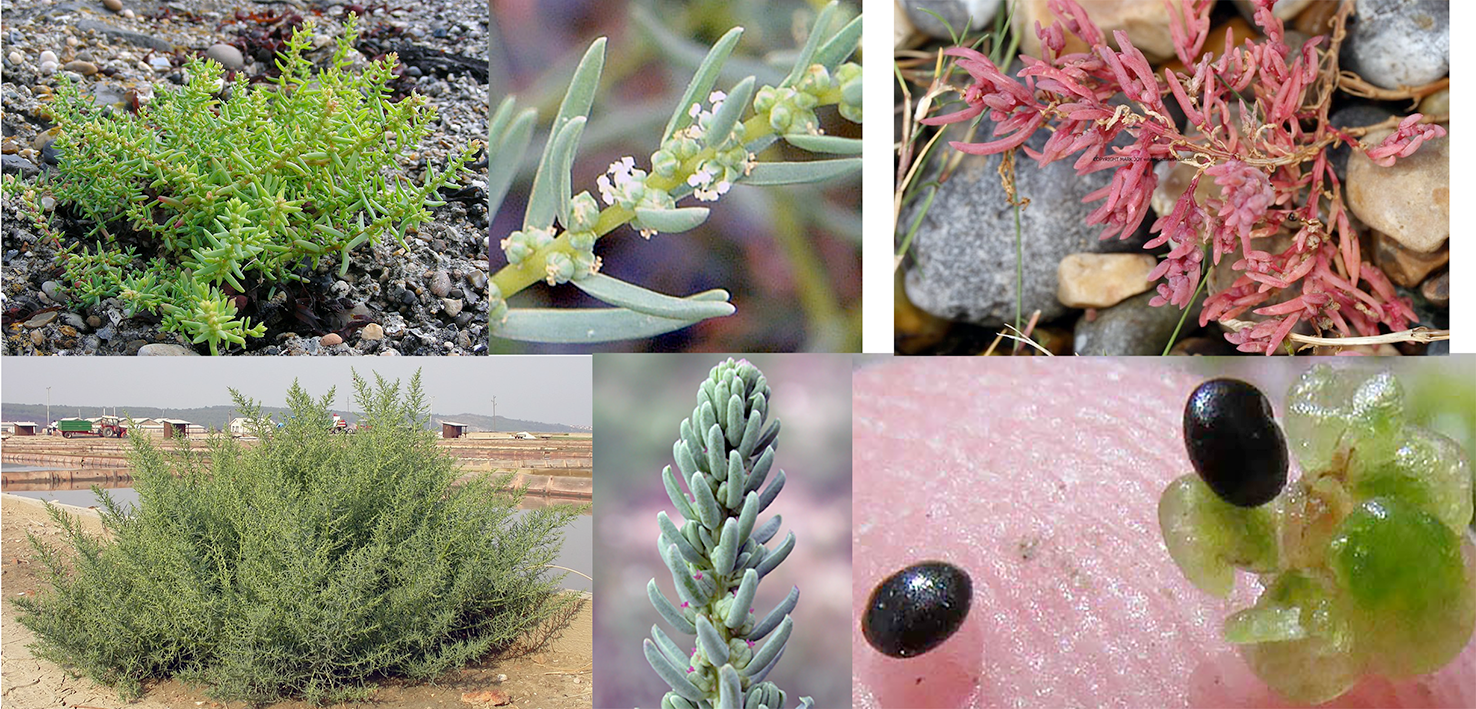
 Annual Sea-Blite (Suaeda maritima),showing (alternating
top to bottom) a young plant, a mature plant, a frond in flower,
an edible stem tip, a red-fronded form and a close-up of the
seeds)..
| Common Name: Annual Sea-Blite |
| Scientific Name: Suaeda maritima |
| Other Names: Sea Blite, Herbaceous seepweed, Rich's seepweed |
| Family: Amaranthaceae |
| Range: European coasts and saline areas inland, south from Norway to eastern Asia, E. Indies, N. America. |
Physical Characteristics Annual Sea-blite, Suaeda maritima is a ANNUAL growing to 0.3 m (1ft). It is in flower from July to October, and the seeds ripen from August to October. The species is hermaphrodite (has both male and female organs) and is pollinated by Wind. The plant is self-fertile.
 Suitable: light (sandy) and medium (loamy) soils. Suitable pH: neutral and basic (mildly alkaline) soils and can grow in very alkaline and saline soils. It cannot grow in the shade. It prefers moist soil. The plant can tolerate maritime exposure. |
| Edible Parts: Leaves, Shoots, Seeds |
 Edibility Rating: 3 Edibility Rating: 3 
|
 Known Hazards: None Known. Known Hazards: None Known.
|
Monthly Availability:
|
Welcome to the summary page for FabulousFusionFood's Wild Food guide to Annual Sea-Blite along with all the Annual Sea-Blite containing recipes presented on this site, with 6 recipes in total.
These recipes, all contain Annual Sea-Blite as a major wild food ingredient.
Annual Sea-blite ( Suaeda maritima is flowering plant in the family Amaranthaceae known by the common names herbaceous seepweed[2] and annual seablite
It is a yellow-green shrub with fleshy, succulent leaves and green flowers. It grows to about 35 cm (14 in) in salt marshes.[3] It is edible as a leaf vegetable, and due to its high salt content it can be used in combination with other foods as a seasoning. It is found worldwide,[4] but in North America it is primarily located on the northern east coast: in New England, S. maritima ssp. maritima is introduced, while the native species is S. maritima ssp. richii. The native New England species is on endangered rare plant lists in Massachusetts (rare) and Maine, New Hampshire and Rhode Island (extremely rare, S1), subject to protection and prohibition from disturbance.
This plant resides in aquatic, terrestrial, and wetland habitats.[5] But mainly in salt marshes and sea shores, usually below the high water mark. Additionally, Suaeda maritima is able to catch mud and help build up the marshes
The young leaves of sea blite can be consumed raw or cooked, although it has a strong salty flavour. The seeds are also consumable raw or cooked. The young leaves are eaten raw or cooked and have a pleasant salty flavour (though not as salty as marsh samphire). They make a nice addition in small quantities to a salad. They are often mixed with other vegetables in order to reduce their saltiness[183]. The young shoots are pickled in vinegar and eaten on their own or used as a relish[183]. Seeds can be eaten raw or cooked.
the plant is commonly collected in Thailand where it's used in salads, sea blite and crab curry. It is also served scalded with chilli paste. It is most commonly used in salads but the leaves also make a tasty garnish for fish.
[2]. Huxley, A. The New RHS Dictionary of Gardening. 1999
[3]. Tanaka, T. Tanaka's Cyclopaedia of Edible Plants of the World.
[4]. Lim T.K. Edible Medicinal And Non-Medicinal Plants, Vols 1–12.
[5]. Thomas, G. S. Perennial Garden Plants, 2004
[6]. Milner, E. Trees of Britain and Ireland, 2011
[7]. Rose, F. & O'Reilly, C. The Wild Flower Key (Revised Edition) — How to identify wild plants, trees and shrubs in Britain and Ireland, 2006
[8]. Streeter, D. & Garrard, I. The Wild Flowers of the British Isles, 1983
[9]. Clapham, A.R.; Tutin, T.G. & Moore, D.M. Flora of the British Isles, 1987
[10]. Phillips, R. Mushrooms, 2006
[11]. Jordan, P. & Wheeler, S. The Complete Book of Mushrooms: An Illustrated Encyclopedia of Edible Mushrooms, 2011
[12]. Bunker, F. Seaweeds of Britain and Ireland, Second Edition, 2017
[13]. Facciola, S. Cornucopia II — A Source Book of Edible Plants, 1998
[14]. Hartford, R. Edible and Medicinal Wild Plants of Britain and Ireland: A Foraging and Photographic Identification Guide
(Note that the above book links are Amazon Affiliate links)
These recipes, all contain Annual Sea-Blite as a major wild food ingredient.
Annual Sea-blite ( Suaeda maritima is flowering plant in the family Amaranthaceae known by the common names herbaceous seepweed[2] and annual seablite
It is a yellow-green shrub with fleshy, succulent leaves and green flowers. It grows to about 35 cm (14 in) in salt marshes.[3] It is edible as a leaf vegetable, and due to its high salt content it can be used in combination with other foods as a seasoning. It is found worldwide,[4] but in North America it is primarily located on the northern east coast: in New England, S. maritima ssp. maritima is introduced, while the native species is S. maritima ssp. richii. The native New England species is on endangered rare plant lists in Massachusetts (rare) and Maine, New Hampshire and Rhode Island (extremely rare, S1), subject to protection and prohibition from disturbance.
This plant resides in aquatic, terrestrial, and wetland habitats.[5] But mainly in salt marshes and sea shores, usually below the high water mark. Additionally, Suaeda maritima is able to catch mud and help build up the marshes
The young leaves of sea blite can be consumed raw or cooked, although it has a strong salty flavour. The seeds are also consumable raw or cooked. The young leaves are eaten raw or cooked and have a pleasant salty flavour (though not as salty as marsh samphire). They make a nice addition in small quantities to a salad. They are often mixed with other vegetables in order to reduce their saltiness[183]. The young shoots are pickled in vinegar and eaten on their own or used as a relish[183]. Seeds can be eaten raw or cooked.
the plant is commonly collected in Thailand where it's used in salads, sea blite and crab curry. It is also served scalded with chilli paste. It is most commonly used in salads but the leaves also make a tasty garnish for fish.
References:
[1]. David Evans Notes from field observations, tastings and cookery experiments.[2]. Huxley, A. The New RHS Dictionary of Gardening. 1999
[3]. Tanaka, T. Tanaka's Cyclopaedia of Edible Plants of the World.
[4]. Lim T.K. Edible Medicinal And Non-Medicinal Plants, Vols 1–12.
[5]. Thomas, G. S. Perennial Garden Plants, 2004
[6]. Milner, E. Trees of Britain and Ireland, 2011
[7]. Rose, F. & O'Reilly, C. The Wild Flower Key (Revised Edition) — How to identify wild plants, trees and shrubs in Britain and Ireland, 2006
[8]. Streeter, D. & Garrard, I. The Wild Flowers of the British Isles, 1983
[9]. Clapham, A.R.; Tutin, T.G. & Moore, D.M. Flora of the British Isles, 1987
[10]. Phillips, R. Mushrooms, 2006
[11]. Jordan, P. & Wheeler, S. The Complete Book of Mushrooms: An Illustrated Encyclopedia of Edible Mushrooms, 2011
[12]. Bunker, F. Seaweeds of Britain and Ireland, Second Edition, 2017
[13]. Facciola, S. Cornucopia II — A Source Book of Edible Plants, 1998
[14]. Hartford, R. Edible and Medicinal Wild Plants of Britain and Ireland: A Foraging and Photographic Identification Guide
(Note that the above book links are Amazon Affiliate links)
The alphabetical list of all Annual Sea-Blite recipes on this site follows, (limited to 100 recipes per page). There are 6 recipes in total:
Page 1 of 1
| Blanched Sea Blite with Thai Chilli Paste Origin: Thailand | Sea Blite with Crab and Vanilla Mayonnaise Origin: Britain | Slow-cooked Octopus with Blanched Sea Blite or Marsh Samphire Salad Origin: Britain |
| Salad with Asparagus, Samphire and Sea-blite Origin: Britain | Shorshe Chingri (Bengali Prawns and Sea Blite) Origin: Bangladesh | Thai Crab and Sea-blite Curry Origin: Thailand |
Page 1 of 1