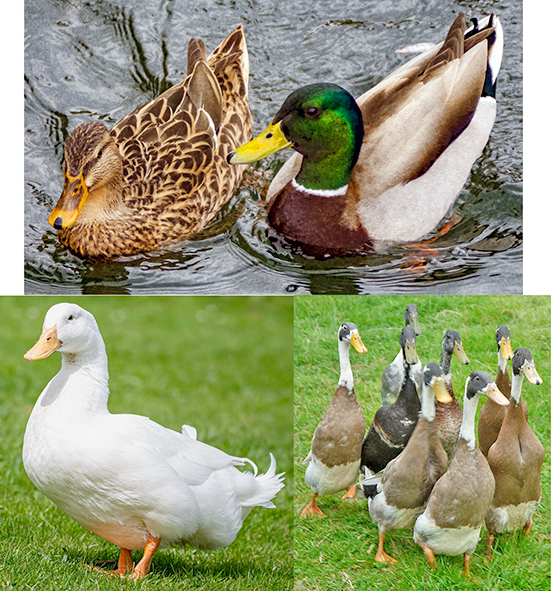
 The image above shows female and male wild mallard ducks top and
the Chinese (pekin) and Indian runner duck, bottom..
Welcome to the summary page for FabulousFusionFood's Cook's Guide entry for Duck along with all the trcipes employing Duck presented on this site, with 104 recipes in total.
This is a continuation of an entire series of pages that will, I hope, allow my visitors to better navigate this site. As well as displaying recipes by name, country and region of origin I am now planning a whole series of pages where recipes can be located by meal type and main ingredient. This page gives a listing of all the Duck recipes added to this site.
These recipes, all contain Duck as a major wild food ingredient.
Domestic ducks (mainly mallards, Anas platyrhynchos domesticus, with some Muscovy ducks, Cairina moschata domestica) are ducks that have been domesticated and raised for meat and eggs. A few are kept for show, or for their ornamental value. Most varieties of domesticated ducks, apart from the Muscovy duck and hybrids, are descended from the wild mallard, which was domesticated in China around 2000 BC.
Duck farming is simplified by their reliable flocking behaviour, and their ability to forage effectively for themselves. Over 80% of global duck production is in China. Breeds such as White Pekin are raised for meat, while the prolific Indian Runner can produce over 300 eggs per year. In East and Southeast Asia, polycultures such as rice-duck farming are widely practised: the ducks assist the rice with manure and by eating small pest animals, so that the same land produces rice and ducks at once.
Domestic ducks appear from whole-genome sequencing to have originated from a single domestication event of mallards during the Neolithic, followed by rapid selection for lineages favouring meat or egg production. They were probably domesticated in Southern China around 200 BCE – by the rice paddy-farming ancestors of modern Southeast Asians – and spread outwards from that region. There are few archaeological records, so the date of domestication is unknown; the earliest written records are in Han Chinese writings from central China dating to about 500 BC. Duck farming for both meat and eggs is a widespread and ancient industry in Southeast Asia.
Wild ducks were hunted extensively in Egypt and other parts of the world in ancient times, but were not domesticated. Ducks are documented in Ancient Rome from the second century BC, but descriptions – such as by Columella – suggest that ducks in Roman agriculture were captured in the wild, not domesticated; there was no duck breeding in Roman times, so eggs from wild ducks were needed to start duck farms.
Mallards were domesticated in Eurasia. The Muscovy duck was domesticated in Mexico and South America.
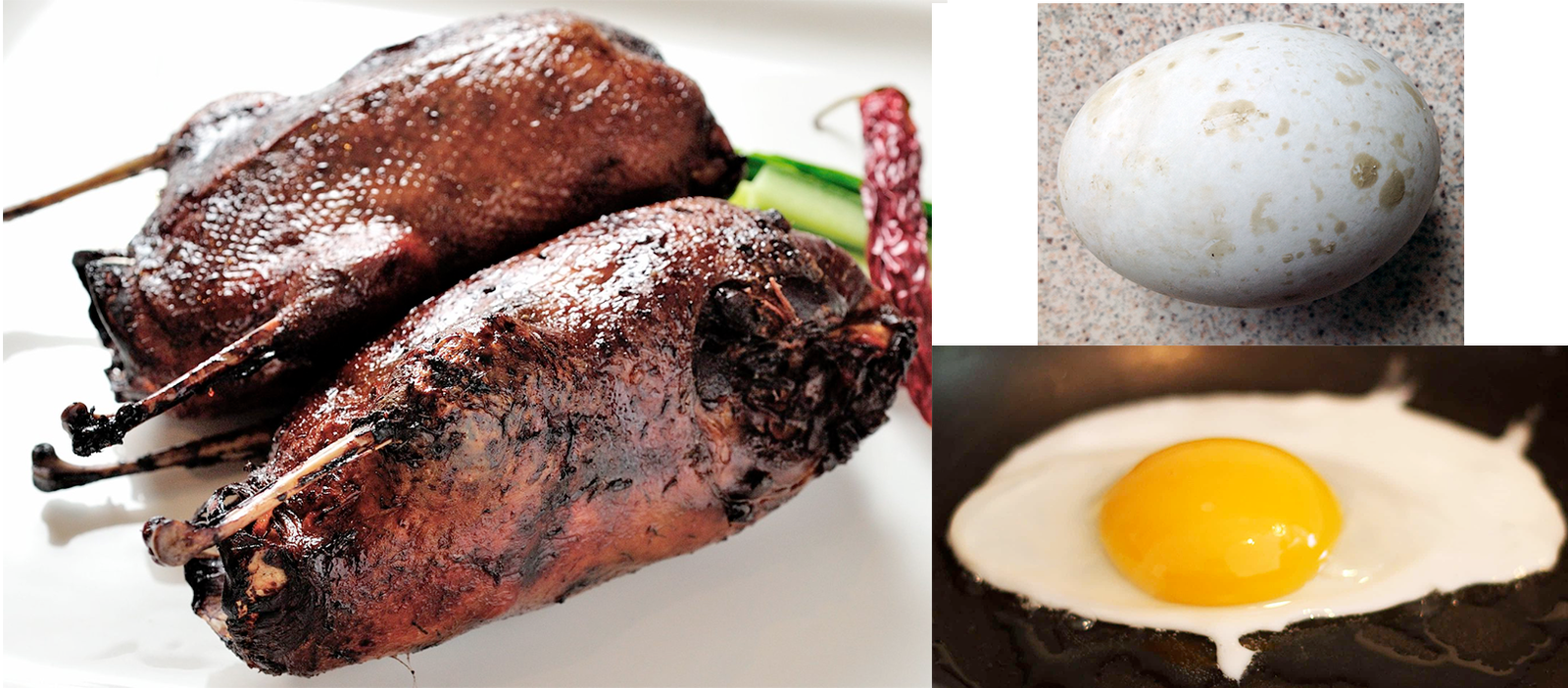
Chinese-style cooked duck, duck egg and fried duck egg
Most breeds and varieties of domestic duck derive from the mallard, Anas platyrhynchos; a few derive from Cairina moschata, the Muscovy duck, or are mullards, hybrids of these with A. platyrhynchos stock. Domestication has greatly altered their characteristics. Domestic ducks are mostly promiscuous, where wild mallards are monogamous. Domestic ducks have lost the mallard's territorial behaviour, and are less aggressive than mallards. Despite these differences, domestic ducks frequently mate with wild mallard, producing fully fertile hybrid offspring. A wild mallard weighs some 1.1 kg (2.4 lb), but large breeds like the Aylesbury may weigh 4.6 kg (10 lb) (and hybrids even more), while small breeds like the Appleyard may be only 0.7 kg (1.5 lb). Those breeds are raised for meat and eggs, while other breeds are purely ornamental, having been selected for their crests, tufts, or striking plumage, for exhibition in competitions.
Since ancient times, the duck has been eaten as food. Usually only the breast and thigh meat is eaten. It does not need to be hung before preparation, and is often braised or roasted, sometimes flavoured with bitter orange or with port. Peking duck is a dish of roast duck from Beijing, China, that has been prepared since medieval times. It is today traditionally served with spring pancakes, spring onions and sweet bean sauce.
In France, ducks are used for the production of foie gras de canard. In some cultures the blood of ducks slaughtered for meat is used as food; it may be eaten seasoned and lightly cooked, as in Ireland: 392 or be used as an ingredient, as in a number of regional types of blood soup, among them the czarnina of Poland: 299 and the tiết canh of Vietnam.
Duck eggs are eaten mainly in Asian countries such as China;: 258 in the Philippines, balut – a fertilised duck egg at about 17 days of development, boiled and eaten with salt – is considered a delicacy and is sold as street food.
Humans have hunted ducks since prehistoric times. Excavations of middens in California dating to 7800 – 6400 BP have turned up bones of ducks, including at least one now-extinct flightless species. Ducks were captured in "significant numbers" by Holocene inhabitants of the lower Ohio River valley, suggesting they took advantage of the seasonal bounty provided by migrating waterfowl. Neolithic hunters in locations as far apart as the Caribbean, Scandinavia, Egypt, Switzerland, and China relied on ducks as a source of protein for some or all of the year. Archeological evidence shows that Māori people in New Zealand hunted the flightless Finsch's duck, possibly to extinction, though rat predation may also have contributed to its fate. A similar end awaited the Chatham duck, a species with reduced flying capabilities which went extinct shortly after its island was colonised by Polynesian settlers. It is probable that duck eggs were gathered by Neolithic hunter-gathers as well, though hard evidence of this is uncommon.
This is a continuation of an entire series of pages that will, I hope, allow my visitors to better navigate this site. As well as displaying recipes by name, country and region of origin I am now planning a whole series of pages where recipes can be located by meal type and main ingredient. This page gives a listing of all the Duck recipes added to this site.
These recipes, all contain Duck as a major wild food ingredient.
Domestic ducks (mainly mallards, Anas platyrhynchos domesticus, with some Muscovy ducks, Cairina moschata domestica) are ducks that have been domesticated and raised for meat and eggs. A few are kept for show, or for their ornamental value. Most varieties of domesticated ducks, apart from the Muscovy duck and hybrids, are descended from the wild mallard, which was domesticated in China around 2000 BC.
Duck farming is simplified by their reliable flocking behaviour, and their ability to forage effectively for themselves. Over 80% of global duck production is in China. Breeds such as White Pekin are raised for meat, while the prolific Indian Runner can produce over 300 eggs per year. In East and Southeast Asia, polycultures such as rice-duck farming are widely practised: the ducks assist the rice with manure and by eating small pest animals, so that the same land produces rice and ducks at once.
Domestic ducks appear from whole-genome sequencing to have originated from a single domestication event of mallards during the Neolithic, followed by rapid selection for lineages favouring meat or egg production. They were probably domesticated in Southern China around 200 BCE – by the rice paddy-farming ancestors of modern Southeast Asians – and spread outwards from that region. There are few archaeological records, so the date of domestication is unknown; the earliest written records are in Han Chinese writings from central China dating to about 500 BC. Duck farming for both meat and eggs is a widespread and ancient industry in Southeast Asia.
Wild ducks were hunted extensively in Egypt and other parts of the world in ancient times, but were not domesticated. Ducks are documented in Ancient Rome from the second century BC, but descriptions – such as by Columella – suggest that ducks in Roman agriculture were captured in the wild, not domesticated; there was no duck breeding in Roman times, so eggs from wild ducks were needed to start duck farms.
Mallards were domesticated in Eurasia. The Muscovy duck was domesticated in Mexico and South America.
Chinese-style cooked duck, duck egg and fried duck egg
Most breeds and varieties of domestic duck derive from the mallard, Anas platyrhynchos; a few derive from Cairina moschata, the Muscovy duck, or are mullards, hybrids of these with A. platyrhynchos stock. Domestication has greatly altered their characteristics. Domestic ducks are mostly promiscuous, where wild mallards are monogamous. Domestic ducks have lost the mallard's territorial behaviour, and are less aggressive than mallards. Despite these differences, domestic ducks frequently mate with wild mallard, producing fully fertile hybrid offspring. A wild mallard weighs some 1.1 kg (2.4 lb), but large breeds like the Aylesbury may weigh 4.6 kg (10 lb) (and hybrids even more), while small breeds like the Appleyard may be only 0.7 kg (1.5 lb). Those breeds are raised for meat and eggs, while other breeds are purely ornamental, having been selected for their crests, tufts, or striking plumage, for exhibition in competitions.
Since ancient times, the duck has been eaten as food. Usually only the breast and thigh meat is eaten. It does not need to be hung before preparation, and is often braised or roasted, sometimes flavoured with bitter orange or with port. Peking duck is a dish of roast duck from Beijing, China, that has been prepared since medieval times. It is today traditionally served with spring pancakes, spring onions and sweet bean sauce.
In France, ducks are used for the production of foie gras de canard. In some cultures the blood of ducks slaughtered for meat is used as food; it may be eaten seasoned and lightly cooked, as in Ireland: 392 or be used as an ingredient, as in a number of regional types of blood soup, among them the czarnina of Poland: 299 and the tiết canh of Vietnam.
Duck eggs are eaten mainly in Asian countries such as China;: 258 in the Philippines, balut – a fertilised duck egg at about 17 days of development, boiled and eaten with salt – is considered a delicacy and is sold as street food.
Humans have hunted ducks since prehistoric times. Excavations of middens in California dating to 7800 – 6400 BP have turned up bones of ducks, including at least one now-extinct flightless species. Ducks were captured in "significant numbers" by Holocene inhabitants of the lower Ohio River valley, suggesting they took advantage of the seasonal bounty provided by migrating waterfowl. Neolithic hunters in locations as far apart as the Caribbean, Scandinavia, Egypt, Switzerland, and China relied on ducks as a source of protein for some or all of the year. Archeological evidence shows that Māori people in New Zealand hunted the flightless Finsch's duck, possibly to extinction, though rat predation may also have contributed to its fate. A similar end awaited the Chatham duck, a species with reduced flying capabilities which went extinct shortly after its island was colonised by Polynesian settlers. It is probable that duck eggs were gathered by Neolithic hunter-gathers as well, though hard evidence of this is uncommon.
The alphabetical list of all Duck recipes on this site follows, (limited to 100 recipes per page). There are 104 recipes in total:
Page 1 of 2
| A Chinese Balloon Origin: Fusion | Duck with Lentils, Dates and Radicchio Origin: Fusion | Parmentier de Canard (Duck Parmentier) Origin: France |
| Adobong Pato a la Moja (Duck Adobo with Pineapple and Dates) Origin: Philippines | Duck with Lentils, Dates and Radicchio Origin: Britain | Parmentier de confit de canard (Confit of Duck Cottage Pie) Origin: France |
| Air Fryer Crispy Sichuan Duck Origin: Britain | Duck with Marmalade Origin: Scotland | Patka sa kiselim kupusom (Duck with Sauerkraut) Origin: Croatia |
| Aliter Gruem vel Anatem (Crane or Duck, Another Way) Origin: Roman | Duck with Plums and Burdock Origin: Fusion | Pato con Aceitunas (Duck with Olives) Origin: Spain |
| Aliter in grue vel in anate vel in pullo (Roast Duck with Damson Sauce) Origin: Roman | Duck with Wild Plum Sauce Origin: Britain | Peking Duck Origin: China |
| Aliter in Grue vel Qnate Elixa (Sauce for Boiled Crane or Duck, Another Way II) Origin: Roman | Duckling Dar es Salaam Origin: Tanzania | Poppy Seed and Blackberry Cake Origin: Ancient |
| Aliter in Gruem vel Anatem Elixam (Sauce for Boiled Crane or Duck, Another Way) Origin: Roman | Duckling with New Peas Origin: Britain | Poto no Tucupi (Brazilian Tucupi and Duck Soup) Origin: Brazil |
| Ancient Pancakes Origin: Ancient | Empanadas Fritas (Fried Empanadas) Origin: Mexico | Ragù d'anatra (Venetian Duck Ragu) Origin: Italy |
| Asian Duck Curry Origin: Fusion | French Bean and Duck Green Thai Curry Origin: Thailand | Rich Bread Origin: Ancient |
| Bafado Origin: India | Fruity Duck Origin: Britain | Rillettes de canard (Duck Rillettes) Origin: France |
| Barbecued Duckling Origin: Britain | Game Terrine Origin: Britain | Ritra de Canard (Ritra of Duck) Origin: Madagascar |
| Batak Raichat (Duck Raichat) Origin: India | Glazed Duckling with Pineapple Salsa Origin: Fusion | Roast Christmas Duck with Honey-five-spice Glaze Origin: Fusion |
| Bibinka (Savoury Coconut Rice Cake) Origin: East Timor | Gratin de Couac (Couac Gratin) Origin: French Guiana | Roast Duck Breasts with Prunes and Armagnac Origin: Britain |
| Boiled and Fried Sea Kale Roots Origin: Britain | Gruem vel anatem (Crane or Duck in Spiced Gravy) Origin: Roman | Roast Duck with Orange Salad Origin: Britain |
| Brestiau Hwyaden â Saws Afalau, Eirin a Mêl (Duck Breasts with Apple, Plum and Honey Sauce) Origin: Welsh | Gruem vel Anatem ex Rapis (Crane or Duck with Turnips) Origin: Roman | Roast Wild Duck Origin: Britain |
| Bronnau Hwyaden gyda Saws Eirin Dinbych Sbeislyd (Duck Breasts with Spiced Denbigh Plum Sauce) Origin: Welsh | Hunan Braised Duck Origin: China | Roast Wild Mallard with Chanterelles Origin: Britain |
| Canard au cidre (Duck with Cider) Origin: France | Hwyaden Hallt Cymreig (Welsh Salt Duck) Origin: Welsh | Salted Duck Eggs Origin: China |
| Canard au curry (Curried Duck) Origin: DR-Congo | Hwyaden Wyllt gyda Saws Mwyar Duon (Wild Duck with Blackberry Sauce) Origin: Welsh | Salted Duck Eggs Origin: East Timor |
| Century Eggs Origin: China | Kaeng Phet Pet Yang (Thai Red Roast Duck Curry) Origin: Thailand | Satsabeli Bazha (Poultry in Walnut Sauce) Origin: Georgia |
| Century Eggs Origin: Christmas Island | Katami Satsabeli Baga (Duck in Georgian Walnut Sauce) Origin: Georgia | Sauce noyre for malard (Black Sauce for Malards (or ducks)) Origin: England |
| Chinese Crispy Duck Origin: China | Laj Ntses (Fish Larb) Origin: Laos | Sesame Orange Duckling Origin: Britain |
| Citrus Duckling Skewers Origin: Britain | Le Canard au tangor et à la Vanille (Clementine and Vanilla Duck) Origin: Reunion | Slow Cooker Duck and Potato Massaman Curry Origin: Britain |
| Confit of Duck Origin: France | Le cassoulet de la mer à la bretonne (Breton seaside cassoulet) Origin: France | Slow-cooked Duck Ragù for Valentine's Origin: Fusion |
| Confit of Duck Tostadas Origin: Fusion | Libata (Duck with Carrots) Origin: DR-Congo | South African Roast Potatoes with Biltong Origin: South Africa |
| Crispy Air Fryer Duck Breast Origin: Britain | Magret de Canard Rôti (Roast Duck Magret) Origin: France | Spaghetti with Duck Egg Carbonara Origin: Britain |
| Crispy duck noodles with vegetables Origin: Britain | Magrets de Canard Fumés (Hot-smoked Duck Breasts) Origin: France | Sticky-spiced Duck Legs with Plums Origin: Fusion |
| Curry Chicken with Potatoes Origin: Trinidad | Maidd ac Ŵy Hwyaden (Duck Egg Whey) Origin: Welsh | Terrine Hwyaden, Porc a Mafon (Duck, Pork and Raspberry Terrine) Origin: Welsh |
| Devilled Duck Liver and Wilding Apple Origin: Britain | Malardis Origin: England | Thai Red Curry Duck Origin: Thailand |
| Duck and Cabbage Soup Origin: China | Manx Broth for a Wedding Origin: Manx | Tournedos Rossini (Fillet Rossini) Origin: France |
| Duck and Green Pea Curry Origin: India | Manx Salt Duck Origin: Manx | Tournedos Rossini Origin: France |
| Duck Curry with Aubergine and Bamboo Origin: Vietnam | Microwave Duck à l'Orange Origin: Britain | Traditional Roast Duck Origin: Britain |
| Duck Egg Scotch Eggs Origin: Scotland | Ohn-No Khaukswe (Coconut Noodles) Origin: Myanmar | Trinidadian Curry Duck Origin: Trinidad |
| Duck Egg Victoria Sponge Origin: Britain | Paella Valencia de la Huerta (Traditional Chicken Paella) Origin: Spain | |
| Duck Sukuti Origin: Nepal | Paia Katsarolas (Duck Casserole) Origin: Cyprus |
Page 1 of 2