FabulousFusionFood's Mushroom-based Recipes 4th Page
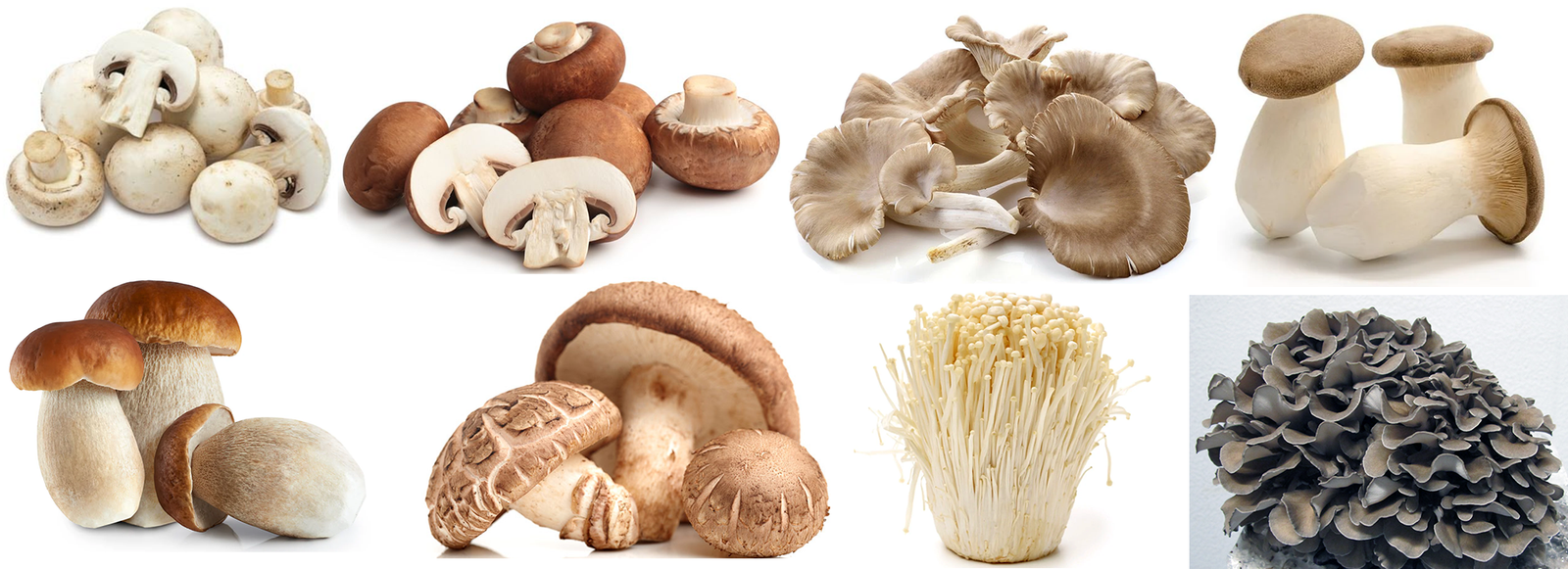 Selection of different cultivated mushrooms.
Welcome to FabulousFusionFood's Mushroom-based Recipes Page — The recipes presented here are all based on mushrooms as an ingredient base. Biologically, mushrooms toadstools are the fleshy, spore-bearing fruiting body of a fungus, typically produced above ground, on soil, or on its food source. Toadstool generally denotes one poisonous to humans. The standard for the name "mushroom" is the cultivated white button mushroom, Agaricus bisporus; hence, the word "mushroom" is most often applied to those fungi (Basidiomycota, Agaricomycetes) that have a stem (stipe), a cap (pileus), and gills (lamellae, sing. lamella) on the underside of the cap. "Mushroom" also describes a variety of other gilled fungi, with or without stems; therefore the term is used to describe the fleshy fruiting bodies of some Ascomycota. The gills produce microscopic spores which help the fungus spread across the ground or its occupant surface. Forms deviating from the standard morphology usually have more specific names, such as "bolete", "truffle", "puffball", "stinkhorn", and "morel", and gilled mushrooms themselves are often called "agarics" in reference to their similarity to Agaricus or their order Agaricales. By extension, the term "mushroom" can also refer to either the entire fungus when in culture, the thallus (called mycelium) of species forming the fruiting bodies called mushrooms, or the species itself.
Mushrooms are used extensively in cooking, in many cuisines (notably Chinese, Korean, European, and Japanese). Humans have valued them as food since antiquity. Most mushrooms sold in supermarkets have been commercially grown on mushroom farms. The most common of these, Agaricus bisporus, is considered safe for most people to eat because it is grown in controlled, sterilized environments. Several varieties of A. bisporus are grown commercially, including whites, crimini, and portobello. Other cultivated species available at many grocers include Hericium erinaceus, shiitake, maitake (hen-of-the-woods), Pleurotus, and enoki. In recent years, increasing affluence in developing countries has led to a considerable growth in interest in mushroom cultivation, which is now seen as a potentially important economic activity for small farmers.
Separating edible from poisonous species requires meticulous attention to detail; there is no single trait by which all toxic mushrooms can be identified, nor one by which all edible mushrooms can be identified. People who collect mushrooms for consumption are known as mycophagists, and the act of collecting them for such is known as mushroom hunting, or simply "mushrooming". Even edible mushrooms may produce allergic reactions in susceptible individuals, from a mild asthmatic response to severe anaphylactic shock. Even the cultivated A. bisporus contains small amounts of hydrazines, the most abundant of which is agaritine (a mycotoxin and carcinogen). However, the hydrazines are destroyed by moderate heat when cooking.
A number of species of mushrooms are poisonous; although some resemble certain edible species, consuming them could be fatal. Eating mushrooms gathered in the wild is risky and should only be undertaken by individuals knowledgeable in mushroom identification. Common best practice is for wild mushroom pickers to focus on collecting a small number of visually distinctive, edible mushroom species that cannot be easily confused with poisonous varieties. Common mushroom hunting advice is that if a mushroom cannot be positively identified, it should be considered poisonous and not eaten.
Identifying what is and is not a mushroom requires a basic understanding of their macroscopic structure. Most are basidiomycetes and gilled. Their spores, called basidiospores, are produced on the gills and fall in a fine rain of powder from under the caps as a result. At the microscopic level, the basidiospores are shot off basidia and then fall between the gills in the dead air space. As a result, for most mushrooms, if the cap is cut off and placed gill-side-down overnight, a powdery impression reflecting the shape of the gills (or pores, or spines, etc.) is formed (when the fruit body is sporulating). The colour of the powdery print, called a spore print, is useful in both classifying and identifying mushrooms. Spore print colours include white (most common), brown, black, purple-brown, pink, yellow, and creamy, but almost never blue, green, or red.
In general, identification to genus can often be accomplished in the field using a local field guide. Identification to species, however, requires more effort. A mushroom develops from a button stage into a mature structure, and only the latter can provide certain characteristics needed for the identification of the species. However, over-mature specimens lose features and cease producing spores. Many novices have mistaken humid water marks on paper for white spore prints, or discoloured paper from oozing liquids on lamella edges for coloured spored prints.
A mushroom develops from a nodule, or pinhead, less than two millimetres in diameter, called a primordium, which is typically found on or near the surface of the substrate. It is formed within the mycelium, the mass of threadlike hyphae that make up the fungus. The primordium enlarges into a roundish structure of interwoven hyphae roughly resembling an egg, called a "button". The button has a cottony roll of mycelium, the universal veil, that surrounds the developing fruit body. As the egg expands, the universal veil ruptures and may remain as a cup, or volva, at the base of the stalk, or as warts or volval patches on the cap. Many mushrooms lack a universal veil, therefore they do not have either a volva or volval patches. Often, a second layer of tissue, the partial veil, covers the blade-like gills that bear spores. As the cap expands the veil breaks, and remnants of the partial veil may remain as a ring, or annulus, around the middle of the stalk or as fragments hanging from the margin of the cap. The ring may be skirt-like as in some species of Amanita, collar-like as in many species of Lepiota, or merely the faint remnants of a cortina (a partial veil composed of filaments resembling a spiderweb), which is typical of the genus Cortinarius. Mushrooms lacking partial veils do not form an annulus.
For more information on a selection of edible wild mushrooms, please visit this site's guide to edible wild mushrooms.
The alphabetical list of all the mushroom-based recipes on this site follows, (limited to 100 recipes per page). There are 700 recipes in total:
Page 4 of 8
Page 4 of 8