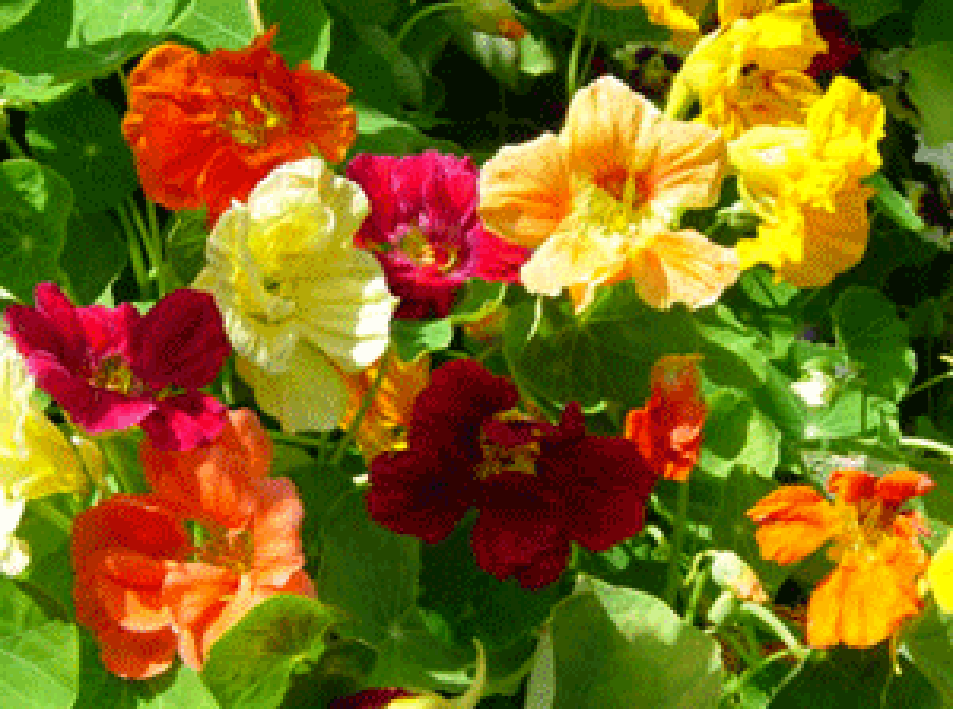
 Edible nasturtium flowers and leaves.
Welcome to the summary page for FabulousFusionFood's Cook's Guide entry for Nasturtium along with all the recipes employing Nasturtium presented on this site, with 20 recipes in total.
This is a continuation of an entire series of pages that will, I hope, allow my visitors to better navigate this site. As well as displaying recipes by name, country and region of origin I am now planning a whole series of pages where recipes can be located by meal type and main ingredient. This page gives a listing of all the Nasturtium recipes added to this site.
These recipes, all contain Nasturtium as a major wild food ingredient.
Nasturtium is the common name for genus of roughly 80 species of annual and perennial herbaceous flowering plants in the genus Trapaeolum (from Greek tropaion [τρόπαιον or τροπαῖον] 'trophy') in the Tropaeolaceae family. The word nasturtium itself literally means 'nose twister' or 'nose tweaker' and this plant should not be confused with the Watercresses of the genus Nasturtium which is a member of the mustard family.
The entire genus is native to southern and central America and one of the most commonly grown is Tropaeolum majus which is also by far the best and most edible. All nasturtiums produce isothiocyanates and it's this chemical that give nasturtiums their peppery qualities.
Leaves, flowers and even the unripe fruit of nasturtiums are edible. The leaves and flowers make wonderful additions to salads or as garnishes to savoury dishes and the flower buds and seed buds if picked when soft can be pickled in vinegar and makes a very acceptable substitute for capers.
This is a continuation of an entire series of pages that will, I hope, allow my visitors to better navigate this site. As well as displaying recipes by name, country and region of origin I am now planning a whole series of pages where recipes can be located by meal type and main ingredient. This page gives a listing of all the Nasturtium recipes added to this site.
These recipes, all contain Nasturtium as a major wild food ingredient.
Nasturtium is the common name for genus of roughly 80 species of annual and perennial herbaceous flowering plants in the genus Trapaeolum (from Greek tropaion [τρόπαιον or τροπαῖον] 'trophy') in the Tropaeolaceae family. The word nasturtium itself literally means 'nose twister' or 'nose tweaker' and this plant should not be confused with the Watercresses of the genus Nasturtium which is a member of the mustard family.
The entire genus is native to southern and central America and one of the most commonly grown is Tropaeolum majus which is also by far the best and most edible. All nasturtiums produce isothiocyanates and it's this chemical that give nasturtiums their peppery qualities.
Leaves, flowers and even the unripe fruit of nasturtiums are edible. The leaves and flowers make wonderful additions to salads or as garnishes to savoury dishes and the flower buds and seed buds if picked when soft can be pickled in vinegar and makes a very acceptable substitute for capers.
The alphabetical list of all Nasturtium recipes on this site follows, (limited to 100 recipes per page). There are 20 recipes in total:
Page 1 of 1
| Blossom-stuffed Pork Tenderloin Origin: American | Herring Pie Origin: Britain | Penne with Edible Flowers Origin: Britain |
| Caper Sauce for Boiled Mutton Origin: Britain | Nasturtium Flower Tabbolueh Origin: Fusion | Pickled Nasturtium Seed Pods Origin: Britain |
| Early Spring Salad Origin: Britain | Nasturtium Leaf Pesto Origin: Britain | Red-red with Spiced Plantains Origin: Ghana |
| Edible Flower Pancakes Origin: American | Nasturtium Soup Origin: American | Stuffed Nasturtium Leaves Origin: Fusion |
| Floral Mayonnaise Origin: American | Nasturtium Vinaigrette Origin: American | Stuffed Nasturtiums Origin: American |
| Grilled Courgettes with Sea Arrowgrass and Peas Origin: Britain | Nasturtium Vinegar Origin: American | Wild Rocket, Nasturtium and Herb Salad Origin: Britain |
| Grilled Courgettes with Sea Plantain and Peas Origin: Britain | Nasturtiums with Cream Cheese and Almond Filling Origin: Britain |
Page 1 of 1