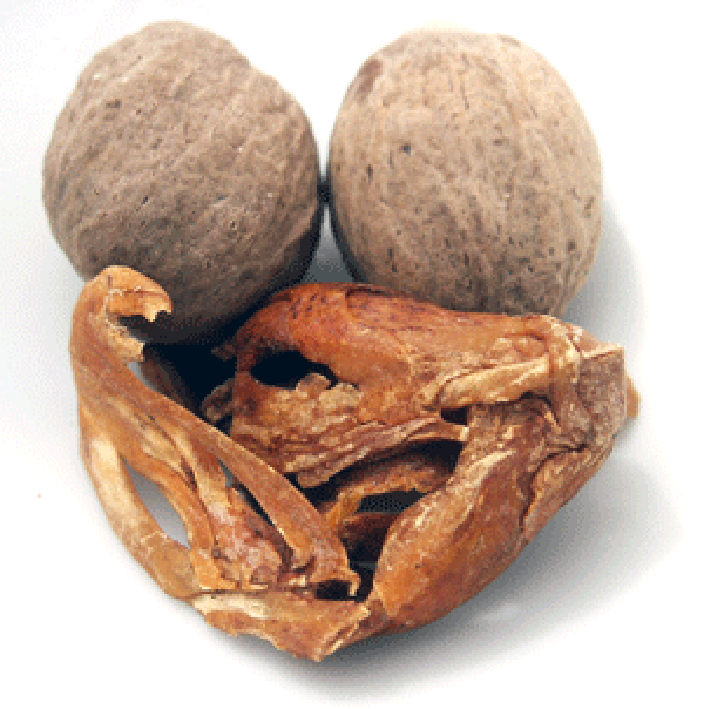
 Two nutmegs (top) and blades of mace (bottom).
Welcome to the summary page for FabulousFusionFood's Cook's Guide entry for Mace along with all the recipes employing Mace presented on this site, with 202 recipes in total.
This is a continuation of an entire series of pages that will, I hope, allow my visitors to better navigate this site. As well as displaying recipes by name, country and region of origin I am now planning a whole series of pages where recipes can be located by meal type and main ingredient. This page gives a listing of all the Mace recipes added to this site.
These recipes, all contain Mace as a major wild food ingredient.
Mace is the outer skin of the fruit of the nutmeg tree, Myristica fragrans that originate only from the Banda Islands of Indonesia. This tree is a member of the Myristicaceae (generally referred to as the Nutmeg family). There are about 100 distinct species of Myristica of which Papuan Nutmeg M argentea from New Guinea, and Bombay Nutmeg M malabarica from India are also used as spices. Nutmeg trees grow up to 20m tall thrive in very warm, humid climates. They need year-round water, but don't like flooding. There are both male and female type trees, both are required for pollination and fruit set. The trees produce their first crop of fruit after about 7 years and reach maturity after about 20 years.
Nutmegs bear yellowish fruit with a white pulp. This is split to reveal the seed inside. The seed itself is covered by a 'lacy' reddish covering (the arillus) and it is this arillus in dried form that yields mace. The seed within is the nutmeg. Both seed and arillus are generally sun-dried for about two months after which the arillus is removed and the seed itself is cracked, revealing the fragrant nutmeg interior.
Both nutmeg and mace have similar taste qualities, though nutmeg is slightly sweeter in taste and mace has a more delicate flavour. Mace is more expensive and tends to be used in light-coloured dishes where it imparts a bright yellow saffron-like colour. Nutmeg suits all milk-based products and is excellent grated freshly into cheese sauces. In Indian cuisine nutmeg is used almost exclusively for sweets. In European cuisine, nutmeg and mace are used especially in potato dishes and in processed meat products; they are also used in soups, sauces and baked goods. Japanese curry powders generally include nutmeg as an ingredient. Nutmet is also a traditional ingredient in all mulled alcohols (mulled cider, mulled beer, mulled mead or mulled wine). Small quantities of grated nutmet are also used in some Idian garam masala mixes.
This is a continuation of an entire series of pages that will, I hope, allow my visitors to better navigate this site. As well as displaying recipes by name, country and region of origin I am now planning a whole series of pages where recipes can be located by meal type and main ingredient. This page gives a listing of all the Mace recipes added to this site.
These recipes, all contain Mace as a major wild food ingredient.
Mace is the outer skin of the fruit of the nutmeg tree, Myristica fragrans that originate only from the Banda Islands of Indonesia. This tree is a member of the Myristicaceae (generally referred to as the Nutmeg family). There are about 100 distinct species of Myristica of which Papuan Nutmeg M argentea from New Guinea, and Bombay Nutmeg M malabarica from India are also used as spices. Nutmeg trees grow up to 20m tall thrive in very warm, humid climates. They need year-round water, but don't like flooding. There are both male and female type trees, both are required for pollination and fruit set. The trees produce their first crop of fruit after about 7 years and reach maturity after about 20 years.
Nutmegs bear yellowish fruit with a white pulp. This is split to reveal the seed inside. The seed itself is covered by a 'lacy' reddish covering (the arillus) and it is this arillus in dried form that yields mace. The seed within is the nutmeg. Both seed and arillus are generally sun-dried for about two months after which the arillus is removed and the seed itself is cracked, revealing the fragrant nutmeg interior.
Both nutmeg and mace have similar taste qualities, though nutmeg is slightly sweeter in taste and mace has a more delicate flavour. Mace is more expensive and tends to be used in light-coloured dishes where it imparts a bright yellow saffron-like colour. Nutmeg suits all milk-based products and is excellent grated freshly into cheese sauces. In Indian cuisine nutmeg is used almost exclusively for sweets. In European cuisine, nutmeg and mace are used especially in potato dishes and in processed meat products; they are also used in soups, sauces and baked goods. Japanese curry powders generally include nutmeg as an ingredient. Nutmet is also a traditional ingredient in all mulled alcohols (mulled cider, mulled beer, mulled mead or mulled wine). Small quantities of grated nutmet are also used in some Idian garam masala mixes.
The alphabetical list of all Mace recipes on this site follows, (limited to 100 recipes per page). There are 202 recipes in total:
Page 1 of 3
| A dauce egre (Fish in Sweet and Sour Sauce) Origin: England | Country Pork Terrine Origin: England | Honey and Spice Buns Origin: Britain |
| Anchovy Paste Origin: Britain | Crab Sauce for Fish Origin: Britain | Hot Tomato Sauce Origin: British |
| Another Walnut Catsup Origin: Britain | Creole Mustard Origin: Louisiana | Hypocras Origin: France |
| Béchamel Sauce Origin: France | Cumberland Sausage Origin: England | Irish Kidney Soup Origin: Ireland |
| Bachelor Soup Origin: Britain | Curry Vovoka (Malagasy Curry Powder) Origin: Madagascar | Irish Saffron Cake Origin: Ireland |
| Basic Irish Sausages Origin: Ireland | Dakbungalow Curry Powder Origin: Anglo-Indian | Japanese Knotweed and Pineapple Marmalade Origin: Britain |
| Beef and Pistachio Terrine Origin: Britain | Dhansak Masala Origin: India | Kede in Bokenade (Kid Goat in Sauce) Origin: England |
| Beef Koftas with Fruity Couscous Origin: Morocco | Dominica Colombo Curry Powder Origin: Dominica | Kerala Masala Powder Origin: India |
| Bhojpur Mutton Curry Origin: India | Dry Pound Cake Mix Origin: American | Keralan Garam Masala Origin: India |
| Biryani Masala Origin: Pakistan | Duck Egg Scotch Eggs Origin: Scotland | Kilmeny Kail Origin: Scotland |
| Boscastle Marinated Mackerel Origin: England | Economical Aspic Jelly Origin: Britain | Krampez Yar (Cornish Chicken Pie) Origin: England |
| Bottle Masala Origin: India | Economical Stock Origin: Britain | Lamb Curry with Winter Vegetables and Spinach Origin: Fusion |
| Bread Sauce I Origin: Britain | Egg Noodles with Reedmace Pollen Origin: Britain | Lazeez Lauki (Tasty Stuffed Bottle Gourd) Origin: India |
| Bryndons Origin: England | Egredouce of fysche (Fish in Sweet and Sour Sauce) Origin: England | Leche Frys in Lentoun (Almond Milk Fruit Pie) Origin: England |
| Buttered Colle-floure (Buttered Cauliflower) Origin: Britain | Eight-day Spiced Beef Origin: Britain | Leshes fryed in Lenton (Fried Cakes for Lent) Origin: England |
| Cameline Sauce Origin: France | Elizabethan Pickled Mushrooms Origin: Britain | Lobster Sauce for Fish Origin: Britain |
| Câpres de sureau verte (Green Elderberry Capers) Origin: France | Ffagod Cig Oen (Welsh Lamb Faggots) Origin: Welsh | Long-method Béchamel Sauce Origin: France |
| Cardamom, Coconut and Lime Rice Pudding Origin: Fusion | Fijian Palao Masala Origin: Fiji | Luss-Ny-Greg Saillt (Pickled Samphire) Origin: Manx |
| Cattail Hearts with Wild Oyster Mushrooms Origin: America | Fish Soup Origin: Scotland | Mackerel and Seaweed Pâté Origin: Britain |
| Cawl Wstrys Bro Gŵyr (Gower Peninsula Oyster Broth) Origin: Welsh | Francatelli Brown Gravy Origin: Britain | Maria Rundell's Bechamel or White Sauce Origin: Britain |
| Cheesecake Origin: Britain | Frankfurter Sausage Origin: Germany | Masala Meusi Origin: East Africa |
| Chestnut and Bacon Stuffing Origin: Scotland | Fruit Risshews Origin: England | Mauritian Prawn Curry Origin: Mauritius |
| Chevreuil Sauce Origin: Britain | Fruit Risshews Origin: England | Mawmenee Origin: England |
| Chicken and Leek Pie Origin: Ireland | Gelyne in Dubbatte (Hen in Wine Broth) Origin: England | Medium Stock Origin: Britain |
| Chicken and Wild Food Stir-fry Origin: Fusion | Gentleman's Relish Origin: Britain | Melachino (Greek Wedding Cake) Origin: Greece |
| Christmas Island Pickled Eggs Origin: Christmas Island | Ginger and Rhubarb Conserve Origin: Britain | Microwave Christmas Pudding Origin: Britain |
| Coconut Caramel Fudge with Wild Flour Origin: Britain | Gluten-free Rich Fruit Cake Origin: Britain | Microwave Hot Honey Fruit Punch Origin: Britain |
| Cocos Potiedig (Potted Cockles) Origin: Welsh | Goan Lamb Xacutti Origin: India | Mitten of Pork Origin: Britain |
| Collared Eel Origin: British | Goat Water Origin: Antigua | Mixed Spice Origin: Britain |
| Comadore (Fruit Pie Delicacies) Origin: England | Gode Powder Origin: England | Montserratian Goat Water Origin: Montserrat |
| Common Daisy Capers Origin: Britain | Grenada Curry Powder Origin: Grenada | Mrs Beeton White Stock Origin: Britain |
| Connynges in Syrup (Rabbits in Syrup) Origin: England | Haggis Origin: Scotland | Multi-grain Pancakes with Reedmace Pollen Origin: American |
| Consommé Origin: Britain | Henne in Bokenade (Hen in Sauce) Origin: England | |
| Cossack's Asparagus Origin: Russia | Hoenderpastei (South African Chicken Pie) Origin: South Africa |
Page 1 of 3