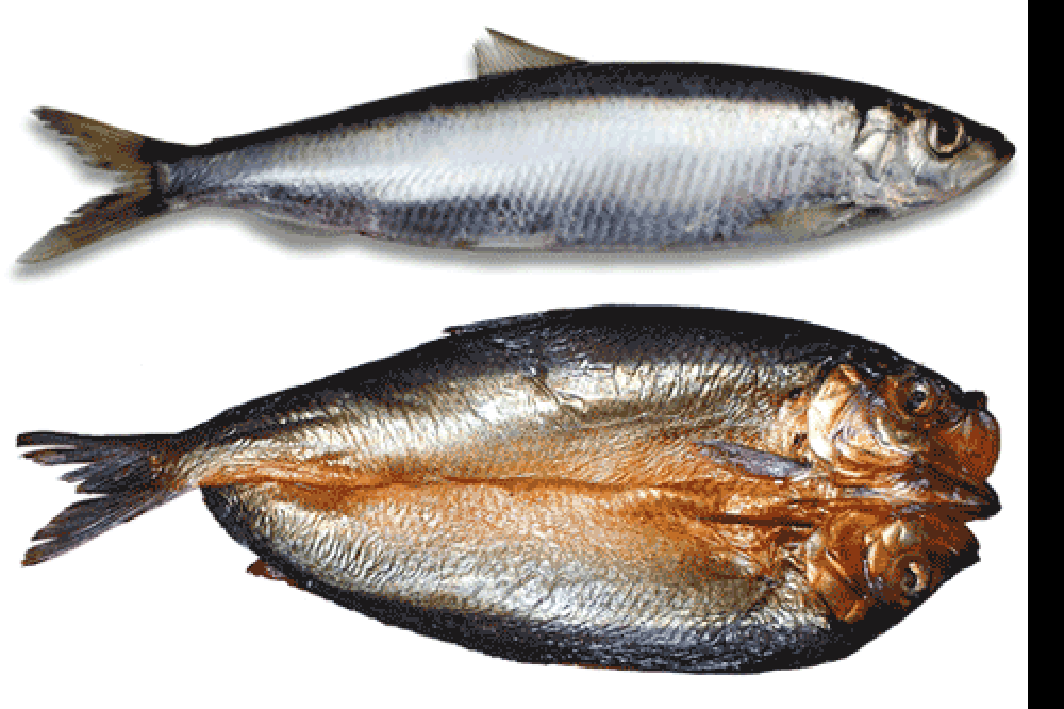
 Image of whole Atlantic Herring (Clupea harengus) with a
smoked herring kipper..
Welcome to the summary page for FabulousFusionFood's Cook's Guide entry for Herring and Kippers along with all the recipes employing Herring and Kippers presented on this site, with 63 recipes in total.
This is a continuation of an entire series of pages that will, I hope, allow my visitors to better navigate this site. As well as displaying recipes by name, country and region of origin I am now planning a whole series of pages where recipes can be located by meal type and main ingredient. This page gives a listing of all the Herring and Kippers recipes added to this site.
These recipes, all contain Herring and Kippers as a major wild food ingredient.
Herring — Herring represent a number of species schooling forage fish mostly belonging to the Clupeidae family. The most commercially important species (and the most abundant) belong to the genus Clupea and are typically found particularly in shallow, temperate waters of the North Pacific and the North Atlantic oceans, including the Baltic Sea, as well as off the west coast of South America. Three species of the genus Clupea provide almost 90% of herring caught by commercial fisheries. These are the Atlantic Herring (Clupea harengus), Pacific Herring (Clupea pallasii) and Araucanian herring (Clupea bentincki).
Herring, being members of the family Clupeidae are related to shads, sardines and menhadens. They all share similar characteristics: they are silvery-coloured, possess a large dorsal fin, which is soft, without spines. They have no lateral line and have a protruding lower jaw. Their size varies between subspecies: the Baltic herring (Clupea harengus membras) is small, 14 to 18cm; the proper Atlantic herring (C h harengus) can grow to about 46cm and weigh up 700g; and Pacific herring grow to about 38cm.
Adult herring are harvested both for their flesh and for their eggs (roe). The trade in herring is an important sector of many national economies. In Europe the fish has been called the "silver of the sea", and its trade has been so significant to many countries that it has been regarded as the most commercially important fishery in history. Though massively over-fished in Victorian times (when the populations collapsed), the Atlantic herring (Clupea harengus) fishery is now considered one of the more environmentally responsible fisheries.
Archaeological evidence suggests that herring has been a staple food for humans for at least 3000 BCE. They are prepared in a wide range of ways and can be fermented, pickled, salted and smoked. Herring are traditionally split and hung before smoking. A herring smoked by this means is called a kipper. Herring is classed as an oily fish and are high in the long-chain Omega-3 fatty acids EPA and DHA
Technically, a kipper is a herring that has been split from tail to head, gutted, salted or pickled, and cold smoked. In the United Kingdom, in Japan, and in some North American regions they are often eaten for breakfast. In the UK, kippers, along with other preserved fish such as the bloater and buckling, were also once commonly enjoyed as a high tea or supper treat; most popularly with inland and urban working-class populations before World War II. The term 'kipper' comes from the 'kippering' process of salting, drying and then cold smoking fish. Other fish apart from herring can be kippered and kippered salmon was popular in Victorian times.
'Cold smoked' fish, that have not been salted for preservation, need to be cooked before being eaten safely (they can be boiled, fried, grilled, jugged or roasted, for instance). A kipper is also sometimes referred to as a "red herring", although particularly strong curing is required to produce a truly red kipper (the term dates back to the middle ages).
A famous type of cold-smoked, split herring is the Finnan haddock. This is representative of a regional method of smoking with green wood and peat in Northeast Scotland and is associated with the village of Findon, Aberdeenshire in Scotland. Although known and admired in Scotland for a long time, Finnan haddie during the 1830s. The traditional preparation is to roast or broil the whole pieces of fish over high heat. Finnan haddie is also often served poached in milk for breakfast and is an important part of traditional kedgeree and the Arnold Bennett omelet.
Arbroath Smokies are herring that are prepared in a similar manner to kippers (they are split open and brined over night then air dried for 24 hours). However, unlike kippers, Arbroath Smokies are hot-smoked. This means that they do not need to be cooked before consumption. This is a speciality of the town of Arbroath in Angus, Scotland.
A bloater, which will often be seen referred to in Victorian cookery books is a whole cold-smoked herring (it is not split like a kipper). Bloaters are 'salted and lightly smoked without gutting, giving a characteristic slightly gamey flavour' and are particularly associated with Great Yarmouth, England. Today they are very rare.
A Buckling is a whole herring that is decapitated and gutted before being hot-smoked. Unlike cold-smoked herring they do not need to be cooked prior to eating and can be consumed hot or cold. The word may derive from the German Bückling or the Swedish böckling both words denoting a hot smoked variety of the kipper.
This is a continuation of an entire series of pages that will, I hope, allow my visitors to better navigate this site. As well as displaying recipes by name, country and region of origin I am now planning a whole series of pages where recipes can be located by meal type and main ingredient. This page gives a listing of all the Herring and Kippers recipes added to this site.
These recipes, all contain Herring and Kippers as a major wild food ingredient.
Herring — Herring represent a number of species schooling forage fish mostly belonging to the Clupeidae family. The most commercially important species (and the most abundant) belong to the genus Clupea and are typically found particularly in shallow, temperate waters of the North Pacific and the North Atlantic oceans, including the Baltic Sea, as well as off the west coast of South America. Three species of the genus Clupea provide almost 90% of herring caught by commercial fisheries. These are the Atlantic Herring (Clupea harengus), Pacific Herring (Clupea pallasii) and Araucanian herring (Clupea bentincki).
Herring, being members of the family Clupeidae are related to shads, sardines and menhadens. They all share similar characteristics: they are silvery-coloured, possess a large dorsal fin, which is soft, without spines. They have no lateral line and have a protruding lower jaw. Their size varies between subspecies: the Baltic herring (Clupea harengus membras) is small, 14 to 18cm; the proper Atlantic herring (C h harengus) can grow to about 46cm and weigh up 700g; and Pacific herring grow to about 38cm.
Adult herring are harvested both for their flesh and for their eggs (roe). The trade in herring is an important sector of many national economies. In Europe the fish has been called the "silver of the sea", and its trade has been so significant to many countries that it has been regarded as the most commercially important fishery in history. Though massively over-fished in Victorian times (when the populations collapsed), the Atlantic herring (Clupea harengus) fishery is now considered one of the more environmentally responsible fisheries.
Archaeological evidence suggests that herring has been a staple food for humans for at least 3000 BCE. They are prepared in a wide range of ways and can be fermented, pickled, salted and smoked. Herring are traditionally split and hung before smoking. A herring smoked by this means is called a kipper. Herring is classed as an oily fish and are high in the long-chain Omega-3 fatty acids EPA and DHA
Technically, a kipper is a herring that has been split from tail to head, gutted, salted or pickled, and cold smoked. In the United Kingdom, in Japan, and in some North American regions they are often eaten for breakfast. In the UK, kippers, along with other preserved fish such as the bloater and buckling, were also once commonly enjoyed as a high tea or supper treat; most popularly with inland and urban working-class populations before World War II. The term 'kipper' comes from the 'kippering' process of salting, drying and then cold smoking fish. Other fish apart from herring can be kippered and kippered salmon was popular in Victorian times.
'Cold smoked' fish, that have not been salted for preservation, need to be cooked before being eaten safely (they can be boiled, fried, grilled, jugged or roasted, for instance). A kipper is also sometimes referred to as a "red herring", although particularly strong curing is required to produce a truly red kipper (the term dates back to the middle ages).
A famous type of cold-smoked, split herring is the Finnan haddock. This is representative of a regional method of smoking with green wood and peat in Northeast Scotland and is associated with the village of Findon, Aberdeenshire in Scotland. Although known and admired in Scotland for a long time, Finnan haddie during the 1830s. The traditional preparation is to roast or broil the whole pieces of fish over high heat. Finnan haddie is also often served poached in milk for breakfast and is an important part of traditional kedgeree and the Arnold Bennett omelet.
Arbroath Smokies are herring that are prepared in a similar manner to kippers (they are split open and brined over night then air dried for 24 hours). However, unlike kippers, Arbroath Smokies are hot-smoked. This means that they do not need to be cooked before consumption. This is a speciality of the town of Arbroath in Angus, Scotland.
A bloater, which will often be seen referred to in Victorian cookery books is a whole cold-smoked herring (it is not split like a kipper). Bloaters are 'salted and lightly smoked without gutting, giving a characteristic slightly gamey flavour' and are particularly associated with Great Yarmouth, England. Today they are very rare.
A Buckling is a whole herring that is decapitated and gutted before being hot-smoked. Unlike cold-smoked herring they do not need to be cooked prior to eating and can be consumed hot or cold. The word may derive from the German Bückling or the Swedish böckling both words denoting a hot smoked variety of the kipper.
The alphabetical list of all Herring and Kippers recipes on this site follows, (limited to 100 recipes per page). There are 63 recipes in total:
Page 1 of 1
| A Third Salamongundy Origin: British | Herring Pie Origin: Britain | Pisces Scorpiones Rapulatos (Scorpion Fish with Turnips in Saffron Sauce) Origin: Roman |
| Amia (Roman Fish in Vine Leaves) Origin: Roman | Herring Rougail (Le Rougail Z'hareng) Origin: Reunion | Potted Herrings Origin: Ireland |
| Baked Herrings in Tomato Sauce Origin: Scotland | Home Cured Herring Origin: Britain | Prassyn as Skeddan (Tatties an' herrin') Origin: Manx |
| Baked White Herrings Origin: British | Inglad Sill (Pickled Salt Herring) Origin: Sweden | Red Herrings or Yarmouth Bloaters Origin: British |
| Belfast Potted Herring Origin: Northern Ireland | Inglad Sill (Swedish Pickled Herring) Origin: Sweden | Roasted breadfruit and smoked herring Origin: Saint Lucia |
| Cawl Penwaig (Welsh Herring Soup) Origin: Welsh | Kipper Cream Origin: Scotland | Rossolye (Salad with Herring and Beetroot) Origin: Estonia |
| Chilisill (Chilli Herring) Origin: Sweden | Kippers with Marmalade Origin: Britain | Scottish Pickled Herring Origin: Scotland |
| Cornish Baked Herring Origin: Britain | Manx Kipper and Black Pudding Cakes Origin: Manx | Scottish Potted Herring Origin: Scotland |
| Dulse Muffins Origin: Britain | Manx Kipper and Poached Egg Breakfast Origin: Manx | Scottish Smokies in Hot Cream Sauce Origin: Scotland |
| Dutch Herrings Origin: British | Manx Potted Herring Origin: Manx | Sgadan Hallt (Salted HerringSalted Herring) Origin: Welsh |
| Flemish Salad Origin: British | Manx Smoked Salmon with Kipper Pate Filling Origin: Manx | Shellfish and Leek Roly-poly Origin: Britain |
| Forshmak (Georgian Minced Meat Soufflé) Origin: Georgia | Mustard-crusted Herring Origin: Britain | Shuba (Herring and Beet Salad) Origin: Moldova |
| Fried Herring Origin: Scotland | Pâté Cregyn Gleision y Fenai (Menai Straits Mussel Pâté) Origin: Welsh | Sill Potatis (Pickled Herring with Boiled Potatoes and Sour Cream) Origin: Sweden |
| Gehackte Herring Origin: South Africa | Pastes hern lagesek (Stargazy Pie) Origin: England | Smørrebrød (Danish Open-faced Herring Sandwich) Origin: Denmark |
| Gepekelde Haring (Soused Herring) Origin: Netherlands | Pastes hern lagesek (Stargazy Pie) Origin: England | Solomon-a-Gundy Origin: Jamaica |
| Gezouten haring met ui en augurken (soused herring with onion and pickles) Origin: Netherlands | Pennog Ffres (Fresh Herring) Origin: Welsh | Soused Herrings Origin: Scotland |
| Grilled Kippered Salmon Origin: British | Penwaig Hallt (Salt Herring) Origin: Welsh | Stargazy Pasty Origin: England |
| Halltu Penwaig (Salting Herring) Origin: Welsh | Penwaig Nefyn (Nefyn Herring) Origin: Welsh | Swper 'Sgadan (Welsh Herring Supper) Origin: Welsh |
| Hekele (Herring Starter) Origin: Poland | Penwaig Wedi Stwffio (Stuffed Herring) Origin: Welsh | Tatties an' Herrin' Origin: Scotland |
| Herring in Oatmeal Origin: Scotland | Penwaig wedi Stwffio (Stuffed Herring) Origin: Welsh | Traditional Omelette Arnold Bennet Origin: British |
| Herring Pasty Origin: England | Pickled Herring (Pennog Picl) Origin: Welsh | Yarmouth Bloaters Origin: British |
Page 1 of 1