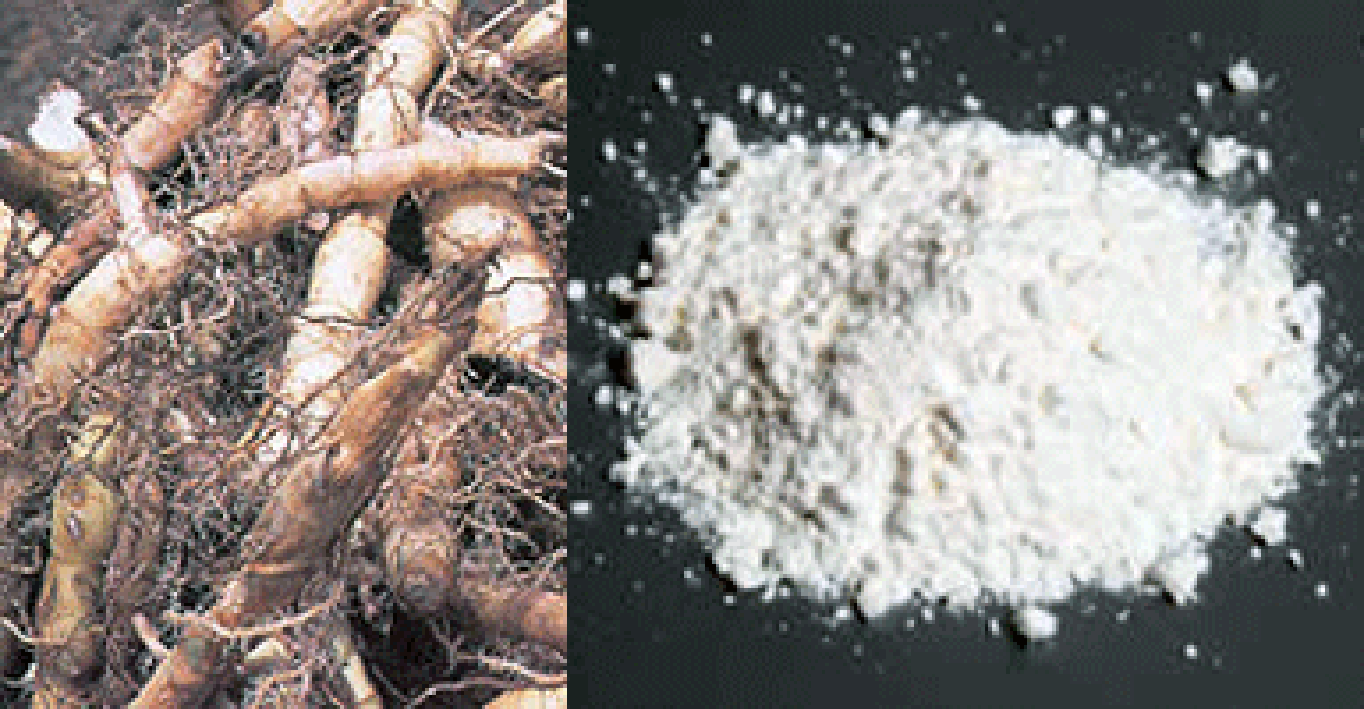
 Pile of arrowroot roots next to arrowroot powder (made from the
dried and ground toots).
Welcome to the summary page for FabulousFusionFood's Cook's Guide entry for Arrowroot along with all the recipes employing Arrowroot presented on this site, with 66 recipes in total.
This is a continuation of an entire series of pages that will, I hope, allow my visitors to better navigate this site. As well as displaying recipes by name, country and region of origin I am now planning a whole series of pages where recipes can be located by meal type and main ingredient. This page gives a listing of all the Arrowroot recipes added to this site.
These recipes, all contain Arrowroot as a major wild food ingredient.
Arrowroot is the name of the easily-digestible starch derived from the rhizomes (rootstock) of West Indian arrowroot plants (Maranta arundinacea). The plant itself is chiefly cultivated in the West Indies (Jamaica and St. Vincent), Australia, Southeast Asia, and South and East Africa. The roots themselves are dug when they are about twenty years old and when ground they contain about 23% starch.
Arrowroot is an excellent thickening agent and is used in sauces, juices and syrups. When heated the starch turns to jelly and so thickens the liquid. Its great advantage over cornflour is that it's completely tasteless (whereas cornflour can need cooking to get rid of its 'raw' taste) and gives a clear finish when used to thicken certain soups, fruit syrups or sauces.
In cooking it should always be used as a slurry (where dry arrowroot is mixed at a 1:1 ratio with cold water) before being tipped into and mixed with the food to be thickened.
As a rule of thumb, to thicken 300ml of sauce (gravy or custard, for example) you will need 2 tbsp arrowroot (mix this with 2 tbsp cold water to get a slurry). If you are making a glaze then you will need just 1 tbsp arrowroot in 1 tbsp cold water per 300ml of the glaze.
It is often compared with cornflour (cornstarch) that's also used in a similar manner. Arrowroot has the advantages of being totally flavourless and is colourless when cooked. As such it can be used as a thickener for clear soups and broths. It is also acid resistant (unlike cornflour) and can be used to thicken sharp fruit-based sauces, stews and jams. It's ideal for using as a thickener to fruit pie fillings.
The alphabetical list of all Arrowroot recipes on this site follows, (limited to 100 recipes per page). There are 66 recipes in total:
Page 1 of 1
| A Good Beef Gravy for Poultry, Game etc Origin: British | Chocolate and Hawthorn Flour Cake Origin: Britain | Orangeade Origin: British |
| A Good Mutton Soup Origin: British | Chocolate and Wild Flour Blend Cake Origin: American | Piahia (Coconut Milk Sauce) Origin: Federated States Micronesia |
| Acorn Tortillas Origin: American | Chocolate Roll Origin: Britain | Po'e Origin: Tahiti |
| Arrowroot Blanc-Mange Origin: British | Cranberry Hot Sauce Origin: Britain | Poke Origin: Cook Islands |
| Arrowroot Cream Origin: British | Cream-less Quiche Origin: Fusion | Poke Origin: Tokelau |
| Arrowroot Halwa Origin: India | Curried Daylilies Origin: Britain | Potage Darblay Origin: Britain |
| Arrowroot Jelly II Origin: British | Duchess Soup Origin: British | Potage Madrilène Origin: Britain |
| Arrowroot Pudding Origin: British | Flan Amande et d'abricot (Almond and Apricot Flan) Origin: France | Poulet Fafa (Chicken with Taro Leaves) Origin: Tahiti |
| Arrowroot Pudding II Origin: British | Gooseberry and Elderflower Custard Origin: Britain | Poulet Fafa (Chicken with Taro Leaves) Origin: Wallis Futuna |
| Arrowroot Sauce Origin: Britain | Gooseberry and Elderflower Tart Origin: British | Pwdin Mêl (Honey Pudding) Origin: Welsh |
| Arrowroot with Milk Origin: British | Gooseberry Fool Origin: British | Pwdin Triog Melyn (Golden Syrup Pudding) Origin: Welsh |
| Arrowroot with Water Origin: British | Haluwa (Carrot Sweetmeat) Origin: Tanzania | Sagu Keju (Indonesian Cheese Biscuits) Origin: Indonesia |
| Baked or Boiled Arrowroot Pudding Origin: British | Iced Curry Soup Origin: Britain | Strawberry Galette Origin: Britain |
| Blackcurrant and Lemon Sauce Origin: British | Jam Sauce Origin: British | Sweet and Sour Noodles with Chicken Origin: China |
| Bonnie Prince Pudding Origin: Scotland | Kinaki (Island Root Vegetables) Origin: Cook Islands | Tamarind Paste Origin: Indonesia |
| Bu'oy ni im (Polynesian Chestnut Cake) Origin: Federated States Micronesia | Madungo Bakes Origin: Saint Vincent | Tarten Ceirios (Cherry Tart) Origin: Welsh |
| Cherry and Bird Cherry Flour Muffins Origin: American | Milkless Vanilla Ice-cream Origin: Britain | Tarten Eirin (Plum Tart) Origin: Welsh |
| Cherry and Curly Dock Seed Flour Muffins Origin: American | Mrs Beeton Béchamel Sauce Origin: British | Tarten Eirin Mair (Gooseberry Tart) Origin: Welsh |
| Chestnut Fool Origin: Britain | Mushroom and Burdock Soup Origin: Fusion | Velvet Shank and Burdock Soup Origin: Fusion |
| Chinese Mushroom Soup Origin: China | Nước Cốt Dừa (Coconut Milk Sauce) Origin: Vietnam | Whole-grain Goji Berry Mango Muffins (Whole-grain Goji Berry Mango Muffins) Origin: American |
| Chocolate and Bird Cherry Flour Cake Origin: American | Nyponsoppa (Wild Rosehip Soup) Origin: Sweden | Whole-grain Goji Berry Muffins Origin: American |
| Chocolate and Haw Flour Cake Origin: American | Orange Sauce Origin: Britain | Xavier Suppe (Xavier Soup) Origin: Italy |
Page 1 of 1