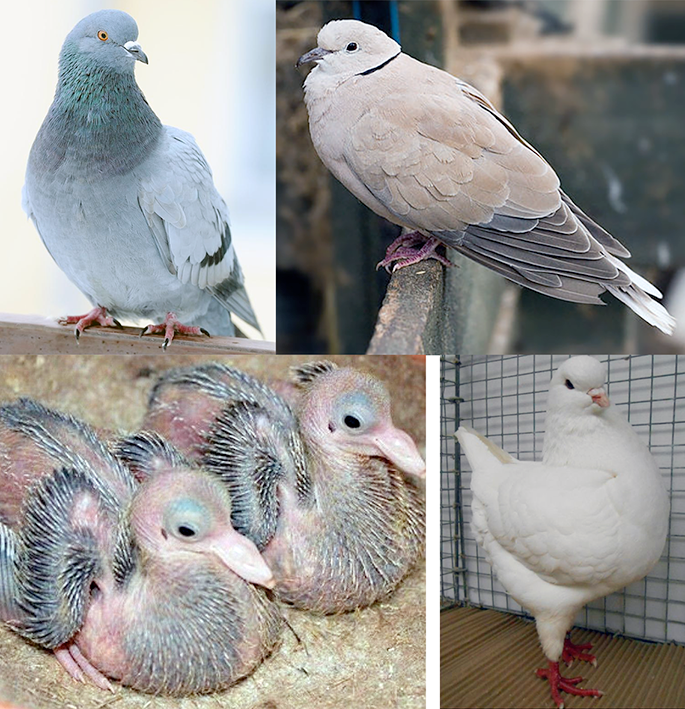
 Clockwise from top left: Domestic Pigeon; Barbary dove; white
King pigeon and squab (baby) pigeons..
Welcome to the summary page for FabulousFusionFood's Cook's Guide entry for Pigeon along with all the recipes employing Pigeon presented on this site, with 54 recipes in total.
This is a continuation of an entire series of pages that will, I hope, allow my visitors to better navigate this site. As well as displaying recipes by name, country and region of origin I am now planning a whole series of pages where recipes can be located by meal type and main ingredient. This page gives a listing of all the Pigeon recipes added to this site.
These recipes, all contain Pigeon as a major wild food ingredient.
The domestic pigeon (Columba livia 'domestica' or Columba livia forma domestica) is a domesticated bird derived from the rock dove Columba livia. Although often termed a "subspecies", the domesticated pigeon does not constitute an accepted zoological subspecies of the rock dove, but a collection of over 350 breeds. The rock dove is among the world's first birds to be domesticated; Mesopotamian cuneiform tablets mention the domestication of pigeons more than 5,000 years ago, as do Egyptian hieroglyphics.
Pigeons have held historical importance to humans as food, pets, holy animals, and messengers. Due to their homing ability, pigeons have been used to deliver messages, including war pigeons during the two world wars. Despite this, city pigeons, which are feral birds, are generally seen as pests, mainly due to their droppings and a reputation for spreading disease.
Which subspecies of C. livia was the progenitor of domestics, exactly when, how many times, where and how they were domesticated, and how they spread, remains poorly known; despite the long history of pigeons, little is known about the specifics of their initial domestication. Genetically, domesticated pigeons are closest to a cluster of origins of rock dove in the Middle East, particularly in the Syria – Jordan – Iraq – Arabian Peninsula region but also eastern Sudan, thus encompassing all or parts of the ranges of C. l. gaddi, C. l. palaestinae, and C. l. butleri.
Pigeons were most likely domesticated at least 2000–5000 years ago, and may have been domesticated earlier as a food source. Some research suggests that domestication occurred as early as 10,000 years ago. The earliest recorded mention of pigeons comes from Mesopotamia some 5,000 years ago. Pigeon Valley in Cappadocia has rock formations that were carved into ancient dovecotes. Ancient Egyptians kept vast quantities of them, and would sacrifice tens of thousands at a time for ritual purposes. Akbar the Great traveled with a coterie of thousands of pigeons.
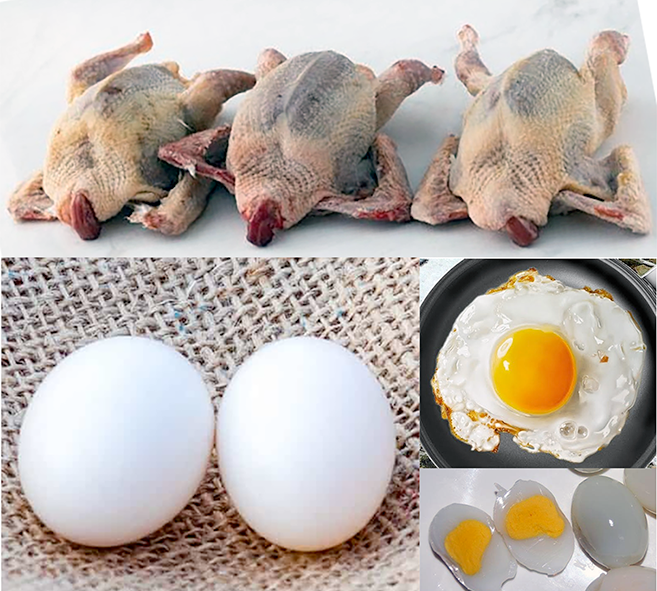
Three squab pigeons dressed for the oven (top) and two pigeon eggs (bottom) with fried and boiled eggs
Because domestic and feral pigeons have extensively interbred with wild rock doves, genetically pure wild-type rock doves are now rare and endangered, confined to remote regions such as the oceanic fringes of the species' natural range, in particular the Outer Hebrides off western Scotland. This frequent admixture further muddies the true origins of pigeons.
Pigeons bred for meat are generally referred to as a meat or utility breed. The term "squab" can either refer to young birds or the meat harvested from them; these birds grow to a very large size in the nest before they fledge and are able to fly; during this stage of development they are often fattier and seen as being tastier than the fully-flighted adults. Squabs during this stage are valued as food; in Neolithic and early agricultural communities they were an easy and reliable source of protein, the birds requiring only reliable sources of grains and water (which they independently foraged for) to enter breeding condition, and the rock formations they nested in would have made for attractive dwellings for early humans.
Pigeon meat, both from squabs and from adult birds, are still a source of protein for people worldwide. Breeds of pigeons harvested for their meat during adulthood are collectively known as utility pigeons. For commercial meat production a breed of large white pigeon, the King pigeon, has been developed by selective breeding.
Etymology: Pigeon is a French word that derives from the Latin pīpiō, for a 'peeping' chick, while dove is an ultimately Germanic word, possibly referring to the bird's diving flight. The English dialectal word culver appears to derive from Latin columba. A group of doves has sometimes been called a 'dule', taken from the French word deuil ('mourning').
Pigeons and doves exhibit considerable variation in size, ranging in length from 15 to 75 centimetres (5.9 to 29.5 in), and in weight from 30g to above 2kg. The largest extant species are the crowned pigeons of New Guinea, which are nearly turkey-sized, with lengths of 66–79 cm (2.17–2.59 ft) and weights ranging 1.8–4 kg. One of the largest arboreal species, the Marquesan imperial pigeon with a length of 55 cm (22 in), currently battles extinction. The extinct, flightless dodo is the largest columbid to have ever existed, with a height of about 62.6–75 cm, and a range of suggested weights from 10.2–27.8 kilograms, although the higher estimates are thought to be based on overweight birds.
The ringneck dove (also known as: Barbary dove, ringed turtle dove, ringneck dove, ring-necked turtle dove, or ring dove (Streptopelia risoria)) is a smaller species of domestic columbid that was kept as a source of food. As a result of selection for tame individuals who would not escape their cages, they lack a survival instinct and cannot survive release. They can be crossed with the pigeon to create offspring, but the offspring are not fertile.
Where pigeons are regularly housed (as in a dovecote) then pigeon eggs are also consumed (eg France, Egypt, Algeria). They are typically either fried or boiled. Pigeon eggs are very mild in flavour and are often used as a garnish for squab pigeon.
This is a continuation of an entire series of pages that will, I hope, allow my visitors to better navigate this site. As well as displaying recipes by name, country and region of origin I am now planning a whole series of pages where recipes can be located by meal type and main ingredient. This page gives a listing of all the Pigeon recipes added to this site.
These recipes, all contain Pigeon as a major wild food ingredient.
The domestic pigeon (Columba livia 'domestica' or Columba livia forma domestica) is a domesticated bird derived from the rock dove Columba livia. Although often termed a "subspecies", the domesticated pigeon does not constitute an accepted zoological subspecies of the rock dove, but a collection of over 350 breeds. The rock dove is among the world's first birds to be domesticated; Mesopotamian cuneiform tablets mention the domestication of pigeons more than 5,000 years ago, as do Egyptian hieroglyphics.
Pigeons have held historical importance to humans as food, pets, holy animals, and messengers. Due to their homing ability, pigeons have been used to deliver messages, including war pigeons during the two world wars. Despite this, city pigeons, which are feral birds, are generally seen as pests, mainly due to their droppings and a reputation for spreading disease.
Which subspecies of C. livia was the progenitor of domestics, exactly when, how many times, where and how they were domesticated, and how they spread, remains poorly known; despite the long history of pigeons, little is known about the specifics of their initial domestication. Genetically, domesticated pigeons are closest to a cluster of origins of rock dove in the Middle East, particularly in the Syria – Jordan – Iraq – Arabian Peninsula region but also eastern Sudan, thus encompassing all or parts of the ranges of C. l. gaddi, C. l. palaestinae, and C. l. butleri.
Pigeons were most likely domesticated at least 2000–5000 years ago, and may have been domesticated earlier as a food source. Some research suggests that domestication occurred as early as 10,000 years ago. The earliest recorded mention of pigeons comes from Mesopotamia some 5,000 years ago. Pigeon Valley in Cappadocia has rock formations that were carved into ancient dovecotes. Ancient Egyptians kept vast quantities of them, and would sacrifice tens of thousands at a time for ritual purposes. Akbar the Great traveled with a coterie of thousands of pigeons.
Three squab pigeons dressed for the oven (top) and two pigeon eggs (bottom) with fried and boiled eggs
Because domestic and feral pigeons have extensively interbred with wild rock doves, genetically pure wild-type rock doves are now rare and endangered, confined to remote regions such as the oceanic fringes of the species' natural range, in particular the Outer Hebrides off western Scotland. This frequent admixture further muddies the true origins of pigeons.
Pigeons bred for meat are generally referred to as a meat or utility breed. The term "squab" can either refer to young birds or the meat harvested from them; these birds grow to a very large size in the nest before they fledge and are able to fly; during this stage of development they are often fattier and seen as being tastier than the fully-flighted adults. Squabs during this stage are valued as food; in Neolithic and early agricultural communities they were an easy and reliable source of protein, the birds requiring only reliable sources of grains and water (which they independently foraged for) to enter breeding condition, and the rock formations they nested in would have made for attractive dwellings for early humans.
Pigeon meat, both from squabs and from adult birds, are still a source of protein for people worldwide. Breeds of pigeons harvested for their meat during adulthood are collectively known as utility pigeons. For commercial meat production a breed of large white pigeon, the King pigeon, has been developed by selective breeding.
Etymology: Pigeon is a French word that derives from the Latin pīpiō, for a 'peeping' chick, while dove is an ultimately Germanic word, possibly referring to the bird's diving flight. The English dialectal word culver appears to derive from Latin columba. A group of doves has sometimes been called a 'dule', taken from the French word deuil ('mourning').
Pigeons and doves exhibit considerable variation in size, ranging in length from 15 to 75 centimetres (5.9 to 29.5 in), and in weight from 30g to above 2kg. The largest extant species are the crowned pigeons of New Guinea, which are nearly turkey-sized, with lengths of 66–79 cm (2.17–2.59 ft) and weights ranging 1.8–4 kg. One of the largest arboreal species, the Marquesan imperial pigeon with a length of 55 cm (22 in), currently battles extinction. The extinct, flightless dodo is the largest columbid to have ever existed, with a height of about 62.6–75 cm, and a range of suggested weights from 10.2–27.8 kilograms, although the higher estimates are thought to be based on overweight birds.
The ringneck dove (also known as: Barbary dove, ringed turtle dove, ringneck dove, ring-necked turtle dove, or ring dove (Streptopelia risoria)) is a smaller species of domestic columbid that was kept as a source of food. As a result of selection for tame individuals who would not escape their cages, they lack a survival instinct and cannot survive release. They can be crossed with the pigeon to create offspring, but the offspring are not fertile.
Where pigeons are regularly housed (as in a dovecote) then pigeon eggs are also consumed (eg France, Egypt, Algeria). They are typically either fried or boiled. Pigeon eggs are very mild in flavour and are often used as a garnish for squab pigeon.
The alphabetical list of all Pigeon recipes on this site follows, (limited to 100 recipes per page). There are 54 recipes in total:
Page 1 of 1
| Ambrevades au Curry (Pigeon Pea and Coconut Curry) Origin: Comoros | Hamam Meshwi (Char-grilled Pigeon) Origin: Egypt | Pigeons aux Champignons (Pigeons with Mushrooms) Origin: France |
| Andhra Pappu Charu (Andhra-style Lentil Puree Curry) Origin: India | Jugged Pigeons Origin: Britain | Pigeons aux Mandarines (Pigeons with Tangerines) Origin: France |
| Anguillan Rice and Peas Origin: Anguilla | Microwave Casseroled Pigeons in Port Wine Origin: Britain | Pigeons Bonne Femme Origin: France |
| Arroz con Gandules (Puerto Rican Rice and Beans with Sofrito) Origin: Puerto Rico | Montserratian Rice and Peas Origin: Montserrat | Pigeons Chasseur Origin: France |
| Bahamian Crab and Rice Origin: Saint Barthelemy | Moro de guandules con coco (Christmas Rice and Pigeon Peas) Origin: Dominican Republic | Pigeons grillés au makala (Grilled Makala Pigeons) Origin: DR-Congo |
| Bébélé (Tripe and Plantain Stew) Origin: Guadeloupe | Muland Saangi Ambat (Radish Pod Gravy) Origin: India | Pigeons in a Hole Origin: Britain |
| Braised Pigeons with Cherries Origin: Zambia | Mullangi Sambar (White Radish Sambar) Origin: India | Pois d'Angole (Pigeon Peas) Origin: Guadeloupe |
| Breadfruit Curry Origin: India | Padavalanga Parippu Curry (Snake Gourd Curry) Origin: India | Rice with Pigeon Peas Origin: Puerto Rico |
| Cape Pigeons in Coconut Milk Origin: Zambia | Peas and Rice Origin: Turks Caicos | Roast Stuffed Pigeons Origin: South Africa |
| Cornish Squab Pie Origin: Britain | Peiouns y Stewed (Stewed Pigeons) Origin: England | Saba Pigeon Pea Stew Origin: Saba |
| Crustardes of Flessh Origin: England | Pelau Origin: Saint Kitts | Saint Vincent Chicken Pelau Origin: Saint Vincent |
| Dal Tadka (Lentil Curry, Restaurant Style) Origin: India | Pigeon Breast with Red Wine Gravy, Roast Leeks and Wild Mushrooms Origin: Britain | Salmis de Palombe (Salmis of Pigeons) Origin: France |
| Dal Takda (Lentil Curry, Restaurant Style) Origin: India | Pigeon Breasts Origin: Scotland | Skewered Pigeon Breasts Origin: British |
| Dhal Dhokla Origin: India | Pigeon Curry Origin: India | Spicy Sambar Curry Origin: Britain |
| Fonnell Origin: England | Pigeon Peas and Rice Origin: Barbados | Tamil Nadu Sambar Curry Origin: India |
| Gongura Pappu (Sorrel Leaf Dal) Origin: India | Pigeon Peas and Rice Origin: Anguilla | Trinidad Chicken Pelau Origin: Trinidad |
| Grenadian Pelau Origin: Grenada | Pigeon Pie Origin: Britain | Turn Cornmeal Origin: British Virgin Islands |
| Gungo Rice and Peas Origin: Jamaica | Pigeons à la Chinois (Chinese Pigeons) Origin: France | Turtures (Turtledoves) Origin: Roman |
Page 1 of 1