FabulousFusionFood's Proper Newe Booke of Cookerye Home Page
Welcome to FabulousFusionFood's Proper New Book of Cookery Recipes Page — This page brings together all the recipes on this site redacted (updated) from the late 16th century volume (circa 1557 and with earliest edition of 1545) known as: The Proper Newe Booke of Cookerye, the author of which is unknown. All recipes are given both in their original form and as a modern redaction that and cook today could follow so that you, too, can prepare classic Elizabethan fare at home. Below I also provide a brief outline the history of the book specifically the Corpus Christi College, Cambridge volume, on which the facsimile version of the text presented on this site is based. I am making my way through the entire recipe collection and as soon as they are added to my site they will be available here. (For the recipe list scroll down.) Enjoy...
For the complete list of recipes, please scroll down to the 'links to the Proper New Book of Cookery recipes' below.
Related Historical Cookbooks Recipe Links
The Proper New Book of Cookery is not the only important historical cookbook, chef or cookery writer or recipe book available on this site. You can find information about recipe books and historical chefs from the very first cookery book written in English right up to the modern day:
Recipes from Various Historical Periods (All this site's historical recipes)Apicius' De Re Coquinaria (4th Century)
The Forme of Cury (1391)
Proper New Book of Cookery (1545)
Delightes for Ladies (1602)
Closet for Ladies (submitted 1602, published 1608)
Robert May — The Accomplisht Cook (1660)
The Compleat Cook (1658) Hannah Glasse — The Art of Cookery (1747)
Eliza Acton — Modern Cookery (1845)
Alexis Soyer — The Modern Housewife or Ménagère (1849)
Francatelli — Cook's Guide (1851)
Alexis Soyer — A Shilling Cookery Book for the People (1854)
Mrs Beeton — Book of Household Management (1861)
The Proper New Book of Cookery
The Proper Newe Booke of Cookerye — Circa 1557 The tale of this book is one of happy chance. Through increasing social mobility in the 16th century meant that there was a market for cookery books to newly-wealthy households which were just becoming established but which were not yet wealthy enough to have servants. As a result, a slew of cookery books began to be published in the middle to the late 16th century. This was also the first time that cookery books became specifically targeted towards a female audience (previously they were written by chefs for chefs or were part of court and noble house records).
Of course, only a relatively small (and wealthy) portion of the population could both read and afford to buy books. These were the same people who could afford the sugar and spices specified in so many of the recipes. But, as the audience was often new to cookery we also see a shift in style. Fr the first time we see quantities being specified for ingredients and cooking times being stated. However, apart from a few recent imports from France, most of the recipes still owe their origins to their Medieval antecedents. But increasing trade is apparent as far more basic ingredients are available than during Medieval times. The Proper New Book also sets out recipe options for a multi-course meal.
The problem with the period is, that the cookery books were intended to be actually used in kitchens, which they really were. As a result very few cookery books of the period survive. Which is why the Proper New Book is so rare and so important. There are two key exemplars of the book. One is in the British Library and the other is in the library of Corpus Christi College, Cambridge. The British Library book is dated to 1575 and was published by William How, for A. Veale, Fleet Street, London 1575. The Corpus Christi College version was published by John Kynge and Thomas Marche, Crede Lane, London. There is no date of publication, but evidence suggests 1557–1558 as a likely publication. There is also an earlier edition, dated 1545 now housed at the University of Glasgow.
Several versions of the British Library manuscripts of this text are already on the Internet, so I have focussed on the Corpus Christi text for this website. I have managed to obtain a scanned image of every page and, using an early Elizabethan typeface I am presenting the text here in facsimile version, with a parallel text in Modern English and modern redactions of all the 49 recipes.
History of The Proper New Booke
From here on in we will be dealing with the history of the Corpus Christi volume, which is often called 'Margaret Parker's Book' for the original owner of the volume. An image of the title page is shown above. The Corpus Christi version of the Proper New Book survives bound up into a collection of short texts that were assembled and indexed by Matthew Parker. Parker was the fourteenth Master of the college, and it is his bequeath of his own book collection (made in 1574, a year before his death) that forms the core of the college's present library. Parker's description of the book as 'Of Cokery and Seruing of Meates' is shown here in his own handwriting.
The history of this particular volume is also the history of Matthew Parker, his wife Margaret and the English Reformation. Indeed, were it not for the Reformation and the accompanying religious upheaval in England then it's likely that the book would not have come into Margaret Parker's possession and it would not have been preserved for posterity.
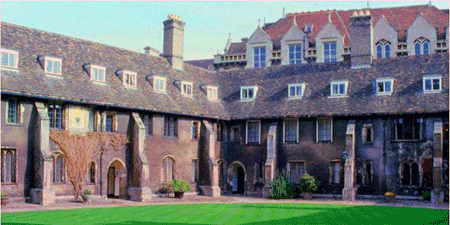
Old Court, Corpus Christi college, Cambridge
Matthew Parker was born around 1505 in Norfolk, and was admitted to Corpus Christi in 1521, gaining his BA in 1524. By 1527 he had been ordained as a priest and a year later became a Fellow of Corpus Christi college (the image above shows the Old Court from Corpus Christi college, Cambridge, where the Master's lodge used to be). He became chaplain to Henry VIII and in 1544 Henry commended him as Master of the college (he was elected to that post later in the same year).
Margaret Harleston was the daughter of Robert Harleston, a gentleman of Norfolk and was born in 1519. She lost her mother at an early age as a result she would almost certainly have helped to run her father's household and she would have received at least a rudimentary education. How and where Margaret met is not recorded, but it is known that by 1544 they had fallen in love. However, clerical marriage at the time was disallowed by both church and state (it had been commonplace until the early Middle Ages). As a result, Margaret and Matthew agreed to remain faithful to one another, but not to take any other partner.
Henry VIII died in 1547 and was succeeded by his son, Edward VI. This change and the increasing rise of Protestantism led to the repeal of the laws governing the marriage of priests, which allowed Matthew and Margaret to marry. By this time, Margaret had waited for Matthew for seven years. The marriage was a private affair, but afterwards Margaret came to live with Matthew in Corpus Christi as the Master's wife. It was very uncommon for the clergy to marry and many though the practice unnatural and against god's laws. As such the wives of clergy were viewed with suspicion and often denigrated (a view that Elizabeth Ist shared). The parkers were happy and the Master's lodge at that time was famed for his hospitality.

Wenceslaus Hollar's drawing of Lambeth Palace
In 1558 Mary died and her half-sister Elizabeth ascended to the throne. On her accession Elizabeth asked Matthew to be her first Archbishop of Canterbury (he had previously been chaplain to her mother, Anne Boleyn). By now Mathew, Margaret and their two sons had returned to Cambridge. It was well known that Elizabeth disapproved of married clergy, but Matthew was eventually persuaded to accept the post, which office he took up on 17th December 1559 (the image above shows Lambeth Palace, the Archibishiop's resicence, as shown in a 1647 drawing by Wenceslaus Hollar).
Tough Matthew was 14 years older than his wife, it was Margaret who died first. She passed away on the 17th of August 1570. Matthew Parker died in 1575 when he was 72 years old, a prodigious age for the times. As already mentioned, the Proper New Booke of Cookerye was bound into a single volume with other small books by Matthew parker. The other books in the volume are all weighty tomes and the Proper New Booke stands out. Perhaps it was placed there by Matthew in memory of his beloved wife.
When Matthew Parker bequeathed his library to Corpus Christi college, the Proper New Book was included with them. And this is what ultimately ensured its survival for over 450 years. Indeed, it is the only surviving cookbook from Henry VIII's realm that we have (as we know that an edition was published at least 1545).
It's this site's aim to provide the original text of all the recipes in the Proper Newe Booke of Cookerye and to provide the modern cook with a current redaction of the recipe. You can also find more recipes from the Elizabethan period in this site's Elizabethan recipes page.
The book is presented here in a facsimile version of the original text, with a parallel text in Modern English. The links below take you directly to the sections of the book:
Part 1: Frontispiece, Meats and when in Season, Courses and 8 recipes
Part 2: 41 recipes from the Proper Newe Booke
Proper New Book of Cookery: Table of Contents
The alphabetical list of all the Proper Newe Booke of Cookerye recipes on this site follows, (limited to 100 recipes per page). There are 31 recipes in total:
Page 1 of 1
Page 1 of 1