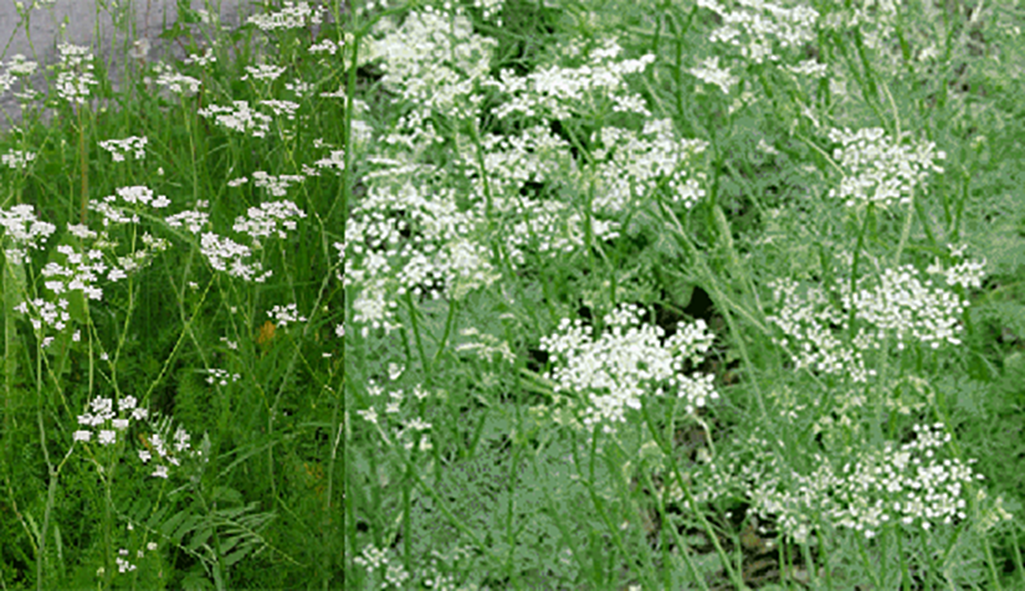
 The image, above, shows the full caraway plant (Carum
carvi), left, with a close-up of the flower heads, right and
the seeds, inset..
| Common Name: Caraway |
| Scientific Name: Carum carvi |
| Other Names: |
| Family: Apiaceae |
| Range: Europe. Occasionally naturalized in Britain. Perhaps native in S.E. England |
Physical Characteristics Carum carvi is a hardy Biennial plant, growing to 60cm (2 ft) by 30cm (1 ft) in size. It is hardy to zone 5 and is not frost tender. The plant flowers from June to July and seeds ripen from July to August. The flowers are hermaphrodite and are pollinated by bees. The plant is self-fertile. |
| Edible Parts: Leaves, Root, Seeds |
 Edibility Rating: 4 
|
 Known Hazards: Though hard to pin down in the literature, some reports cite that caraway contains the alleged 'psychotroph' myristicine. Excessive intake has been linked to kidney and liver damage. |
Welcome to the summary page for FabulousFusionFood's Wild Food guide to Caraway along with all the Caraway containing recipes presented on this site, with 145 recipes in total.
These recipes, all contain Caraway as a major wild food ingredient.
This page is a continuation of the list of wild food recipes including Caraway held on the FabulousFusionFood site. If you are specifically looking for this site's information on as a Wild Food please navigate to First Page of the Caraway Containing Recipes entry on this site.
The alphabetical list of all Caraway recipes on this site follows, (limited to 100 recipes per page). There are 145 recipes in total:
Page 2 of 2
| Pizzoccheri with Miso Cabbage and Spiced Breadcrumbs Origin: Fusion | Short Cakes Origin: Britain | To Make a Marchpane Origin: Britain |
| Porcellum Flaccianum (Suckling Pig a la Flaccus) Origin: Roman | Sklandrausis (Vegetable Tarts) Origin: Latvia | To Make Buns Origin: British |
| Porcellum Lacte Pastum Elixum (Suckling Pig Crowned with Bayleaves) Origin: Roman | Soda Bread Biscuits Origin: Ireland | To make Cakes of Almonds in thin slices Origin: British |
| Porcellum Lasaratum (Suckling Pig Seasoned with Laser) Origin: Roman | Spare Ribs, Cabbage, and Sauerkraut Origin: American | To make Knotts or Gumballs Origin: Britain |
| Potato and Onion Flan Origin: Ireland | Speckknoedel (Austrian Bacon Dumplings) Origin: Austria | To make plain Bisket-Cakes Origin: British |
| Prince Bisket Origin: Britain | Speckzelten (Bacon Tents) Origin: Germany | To make pound cake Origin: British |
| Pumpernickel Origin: Germany | Sponge Cake I Origin: British | Tonbridge Biscuits Origin: England |
| Reuben Sandwich Origin: American | Sponge Cake IV Origin: British | Tunisian Harissa Origin: Tunisia |
| Rupjmaize (Latvian Rye Bread) Origin: Latvia | Sugar Plums Origin: Britain | Vepřo Knedlo Zelo (Pork with Sauerkraut and Bread Dumplings) Origin: Czech |
| Rye Bread with Caraway Seeds Origin: British | Sumen Plenum (Stuffed Sow's Belly) Origin: Roman | Veprove S Krenem (Piquant Pork with Horseradish) Origin: Russia |
| Salata Méchouia Nablia (Grilled Red Pepper, Chilli and Tomato Salad) Origin: Tunisia | Szeged Gulyasz (Pork Goulash with Sauerkraut) Origin: Czech | Viennese Braised Red Cabbage Origin: Austria |
| Sarmale (Stuffed Cabbage Leaves) Origin: Romania | Szureti Birkaporkolt (Mutton Porkolt) Origin: Hungary | West African Curry Powder Origin: West Africa |
| Schlesischer frischer Schinken (Silesian Fresh Ham) Origin: Germany | Tabil Spice Origin: Tunisia | Wigs Origin: British |
| Scottish Christmas Cake Origin: Scotland | Tajine Maadnous (Tunisian Tajine with Eggs, Parsley and Chicken) Origin: Tunisia | Yeasted Barm Brack Origin: Ireland |
| Sesame Seed Dry-roasted Sprinkles Origin: Middle East | Tawabel (Maghrebi Spice Blend) Origin: Algeria | Zakysanou Smetanou Polévka z Krkonoš (Sour Cream Soup from the Giant Mountains) Origin: Czech |
Page 2 of 2